Husky in India: heat, coat and what a sitter must know
Updated By PetymFacts checked against official sources on
Quick answer
A Husky is safe with a sitter in India only if the home stays cool and exercise happens in the coolest hours. Merck's Veterinary Manual notes that sled dogs struggle to cool off in hot weather. A sitter must keep it indoors through the hot day, walk it before sunrise and after dark, and never shave it.
The Husky also needs more than 2 hours of exercise a day, according to The Royal Kennel Club. Matching a cold-climate athlete's energy to an Indian summer is the whole job.
- Meet your sitter first, free
- PAN-checked, first-aid trained
- A photo every day
- Pay through Petym, never cash

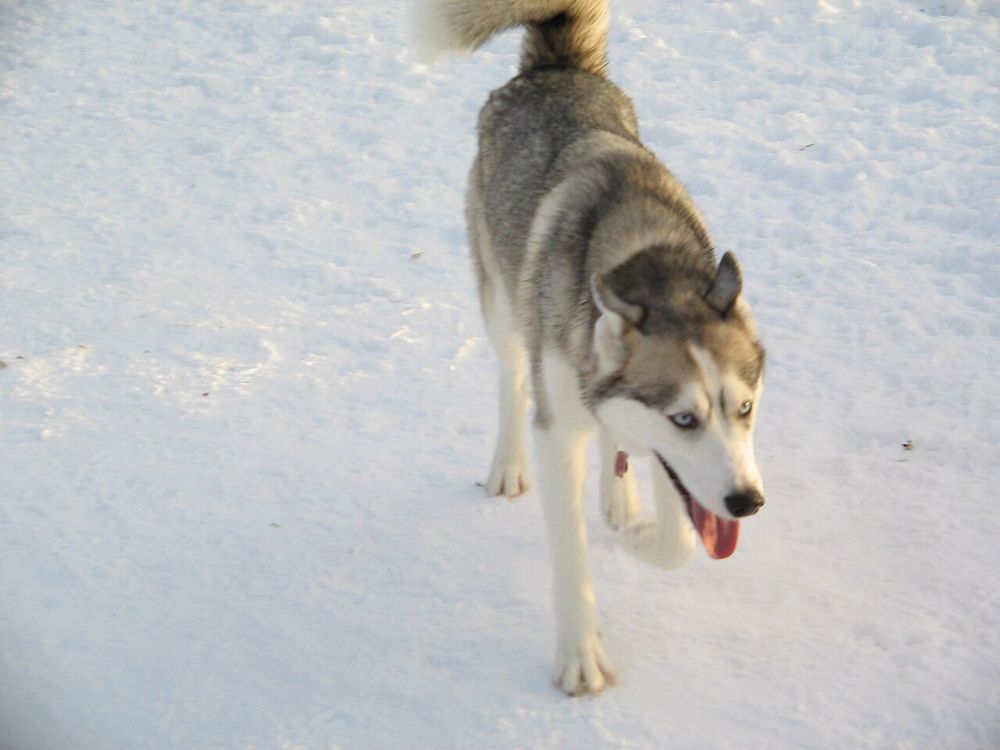
- Origin
- North-east Siberia, bred by the Chukchi people (the FCI standard is held by the USA)The Royal Kennel Club
- Adult weight
- 15.5 to 28 kg (FCI standard: females 15.5 to 23 kg, males 20.5 to 28 kg)Fédération Cynologique Internationale
- Height
- 50.5 to 60 cm (FCI standard: females 50.5 to 56 cm, males 53.5 to 60 cm)Fédération Cynologique Internationale
- Coat
- A double coat of medium length: a soft, dense undercoat under straight, smooth-lying guard hairs. The FCI standard says losing the undercoat in the shedding season is normal.Fédération Cynologique Internationale
- Energy
- Very highThe Royal Kennel Club
- Indian heat
- Struggles in heatMerck Veterinary Manual
- Flats
- Needs spaceThe Royal Kennel Club
Siberian Husky snapshot
| What | The rule | Source |
|---|---|---|
| Size | Medium to large, says The Royal Kennel Club. AKC gives 21 to 23.5 inches and 45 to 60 pounds for males, 20 to 22 inches and 35 to 50 pounds for females. | American Kennel Club |
| Exercise need | More than 2 hours a day (The Royal Kennel Club), which lists the breed for the country rather than the town. | The Royal Kennel Club |
| Alone-time tolerance | Not scored by kennel clubs. AKC rates the breed at the top of its scale for barking and howling, which a neighbour in a flat will notice. PDSA's general limit is 4 hours alone. | American Kennel Club |
| Heat tolerance | Poor in hot weather. Merck notes that sled dogs survive extreme cold but struggle to cool off in heat. | Merck Veterinary Manual |
| Coat and shedding | AKC describes a thickly coated sled dog; it sheds, and The Royal Kennel Club advises grooming more than once a week. | The Royal Kennel Club |
| With other dogs | AKC rates it at the top of its scale (5 of 5) for getting on with other dogs. | American Kennel Club |
Where does the Siberian Husky come from?
The Siberian Husky comes from north-east Siberia, where the Chukchi people used it to haul sleds over long distances, which is why it is also called the Chukchi sled dog. The Royal Kennel Club says the region's remoteness kept the bloodlines pure for centuries, that the Chukchi kept only their strongest lead dogs, and that because the dogs lived with families they were bred for temperament as well as work.
By the early 1900s the breed dominated sled racing and joined well-known expeditions. In 1925 relay teams of Huskies carried diphtheria serum hundreds of miles to Nome in Alaska, a run marked by a statue in New York's Central Park. The breed standard is now held by the USA, and the FCI standard describes a medium-sized working dog built to carry a light load at moderate speed over great distances, friendly and gentle rather than a guard dog.
How did the Siberian Husky come to India?
No source we found records when the Siberian Husky first reached India. What is documented is the trade around it: from 25 April 2016 the Directorate General of Foreign Trade allowed dogs to be imported only as personal pets, for research or for the police and defence forces, and barred imports for commercial breeding. On 6 June 2023 the Madras High Court set that notification aside on a petition by the Kennel Club of India and the Madras Canine Club.
The heat is the breed's real problem here. In April 2026 more than 30 Huskies were found abandoned near Nandigaon on the outskirts of Hyderabad, weak and badly dehydrated, and one had died. The Week's report noted that Huskies are adapted to cold climates and need controlled environments in higher temperatures, and that a Husky can cost Rs 40,000 to Rs 1.5 lakh in India. A Husky in an Indian city needs a cool room, exercise only in the coolest hours, and an owner who has planned for both.
What care does a Siberian Husky need?
The three things that shape a good day for this breed.
Exercise
More than 2 hours a day, says The Royal Kennel Club, and PDSA says a minimum of two hours, spread across the day with varied routes and off-lead running only in a secure area. In India, fit it into early morning and after dark, and keep the hot hours for indoor games. The Royal Kennel Club
Grooming
Brush a few times a week, and more in the heavy spring and autumn moult (PDSA). Texas A&M's vet college warns that shaving can make some dogs less tolerant of heat, so ask a groomer to thin the undercoat rather than shave it. PDSA
Training
The FCI standard describes an intelligent, tractable, eager dog that is neither possessive like a guard dog nor aggressive with other dogs. PDSA notes separation anxiety as a known issue, so build up time alone slowly and keep the dog busy. Texas A&M College of Veterinary Medicine (Pet Talk, 16 June 2022)
How much should a Siberian Husky eat?
Daily calories for a healthy, neutered adult Siberian Husky, worked out from its weight with the formula vets use (70 x weight in kg to the power 0.75, then AAHA's factor for a neutered adult). Divide by the kcal per kg on your food's pack for grams a day, and adjust by body shape.
| Resting need (kcal a day) | Neutered adult (kcal a day) | |
|---|---|---|
| 15.5 kg AAHA (American Animal Hospital Association) | 550 | 770 to 870 |
| 21.8 kg | 710 | 990 to 1130 |
| 28 kg | 850 | 1190 to 1360 |
PDSA advises a good quality, complete commercial dog food, split into two meals, at the same times each day, with a gap between eating and exercise, and treats kept to no more than 10% of daily calories. WSAVA's guidance is to check the label says the food is complete for your dog's life stage. The FCI standard says a Husky in proper condition does not carry excess weight, and in the UK heat study heavier dogs had higher odds of heat-related illness, so keep a Husky lean. From the Indian kitchen, keep away onion and garlic (in curries and gravies), grapes, raisins and tamarind, chocolate, salty snacks and anything sweetened with xylitol. Milk and other dairy can cause diarrhoea. Ask your vet how much your dog needs; the energy table on this page gives a starting range. Meals a day: 6 to 12 weeks, 4 a day, puppy food; 3 to 6 months, 3 a day, puppy food; 6 to 12 months, 2 a day, puppy food; adult, 2 a day. Puppies, kittens, working, pregnant and older animals need different amounts: ask your vet, or use Petym's food calculator.
Which illnesses is the Siberian Husky prone to, and how are they treated?
The conditions veterinary studies and breed surveys most often report in the Siberian Husky. Knowing the early signs means a vet sees it sooner.
See your vet first. This is general information from veterinary sources, not a diagnosis. Only a vet who has examined your pet can say what is wrong and prescribe treatment, and this page never gives a dose. Do not give your pet human medicine. If your pet seems very unwell, go to a 24-hour vet: find one in your city.
Heatstroke
Emergency: go to a vet nowDogs cool mainly by panting, and Merck notes that sled dogs survive extreme cold but struggle to cool off in heat. A thick-coated, high-energy dog exercised in Indian heat is at real risk. Merck Veterinary Manual
Signs to watch for
- Heavy panting and fast or difficult breathing
- Drooling, vomiting or diarrhoea
- Bright red or very pale gums
- Weakness, wobbliness, collapse or seizures
How a vet treats it
PDSA says to move the dog somewhere cool, pour cold water over the body away from the nose and mouth, and go to the nearest vet while cooling on the way. Vets cool the dog with water and fans and may give a fluid drip; severe cases may need oxygen, medication, blood tests and several days in hospital.
Prevention
Walk only in the early morning or evening, always provide shade and water, and never leave the dog in a car.
Hip dysplasia
See a vet soonAn abnormal development of the hip joint that leaves it loose and leads to arthritis. PDSA lists it among the Husky's health problems, and The Royal Kennel Club recommends hip scoring before breeding. PDSA
Signs to watch for
- Lameness that gets worse after exercise
- A bunny-hopping gait with the back legs
- Stiffness, or reluctance to rise or jump
- Loss of muscle on the back legs
How a vet treats it
A vet diagnoses it with X-rays. Merck lists weight loss, limiting exercise on hard surfaces, physical therapy and anti-inflammatory drugs for milder cases, and a range of surgical procedures up to total hip replacement. ACVS adds that some surgeries work only in young dogs, so early checks matter.
Prevention
Choose a puppy from hip-scored parents, avoid rapid weight gain while growing, and keep the dog slim for life.
Glaucoma
Emergency: go to a vet nowA build-up of pressure inside the eye from an imbalance between fluid made and fluid drained, which damages the retina and optic nerve. PDSA lists glaucoma for the Husky, and The Royal Kennel Club asks breeders for eye testing with gonioscopy, an examination of the eye's drainage angle. PDSA
Signs to watch for
- A red eye
- A dilated pupil that reacts slowly
- A cloudy eye or squinting from pain
- Bumping into things
How a vet treats it
A vet measures the pressure in the eye with a tonometer. Merck says drugs that draw fluid out of the eye or reduce how much is made are often prescribed, and an eye that is blind and painful may need to be removed by surgery to relieve the pain.
Epilepsy
See a vet soonRepeated seizures. PDSA lists epilepsy among the Husky's health problems; idiopathic epilepsy, of unknown cause, is the most common cause of seizures in dogs. PDSA
Signs to watch for
- Sudden collapse with jerking or paddling legs
- Foaming at the mouth or loss of consciousness
- Twitching of the face or snapping at the air
- Confusion for minutes to hours afterwards
How a vet treats it
Cornell says idiopathic epilepsy is diagnosed once a vet has ruled out other causes, and a video of the episode helps. A vet may prescribe anti-seizure medicine, usually considered when seizures happen more than once a month, and may supply an emergency rescue medicine for clusters.
Prevention
Not preventable, but a seizure diary and medicines given exactly as prescribed help control it. A seizure lasting over five minutes, or several in a day, needs a vet at once.
Can a Husky cope with Indian heat?
It can be kept safe, but only with cooling indoors and careful timing outdoors. It is never fully at home in an Indian summer.
Merck's Veterinary Manual explains that dogs cannot sweat like people and cool down mainly by panting, and that dogs from cold climates carry a soft, thick undercoat for warmth. Sled dogs, it says, can survive very cold weather because their fur keeps them warm, but they struggle to cool off in hot weather. Indian plains cities regularly reach heat-wave levels, which the India Meteorological Department defines as a maximum of at least 40 °C at a plains station.
The research is more nuanced than social media suggests. In a large UK study of heat-related illness, Siberian Huskies did not show significantly higher odds than Labradors, but the numbers of Huskies were small and the UK is a cool country. The same study found that exercise was the main trigger and that heavier dogs were at higher risk. For a Husky in India the practical answer is the same either way: the dog's heavy exercise need has to be met when it is cool, and the hot part of the day has to be spent indoors.
Shaving a Husky and other summer myths
You may have read
Shaving a Husky keeps it cool in an Indian summer.
Myth
What the sources say
Texas A&M's veterinary college says a thick coat is natural insulation that helps dogs regulate their temperature, that shaving can make some dogs less tolerant of heat, and that the undercoat may grow back first and change the coat. A full shave is not usually needed unless the coat is matted. Texas A&M College of Veterinary Medicine (Pet Talk, 16 June 2022)
You may have read
A Husky that loves the AC room can skip its walks in summer.
Myth
What the sources say
The Royal Kennel Club puts its exercise need at more than 2 hours a day. Without it, a bored Husky chews, digs and howls. Move the exercise to the cool hours and add training and food games indoors. The Royal Kennel Club
You may have read
Brushing is only for show dogs.
Myth
What the sources say
The Royal Kennel Club advises grooming more than once a week. Brushing out the loose undercoat, especially when it sheds heavily, helps air reach the skin. The Royal Kennel Club
You may have read
If a Husky is panting, it is just being a Husky.
Myth
What the sources say
Heavy panting is the first sign of heat stress in PDSA's list, before drooling, vomiting and collapse. Move the dog somewhere cool and, if it does not settle, call the vet. PDSA
A Husky's day in an Indian summer
Petym’s working from the official rules, no government publishes a total.
A sample plan for a sitter. It fits most of the exercise into the coolest hours and keeps the dog indoors in the heat.
Before sunrise
The main session: 60 minutes of walking or a steady jog on soil or grass, with water. Stop at once if the dog lags, pants hard or lies down.
Back home
Straight into the coolest room. Water first, breakfast once the panting has settled.
Morning
A 10 to 15 minute brush, working the loose undercoat out with the brush the owner uses.
Late morning to late afternoon
Indoors in air conditioning or the coolest room. Food puzzle, chew toy, short training games. Toilet breaks only, on shaded ground.
Power cut
The coolest corner of the home, away from windows; damp towels on the floor to lie on, a fan on a battery or inverter if there is one. Watch the breathing.
After dark
The second session, 45 to 60 minutes, once the ground passes PDSA's 7-second palm test. Then dinner, a last check and the daily photo update.
Heat and health signs a Husky's sitter must act on
No published breed health list was found for the Siberian Husky from Science for Animal Welfare, so the sitter's list here centres on heat, ticks and the coat. Call the vet for anything sudden or severe.
If Heavy panting that does not settle indoors, thick drool, a hot body, weakness or wobbliness.
Treat as heatstroke: cool room or shade, cool water poured over the body away from the nose and mouth, a breeze, and go to the vet. Do not wait for it to pass. PDSA
If Vomiting, diarrhoea, confusion, a seizure or collapse in the heat.
Emergency. Start cooling and go to the nearest 24-hour vet now. PDSA
If Ticks deep in the coat around the ears, neck, armpits and toes.
Part the coat and check after every walk; remove ticks with tweezers close to the skin and tell the owner. Merck Veterinary Manual
If Fever, low energy or loss of appetite in a dog that has had ticks.
Call the vet the same day. About half of 525 dogs surveyed in four Indian cities carried a tick-borne infection. Parasites & Vectors (2011)study
If Damp, smelly skin under the thick coat after the monsoon or a bath.
Dry the coat right to the skin with towels and a cool dryer, and ask the vet about any red or sore patch.
A Husky through the Indian year
| Hot months (March to May) | Monsoon (June to September) | Cooler months (November to February) | |
|---|---|---|---|
| Exercise | Before sunrise and after dark only; indoor games in the day | Short walks between showers; humid days can feel as hard as hot ones | The best months for long walks and runs |
| Coat | Brush often to clear loose undercoat; never shave | Dry to the skin after every wet walk | Weekly brush; expect a heavy shed as seasons change |
| Home | A cool room all day and a power-cut plan | Dry bedding off the floor | Normal room; many Huskies prefer the cool floor |
| Watch for | Heavy panting, drool, slowing down on walks | Ticks and damp skin | Weight gain if walks get skipped in the festival season |
Petym's practical plan from the sources on this page. Hill towns are cooler than the plains: adjust to your city.
Feeding notes for a Husky
Keep the food, bowls and times exactly as at home, with enough for the whole stay and a few days extra; a sudden change can upset the stomach. In the heat many Huskies eat less, which is common, but a dog that refuses two meals in a row, or stops drinking, needs a call to the vet. Leave water in at least two bowls, in shade, and refill it often, as the Animal Welfare Board of India advises for hot weather.
Count treats as part of the day: WSAVA suggests they stay under about 10% of daily calories. Keep chocolate, grapes, raisins, onion, garlic and anything with xylitol out of reach, and avoid feeding a big meal straight after a hard run.
Husky sitter checklist
- The coolest room, the air conditioning rules, the inverter or battery fan, and the plan for a power cut.
- Walk and run times for the season, and the shaded or grassy route.
- The brush and how often, plus a note that the dog is never to be shaved.
- Escape points: doors, balcony, society gate. A secure harness and leash on every walk.
- Meal amounts, times, treat allowance and the dog's usual summer appetite.
- Tick prevention product and next due date.
- Howling triggers and what calms the dog.
- The vet's number and the nearest 24-hour vet on Petym's city list.
Which Petym service suits a Husky?
A Husky is usually safest in its own cooled home with a sitter who sticks to the cool-hours plan.
Best fit
Overnight pet sitting
The sitter lives in your home, keeps the AC room and the dawn and night walks, and sends a daily photo update.
Dog walking
Early-morning or late-night walks on workdays, when you cannot do them yourself.
Pet boarding
Only in a sitter's home with reliable cooling and space. Ask about both at the meet and greet.
Breeds with similar care needs to the Siberian Husky
Going away soon? Tell us your dates.
A checked local sitter feeds, walks and keeps your pet company at home, follows your care sheet to the letter and sends a photo every day. Petym is opening city by city: send your dates and we will tell you when a sitter can take them.
- Meet your sitter first, free
- PAN-checked, first-aid trained
- A photo every day
- Pay through Petym, never cash


Questions owners ask
Can a Husky survive in India?
- It can be kept safe with real effort, but it is a cold-climate sled dog. Merck notes sled dogs struggle to cool off in hot weather. A Husky in Indian plains needs a cool room through the day, a plan for power cuts, and its long exercise moved to before sunrise and after dark.
Should I shave my Husky in summer?
- No. Texas A&M's veterinary college says a thick coat is natural insulation that helps a dog regulate its temperature, and that shaving can make some dogs less tolerant of heat and change how the coat grows back. Brush out loose undercoat often instead.
Can a Husky live in a flat in India?
- Only with a lot of exercise and a cool room. The Royal Kennel Club puts its exercise need at more than 2 hours a day and lists it for the country. In a flat, that means long walks at dawn and night, games indoors, and air conditioning or the coolest room in the hot months.
How long can a Husky be left alone?
- PDSA's general limit for any dog is 4 hours at a time. AKC rates Huskies at the top of its scale for barking and howling, so a bored, lonely Husky in a flat is often heard by the whole floor. Arrange a sitter or walker on long days.
What time should a sitter walk a Husky in Indian summer?
- Before sunrise and after dark, when the ground and air are coolest. Exercise caused most heat-related illness in a large UK study. Check the India Meteorological Department's heat warnings, test the ground with your palm for 7 seconds, and stop if the dog lags or pants hard.
Are Huskies good with other dogs at a sitter's home?
- Usually. AKC rates the breed at the top of its scale for getting on with other dogs. The bigger issues at a sitter's home are cooling and exercise space, so ask about air conditioning, walking routes and escape points at the meet and greet.
How does a Husky cope in the monsoon?
- Cooler days help, but the India Meteorological Department notes that high humidity makes the impact of heat worse, and a thick coat stays damp for hours. Dry the coat to the skin after every wet walk, keep bedding dry and check for ticks often. Call the vet if the skin under the coat turns red, sore or smelly.
Keep reading
- Dog care hub
- Summer pet care in India
- Heatstroke in dogs
- Monsoon care for dogs
- Samoyed careAnother thick-coated spitz.
- Overnight pet sitting
Services that help
Free tools for this
Words on this page, explained
Keep exploring
Other dog breeds
- Akita
- Alaskan Malamute
- American Bully
- American Cocker Spaniel
- American Pit Bull Terrier
- Australian Shepherd
- Bakharwal dog
- Basset Hound
- Beagle
- Belgian Malinois
- Bernese Mountain Dog
- Bichon Frise
- Border Collie
- Boston Terrier
- Boxer
- Bull Terrier
- Bulldog
- Bullmastiff
- Cane Corso
- Caucasian Shepherd Dog
- Cavalier King Charles Spaniel
- Chihuahua
- Chippiparai
- Chow Chow
- Cocker Spaniel
- Dachshund
- Dalmatian
- Dobermann
- Dogo Argentino
- English Mastiff
- English Springer Spaniel
- French Bulldog
- Gaddi Kutta (Gaddi dog)
- German Shepherd
- Golden Retriever
- Great Dane
- Greyhound
- Havanese
- Indian pariah dog (Indie)
- Indian Spitz
- Irish Setter
- Jack Russell Terrier
- Kangal
- Kanni
- Kombai
- Labrador Retriever
- Lhasa Apso
- Maltese
- Miniature Pinscher
- Miniature Schnauzer
- Mudhol Hound
- Neapolitan Mastiff
- Newfoundland
- Papillon
- Pekingese
- Pembroke Welsh Corgi
- Pomeranian
- Poodle
- Pug
- Rajapalayam
- Rampur Greyhound
- Rhodesian Ridgeback
- Rottweiler
- Saint Bernard
- Samoyed
- Shar Pei
- Shiba Inu
- Shih Tzu
- Tibetan Mastiff
- Weimaraner
- West Highland White Terrier
- Whippet
- Yorkshire Terrier
Sources
Each source was opened and read on the date shown. How Petym checks its sources
- The Royal Kennel Club: Siberian Husky: breed information (opens in a new tab)
- Fédération Cynologique Internationale: FCI-Standard No 270: Siberian Husky (18 November 2022) (opens in a new tab)
- Merck Veterinary Manual: Description of dogs (opens in a new tab)
- Directorate General of Foreign Trade, Ministry of Commerce and Industry: Notification No. 3/2015-2020 (25 April 2016): policy conditions on import of dogs; import of commercial dogs for breeding not permitted (opens in a new tab)
- PDSA: Siberian Husky (opens in a new tab)
- Texas A&M College of Veterinary Medicine (Pet Talk, 16 June 2022): Time for a summer cut? Tips for warm weather dog grooming (opens in a new tab)
Show all 29 sourcesShow fewer
- WSAVA Global Nutrition Committee: Guidelines on selecting pet foods (updated 10 March 2021) (opens in a new tab)
- Merck Veterinary Manual: Puppy care (opens in a new tab)
- ASPCA Animal Poison Control: People foods to avoid feeding your pets (opens in a new tab)
- Merck Veterinary Manual: Garlic and onion (Allium spp) toxicosis in animals (opens in a new tab)
- Merck Veterinary Manual: Grape, raisin, and tamarind (Vitis spp, Tamarindus spp) toxicosis in dogs (full review September 2024) (opens in a new tab)
- AAHA (American Animal Hospital Association): 2021 AAHA Nutrition and Weight Management Guidelines for Dogs and Cats: energy requirement calculations (Box 1, PDF) (opens in a new tab)
- Merck Veterinary Manual: Nutritional requirements of small animals (full review November 2023, updated September 2024) (opens in a new tab)
- PDSA: Heatstroke in dogs (opens in a new tab)
- Merck Veterinary Manual: Hip dysplasia (dog owners) (opens in a new tab)
- American College of Veterinary Surgeons: Canine Hip Dysplasia (opens in a new tab)
- Merck Veterinary Manual: Glaucoma in dogs (dog owners) (opens in a new tab)
- Cornell University College of Veterinary Medicine: Managing seizures (Riney Canine Health Center) (opens in a new tab)
- American Kennel Club: Siberian Husky dog breed information (opens in a new tab)
- India Meteorological Department: FAQ on heat wave (opens in a new tab)
- PDSA: Separation anxiety in dogs (opens in a new tab)
- Merck Veterinary Manual: Ticks of dogs (opens in a new tab)
- Animal Welfare Board of India: Request to ensure care and protection of animals from direct heat during extreme hot weather (4 May 2026) (opens in a new tab)
- WSAVA: Frequently asked questions and myths (Global Nutrition Committee) (opens in a new tab)
- PDSA: Diarrhoea after a change of food (opens in a new tab)
- Scientific Reports (2020): Incidence and risk factors for heat-related illness in UK dogs (opens in a new tab)
- Parasites & Vectors (2011): A survey of canine tick-borne diseases in India (opens in a new tab)
- SCC Online: Madras High Court sets aside notification banning import of dogs for commercial activities (13 June 2023) (opens in a new tab)
- The Week (30 April 2026): Over 30 Siberian Husky dogs abandoned on Hyderabad outskirts amidst searing heat, one dead (opens in a new tab)