Pekingese in Indian heat: eyes, coat and care from your sitter
Updated By PetymFacts checked against official sources on
Quick answer
A Pekingese is a dignified, independent little dog that settles with a sitter at home, but it combines a flat face with a long coat, so Indian heat is a real danger. The sitter must keep it cool, walk it briefly at dawn and dusk, groom it daily, and treat any eye injury or bulging eye as an emergency.
UFAW lists three genetic welfare problems in the breed: airway obstruction (BOAS), an eye syndrome linked to its prominent eyes, and skin fold dermatitis. Each needs a vet, and the eye one can need one within the hour.
- Meet your sitter first, free
- PAN-checked, first-aid trained
- A photo every day
- Pay through Petym, never cash

- Origin
- China (the imperial palace in Peking, now Beijing)The Royal Kennel Club (UK)
- Adult weight
- 5 to 5.4 kg (the FCI standard sets only an ideal upper weight: not over 5 kg for males and 5.4 kg for females; no minimum is published)Fédération Cynologique Internationale
- Coat
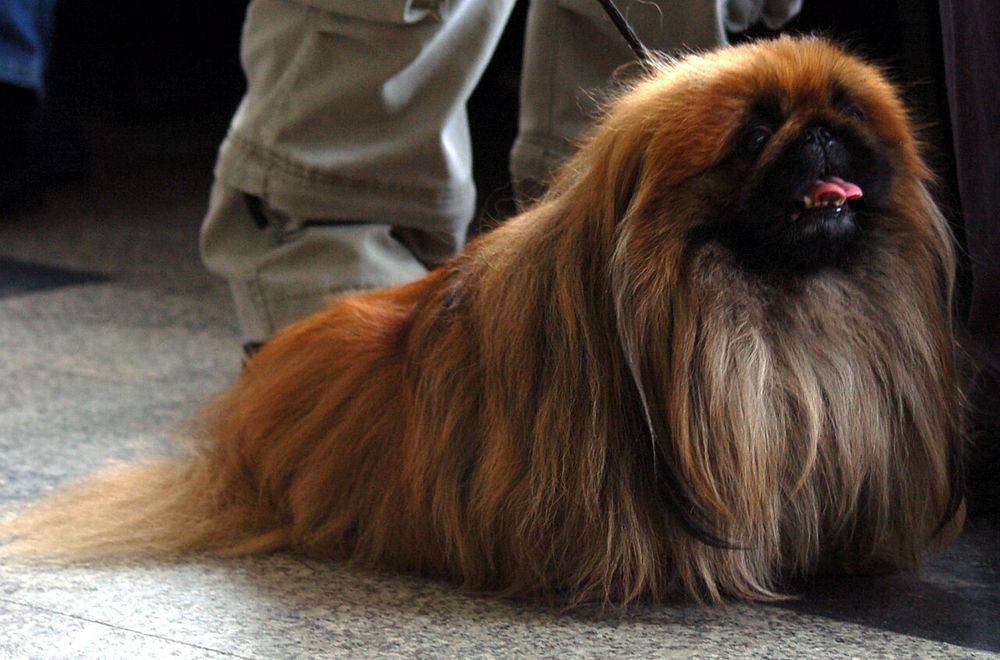
- Moderately long and straight, with a mane forming a cape round the neck, a coarse top coat over a thick, softer undercoat, and feathering on the ears, legs, tail and toes. All colours are allowed.Fédération Cynologique Internationale
- Energy
- LowThe Royal Kennel Club (UK)
- Indian heat
- Struggles in heatPDSA
- Flats
- Suits a flatThe Royal Kennel Club (UK)
Pekingese care snapshot
| What | The rule | Source |
|---|---|---|
| Size | Small, suited to a flat or apartment, in the Royal Kennel Club's breed information. | The Royal Kennel Club (UK) |
| Exercise need | Up to 30 minutes a day (Royal Kennel Club). | The Royal Kennel Club (UK) |
| Alone-time tolerance | Not rated by kennel clubs. PDSA advises no more than 4 hours alone for any dog, and a flat-faced dog alone in summer needs a room that stays cool. | PDSA |
| Heat tolerance | Low. PDSA lists flat-faced and long-haired dogs among those most at risk of heatstroke, and the Pekingese is both. | PDSA |
| Shedding and coat | Long coat, sheds, grooming every day (Royal Kennel Club). | The Royal Kennel Club (UK) |
| Sociability with other dogs | Described in words only: great character and determination, with a dignified bearing. Ask the owner how this dog reacts to other dogs. | The Royal Kennel Club (UK) |
Where does the Pekingese come from?
The Royal Kennel Club traces the Pekingese to China's Tang dynasty, with short-legged, short-faced dogs of this kind recorded as early as the 8th century. It was a favourite of the imperial palace in Peking, and only the upper classes were allowed to keep one.
After British forces took Peking in 1860, four of the dogs were brought to Britain, where they quickly became fashionable. The breed was very popular in Victorian times and gained Kennel Club recognition in 1910. The FCI gives its origin as China under British patronage, lists its use as a companion dog, and describes it as fearless, loyal and aloof, neither timid nor aggressive.
How did the Pekingese come to India?
No source we found records when or how the Pekingese came to India; its arrival is not documented. It lives here as a small companion dog, and the Kennel Club of India registers pedigree dogs of recognised breeds through its single-dog and litter forms.
Indian summers are the main challenge. PDSA lists flat-faced and long-haired dogs among those most at risk of heatstroke, and the Pekingese is both. In most of the Indian plains the heat-wave season runs from March to June, so a Pekingese needs a room that stays cool through the afternoon and a plan for power cuts.
What care does a Pekingese need?
The three things that shape a good day for this breed.
Exercise
Up to 30 minutes a day, says The Royal Kennel Club, in short, slow walks. In summer walk only at first light and after dark, on a harness, and stop at the first sign of noisy or laboured breathing. The Royal Kennel Club (UK)
Grooming
Every day, says The Royal Kennel Club: brush right down to the skin, especially behind the ears and on the trousers. Wipe and dry the face folds daily, since Science for Animal Welfare says folds trap moisture and an unpleasant smell is often the first sign of trouble. UFAW Science for Animal Welfare (genetic welfare problems of companion animals)
Training
The Royal Kennel Club describes great character and determination with a dignified bearing, and the FCI standard says aloof. Short, calm, reward-based sessions work; avoid pulling on the neck, and handle the face and eyes gently from puppyhood so daily checks are easy. Fédération Cynologique Internationale
How much should a Pekingese eat?
Daily calories for a healthy, neutered adult Pekingese, worked out from its weight with the formula vets use (70 x weight in kg to the power 0.75, then AAHA's factor for a neutered adult). Divide by the kcal per kg on your food's pack for grams a day, and adjust by body shape.
| Resting need (kcal a day) | Neutered adult (kcal a day) | |
|---|---|---|
| 5 kg AAHA (American Animal Hospital Association) | 230 | 330 to 370 |
| 5.2 kg | 240 | 340 to 390 |
| 5.4 kg | 250 | 350 to 400 |
Feed a complete and balanced small-breed food, with puppy food until adulthood, as the Merck Veterinary Manual advises. Keep the dog lean: PDSA lists obese dogs among those most at risk of heatstroke, and extra weight makes a short airway work harder. Hold treats under about 10% of daily calories, as WSAVA suggests, and skip table scraps such as roti with ghee or mithai. Never give onion or garlic, grapes, raisins or tamarind, chocolate, or xylitol. Wipe and dry the face after each meal so food does not sit in the folds. The energy table below works from the standard's upper weights; ask your vet for your dog's ideal weight and amount. Meals a day: 6 to 12 weeks, 4 a day; 3 to 6 months, 3 a day; 6 to 12 months, 2 a day; adult, 2 a day. Puppies, kittens, working, pregnant and older animals need different amounts: ask your vet, or use Petym's food calculator.
Which illnesses is the Pekingese prone to, and how are they treated?
The conditions veterinary studies and breed surveys most often report in the Pekingese. Knowing the early signs means a vet sees it sooner.
See your vet first. This is general information from veterinary sources, not a diagnosis. Only a vet who has examined your pet can say what is wrong and prescribe treatment, and this page never gives a dose. Do not give your pet human medicine. If your pet seems very unwell, go to a 24-hour vet: find one in your city.
Brachycephalic airway obstruction syndrome (BAOS)
See a vet soonThe short skull squeezes the soft tissues of the nose and throat into too little space, narrowing the airway. Science for Animal Welfare says probably all Pekingese are affected to some degree and that it is a progressive disease. Science for Animal Welfare (formerly UFAW)
Signs to watch for
- Snoring and noisy breathing
- Mouth breathing and fast breathing
- Tiring easily and overheating
- Disturbed sleep, or collapse in a severe episode
How a vet treats it
Vets suspect it from the signs; confirming the problems usually needs anaesthesia, x-rays and sometimes endoscopy, and anaesthesia carries extra risk in these dogs. Surgery can help some of the primary problems, such as narrow nostrils and an elongated soft palate.
Prevention
Choose a puppy whose parents show no signs of BAOS, and keep the dog lean and cool.
Brachycephalic ocular syndrome and eye prolapse
Emergency: go to a vet nowScience for Animal Welfare says the breed's extreme short head shape changes the anatomy of the eyes, so problems such as extra lashes, nose-fold hairs rubbing the eye and very large eyelid openings cause chronic irritation, pain and corneal ulcers. The eye can also prolapse out of its socket. UFAW Science for Animal Welfare (genetic welfare problems of companion animals)
Signs to watch for
- Squinting, blinking a lot or sensitivity to light
- Watering, discharge, redness or tear staining
- Rubbing the face
- An eye bulging forward or out of its socket
How a vet treats it
A thorough eye examination by the vet. Science for Animal Welfare says several operations may be needed for problem lashes and nose-fold hairs, and a lifetime of eye drops or ointments may still be needed after surgery. A prolapsed eye is a medical emergency needing immediate treatment, and deep ulcers can rupture the eye.
Prevention
Check the eyes every day and see a vet the same day for any squint or cloudiness. Science for Animal Welfare advises not breeding from dogs that have shown signs.
Skin fold dermatitis
See a vet soonIrritation and infection in the folds of the face, where hair and skin rub together and trap warmth and moisture. Science for Animal Welfare says Pekingese have large amounts of wrinkled skin on the head because the muzzle is so short. UFAW Science for Animal Welfare (genetic welfare problems of companion animals)
Signs to watch for
- An unpleasant smell, often the first sign
- Red, inflamed or itchy skin
- Discharge matting the fur
- Thick, dark skin in long-standing cases
How a vet treats it
Science for Animal Welfare says long-term medication is often needed to control it, and surgery may be needed in some dogs to remove the folds. Your vet decides which.
Prevention
Clean and dry the folds daily as your vet shows you.
Intervertebral disc disease (IVDD)
Emergency: go to a vet nowA spinal disc bulges or bursts and presses on the spinal cord. ACVS names the Pekingese among the chondrodystrophoid (short-legged) breeds that account for most disc ruptures. American College of Veterinary Surgeons
Signs to watch for
- Back or neck pain, yelping when lifted
- A hunched back
- A wobbly, drunken walk
- Weak or paralysed back legs, or loss of bladder control
How a vet treats it
Vets use x-rays and then a myelogram, CT or MRI. ACVS says mild first episodes are often managed with cage rest, confinement and pain medication, while surgical decompression of the spinal cord is nearly always recommended, and that a disc rupture can be a true surgical emergency.
Cherry eye
See a vet soonThe tear gland of the third eyelid pops out of the inner corner of the eye. PDSA lists the Pekingese among breeds at risk. PDSA
Signs to watch for
- A red swelling in the inner corner of the eye
- Rubbing the eye
- Discharge
How a vet treats it
PDSA says surgery to stitch the gland back into place is the most common treatment, with eye drops for comfort before and after. Removal is rarely done now because it can cause dry eye.
How does a Pekingese cope when you are away?
Calmly, as long as the sitter respects its independence and keeps it cool, groomed and quiet.
The Royal Kennel Club describes the Pekingese as a breed of great character and determination with a dignified bearing. Many Pekes are happy to watch the household from their own spot rather than demand play, which makes them easy company for a sitter. They need little exercise, up to 30 minutes a day, and fit well in flats.
That calm can hide a problem. UFAW notes that dogs with the Pekingese eye syndrome may show fewer outward signs of pain because the surface of the eye is less sensitive, so an injured eye can get worse before anyone notices. A sitter has to look at the eyes, the face folds and the breathing every day, not wait for the dog to complain. PDSA's guidance of no more than 4 hours alone at a time applies, and in summer the room matters as much as the hours.
Why is Indian heat harder for a Pekingese?
A short airway and a thick, long coat both make it harder to lose heat.
UFAW explains that the nose normally helps cool a dog and that this is disrupted in flat-faced breeds, which are particularly heat-sensitive. The Royal Kennel Club added breathing testing for BOAS to the Pekingese's recognised health tests in August 2026, which shows how seriously the breed's airway is now taken. PDSA lists both flat-faced and long-haired dogs among those most at risk of heatstroke.
In most of the Indian plains IMD's heat-wave season runs from March to June. For a Peke that means a cool room through the afternoon, walks only at first light and after dark, and no long car journeys in the heat. PDSA suggests considering clipping a heavy coat and brushing it regularly in hot weather. How short to clip a Pekingese is a choice for the owner with the groomer and vet; a sitter keeps up the daily brushing either way, because a matted coat is hard to keep clean and dry.
Which Pekingese problems need a vet, and how fast?
Eyes first. UFAW calls eyeball prolapse a veterinary emergency that can lead to blindness.
If An eye that bulges forward or has come out of its socket
Emergency. Stop the dog pawing at it, keep it calm and go to the nearest 24-hour vet now, calling the owner on the way. UFAW Science for Animal Welfare (genetic welfare problems of companion animals)
If Squinting, a watering or cloudy eye, rubbing the face, or discharge
UFAW warns that corneal ulcers can deepen until the eye ruptures. Call the vet the same day, even if the dog seems unbothered. UFAW Science for Animal Welfare (genetic welfare problems of companion animals)
If Loud snoring while awake, mouth breathing at rest or struggling for breath
UFAW lists BOAS among the breed's genetic welfare problems, and these are its signs. Stop activity, cool the dog and call the vet; collapse is an emergency. UFAW Science for Animal Welfare (genetic welfare problems of companion animals)
If A bad smell from the face or around the tail, red skin or discharge matting the fur
UFAW says an unpleasant odour is often the first sign of skin fold dermatitis. Keep the folds dry and book the vet. UFAW Science for Animal Welfare (genetic welfare problems of companion animals)
If Yelping when lifted, a hunched back, or wobbly back legs
Vet surgeons list the Pekinese among the short-legged breeds behind most disc ruptures. Keep the dog still and call the vet the same day. American College of Veterinary Surgeons
If Heavy panting, drooling or wobbling in the heat
Possible heatstroke: shade, cool water over the body, a fan, then the vet. PDSA
What does a sitter's day with a Pekingese look like in summer?
Two short, slow walks, one grooming session and a lot of cool rest.
5:45 to 6:30
A slow ten-minute walk on a harness after the palm test on the ground. PDSA
7:30
Breakfast as the owner writes it; wipe and dry the face afterwards.
Late morning
Daily grooming in the cool room: brush through to the skin, check the eyes, face folds and tail folds.
Noon to 5:30
Rest in the coolest room. Check the fan or AC and water every couple of hours.
After sunset
A second short walk once the ground has cooled, then dinner.
Night
Note breathing during sleep, top up water and send the daily photo update.
How should a sitter groom a Pekingese each day?
The Royal Kennel Club says the breed needs grooming every day. Work in this order, gently.
Eyes
Look first, touch last. Clear, open and not watering is normal; anything else goes on the list for the vet. UFAW Science for Animal Welfare (genetic welfare problems of companion animals)
Face folds
Wipe with what the owner has left and dry thoroughly. Smell or redness is the early sign to report. UFAW Science for Animal Welfare (genetic welfare problems of companion animals)
Coat
Brush right down to the skin, section by section, especially behind the ears, in the armpits and on the trousers. The Royal Kennel Club (UK)
Tail and rear
UFAW notes Pekes can get fold disease around the curled tail. Keep the area clean and dry. UFAW Science for Animal Welfare (genetic welfare problems of companion animals)
Paws
Check between the pads for burrs and damp, and dry after monsoon walks.
What should a sitter know about feeding a Pekingese?
The owner's food at the owner's times, a lean dog and a clean face.
Do
- Measure every meal; PDSA lists obese dogs among those most at risk of heatstroke. PDSA
- Use a shallow bowl so the face does not press into the food, if that is what the owner uses.
- Wipe and dry the face and folds after eating and drinking.
- Log appetite and water at every meal.
Don’t
- Do not change the food during the stay.
- Do not share table food: roti with ghee, mithai and biscuits all add weight.
- Do not use eye drops, creams or medicines the owner has not left with written instructions.
What should a Pekingese's owner leave for the sitter?
Before the meet and greet, write these down, and show the sitter the grooming routine in person so they can copy it on the first morning.
- The brush and comb you use, and a short demonstration of how your Peke likes to be groomed.
- Fold wipes or cloths, and any eye products only if your vet has approved them.
- Any eye history: past ulcers, surgery, drops and the vet who treated them.
- The harness: never lead a Pekingese by a collar that presses on the neck.
- The coolest room, AC and fan settings, and the power-cut plan.
- The nearest 24-hour vet on the city's list, and how to get there quickly with a dog whose eye is injured.
- Food, amounts, times and the vaccination card.
Which Petym service suits a Pekingese?
Most Pekes do well staying home, where the cooling and the grooming routine are already set up.
If You are away overnight or longer
Overnight sitting keeps your Peke in its own cool room, with daily grooming and checks. Overnight sitting
If You are out for a long day in cooler months
A drop-in visit for a short walk, a groom and an eye check. Drop-in visits
If Your Pekingese is on eye drops or recovering from surgery
Special-needs care, with the vet's plan followed and logged. Special-needs care
Breeds with similar care needs to the Pekingese
Going away soon? Tell us your dates.
A checked local sitter feeds, walks and keeps your pet company at home, follows your care sheet to the letter and sends a photo every day. Petym is opening city by city: send your dates and we will tell you when a sitter can take them.
- Meet your sitter first, free
- PAN-checked, first-aid trained
- A photo every day
- Pay through Petym, never cash


Questions owners ask
Can a Pekingese live in Indian heat?
- Yes, indoors with cooling. PDSA lists flat-faced and long-haired dogs among the most at risk of heatstroke, and a Pekingese is both. Keep it in a cool room from March to June, walk only at dawn and after dark, and brush the coat daily so it does not mat.
Should I shave my Pekingese in summer?
- Ask your groomer and vet. PDSA suggests considering clipping a heavy coat in hot weather, but how short to go is the owner's decision with professional advice. Whatever the length, daily brushing keeps the coat free of mats and makes skin problems easier to spot.
What should a sitter do if a Pekingese's eye pops out?
- Treat it as an emergency. UFAW calls eyeball prolapse a veterinary emergency that can lead to blindness. Stop the dog rubbing it and go to the nearest 24-hour vet straight away while calling the owner.
Why does my Pekingese have watery eyes?
- Prominent eyes and eyelids that do not close fully are part of brachycephalic ocular syndrome, which UFAW lists in the breed, and tears can overflow and stain the face. New squinting, cloudiness or discharge needs a vet the same day.
How much exercise does a Pekingese need?
- The Royal Kennel Club gives up to 30 minutes a day. In Indian heat, two short, slow walks on a harness at first light and after dark are enough, with gentle play indoors in a cool room.
How long can a Pekingese be left alone?
- PDSA advises no more than 4 hours at a time for any dog. A Peke often seems content alone, but its eyes, folds and breathing need daily checks, and in summer its room must stay cool, so plan visits or an overnight sitter.
How should a sitter care for a Pekingese in the monsoon?
- Keep walks short and between showers, then dry the coat, face folds, tail area and paws thoroughly. UFAW notes that Pekes get skin fold disease on the face and around the curled tail, so drying those folds after every wet walk is part of the routine. Report any smell or redness to the owner and vet.
How long do Pekingese live?
- The Royal Kennel Club gives a lifespan of over 12 years. Long life makes daily care count: lean weight, a cool home, clean folds and a vet visit at the first sign of an eye problem all help a Peke stay comfortable for longer.
Keep reading
- Caring for a dog while you are away
- Heatstroke in dogs
- Signs your pet needs a vet now
- Overnight pet sitting
- Shih Tzu careAnother flat-faced, long-coated small dog.
- Lhasa Apso careLong coat, daily grooming.
Services that help
Free tools for this
Words on this page, explained
Keep exploring
Other dog breeds
- Akita
- Alaskan Malamute
- American Bully
- American Cocker Spaniel
- American Pit Bull Terrier
- Australian Shepherd
- Bakharwal dog
- Basset Hound
- Beagle
- Belgian Malinois
- Bernese Mountain Dog
- Bichon Frise
- Border Collie
- Boston Terrier
- Boxer
- Bull Terrier
- Bulldog
- Bullmastiff
- Cane Corso
- Caucasian Shepherd Dog
- Cavalier King Charles Spaniel
- Chihuahua
- Chippiparai
- Chow Chow
- Cocker Spaniel
- Dachshund
- Dalmatian
- Dobermann
- Dogo Argentino
- English Mastiff
- English Springer Spaniel
- French Bulldog
- Gaddi Kutta (Gaddi dog)
- German Shepherd
- Golden Retriever
- Great Dane
- Greyhound
- Havanese
- Indian pariah dog (Indie)
- Indian Spitz
- Irish Setter
- Jack Russell Terrier
- Kangal
- Kanni
- Kombai
- Labrador Retriever
- Lhasa Apso
- Maltese
- Miniature Pinscher
- Miniature Schnauzer
- Mudhol Hound
- Neapolitan Mastiff
- Newfoundland
- Papillon
- Pembroke Welsh Corgi
- Pomeranian
- Poodle
- Pug
- Rajapalayam
- Rampur Greyhound
- Rhodesian Ridgeback
- Rottweiler
- Saint Bernard
- Samoyed
- Shar Pei
- Shiba Inu
- Shih Tzu
- Siberian Husky
- Tibetan Mastiff
- Weimaraner
- West Highland White Terrier
- Whippet
- Yorkshire Terrier
Sources
Each source was opened and read on the date shown. How Petym checks its sources
- The Royal Kennel Club (UK): Pekingese | Breeds A to Z | The Kennel Club (opens in a new tab)
- Fédération Cynologique Internationale: FCI-Standard No 207: Pekingese (valid standard published 8 September 2026) (opens in a new tab)
- PDSA: Heatstroke in dogs (opens in a new tab)
- The Kennel Club of India: KCI Form C/1: application for registration of a single dog (opens in a new tab)
- India Meteorological Department: FAQ on heat wave (opens in a new tab)
- UFAW Science for Animal Welfare (genetic welfare problems of companion animals): Pekingese: Skin Fold Dermatitis (opens in a new tab)
Show all 20 sourcesShow fewer
- Merck Veterinary Manual: Puppy care (opens in a new tab)
- WSAVA: Frequently asked questions and myths (Global Nutrition Committee) (opens in a new tab)
- Merck Veterinary Manual: Garlic and onion (Allium spp) toxicosis in animals (opens in a new tab)
- Merck Veterinary Manual: Grape, raisin, and tamarind (Vitis spp, Tamarindus spp) toxicosis in dogs (full review September 2024) (opens in a new tab)
- ASPCA Animal Poison Control: People foods to avoid feeding your pets (opens in a new tab)
- VCA Animal Hospitals: Feeding times and frequency for your dog (opens in a new tab)
- AAHA (American Animal Hospital Association): 2021 AAHA Nutrition and Weight Management Guidelines for Dogs and Cats: energy requirement calculations (Box 1, PDF) (opens in a new tab)
- Merck Veterinary Manual: Nutritional requirements of small animals (full review November 2023, updated September 2024) (opens in a new tab)
- Science for Animal Welfare (formerly UFAW): Pekingese: brachycephalic airway obstruction syndrome (BAOS) (opens in a new tab)
- UFAW Science for Animal Welfare (genetic welfare problems of companion animals): Pekingese: Brachycephalic Ocular Syndrome (opens in a new tab)
- American College of Veterinary Surgeons: Intervertebral Disc Disease (opens in a new tab)
- PDSA: Cherry eye in dogs (April 2026) (opens in a new tab)
- UFAW Science for Animal Welfare (genetic welfare problems of companion animals): Pekingese (conditions listed: BAOS, brachycephalic ocular syndrome, skin fold dermatitis) (opens in a new tab)
- PDSA: Separation anxiety in dogs (opens in a new tab)