English Springer Spaniel in India: exercise, heat and notes for your sitter
Updated By PetymFacts checked against official sources on
Quick answer
An English Springer Spaniel usually loves a sitter: the FCI standard calls it friendly, happy and biddable. The hard part is energy. The Royal Kennel Club says more than 2 hours of exercise a day, yet the breed had 2.74 times the heatstroke odds of Labradors in a UK study. Split exercise into cool-hour walks and brain games.
AKC says a Springer wants to be with its family and may develop unwanted behaviour if often left alone for long periods, so pick care with company.
- Meet your sitter first, free
- PAN-checked, first-aid trained
- A photo every day
- Pay through Petym, never cash

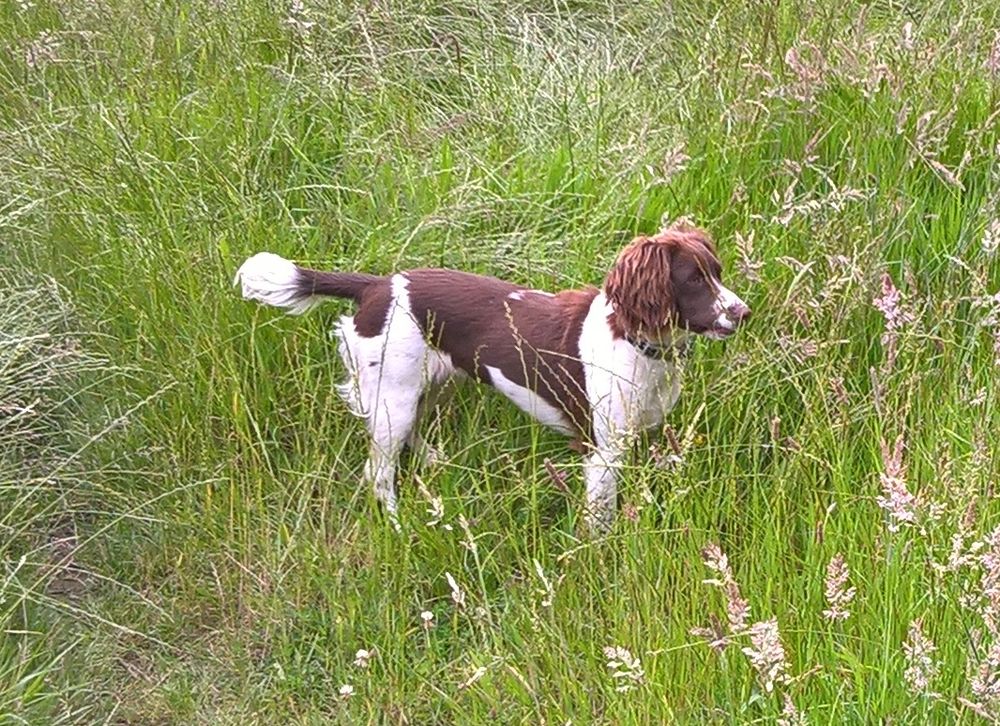
- Origin
- Great BritainFédération Cynologique Internationale
- Adult weight
- 18.1 to 22.7 kg (AKC: about 40 pounds for females, 50 pounds for males)American Kennel Club
- Height
- 48 to 51 cm (AKC: 19 inches for females, 20 inches for males; the FCI standard gives about 51 cm)American Kennel Club
- Lifespan
- 12 to 14 yearsAmerican Kennel Club
- Coat
- Close, straight and weather resisting, of medium length, with moderate feathering on the ears, forelegs, body and hindquarters. Liver and white or black and white, with or without tan markings.Fédération Cynologique Internationale
- Energy
- Very highThe Royal Kennel Club
- Indian heat
- Copes with careScientific Reports (2020)study
- Flats
- A flat, with daily exerciseAmerican Kennel Club
English Springer Spaniel snapshot
| What | The rule | Source |
|---|---|---|
| Size | Medium, says The Royal Kennel Club. AKC gives 20 inches and 50 pounds (about 23 kg) for males, 19 inches and 40 pounds for females. | American Kennel Club |
| Exercise need | More than 2 hours a day, says The Royal Kennel Club. | The Royal Kennel Club |
| Heat tolerance | Raised risk: 2.74 times the odds of heat-related illness of the Labrador in a large UK study. | Scientific Reports (2020)study |
| Temperament | Friendly, happy disposition, biddable; timidity or aggression is unacceptable in the standard (FCI). | Fédération Cynologique Internationale |
| Trainability | AKC rates it 5 of 5, with mental stimulation needs of 4 of 5. | American Kennel Club |
| Coat | Medium length; groom more than once a week, says The Royal Kennel Club. AKC suggests trimming feet, head, neck and under the tail. | The Royal Kennel Club |
| Lifespan | AKC gives 12 to 14 years; The Royal Kennel Club says over 10 years. | American Kennel Club |
Where does the English Springer Spaniel come from?
The English Springer is one of Britain's land spaniels, and the FCI standard calls it of ancient and pure origins, the oldest of the sporting gundogs. Its first job was to find game birds and spring them from cover, into a net, towards a falcon or in front of a greyhound. The Royal Kennel Club says the name comes from that habit of springing forward to flush game into nets.
AKC's history says that for centuries dogs called cockers and springers were often born in the same litter, and only careful breeding sorted them into the English Springer, the English Cocker and the Field Spaniel. After firearms changed hunting from the 17th century on, springers became gundogs that find, flush and retrieve game for the gun, which is what the FCI standard still lists as the breed's use.
At the first British dog shows in the 1870s, English and Welsh Springers were shown as one breed. The Kennel Club in England recognised them separately in 1902. The breed became well known in North America in the 1920s, its AKC parent club first met in 1924, and AKC notes its nose and trainability have since been put to work in detection work.
How did the English Springer Spaniel come to India?
Petym found no Indian source that records when or how the English Springer Spaniel first came to India, so its arrival here is not documented. What the sources do say is how the breed's needs meet Indian conditions. It was bred for long days in cool British fields, and in a large UK study of vet records it had 2.74 times the odds of heat-related illness of the Labrador, so an Indian summer means walks before sunrise and after dark and indoor brain work in between.
Its long, feathered ears and coat pick up grass seeds, mud and ticks, and ticks were found on 53% of dogs in a survey across four Indian cities. A Springer in India needs a daily check of ears, feet and coat, with exercise moved indoors on heat wave days.
What care does a English Springer Spaniel need?
The three things that shape a good day for this breed.
Exercise
The Royal Kennel Club gives more than 2 hours of exercise a day. AKC suggests long walks and play, and dog sports such as obedience, tracking and agility for the mind; in India, keep the long walks to the cool hours. The Royal Kennel Club
Grooming
AKC advises weekly brushing with a slicker brush or metal comb, and trimming of the feet, head, neck and under the tail by the owner or a groomer; the Royal Kennel Club says more than once a week. Trim the nails regularly. American Kennel Club
Training
AKC calls Springers lively and highly intelligent and says early socialisation, puppy classes and continued gentle training are vital. It also warns that a Springer left alone for long periods often may develop unwanted behaviour. The Royal Kennel Club
How much should a English Springer Spaniel eat?
Daily calories for a healthy, neutered adult English Springer Spaniel, worked out from its weight with the formula vets use (70 x weight in kg to the power 0.75, then AAHA's factor for a neutered adult). Divide by the kcal per kg on your food's pack for grams a day, and adjust by body shape.
| Resting need (kcal a day) | Neutered adult (kcal a day) | |
|---|---|---|
| 18.1 kg AAHA (American Animal Hospital Association) | 610 | 860 to 980 |
| 20.4 kg | 670 | 940 to 1080 |
| 22.7 kg | 730 | 1020 to 1160 |
AKC advises a good quality food suited to the dog's age and activity level, few treats because too many cause obesity, and table scraps sparingly if at all, avoiding cooked bones and fatty food. WSAVA's advice is a complete and balanced diet, with treats kept to about 10% of the day's calories. The energy table on this page gives the daily calories for an adult's weight. From the Indian kitchen, keep onion, garlic, grapes and raisins, chocolate and anything sweetened with xylitol away from the dog; ASPCA lists all of them as unsafe. Ask your vet before any change of diet, and make any change slowly. Meals a day: 6 to 12 weeks, 4 a day; 3 to 6 months, 3 a day; 6 to 12 months, 2 a day; adult, over 12 months, 1 or 2 a day. Puppies, kittens, working, pregnant and older animals need different amounts: ask your vet, or use Petym's food calculator.
Which illnesses is the English Springer Spaniel prone to, and how are they treated?
The conditions veterinary studies and breed surveys most often report in the English Springer Spaniel. Knowing the early signs means a vet sees it sooner.
See your vet first. This is general information from veterinary sources, not a diagnosis. Only a vet who has examined your pet can say what is wrong and prescribe treatment, and this page never gives a dose. Do not give your pet human medicine. If your pet seems very unwell, go to a 24-hour vet: find one in your city.
Heatstroke (heat-related illness)
Emergency: go to a vet nowBody temperature rising faster than the dog can lose heat, often during exercise. English Springer Spaniels had 2.74 times the odds of heat-related illness of Labradors in a large UK study of vet records. Scientific Reports (2020)study
Signs to watch for
- Heavy panting that does not settle
- Drooling, vomiting or diarrhoea
- Weakness, wobbling or collapse
- Confusion or a seizure in severe cases
How a vet treats it
PDSA says to cool the dog at once with cool water over the body and moving air, then go to the vet. A vet keeps cooling the dog and may give fluids through a drip, oxygen and other medicines, with blood tests for organ damage; severe cases may need days in hospital.
Prevention
Walk early in the morning and in the evening, carry water, test the ground with your palm for 7 seconds, and keep the dog lean.
Idiopathic epilepsy
See a vet soonRepeated seizures with no other cause found. Science for Animal Welfare lists the English Springer Spaniel as a breed predisposed to it; most first seizures come between one and four years of age. Science for Animal Welfare (formerly UFAW)
Signs to watch for
- Hiding, nervousness or seeking the owner before a fit
- Collapse with stiff legs and paddling, sometimes passing urine or faeces
- Facial twitching, staring or odd behaviour in partial seizures
- Confusion or tiredness afterwards
How a vet treats it
A vet diagnoses it by ruling out other causes, with blood and urine tests and sometimes imaging such as MRI. Treatment is constant, lifelong anti-seizure medication prescribed and monitored by the vet; about a third of dogs do not respond well. PDSA says call the vet straight away if a seizure lasts more than two minutes or there is more than one in 24 hours.
Immune-mediated haemolytic anaemia (IMHA)
See a vet soonThe immune system attacks the dog's own red blood cells faster than the bone marrow can replace them. Science for Animal Welfare says Springer Spaniels are predisposed, though the genetic cause is unknown. Science for Animal Welfare (formerly UFAW)
Signs to watch for
- Tiredness, low energy and poor appetite
- Pale or yellow gums, eyes or skin
- Dark or red urine
- Fast breathing or fast heart rate
How a vet treats it
A vet confirms anaemia on a blood test and runs further tests to rule out other causes. The source names high-dose corticosteroids, chemotherapeutic drugs and blood transfusions; removal of the spleen is sometimes advised. Science for Animal Welfare reports that around 40 to 60% of dogs die during treatment, so early care matters.
Prevention
No test exists; breeding from lines with little or no history of the disease is likely to reduce it.
Ear infections (otitis externa)
See a vet soonInflammation of the ear canal from bacteria, yeast, allergies, parasites or a lodged grass seed. Merck says ear flap and canal shape make some dogs more likely to get it, and AKC advises checking a Springer's long ears regularly for infection. Merck Veterinary Manual
Signs to watch for
- Head shaking and scratching at the ear
- A bad smell or discharge
- Red, swollen or painful ear
- Flaky skin in the ear
How a vet treats it
A vet examines the canal with an otoscope, sometimes under sedation, and tests a swab. The vet cleans the ear and usually prescribes ear drops that combine antibiotics, antifungals and anti-inflammatories, with oral medicine for severe infections; treatment often runs 2 to 4 weeks. Merck warns against vinegar home remedies.
Prevention
Check the ears often, keep them dry after baths and wet walks, and clean them only as your vet directs.
Hip and elbow dysplasia
Ask at a routine checkJoints that develop loosely and wear into arthritis. AKC lists hip and elbow dysplasia in the breed, and the Royal Kennel Club recommends hip and elbow testing before breeding. American Kennel Club
Signs to watch for
- Lameness that is worse after exercise
- A bunny-hopping gait
- Stiffness after rest
- Reluctance to jump or climb stairs
How a vet treats it
A vet uses X-rays to grade the joint. Merck lists weight reduction, limiting exercise on hard surfaces, physical therapy and anti-inflammatory drugs, and a range of surgeries up to total hip replacement for some dogs.
Prevention
Choose a puppy from parents with hip and elbow scores, and keep your dog lean.
How do you exercise a Springer in Indian heat?
In pieces, in the cool hours, with as much work for the nose and brain as for the legs.
The Royal Kennel Club calls the English Springer the most popular spaniel for working in the field and lists more than 2 hours of exercise a day. AKC says it makes a great companion on long walks or hikes and an active, forward explorer. In a cool climate that means long country walks. In an Indian city in May it cannot, because the UK study of heat-related illness found the English Springer Spaniel among nine breeds with significantly higher odds than the Labrador, at 2.74 times, and found exercise caused most cases.
The answer is to split the day. A long walk before sunrise, a second after dark once the ground has cooled, and the rest of the exercise as brain work indoors: sniffing games, hide-and-seek with a toy, short training sessions and food puzzles. AKC rates the breed 5 of 5 for trainability and 4 of 5 for mental stimulation needs, and a tired brain settles a Springer as well as tired legs.
Watch the dog, not the clock. A Springer will keep going after a ball long past the point it should stop. A sitter decides when play ends, offers water often, and heads home at the first sign of heavy panting or lagging behind. On the India Meteorological Department's heat wave days, outdoor exercise shrinks to toilet breaks.
A Springer's summer day with a sitter
Petym’s working from the official rules, no government publishes a total.
A sample plan for April to June in an Indian city.
Before sunrise
The long walk, 45 to 60 minutes on a lead or a long line in a safe space, with sniffing time. Test the road with the back of a hand for seven seconds first. Water on the walk. The Royal Kennel Club
After the walk
Water, a check of ears and feet for grass seeds and ticks, and breakfast once breathing has settled.
Mid-morning
Fifteen minutes of training: retrieve to hand, stays, recalls down a corridor, with pieces of the day's food.
Midday to late afternoon
Indoors in the coolest room. Sniffing games with hidden treats, a chew or a stuffed food toy. No outdoor play. Animal Welfare Board of India
After dark
The second walk, 40 to 50 minutes once the ground has cooled, then dinner.
Evening
A brush of the feathering, ears dried if damp, and the daily photo update to the owner.
English Springer Spaniel health signs to report
A sitter notices, records and tells the owner, and calls the vet for anything sudden.
If Heavy panting that does not settle in the cool, drooling, wobbling, vomiting or collapse after exercise.
Heatstroke is an emergency: move the dog somewhere cool, pour cool water over its body, use a fan, and go to the vet at once. PDSA
If A seizure (fit). Science for Animal Welfare lists idiopathic epilepsy for the breed.
Clear space around the dog, keep hands away from its mouth, do not restrain it, keep the room cool and quiet, and time it. PDSA says call the vet straight away if it lasts longer than two minutes or there is more than one in 24 hours, and call afterwards in any case. PDSA
If Unusual weakness, tiring quickly on a short walk, or a change in gum colour. Science for Animal Welfare lists primary immune-mediated haemolytic anaemia, in which the immune system destroys red blood cells, for the breed.
Call the vet the same day; collapse is an emergency. Science for Animal Welfare (formerly UFAW)
If A squinting, watering or red eye. Spaniel types had 3.13 times the odds of corneal ulcers of crossbreds in an English study.
Same-day vet visit; do not use drops the vet did not prescribe. Canine Genetics and Epidemiology (2017), RVC VetCompassstudy
If Head shaking, scratching an ear, a smell or discharge, or a grass seed lodged in an ear or between the toes after a walk.
Keep the ear dry and call the vet. Do not poke into the ear canal. Merck Veterinary Manual
If A lump on the belly or along the mammary glands of a female. Science for Animal Welfare lists mammary tumours for the breed.
Tell the owner so the vet can check it. Science for Animal Welfare (formerly UFAW)
If Stiffness after rest or a change in gait. AKC lists hip and elbow dysplasia.
Shorter walks on soft ground and a note for the vet. American Kennel Club
Company, alone time and a sitter
AKC calls the Springer affectionate, cheerful and eager to please, and rates it 5 of 5 for affection with family and 4 of 5 with other dogs and strangers. The Royal Kennel Club's gundog group notes these dogs make good companions, ideal all-round family dogs. Most Springers greet a sitter with a wagging body and a toy.
The problem is time alone. AKC says the Springer wants to be with its family and that undesirable behaviours can result if it is regularly left alone for long periods. PDSA's general advice for any dog is no more than 4 hours at a stretch. A bored, under-exercised Springer chews, digs and barks. The best fits are a sitter who stays in your home or a sitter's home where someone is around most of the day.
Off-lead running is part of a Springer's life in the UK, but in an Indian city it is risky: traffic, community dogs and open drains. AKC says the owner should be in control at all times because the Springer is an active, forward explorer. A long line in a safe, enclosed space gives freedom without the risk.
Monsoon, coat and feeding rules
Do
- Dry the ears, feathering and feet after every wet walk; long feathered ears and feet hold water and mud.
- Brush the coat more than once a week and work out tangles with a slicker brush or comb, as AKC suggests. American Kennel Club
- Check for ticks after each walk: ticks were found on 53% of dogs in a survey in four Indian cities. Parasites & Vectors (2011)study
- Measure meals and count treats; WSAVA suggests treats stay under about 10% of daily calories. WSAVA
Don’t
- Do not exercise the dog in the afternoon heat, however keen it is.
- Do not give cooked bones or fatty table scraps; AKC advises avoiding both. American Kennel Club
- Do not feed chocolate, grapes, raisins, onion, garlic or xylitol. ASPCA Animal Poison Control
- Do not change the food during the stay; a sudden change can cause diarrhoea. PDSA
English Springer Spaniel sitter checklist
- Walking times, routes and any safe enclosed space for a long line.
- Harness, lead and long line, and the recall word the dog knows.
- Favourite toys and brain games, and how much play is too much in the heat.
- Meal amounts, times and the treat allowance.
- Any seizure plan or medicines, with the vet's label and times, logged at each dose.
- Towel, brush and comb, and the ear-drying routine.
- Tick prevention product and next due date.
- The vet's number and the nearest 24-hour vet on Petym's city list.
Which Petym service suits a Springer?
Company plus a sitter willing to do two proper walks a day.
Often the best fit
Overnight pet sitting
A sitter in your home who does the dawn and evening walks, the brain games, and a daily photo update.
Pet boarding
A sitter's home with people around, inside the home's pet limit. Springers usually get on with other dogs.
Dog walking
An extra cool-hour walk on workdays for a dog that needs more than 2 hours of exercise.
Doggy day care
Company and play on workdays, with play kept indoors and cool in the hot months.
Breeds with similar care needs to the English Springer Spaniel
Going away soon? Tell us your dates.
A checked local sitter feeds, walks and keeps your pet company at home, follows your care sheet to the letter and sends a photo every day. Petym is opening city by city: send your dates and we will tell you when a sitter can take them.
- Meet your sitter first, free
- PAN-checked, first-aid trained
- A photo every day
- Pay through Petym, never cash


Questions owners ask
Can an English Springer Spaniel live in Indian heat?
- Yes, with care. In a large UK study the breed had 2.74 times the odds of heat-related illness of the Labrador, mostly linked to exercise. Walk before sunrise and after dark, do brain games indoors in the heat, keep it lean and stop play at the first sign of heavy panting.
How much exercise does a Springer Spaniel need?
- A lot. The Royal Kennel Club says more than 2 hours a day. In India, split it into a long dawn walk, a second walk after dark, and indoor training and sniffing games in between, so the dog gets its exercise without the midday heat.
How long can a Springer Spaniel be left alone?
- PDSA's general advice is no more than 4 hours at a time for any dog. AKC says Springers want to be with their family and may develop unwanted behaviour if often left alone for long periods. On long days, use a sitter, day care or a walker.
Are Springer Spaniels good with other dogs?
- Usually. AKC rates the breed 4 of 5 with other dogs and 4 of 5 with strangers, and the FCI standard describes a friendly, happy disposition. That makes boarding in a sitter's home an option for many Springers, especially in cooler months.
What health problems do Springer Spaniels have?
- AKC lists hip and elbow dysplasia and progressive retinal atrophy, and Science for Animal Welfare lists idiopathic epilepsy, immune-mediated haemolytic anaemia and mammary tumours. In India, heatstroke is the most urgent risk. Talk to your vet about your own dog.
Can a Springer be walked off the lead in an Indian city?
- It is safer not to. AKC says the owner should be in control at all times because the Springer is an active, forward explorer. Traffic, community dogs and open drains add risk. Use a long line in a safe, enclosed space instead.
Keep reading
- Heatstroke in dogs
- How hot is too hot to walk a dog?
- Monsoon pet care
- Cocker Spaniel careThe smaller spaniel from the same roots.
- Labrador Retriever care
- Overnight pet sitting
Services that help
Free tools for this
Words on this page, explained
Keep exploring
Other dog breeds
- Akita
- Alaskan Malamute
- American Bully
- American Cocker Spaniel
- American Pit Bull Terrier
- Australian Shepherd
- Bakharwal dog
- Basset Hound
- Beagle
- Belgian Malinois
- Bernese Mountain Dog
- Bichon Frise
- Border Collie
- Boston Terrier
- Boxer
- Bull Terrier
- Bulldog
- Bullmastiff
- Cane Corso
- Caucasian Shepherd Dog
- Cavalier King Charles Spaniel
- Chihuahua
- Chippiparai
- Chow Chow
- Cocker Spaniel
- Dachshund
- Dalmatian
- Dobermann
- Dogo Argentino
- English Mastiff
- French Bulldog
- Gaddi Kutta (Gaddi dog)
- German Shepherd
- Golden Retriever
- Great Dane
- Greyhound
- Havanese
- Indian pariah dog (Indie)
- Indian Spitz
- Irish Setter
- Jack Russell Terrier
- Kangal
- Kanni
- Kombai
- Labrador Retriever
- Lhasa Apso
- Maltese
- Miniature Pinscher
- Miniature Schnauzer
- Mudhol Hound
- Neapolitan Mastiff
- Newfoundland
- Papillon
- Pekingese
- Pembroke Welsh Corgi
- Pomeranian
- Poodle
- Pug
- Rajapalayam
- Rampur Greyhound
- Rhodesian Ridgeback
- Rottweiler
- Saint Bernard
- Samoyed
- Shar Pei
- Shiba Inu
- Shih Tzu
- Siberian Husky
- Tibetan Mastiff
- Weimaraner
- West Highland White Terrier
- Whippet
- Yorkshire Terrier
Sources
Each source was opened and read on the date shown. How Petym checks its sources
- Fédération Cynologique Internationale: FCI standard No. 125: English Springer Spaniel (8 September 2026) (opens in a new tab)
- American Kennel Club: English Springer Spaniel dog breed information (opens in a new tab)
- The Royal Kennel Club: Spaniel (English Springer): breeds A to Z (opens in a new tab)
- India Meteorological Department: FAQ on heat wave (opens in a new tab)
- WSAVA: Frequently asked questions and myths (Global Nutrition Committee) (opens in a new tab)
- ASPCA Animal Poison Control: People foods to avoid feeding your pets (opens in a new tab)
Show all 23 sourcesShow fewer
- Merck Veterinary Manual: Puppy care (opens in a new tab)
- AAHA (American Animal Hospital Association): 2021 AAHA Nutrition and Weight Management Guidelines for Dogs and Cats: energy requirement calculations (Box 1, PDF) (opens in a new tab)
- Merck Veterinary Manual: Nutritional requirements of small animals (full review November 2023, updated September 2024) (opens in a new tab)
- PDSA: Heatstroke in dogs (opens in a new tab)
- Science for Animal Welfare (formerly UFAW): English Springer Spaniel: idiopathic epilepsy (opens in a new tab)
- PDSA: What to do if your pet has a seizure (opens in a new tab)
- Science for Animal Welfare (formerly UFAW): English Springer Spaniel: primary immune-mediated haemolytic anaemia (opens in a new tab)
- Merck Veterinary Manual: Ear infections and otitis externa in dogs (opens in a new tab)
- Merck Veterinary Manual: Hip dysplasia (dog owners) (opens in a new tab)
- Science for Animal Welfare (formerly UFAW): English Springer Spaniel: genetic welfare problems (opens in a new tab)
- PDSA: Separation anxiety in dogs (opens in a new tab)
- PDSA: Diarrhoea after a change of food (opens in a new tab)
- Animal Welfare Board of India: Request to ensure care and protection of animals from direct heat during extreme hot weather (4 May 2026) (opens in a new tab)
- The Royal Kennel Club: The danger of hot pavements (opens in a new tab)
- Scientific Reports (2020): Incidence and risk factors for heat-related illness in UK dogs (opens in a new tab)
- Parasites & Vectors (2011): A survey of canine tick-borne diseases in India (opens in a new tab)
- Canine Genetics and Epidemiology (2017), RVC VetCompass: Corneal ulcerative disease in dogs under primary veterinary care in England (abstract read) (opens in a new tab)