Rajapalayam dog care: sitters, heat and strangers
Updated By PetymFacts checked against official sources on
Quick answer
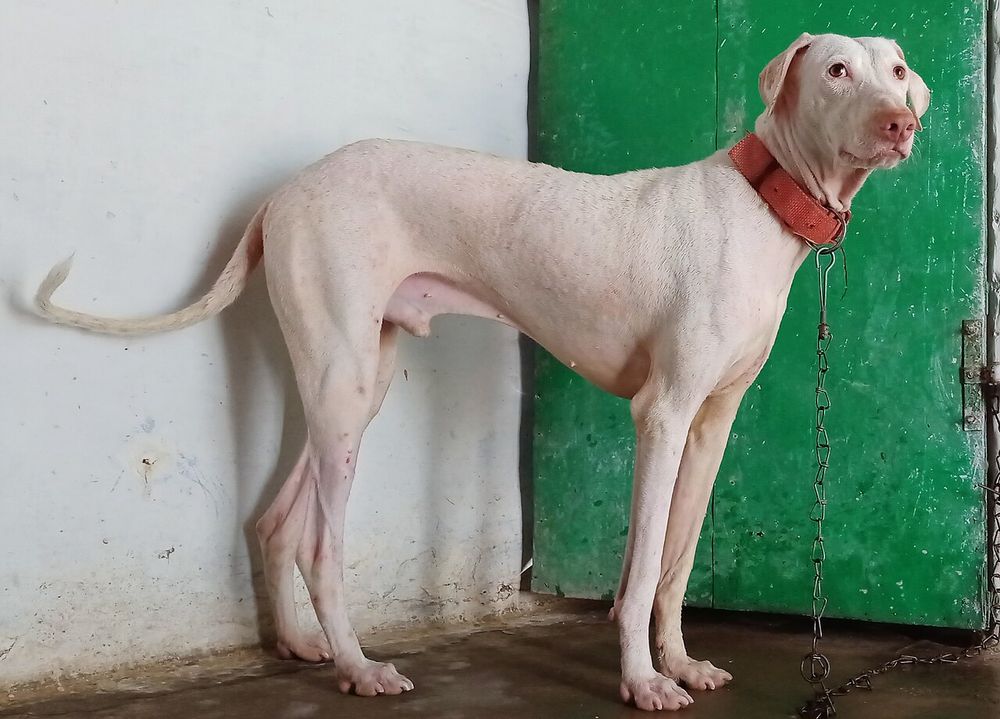
The Rajapalayam is a registered Indian dog breed from southern Tamil Nadu, white-coated with pink skin and golden eyes. Studies describe it as active, obedient and very alert to strangers, and attached to its owner. While you travel, it does best at home with a sitter it has met first, walked early and late, and kept on lead.
Reliable data on the breed is limited. There is no published study of its exercise needs, lifespan or heat tolerance, and the claims about deafness need more research.
- Meet your sitter first, free
- PAN-checked, first-aid trained
- A photo every day
- Pay through Petym, never cash

- Indian breed
- Developed in India
- Origin
- Rajapalayam taluk, Virudhunagar district, southern Tamil NaduIndian Journal of Animal Sciences (2017), ICAR-NBAGR and TANUVASstudy
- Adult weight
- 14 to 32 kg (ICAR-NBAGR's adult range. In a 2017 study of 88 adults, the average was about 24.7 kg for males and 21.4 kg for females.)ICAR-National Bureau of Animal Genetic Resources
- Height
- 38 to 72 cm (NBAGR: 55 to 72 cm at the withers in males and 38 to 70 cm in females. The 2017 study's averages were 63.1 cm (males) and 58.9 cm (females).)ICAR-National Bureau of Animal Genetic Resources
- Coat
- Short, very smooth white coat, with pink skin, nostrils and eyelids and golden eyes. Locally called Vellai Moonji Naai, the white-faced dog.Indian Journal of Animal Sciences (2017), ICAR-NBAGR and TANUVASstudy
- Indian heat
- Copes with careAnimal Welfare Board of India
Rajapalayam at a glance
| What | The rule | Source |
|---|---|---|
| Size | NBAGR records 55 to 72 cm at the withers in males and 38 to 70 cm in females, and 14 to 32 kg as adults. In one study, average adult weight was about 25 kg for males and 21 kg for females. | ICAR-National Bureau of Animal Genetic Resources |
| Exercise | Not measured. A study describes the breed as very active; no source gives a daily amount. | Indian Journal of Animal Sciences (2017), ICAR-NBAGR and TANUVASstudy |
| Alone-time tolerance | Not studied for this breed. PDSA's general advice is that dogs should not be left alone for more than four hours at a time. | PDSA |
| Heat tolerance | Not studied. It comes from hot southern Tamil Nadu, and a 2020 Mann Ki Baat address called Indian breeds better adapted to the Indian environment, but there is no measured data. | Press Information Bureau, Prime Minister's Office |
| Coat and shedding | Short, very smooth white coat, with pink skin, nostrils and eyelids. | Indian Journal of Animal Sciences (2017), ICAR-NBAGR and TANUVASstudy |
| Sociability | Obedient and easily trained, attached to its owner, and very alert against unknown people and wild animals. | Indian Journal of Animal Sciences (2017), ICAR-NBAGR and TANUVASstudy |
Where does the Rajapalayam come from?
The Rajapalayam takes its name from Rajapalayam town in Virudhunagar district of Tamil Nadu. A 2017 study by ICAR-NBAGR and Tamil Nadu Veterinary and Animal Sciences University scientists says it is believed to have been bred by the Nayak dynasty of Tamil Nadu, and reports that the dogs were used during the Carnatic wars against the British army. Locally it is called Vellai Moonji Naai, the white-faced dog.
It was kept as a farm guard. The study found it mainly with the Devar, Naicker and Nadar communities, guarding homes and crops; farmers in the foothills of the Western Ghats used it to protect tapioca, paddy and banana from wild boars at night. Breeders described it as very active, obedient to its owner, easily trained, very alert against strangers and wild animals, and a dog that prefers to live alone with its owner and does not attack the farm's livestock or poultry.
How did the Rajapalayam come to India?
The Rajapalayam is a native Indian breed. ICAR's National Bureau of Animal Genetic Resources lists it as the first registered Indian dog breed, from Tamil Nadu, with accession number INDIA_DOG_1800_RAJAPALAYAM_19001, and an NBAGR paper from 2016 says the Kennel Club of India has registered it. The 2017 study found it mainly around Rajapalayam and in pockets of Madurai and Tirunelveli districts, and also with kennels and pet owners across Tamil Nadu; it adds that the Indian Army has used Rajapalayam dogs as guard dogs on the international borders for some decades.
In his Mann Ki Baat address of 30 August 2020, the Prime Minister named the Rajapalayam among Indian breeds that cost less to raise and are better adapted to the Indian environment. No study has measured its heat tolerance, though, so it still needs shade, water and cool-hour walks in summer.
What care does a Rajapalayam need?
The three things that shape a good day for this breed.
Exercise
No study gives a daily amount, but breeders describe a very active guard dog. Plan two long walks a day in the cool hours on a harness and lead, and time to run inside a secure fence. Indian Journal of Animal Sciences (2017), ICAR-NBAGR and TANUVASstudy
Grooming
The short coat needs little brushing. Breeders in the 2017 study bathed most dogs every week or ten days with dog shampoo, some more often because of skin problems; check the pink skin and the coat for ticks daily. Parasites & Vectors (2011)study
Training
Breeders call it obedient and easily trained, but very alert to strangers. Socialise a puppy widely, introduce visitors and sitters slowly, and reward calm behaviour. Indian Journal of Animal Sciences (2017), ICAR-NBAGR and TANUVASstudy
How much should a Rajapalayam eat?
Daily calories for a healthy, neutered adult Rajapalayam, worked out from its weight with the formula vets use (70 x weight in kg to the power 0.75, then AAHA's factor for a neutered adult). Divide by the kcal per kg on your food's pack for grams a day, and adjust by body shape.
| Resting need (kcal a day) | Neutered adult (kcal a day) | |
|---|---|---|
| 14 kg AAHA (American Animal Hospital Association) | 510 | 710 to 810 |
| 23 kg | 740 | 1030 to 1180 |
| 32 kg | 940 | 1320 to 1510 |
In the 2017 study most breeders fed twice a day, mainly non-vegetarian food with rice, egg and milk. That is tradition, not a tested diet. The Merck Veterinary Manual says nutrition problems come mostly from unbalanced home-made diets, so feed a complete and balanced dog food, or a home-cooked diet only if a vet nutritionist has formulated it. ASPCA notes that dogs lack enough lactase to digest milk, which often causes diarrhoea. Use the energy table below as a starting point and let your vet adjust it by body condition. Keep onion and garlic (in curry and rasam), grapes and raisins, tamarind, chocolate, salty snacks, xylitol and cooked bones out of the bowl. Meals a day: 6 to 12 weeks, 4 a day; 3 to 6 months, 3 a day; 6 to 12 months, 2 a day; adult, 2 a day. Puppies, kittens, working, pregnant and older animals need different amounts: ask your vet, or use Petym's food calculator.
Which illnesses is the Rajapalayam prone to, and how are they treated?
The conditions veterinary studies and breed surveys most often report in the Rajapalayam. Knowing the early signs means a vet sees it sooner.
See your vet first. This is general information from veterinary sources, not a diagnosis. Only a vet who has examined your pet can say what is wrong and prescribe treatment, and this page never gives a dose. Do not give your pet human medicine. If your pet seems very unwell, go to a 24-hour vet: find one in your city.
Congenital deafness
Ask at a routine checkBreeders told the 2017 study that silver-eyed (wall-eyed) Rajapalayams can be deaf in one or both ears, and the authors say it may be linked to the eye colour and needs more study. In other white or piebald breeds, deafness is linked to coat pigment genes. Indian Journal of Animal Sciences (2017), ICAR-NBAGR and TANUVASstudy
Signs to watch for
- No reaction to its name, a clap or the doorbell
- Ears do not prick up at sounds
- A dog deaf in one ear may seem normal
How a vet treats it
A vet can confirm it with a BAER hearing test, which records the brain's response to sound in each ear and can be done in young puppies. Science for Animal Welfare says there is no treatment for this kind of deafness.
Prevention
Ask the breeder about hearing tests, train a deaf dog with hand signals, and never let it off the lead near roads.
Skin problems (dermatitis and pyoderma)
See a vet soonBreeders in the 2017 study reported dermatitis in Rajapalayams, and some bathed their dogs daily to manage it. Merck says most pus-forming skin infections (pyoderma) follow another problem such as allergy or parasites. Indian Journal of Animal Sciences (2017), ICAR-NBAGR and TANUVASstudy
Signs to watch for
- Red, itchy or sore skin
- Bald patches, scabs or scaling
- Smell, pus or crusting
How a vet treats it
Merck says a vet looks for the underlying cause with skin scrapings and sometimes cultures, and may prescribe a full course of antibiotics, medicated shampoos and treatment of the cause, such as parasite control.
Prevention
Keep up tick and flea control and dry the coat well after monsoon walks and baths.
Tick fever (ehrlichiosis)
See a vet soonA blood infection with Ehrlichia canis, spread mainly by the brown dog tick. It is not specific to the Rajapalayam, but ticks were found on 53% of 525 dogs in a survey across four Indian cities. Merck Veterinary Manual
Signs to watch for
- Fever and dullness
- Loss of appetite
- Nosebleeds, bruising or blood in the stool
How a vet treats it
Merck says vets diagnose it with blood tests such as serology and PCR, and treat it with a course of antibiotics, with supportive care and sometimes a platelet or blood transfusion.
Prevention
Tick control as your vet advises, and check the ears, neck and toes after every walk.
What is known about the Rajapalayam?
It is one of three Indian dog breeds registered by ICAR's National Bureau of Animal Genetic Resources (NBAGR), alongside the Chippiparai and the Mudhol Hound.
NBAGR lists the Rajapalayam from Tamil Nadu with accession number INDIA_DOG_1800_RAJAPALAYAM_19001, the first of the three dog breeds it has registered. Its breed page says the dogs are mainly found in the Virudhunagar, Tirunelveli and Madurai districts, are medium in size with a compact body, have a white coat, pink skin, nostrils and eyelids, and golden eyes, and are used for guarding farms and farmhouses. It estimates the population at 3,000 to 4,000 dogs.
A 2017 study by NBAGR and Tamil Nadu Veterinary and Animal Sciences University (TANUVAS) scientists measured 88 adult dogs. It says the breed originated in Rajapalayam taluk of Virudhunagar district and is believed to have been bred by the Nayak dynasty. The dogs were very active, obedient to their owner and easily trained, very alert against strangers and wild animals, and did not attack livestock or poultry. The study also notes that the Indian Army has used Rajapalayam dogs as guard dogs on the international borders for some decades, and that the dogs are now kept as pets by dog lovers throughout Tamil Nadu.
An NBAGR paper from 2016 says the Kennel Club of India has started registering Indian dog breeds, including the Rajapalayam. In his Mann Ki Baat address of 30 August 2020, the Prime Minister named the Rajapalayam among fabulous Indian breeds that cost less to raise and are better adapted to the Indian environment.
What the sources say, and what they do not
Most of what is written online about the Rajapalayam is not backed by a study. This is the honest picture.
| What is recorded | What is not known | |
|---|---|---|
| Size and look ICAR-National Bureau of Animal Genetic Resources | Height, weight, white coat, pink skin, golden eyes (NBAGR, 2017 study) | Breed standard: we could not find a Kennel Club of India standard online |
| Temperament Indian Journal of Animal Sciences (2017), ICAR-NBAGR and TANUVASstudy | Active, obedient, trainable, alert to strangers, attached to the owner | How it behaves in flats, with children or other pets: no study |
| Exercise Indian Journal of Animal Sciences (2017), ICAR-NBAGR and TANUVASstudy | Described as very active | How much exercise a day: no source |
| Health Indian Journal of Animal Sciences (2017), ICAR-NBAGR and TANUVASstudy | Breeders report deafness in silver-eyed dogs and skin problems | How common either is; lifespan; other inherited diseases |
| Heat ICAR-National Bureau of Animal Genetic Resources | Native to hot southern Tamil Nadu | Any measured heat tolerance or heatstroke risk |
How does a Rajapalayam react to a sitter?
Expect caution. A dog bred to guard and described as very alert against strangers will not greet a new person like a Labrador.
The 2017 study says Rajapalayam dogs preferred to be alone with their owner and were very alert against unknown persons. That is a useful trait in a farm guard and a challenge for a pet sitter. It is the main reason a first meeting matters. Petym's free meet and greet lets the dog see the sitter with you present, in its own home, before the first booking.
For a nervous or guarding dog, plan two or three short visits before you travel if you can: the sitter arrives with you, ignores the dog at first, sits down, and lets the dog approach. Treats from the dog's own food help. On the first day of the booking, the sitter should follow your routine exactly, leash the dog the way you do, and avoid reaching over its head.
A dog that is very attached to one person may also find your absence hard. PDSA lists barking, howling, panting, trembling, destructive behaviour and toileting indoors among signs of separation anxiety. Ask your sitter to tell you about them rather than scold the dog.
A walking plan for a Rajapalayam in Indian heat
No source gives an exercise figure for the breed. This plan is built from general heat guidance and the breed's active nature.
Early morning
The main walk, on a secure lead and harness, before the ground heats up. Test the road with the back of a hand for seven seconds. The Royal Kennel Club
On the walk
Keep away from goats, cats and community dogs where possible, and cross the road early. A sighthound reacts to movement at a distance.
Midday
Indoors or in deep shade, with water in stable bowls that cannot tip over. No exercise in the hottest hours. Animal Welfare Board of India
Late afternoon
Calm time: a chew, a food puzzle, or simple training using part of the day's food.
After sunset
The second walk, once the ground has cooled. Grass over tarmac. The Royal Kennel Club
Night
Last toilet break, then the dog's usual bed and routine. Doors, gates and terrace access locked.
Which health signs should a Rajapalayam's sitter know?
Little is published on the breed's health. These are the points the sources support, plus the general emergencies every sitter should know.
If The dog does not respond to its name or to sounds. Breeders told researchers that silver-eyed (wall-eyed) Rajapalayams can be deaf, which the study says needs to be studied in detail.
Not an emergency if known. Ask the owner how the dog is called; a deaf dog must never be off lead. Indian Journal of Animal Sciences (2017), ICAR-NBAGR and TANUVASstudy
If Red, itchy or sore skin, hair loss or scratching. Breeders reported dermatitis to researchers.
Note where and how much, send a photo to the owner and call the vet if it is spreading, raw or the dog seems unwell. Indian Journal of Animal Sciences (2017), ICAR-NBAGR and TANUVASstudy
If Heavy panting, drooling, lethargy, a fast heartbeat or collapse in the heat.
Heatstroke: move the dog somewhere cool, pour plenty of cool water over it, use a fan, and go to the vet at once. Animal Welfare Board of India
If Fever, tiredness, pale gums or not eating after ticks were found.
Call the vet the same day and tell them ticks were found. Keep tick prevention up to date before you travel.
If Vomiting, diarrhoea or refusing food for more than a day.
Call the vet. Keep the dog's food exactly as the owner left it. PDSA
If A bite, cut or limp after meeting another dog on a walk.
Clean the area if the dog allows, call the owner, and see the vet for any bite wound.
Feeding a Rajapalayam while you are away
No source describes a special diet for the breed. Write down exactly what your dog eats, whether a commercial food or a home-cooked meal of rice and meat, the amounts and the times, and ask your sitter to follow it and log each meal. A sudden change of food is a common cause of diarrhoea.
Keep foods toxic to dogs out of reach. ASPCA Animal Poison Control warns that grapes and raisins can lead to kidney damage, xylitol can cause low blood sugar and liver damage, and onion and garlic can damage red blood cells. That rules out many leftovers from an Indian kitchen, such as curries made with onion and garlic.
The 2017 study notes that the owners it surveyed vaccinated their dogs yearly and dewormed them every four months. That describes what those owners did, not a schedule for your dog: ask your vet, and leave the vaccination card (DHPPi, rabies) and deworming dates with the sitter.
Rajapalayam sitter checklist
- A meet and greet at home with you present, and ideally a second short visit before the trip.
- How the dog behaves with strangers, what makes it guard, and how you calm it. Indian Journal of Animal Sciences (2017), ICAR-NBAGR and TANUVASstudy
- Whether the dog is deaf, and how you call it if so. Indian Journal of Animal Sciences (2017), ICAR-NBAGR and TANUVASstudy
- Vet and nearest 24-hour vet details, vaccination card and tick prevention dates.
- Lead, harness and walk routes, with places to avoid.
- Food, amounts and times; no leftovers with onion or garlic. ASPCA Animal Poison Control
- Where the dog sleeps, and which doors, gates and terraces stay locked.
Which Petym service suits a Rajapalayam?
A guarding dog that is wary of strangers usually copes best with one sitter, in its own home.
Most Rajapalayams
Overnight pet sitting
One sitter stays in your home, keeps the dog's routine and walks it early and late. The free meet and greet comes first.
Workdays
Dog walking
Early and late walks on long working days, with the same walker each time.
Only for a settled dog
Pet boarding
A stay in a checked sitter's home suits a Rajapalayam only if it already accepts that sitter and other dogs are not present.
Breeds with similar care needs to the Rajapalayam
Going away soon? Tell us your dates.
A checked local sitter feeds, walks and keeps your pet company at home, follows your care sheet to the letter and sends a photo every day. Petym is opening city by city: send your dates and we will tell you when a sitter can take them.
- Meet your sitter first, free
- PAN-checked, first-aid trained
- A photo every day
- Pay through Petym, never cash


Questions owners ask
Is the Rajapalayam a recognised Indian breed?
- Yes. ICAR-NBAGR has registered it as an Indian dog breed from Tamil Nadu, with accession number INDIA_DOG_1800_RAJAPALAYAM_19001. An NBAGR paper says the Kennel Club of India has also started registering Indian breeds including the Rajapalayam. It is not listed by the FCI or the UK's Kennel Club.
Is a Rajapalayam good with strangers?
- Usually not at first. A 2017 NBAGR and TANUVAS study describes the breed as very alert against unknown persons and attached to its owner. Introduce a sitter slowly, at home and with you present, ideally more than once before you travel, and keep the dog on lead outside.
Can a Rajapalayam be left alone?
- No study has looked at this breed. PDSA's general guidance is that dogs should not be left alone for more than four hours at a time. A dog attached to one person may find a trip hard, so overnight sitting in your home, with a sitter it has met, is usually the gentlest option.
Are Rajapalayam dogs deaf?
- Some may be. Breeders told researchers that silver-eyed Rajapalayams can be deaf, and the 2017 study says this may be linked to the wall or blue eye condition and needs more research. There is no published figure for how common it is. Ask your vet to check your dog's hearing.
Does a Rajapalayam handle Indian heat well?
- It comes from hot southern Tamil Nadu, and a 2020 Mann Ki Baat address said Indian breeds are better adapted to the Indian environment. But no study has measured its heat tolerance, and any dog can get heatstroke. Walk early and late, and keep shade and water available all day.
How much exercise does a Rajapalayam need?
- No source gives a figure. Research describes the breed as very active, so plan two walks a day in the cooler hours, on a secure lead, plus calm games at home. A sitter should keep to the same pattern you use, rather than guess.
Keep reading
- Dogs: caring for a dog while you are away
- Chippiparai careTamil Nadu's other registered sighthound.
- Mudhol Hound careKarnataka's sighthound, used by the BSF and CRPF.
- Indian pariah dog care
- Meet and greet checklist
- Overnight pet sitting
Services that help
Free tools for this
Words on this page, explained
Keep exploring
Other dog breeds
- Akita
- Alaskan Malamute
- American Bully
- American Cocker Spaniel
- American Pit Bull Terrier
- Australian Shepherd
- Bakharwal dog
- Basset Hound
- Beagle
- Belgian Malinois
- Bernese Mountain Dog
- Bichon Frise
- Border Collie
- Boston Terrier
- Boxer
- Bull Terrier
- Bulldog
- Bullmastiff
- Cane Corso
- Caucasian Shepherd Dog
- Cavalier King Charles Spaniel
- Chihuahua
- Chippiparai
- Chow Chow
- Cocker Spaniel
- Dachshund
- Dalmatian
- Dobermann
- Dogo Argentino
- English Mastiff
- English Springer Spaniel
- French Bulldog
- Gaddi Kutta (Gaddi dog)
- German Shepherd
- Golden Retriever
- Great Dane
- Greyhound
- Havanese
- Indian pariah dog (Indie)
- Indian Spitz
- Irish Setter
- Jack Russell Terrier
- Kangal
- Kanni
- Kombai
- Labrador Retriever
- Lhasa Apso
- Maltese
- Miniature Pinscher
- Miniature Schnauzer
- Mudhol Hound
- Neapolitan Mastiff
- Newfoundland
- Papillon
- Pekingese
- Pembroke Welsh Corgi
- Pomeranian
- Poodle
- Pug
- Rampur Greyhound
- Rhodesian Ridgeback
- Rottweiler
- Saint Bernard
- Samoyed
- Shar Pei
- Shiba Inu
- Shih Tzu
- Siberian Husky
- Tibetan Mastiff
- Weimaraner
- West Highland White Terrier
- Whippet
- Yorkshire Terrier
Sources
Each source was opened and read on the date shown. How Petym checks its sources
- ICAR-National Bureau of Animal Genetic Resources: Rajapalayam dog (read in a web-archive copy) (opens in a new tab)
- Animal Welfare Board of India: Request to ensure care and protection of animals from direct heat during extreme hot weather (4 May 2026) (opens in a new tab)
- ICAR-National Bureau of Animal Genetic Resources: Dog breeds of India (registered breeds and accession numbers) (opens in a new tab)
- Press Information Bureau, Prime Minister's Office: English rendering of PM's address in the 15th episode of Mann Ki Baat 2.0 on 30 August 2020 (read in a web-archive copy) (opens in a new tab)
- Merck Veterinary Manual: Nutritional requirements of small animals (full review November 2023, updated September 2024) (opens in a new tab)
- Merck Veterinary Manual: Puppy care (opens in a new tab)
Show all 20 sourcesShow fewer
- VCA Animal Hospitals: Feeding times and frequency for your dog (opens in a new tab)
- ASPCA Animal Poison Control: People foods to avoid feeding your pets (opens in a new tab)
- Merck Veterinary Manual: Grape, raisin, and tamarind (Vitis spp, Tamarindus spp) toxicosis in dogs (full review September 2024) (opens in a new tab)
- AAHA (American Animal Hospital Association): 2021 AAHA Nutrition and Weight Management Guidelines for Dogs and Cats: energy requirement calculations (Box 1, PDF) (opens in a new tab)
- UFAW Science for Animal Welfare (genetic welfare problems of companion animals): Dalmatian: Deafness (opens in a new tab)
- Merck Veterinary Manual: Pyoderma in dogs (opens in a new tab)
- Merck Veterinary Manual: Ehrlichiosis in dogs (opens in a new tab)
- ICAR-National Bureau of Animal Genetic Resources: New breeds registered (read in a web-archive copy) (opens in a new tab)
- PDSA: Separation anxiety in dogs (opens in a new tab)
- The Royal Kennel Club: The danger of hot pavements (opens in a new tab)
- PDSA: Diarrhoea after a change of food (opens in a new tab)
- Indian Journal of Animal Sciences (2017), ICAR-NBAGR and TANUVAS: Phenotypic characterization of Rajapalayam dog of Southern India (opens in a new tab)
- Journal of Livestock Biodiversity (2016), ICAR-NBAGR: A new methodology for characterization of dog genetic resources of India (opens in a new tab)
- Parasites & Vectors (2011): A survey of canine tick-borne diseases in India (opens in a new tab)