Bull Terrier care in India: play, other dogs, health and notes for your sitter
Updated By PetymFacts checked against official sources on
Quick answer
A Bull Terrier is usually a joy for a sitter: the FCI standard calls it courageous, fun-loving and particularly good with people, though obstinate. The catch is other dogs, where AKC rates it 1 of 5. So a sitter keeps it on a strong lead, away from unfamiliar dogs, with play in the cool hours.
In a study of 1,060 English Bull Terrier puppies, 10.19% were deaf in one or both ears, nearly all of them white. A sitter should know whether your dog hears.
- Meet your sitter first, free
- PAN-checked, first-aid trained
- A photo every day
- Pay through Petym, never cash

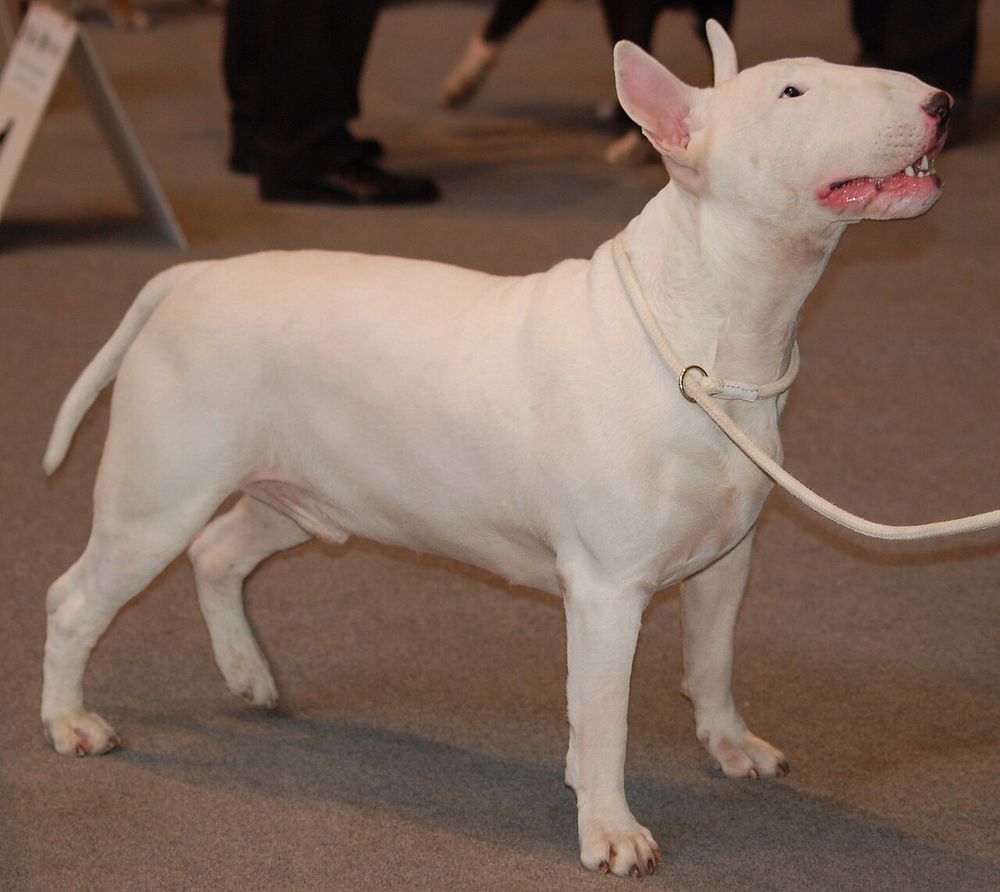
- Origin
- EnglandAmerican Kennel Club
- Adult weight
- 23 to 32 kg (adult, AKC: 50 to 70 pounds, converted to kg)American Kennel Club
- Height
- 53 to 56 cm (adult, AKC: 21 to 22 inches, converted to cm)American Kennel Club
- Lifespan
- 12 to 13 yearsAmerican Kennel Club
- Coat
- Short, flat, harsh and glossy, in white or coloured. A weekly brush is enough.American Kennel Club
- Energy
- ModerateAmerican Kennel Club
- Indian heat
- Copes with careScientific Reports (2020)study
- Flats
- A flat, with daily exerciseThe Royal Kennel Club
Bull Terrier snapshot
| What | The rule | Source |
|---|---|---|
| Size | Medium, says The Royal Kennel Club. AKC gives 21 to 22 inches and 50 to 70 pounds (about 23 to 32 kg). | American Kennel Club |
| Exercise need | Up to 1 hour a day, says The Royal Kennel Club; AKC suggests long daily walks that also stimulate the mind. | The Royal Kennel Club |
| With people | Of even temperament and amenable to discipline; although obstinate, particularly good with people (FCI standard). | Fédération Cynologique Internationale |
| With other dogs | AKC rates it 1 of 5 for getting on with other dogs. | American Kennel Club |
| Coat | Short, flat and harsh; brush weekly and check the ears regularly, AKC says. | American Kennel Club |
| Lifespan | AKC gives 12 to 13 years; The Royal Kennel Club says over 10 years. | American Kennel Club |
| India's 2024 breed list | Not named. The list names terrier breeds such as the Pitbull Terrier and American Staffordshire Terrier, but not the Bull Terrier. | Municipal Corporation Gurugram |
Where does the Bull Terrier come from?
The Bull Terrier comes from England's blood sports. AKC explains that after bull-baiting was outlawed in the 1830s, dogfighting moved into tavern cellars, and Bulldogs proved too slow for it. Breeders crossed Bulldogs with terriers to get the power of one and the spirit of the other, and the Bull Terrier was one of the dogs that came out of those crosses.
When pit fighting was banned too, the breed became fashionable with young gentlemen of the mid-1800s. In the early 1860s an Englishman, James Hinks, refined the old Bull-and-Terrier into the modern, all-white Bull Terrier, using Bulldog-terrier crosses and the now extinct white English Terrier.
Coloured Bull Terriers appeared in the early 1900s, after crosses back to brindle Staffordshires. The breed came to AKC in 1885.
How did the Bull Terrier come to India?
Petym found no official or published source that records when or how the Bull Terrier first came to India, so its arrival is not documented here. Pedigree dogs can be registered with the Kennel Club of India.
The Bull Terrier is not named on the centre's 12 March 2024 list of breeds called ferocious, which named the Pitbull Terrier and American Staffordshire Terrier among others, and the Delhi High Court set that letter aside in April 2024. Ticks are common on Indian dogs: in a survey of 525 dogs in four Indian cities, ticks were found on 53%, and a white coat makes them easy to spot.
What care does a Bull Terrier need?
The three things that shape a good day for this breed.
Exercise
Up to an hour a day, says The Royal Kennel Club. AKC suggests long daily walks that also work the mind. In Indian summers walk at dawn and after dark, and keep it on a strong lead near other dogs. The Royal Kennel Club
Grooming
A weekly brush with a soft-bristle brush or hound glove. Check and clean the ears when needed, and trim the nails often, as long nails make walking uncomfortable (AKC). American Kennel Club
Training
AKC calls the Bull Terrier an independent free thinker that works for fun, not duty. Make training a game, use food or toys as rewards, and start socialising it with dogs and people early. The Royal Kennel Club
How much should a Bull Terrier eat?
Daily calories for a healthy, neutered adult Bull Terrier, worked out from its weight with the formula vets use (70 x weight in kg to the power 0.75, then AAHA's factor for a neutered adult). Divide by the kcal per kg on your food's pack for grams a day, and adjust by body shape.
| Resting need (kcal a day) | Neutered adult (kcal a day) | |
|---|---|---|
| 23 kg AAHA (American Animal Hospital Association) | 740 | 1030 to 1180 |
| 27.5 kg | 840 | 1180 to 1340 |
| 32 kg | 940 | 1320 to 1510 |
AKC advises a good-quality dog food suited to the dog's age, commercial or home-prepared with your vet's approval. Some Bull Terriers gain weight easily, so count treats and keep fresh water out all day. Do not share onion, garlic, grapes and raisins, chocolate, coffee or chai, very salty snacks or xylitol sweets; ASPCA lists them as harmful. Milk and dairy often upset a dog's stomach, ASPCA says, so ask your vet before adding curd or milk. Meals a day: 6 to 12 weeks, 4 a day; 3 to 6 months, 3 a day; 6 to 12 months, 2 a day; adult, 1 or 2 a day; at least 2 suits most dogs. Puppies, kittens, working, pregnant and older animals need different amounts: ask your vet, or use Petym's food calculator.
Which illnesses is the Bull Terrier prone to, and how are they treated?
The conditions veterinary studies and breed surveys most often report in the Bull Terrier. Knowing the early signs means a vet sees it sooner.
See your vet first. This is general information from veterinary sources, not a diagnosis. Only a vet who has examined your pet can say what is wrong and prescribe treatment, and this page never gives a dose. Do not give your pet human medicine. If your pet seems very unwell, go to a 24-hour vet: find one in your city.
Congenital deafness
Ask at a routine checkDeafness present from birth, in one or both ears. In a study of 1,060 English Bull Terrier puppies, 10.19% were deaf, mostly in one ear, and 96.29% of the deaf puppies were white. BMC Veterinary Research (2016)study
Signs to watch for
- Not waking or turning to a call from behind
- Startling when touched while asleep
- Often no sign at all if only one ear is deaf
How a vet treats it
There is no treatment that restores hearing. A vet confirms it with a BAER hearing test, which can be done from about 4 to 5 weeks of age.
Prevention
Buy from a breeder who BAER-tests the parents and puppies.
Hereditary nephritis (inherited kidney disease)
See a vet soonAn inherited kidney disease of Bull Terriers that leads to kidney failure at variable ages. Many affected dogs have blood in the urine. Kidney International (1995)study
Signs to watch for
- Drinking and peeing more than usual
- Weight loss and poor appetite
- Vomiting
- Blood in the urine
How a vet treats it
A vet diagnoses kidney disease with blood and urine tests, including a urine protein check, and imaging. Damage cannot be reversed, but a vet may prescribe a kidney diet, fluids and medicines for protein loss and high blood pressure to slow it down.
Prevention
Breeders should test parents with the urine protein to creatinine ratio test.
Atopic dermatitis (skin allergy)
See a vet soonAn itchy, inherited allergy to things like house dust mites and pollen. A Swedish study found Bull Terriers the breed most likely to be affected, at about 21 times the risk of all dogs. Science for Animal Welfare (formerly UFAW)
Signs to watch for
- Itching, licking and chewing the paws
- Red skin on the belly, face, ears and feet
- Repeated ear infections
- Hair loss and thickened skin
How a vet treats it
There is no single test; a vet rules out mites, fleas, infection and food reactions first. It cannot be cured, but a vet may prescribe corticosteroids or ciclosporin to control the itch, medicated shampoos, and treatment for skin and ear infections.
Patellar luxation (slipping kneecap)
Ask at a routine checkThe kneecap slips out of its groove when the knee bends. AKC lists it for the breed and recommends a patella check. American College of Veterinary Surgeons
Signs to watch for
- Skipping on a back leg for a few steps
- Holding a back leg up
- Lameness that becomes more frequent
How a vet treats it
A vet diagnoses it by feeling the knee, sometimes with X-rays. Mild cases are watched. A vet may advise surgery to deepen the groove and realign the kneecap in dogs that are lame.
Shoulder osteochondrosis
See a vet soonA cartilage disease in the shoulder joint of young, growing dogs. English Bull Terriers are predisposed, and males more often than females. Science for Animal Welfare (formerly UFAW)
Signs to watch for
- A front-leg limp, usually from 5 to 10 months of age
- Lameness that improves with rest then worsens
- Shorter strides and pain when the shoulder is moved
How a vet treats it
A vet confirms it with X-rays or a keyhole camera (arthroscopy). Mild cases may settle with rest. A vet may prescribe anti-inflammatory pain relief and usually advises surgery to remove the loose cartilage flap.
Prevention
Do not breed from affected dogs. Rapid growth and over-feeding may contribute, so keep a growing puppy lean.
How a Bull Terrier gets on with a sitter
Usually very well with the sitter. Plan carefully around other dogs.
AKC describes the Bull Terrier as a goofy, fun-loving sweetheart inside an intimidating body, and rates it 4 of 5 for openness to strangers and for affection with family. The FCI standard says it is particularly good with people. Most Bull Terriers will greet a sitter as a new playmate, which makes the meet and greet easy.
Other dogs are a different story. AKC rates the breed 1 of 5 for getting on with other dogs, and many Bull Terriers react strongly to dogs on the road or in the lift. That is why a sitter in your own home, with no other dogs, is often the safest arrangement. If your dog has ever fought or lunged at dogs, say so at the meet and greet, and agree on routes and times that avoid the society's other dogs.
Training needs to be fun. AKC calls the breed an independent free-thinker with a higher commitment to fun and games than to a work ethic: if it is fun, they will do it. Positive reinforcement with food or toys works; scolding does not. PDSA's general advice is no more than 4 hours alone at a time for any dog, and a bored Bull Terrier tends to chew.
What research has found in Bull Terriers
Figures from a hearing study of English Bull Terrier puppies tested as whole litters in England.
10.19 %
of 1,060 puppies tested had congenital deafness in one or both ears BMC Veterinary Research (2016)study
8.21 %
were deaf in one ear, which owners often do not notice BMC Veterinary Research (2016)study
96.29 %
of the deaf puppies had a white coat, with or without a patch BMC Veterinary Research (2016)study
Bull Terrier health signs a sitter should report
A sitter notices, records and tells the owner; anything sudden goes to the vet.
If Drinking and peeing much more than usual, blood in the urine, weight loss or vomiting. Bull Terrier hereditary nephritis is an inherited kidney disease that causes kidney failure at variable ages, and many affected dogs have blood in the urine.
Call the vet and tell the owner. Note how much the dog drinks in a day. Kidney International (1995)study
If Not responding to a call from behind, startling when touched while asleep. The Royal Kennel Club recommends BAER hearing tests for the breed.
Approach from the front, touch gently to wake it, and tell the owner if this is new. The Royal Kennel Club
If Tiring quickly, coughing or fainting. AKC lists cardiac disease, and The Royal Kennel Club notes a breed club heart and kidney health scheme.
Call the vet the same day; collapse is an emergency. American Kennel Club
If Scratching, licking the paws, red belly or ear skin. Science for Animal Welfare lists canine atopic dermatitis, an allergic skin disease, for the breed.
Tell the owner; the vet decides on treatment. Rinse off grass after walks if the owner does. Science for Animal Welfare (formerly UFAW)
If Skipping on a back leg, or a front-leg limp in a young dog. AKC lists patellar luxation, and Science for Animal Welfare lists shoulder osteochondrosis.
Rest and a note for the vet; persistent limping needs a check. Science for Animal Welfare (formerly UFAW)
If Spinning or chasing its tail for long periods, hard to interrupt. Compulsive tail chasing in a Bull Terrier has been described in a veterinary case report.
Do not laugh or encourage it. Calmly redirect, and tell the owner so they can talk to the vet. Journal of the American Veterinary Medical Association (1993)study
A Bull Terrier walk that avoids trouble
Petym’s working from the official rules, no government publishes a total.
Petym's suggested routine for a sitter, built around heat and other dogs.
Pick the hour
Before sunrise or after dark in summer, and at the quietest time for other dogs in your society. Test the road with the back of a hand for seven seconds first. The Royal Kennel Club
Gear check
A well-fitted harness or collar and a short, strong lead, held by an adult who can hold a muscular dog that lunges.
Scan ahead
Look for dogs before they see you. If one appears, cross the road or turn round calmly; do not let a greeting happen.
Brain work on the way
Stop for a few sits, waits and hand touches with food rewards. AKC says the breed needs mental as well as physical stimulation. American Kennel Club
Play at home
Finish with tug or a ball in a cool room. Bull Terriers love to play, and indoor play keeps them out of the afternoon heat.
Check and log
Water, a tick check behind the ears and between the toes, and a line in the daily update.
Heat, monsoon and food
A Bull Terrier is a solid, muscular dog of medium height. No breed-level heat figure exists, but in the large UK study of heat-related illness, dogs over 10 kg and dogs at or above their breed's average weight had higher odds, and exercise was the main trigger. A Bull Terrier that loves a ball will play past the point it should stop, so a sitter decides when play ends, keeps it in the cool hours, and watches for heavy panting.
In the monsoon, dry the coat and feet after wet walks, and check for ticks: in a survey of 525 dogs in four Indian cities, ticks were found on 53%. A white dog shows dirt and ticks easily, which helps. During Diwali keep it indoors with windows shut.
AKC notes that some dogs are prone to getting overweight and that too many treats cause obesity. Measure meals, count training treats as part of the day (WSAVA suggests under about 10% of daily calories), and never change the food during a stay. A sudden change can cause diarrhoea.
Living with a Bull Terrier in a flat
Do
- Keep toys and chews ready: a bored Bull Terrier finds its own projects.
- Wake a deaf or partly deaf dog with a gentle touch, never by startling it.
- Use the owner's words and rewards; keep training short and fun, as AKC advises. American Kennel Club
- Wait for an empty lift and keep the dog close in corridors.
Don’t
- Do not let it greet unfamiliar dogs, even friendly-looking ones.
- Do not leave it alone with a cat or another dog during the stay.
- Do not feed chocolate, grapes, raisins, onion, garlic or xylitol. ASPCA Animal Poison Control
- Do not leave it on a balcony unsupervised; it may chew, dig or bark at passing dogs.
Bull Terrier sitter checklist
- How the dog behaves with other dogs, cats and visitors, and what triggers it.
- Whether it hears normally, and the hand signals you use if not.
- Harness, strong lead and the safest walking times and routes.
- Toys, chews and the games it loves, plus the ones it guards.
- Meal amounts, times and the treat allowance.
- Any medicines or special diet for kidneys, heart or skin, as the vet prescribed.
- Tick prevention product and next due date.
- The vet's number and the nearest 24-hour vet on Petym's city list.
Which Petym service suits a Bull Terrier?
People yes, other dogs usually no: choose care that keeps it that way.
Often the best fit
Overnight pet sitting
One sitter in your home, no other dogs, and a daily photo update.
Dog walking
A walker who knows your dog's triggers, at quiet hours, for a midday break on long days.
Drop-in visits
For a short trip: play, feeding and a toilet break, more than once a day.
Special-needs pet care
For a dog with kidney, heart or skin treatment to follow.
Breeds with similar care needs to the Bull Terrier
Going away soon? Tell us your dates.
A checked local sitter feeds, walks and keeps your pet company at home, follows your care sheet to the letter and sends a photo every day. Petym is opening city by city: send your dates and we will tell you when a sitter can take them.
- Meet your sitter first, free
- PAN-checked, first-aid trained
- A photo every day
- Pay through Petym, never cash


Questions owners ask
Is the Bull Terrier banned in India?
- No. The Bull Terrier is not named on the centre's 12 March 2024 list of breeds called ferocious, which named the Pitbull Terrier and American Staffordshire Terrier among others. That letter was itself set aside by the Delhi High Court in April 2024. Register your dog where your city requires it.
Are Bull Terriers good with other dogs?
- Often not. AKC rates the breed 1 of 5 for getting on with other dogs. Many are wonderful with people but react to dogs on the road. A sitter should keep it on a strong lead, avoid greetings, and not board it with other dogs.
Are Bull Terriers often deaf?
- Deafness is common in the breed. In a study of 1,060 English Bull Terrier puppies, 10.19% were deaf in one or both ears, and 96.29% of deaf puppies were white. The Royal Kennel Club recommends BAER hearing tests. A sitter should know if your dog hears.
How long can a Bull Terrier be left alone?
- PDSA's general advice is no more than 4 hours at a time for any dog. Bull Terriers love company and play, and a bored one may chew. On long days, arrange a sitter, a walker or drop-in visits, and leave safe chews.
What health problems do Bull Terriers have?
- Research describes inherited kidney disease (hereditary nephritis) and congenital deafness, AKC lists patellar luxation and heart disease, and Science for Animal Welfare lists atopic dermatitis and shoulder osteochondrosis. Talk to your vet about screening your dog.
Can a Bull Terrier handle Indian summers?
- With care. It is a muscular, medium-sized dog, and in a large UK study heavier dogs and dogs above their breed's average weight had higher odds of heat-related illness, mostly from exercise. Walk and play in the cool hours and stop play before it gets heavy.
Keep reading
- Dog care hub
- Banned dog breeds in India
- Reactive dogs explained
- Jack Russell Terrier care
- Dalmatian careAnother breed where deafness is common.
- Overnight pet sitting
Services that help
Free tools for this
Words on this page, explained
Keep exploring
Other dog breeds
- Akita
- Alaskan Malamute
- American Bully
- American Cocker Spaniel
- American Pit Bull Terrier
- Australian Shepherd
- Bakharwal dog
- Basset Hound
- Beagle
- Belgian Malinois
- Bernese Mountain Dog
- Bichon Frise
- Border Collie
- Boston Terrier
- Boxer
- Bulldog
- Bullmastiff
- Cane Corso
- Caucasian Shepherd Dog
- Cavalier King Charles Spaniel
- Chihuahua
- Chippiparai
- Chow Chow
- Cocker Spaniel
- Dachshund
- Dalmatian
- Dobermann
- Dogo Argentino
- English Mastiff
- English Springer Spaniel
- French Bulldog
- Gaddi Kutta (Gaddi dog)
- German Shepherd
- Golden Retriever
- Great Dane
- Greyhound
- Havanese
- Indian pariah dog (Indie)
- Indian Spitz
- Irish Setter
- Jack Russell Terrier
- Kangal
- Kanni
- Kombai
- Labrador Retriever
- Lhasa Apso
- Maltese
- Miniature Pinscher
- Miniature Schnauzer
- Mudhol Hound
- Neapolitan Mastiff
- Newfoundland
- Papillon
- Pekingese
- Pembroke Welsh Corgi
- Pomeranian
- Poodle
- Pug
- Rajapalayam
- Rampur Greyhound
- Rhodesian Ridgeback
- Rottweiler
- Saint Bernard
- Samoyed
- Shar Pei
- Shiba Inu
- Shih Tzu
- Siberian Husky
- Tibetan Mastiff
- Weimaraner
- West Highland White Terrier
- Whippet
- Yorkshire Terrier
Sources
Each source was opened and read on the date shown. How Petym checks its sources
- American Kennel Club: Bull Terrier dog breed information (opens in a new tab)
- The Royal Kennel Club: Bull Terrier: breeds A to Z (opens in a new tab)
- The Kennel Club of India: KCI Form C/1: application for registration of a single dog (opens in a new tab)
- Municipal Corporation Gurugram: Office order on registration and control of pet dogs (23 June 2026) (opens in a new tab)
- High Court of Delhi (order downloaded from the court's server, hosted by LiveLaw): Sikander Singh Thakur v. Union of India, W.P.(C) 4374/2024 and connected matters, order of 16 April 2024 (opens in a new tab)
- ASPCA Animal Poison Control: People foods to avoid feeding your pets (opens in a new tab)
Show all 25 sourcesShow fewer
- Merck Veterinary Manual: Puppy care (opens in a new tab)
- VCA Animal Hospitals: Feeding times and frequency for your dog (opens in a new tab)
- AAHA (American Animal Hospital Association): 2021 AAHA Nutrition and Weight Management Guidelines for Dogs and Cats: energy requirement calculations (Box 1, PDF) (opens in a new tab)
- Merck Veterinary Manual: Nutritional requirements of small animals (full review November 2023, updated September 2024) (opens in a new tab)
- Merck Veterinary Manual: Noninfectious diseases of the urinary system in dogs (pet owner version) (opens in a new tab)
- Science for Animal Welfare (formerly UFAW): Bull Terrier: canine atopic dermatitis (opens in a new tab)
- Science for Animal Welfare (formerly UFAW): Bull Terrier: genetic welfare problems (opens in a new tab)
- American College of Veterinary Surgeons: Patellar Luxation (Dislocating Kneecap) in Dogs | ACVS (opens in a new tab)
- Science for Animal Welfare (formerly UFAW): Bull Terrier: shoulder osteochondrosis (opens in a new tab)
- Fédération Cynologique Internationale: FCI standard No. 11: Bull Terrier (8 September 2026) (opens in a new tab)
- PDSA: Separation anxiety in dogs (opens in a new tab)
- WSAVA: Frequently asked questions and myths (Global Nutrition Committee) (opens in a new tab)
- PDSA: Diarrhoea after a change of food (opens in a new tab)
- The Royal Kennel Club: The danger of hot pavements (opens in a new tab)
- Scientific Reports (2020): Incidence and risk factors for heat-related illness in UK dogs (opens in a new tab)
- Parasites & Vectors (2011): A survey of canine tick-borne diseases in India (opens in a new tab)
- BMC Veterinary Research (2016): Prevalence, heritability and genetic correlations of congenital sensorineural deafness and coat pigmentation in the English bull terrier (abstract read) (opens in a new tab)
- Kidney International (1995): Bull terrier hereditary nephritis: a model for autosomal dominant Alport syndrome (abstract read) (opens in a new tab)
- Journal of the American Veterinary Medical Association (1993): Tail chasing in a bull terrier: a case report (abstract read) (opens in a new tab)