Dobermann care in India: exercise, heart health and your sitter
Updated By PetymFacts checked against official sources on
Quick answer
A Dobermann copes with a sitter once it trusts them, but it is an athletic, people-focused dog: The Royal Kennel Club puts its exercise need at more than 2 hours a day. A sitter must give that exercise in the cool hours, follow the owner's routine closely, and know the signs of the heart disease common in the breed.
Dilated cardiomyopathy, a disease of the heart muscle, was found in 58.2% of Dobermanns over their lifetime in a German study, and affected dogs often show no signs for years. So a sitter should know what tiring, coughing or fainting can mean.
- Meet your sitter first, free
- PAN-checked, first-aid trained
- A photo every day
- Pay through Petym, never cash

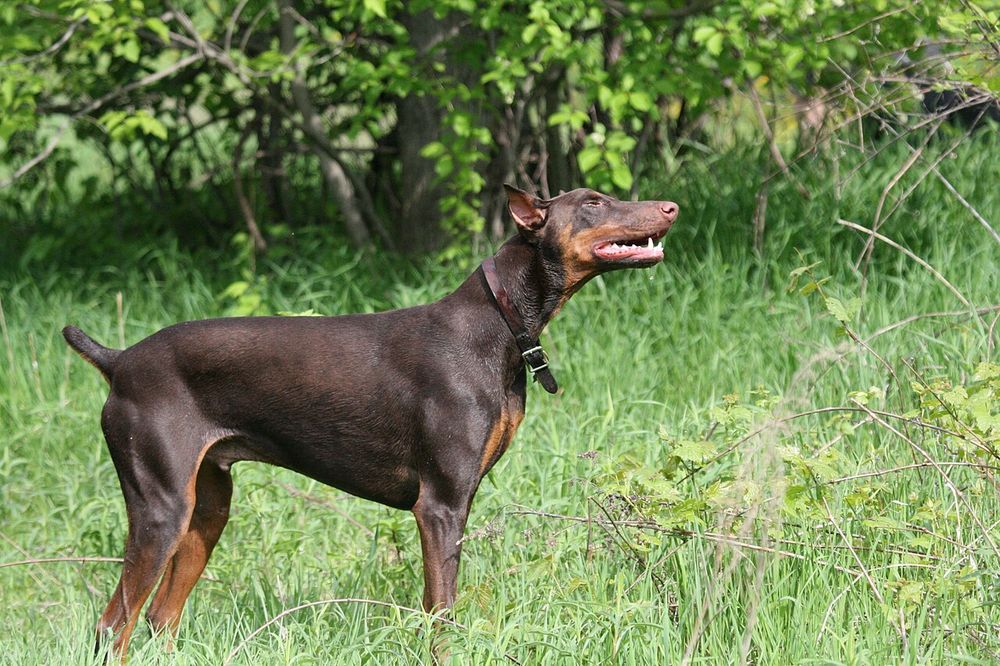
- Origin
- Apolda, GermanyThe Royal Kennel Club
- Adult weight
- 32 to 45 kg (males about 40 to 45 kg, females about 32 to 35 kg (FCI))Fédération Cynologique Internationale
- Height
- 63 to 72 cm (males 68 to 72 cm, females 63 to 68 cm)Fédération Cynologique Internationale
- Lifespan
- 10 to 12 yearsAmerican Kennel Club
- Coat
- Short, hard and dense, lying tight and smooth, with no undercoat. Black or brown with rust red markings. It sheds; groom once a week.Fédération Cynologique Internationale
- Energy
- Very highThe Royal Kennel Club
- Indian heat
- Copes with careScientific Reports (2020)study
- Flats
- Needs spaceThe Royal Kennel Club
Dobermann snapshot
| What | The rule | Source |
|---|---|---|
| Size | Large. AKC gives a height of 26 to 28 inches for males and 24 to 26 inches for females. | American Kennel Club |
| Exercise need | More than 2 hours a day, says The Royal Kennel Club. AKC rates its energy at the top of its scale. | The Royal Kennel Club |
| Alone-time tolerance | Not scored by kennel clubs. A service dog bred to work with a handler; PDSA's general limit for any dog is 4 hours alone. | PDSA |
| Heat tolerance | No breed figure in the large UK heatstroke study. It found every weight band over 10 kg had higher odds of heat-related illness than small dogs. | Scientific Reports (2020)study |
| Coat and shedding | Short coat that sheds; groom once a week. | The Royal Kennel Club |
| With other dogs | AKC places it in the middle of its scale (3 of 5) for getting on with other dogs. | American Kennel Club |
Where does the Dobermann come from?
The Dobermann is the only German breed named after its original breeder, Friedrich Louis Dobermann (1834 to 1894), a tax collector in Apolda. The FCI standard says he was also believed to run a knacker's yard and work as a part-time dog catcher, which gave him a pool of sharp dogs to breed from.
In the 1870s he crossed so-called butcher's dogs, an early type of Rottweiler, with a black and rust shepherd type from Thuringia, aiming for an alert, highly protective working and house dog. The Royal Kennel Club says the breed was developed as a guard dog for its owner and was recognised by the German Kennel Club in 1899.
Its use in police work earned it the nickname "Gendarme dog", and the FCI says it was officially recognised as a police dog by the beginning of the 20th century. The AKC recognised it in 1908 and notes the Dobermanns of the US Marine Corps in the Pacific in the Second World War.
How did the Dobermann come to India?
No source we could find records when the Dobermann first arrived in India. Its working role did carry over: an IndiaSpend report of July 2019 describes the Mumbai police crime branch dog squad, the first in Maharashtra, set up in the 1960s, as a mix of Labradors, Dobermans and Belgian Malinois.
As a pet it lives here mostly in cities, where its need for more than two hours of exercise a day and a large home (The Royal Kennel Club) has to fit around Indian heat. Its short coat with no undercoat gives little protection from heat or from cold North Indian winter mornings.
What care does a Dobermann need?
The three things that shape a good day for this breed.
Exercise
More than two hours a day (The Royal Kennel Club). The AKC calls it an energetic athlete that needs long walks or hikes and a large fenced area to run, and suggests obedience, tracking or agility. In Indian summers keep running to dawn and after dark. The Royal Kennel Club
Grooming
A quick daily going-over with a short-bristled brush or mitt, few baths, nails trimmed at least monthly, teeth brushed and ears wiped every few days (AKC). The Royal Kennel Club puts grooming at once a week. American Kennel Club
Training
The AKC says Dobermanns are very intelligent and learn easily, but are strong dogs that can become pushy and destructive if not raised properly, so puppy socialisation and obedience training are essential. It should live inside the home with its people. The Royal Kennel Club
How much should a Dobermann eat?
Daily calories for a healthy, neutered adult Dobermann, worked out from its weight with the formula vets use (70 x weight in kg to the power 0.75, then AAHA's factor for a neutered adult). Divide by the kcal per kg on your food's pack for grams a day, and adjust by body shape.
| Resting need (kcal a day) | Neutered adult (kcal a day) | |
|---|---|---|
| 32 kg AAHA (American Animal Hospital Association) | 940 | 1320 to 1510 |
| 38.5 kg | 1080 | 1510 to 1730 |
| 45 kg | 1220 | 1700 to 1950 |
The AKC says an excellent-quality dog food is critical for the Dobermann throughout life, with an age-appropriate puppy diet approved by the breeder or vet, and warns that too many treats cause obesity. WSAVA's advice is a complete and balanced food from a maker that can show its nutrition expertise. Fresh water should always be available. The Dobermann is deep-chested and the AKC lists bloat for the breed, so follow ACVS advice: two or three smaller meals a day rather than one large one. From the Indian kitchen, keep onion, garlic, grapes, chocolate, chai and coffee away from the dog. Any change of food should be gradual, over several days. Meals a day: puppy to 12 weeks, 4 a day; 3 to 6 months, 3 a day; 6 to 12 months, 2 a day; adult, 2 to 3 smaller meals a day, not one large one. Puppies, kittens, working, pregnant and older animals need different amounts: ask your vet, or use Petym's food calculator.
Which illnesses is the Dobermann prone to, and how are they treated?
The conditions veterinary studies and breed surveys most often report in the Dobermann. Knowing the early signs means a vet sees it sooner.
See your vet first. This is general information from veterinary sources, not a diagnosis. Only a vet who has examined your pet can say what is wrong and prescribe treatment, and this page never gives a dose. Do not give your pet human medicine. If your pet seems very unwell, go to a 24-hour vet: find one in your city.
Dilated cardiomyopathy (DCM)
Emergency: go to a vet nowA disease of the heart muscle in which the heart becomes thin-walled and enlarged. A German study found it in 58.2% of Dobermanns over their lifetime, and it is inherited as a dominant trait. Science for Animal Welfare (formerly UFAW)
Signs to watch for
- Often no signs for years
- Tiring easily, weakness or fainting
- Coughing or hard breathing from fluid on the lungs
- Sudden collapse
How a vet treats it
A vet diagnoses it with heart ultrasound (echocardiography), and a 24-hour ECG (Holter) can catch early rhythm changes. Treatment is with heart medicines the vet prescribes; Science for Animal Welfare says advances in treatment let some dogs live a year or two after diagnosis. Fainting or laboured breathing at rest needs a vet now.
Prevention
Yearly screening by Holter and echocardiography from two years of age was recommended in the German study. A blood test can identify dogs carrying the mutant gene before breeding.
Von Willebrand disease
See a vet soonAn inherited bleeding disorder caused by a lack of von Willebrand factor, a clotting protein. An Australian study found that 17% of 614 Dobermanns had had bleeding episodes over five years. Science for Animal Welfare (formerly UFAW)
Signs to watch for
- Bleeding from the mouth or nose
- Heavy bleeding after losing a tooth, an injury or surgery
- Prolonged bleeding when in heat
How a vet treats it
A vet measures the clotting factor in a blood test, and a DNA test shows whether a dog carries the gene. Serious bleeds are treated with blood transfusions or concentrated blood products that supply the missing factor. Dobermanns are often tested before planned surgery such as neutering.
Prevention
A DNA test, from a mouth swab or blood, before breeding.
Cervical vertebral malformation (wobbler syndrome)
See a vet soonDevelopmental faults in the neck bones narrow the spinal canal and press on the spinal cord. Most affected Dobermanns are four to eight years old when signs start. Science for Animal Welfare (formerly UFAW)
Signs to watch for
- Wobbly, wide-based back legs
- Holding the head low
- Later, weakness in the front legs too
How a vet treats it
Diagnosis needs imaging, usually MRI or CT, sometimes only at referral centres. A vet may manage it conservatively or refer for surgery to stabilise the neck or relieve pressure on the cord; the outlook without surgery is guarded.
Prevention
No genetic test exists; breeders avoid affected dogs and close relatives. Walking on a harness rather than a neck collar spares the neck.
Hypothyroidism
Ask at a routine checkToo little thyroid hormone because the thyroid glands are damaged. Science for Animal Welfare says Dobermanns have long been recognised as predisposed. Science for Animal Welfare (formerly UFAW)
Signs to watch for
- Lethargy and reluctance to exercise
- Weight gain
- Skin problems and hair loss on both flanks
- Feeling the cold
How a vet treats it
A vet diagnoses it with blood tests, usually T4 and TSH together. Treatment is thyroid hormone tablets given by mouth for life, with regular check-ups; it usually works well but there is no cure.
Bloat (gastric dilatation-volvulus)
Emergency: go to a vet nowThe stomach fills with gas and may twist. ACVS lists deep-chested and large breeds and dogs fed one large meal a day as at risk, and the AKC names bloat for the Dobermann. American College of Veterinary Surgeons
Signs to watch for
- Restlessness and stretching
- Retching without bringing anything up
- Drooling and a swollen belly
- Weakness or collapse
How a vet treats it
An emergency. Vets stabilise the dog with intravenous fluids and oxygen, release the gas with a stomach tube, then operate to untwist the stomach and stitch it to the body wall (gastropexy) so it cannot twist again.
Prevention
Two or three smaller meals a day. ACVS says many surgeons recommend a preventive gastropexy for at-risk breeds, which can be done during spay or neuter surgery.
Doberman hepatitis
See a vet soonA progressive inflammatory liver disease linked to excess copper. Science for Animal Welfare says bitches are at greater risk than males. Science for Animal Welfare (formerly UFAW)
Signs to watch for
- Weight loss, weakness and tiredness
- Vomiting, diarrhoea and belly pain
- Later, a swollen belly and yellowing of the skin or eyes
How a vet treats it
Raised liver enzymes on a blood test are the first clue and a liver sample confirms it. A vet may use chelation therapy to remove copper with a low-copper diet or zinc; the response in Dobermanns is often poor.
How a Dobermann copes when you are away
Well, with the right person and plenty to do. Badly, if it is shut in alone all day.
The Royal Kennel Club describes the Dobermann as an intelligent and courageous service dog. That intelligence needs work: a Dobermann that only gets a short walk will find its own jobs, from guarding the balcony to chewing the sofa. AKC puts the breed at the top of its scale for energy. PDSA's general advice is no more than 4 hours alone at a time, and a Dobermann bred to stay close to its handler often struggles with less company than that.
Like other guarding breeds, many Dobermanns are reserved with strangers. Petym's free meet and greet before the first booking is the time for the sitter to walk the dog with you, learn your commands and feed it once while you are there. Tell the sitter how your dog reacts to the doorbell, delivery staff and other dogs, and agree what happens at the door.
How common is heart disease in Dobermanns?
A German study screened 412 Dobermanns in 775 examinations for dilated cardiomyopathy (DCM). The share affected rose sharply with age.
3.3 %
of dogs aged 1 to under 2 years Journal of Veterinary Internal Medicine (2010), LMU Munichstudy
9.9 %
of dogs aged 2 to under 4 years Journal of Veterinary Internal Medicine (2010), LMU Munichstudy
12.5 %
of dogs aged 4 to under 6 years Journal of Veterinary Internal Medicine (2010), LMU Munichstudy
43.6 %
of dogs aged 6 to under 8 years Journal of Veterinary Internal Medicine (2010), LMU Munichstudy
58.2 %
cumulative prevalence over the dogs' lives Journal of Veterinary Internal Medicine (2010), LMU Munichstudy
What the heart researchers recommend
Word for word
Yearly screening for DCM by Holter examination and echocardiography is recommended, starting at 2 years of age.
Screening is a decision for you and your vet, not for a sitter. If your Dobermann has been diagnosed and takes heart medicines, write the plan in full: the sitter gives each dose as written and logs it. Science for Animal Welfare notes that affected dogs often show no obvious signs for several years.
Dobermann health signs a sitter must act on
A sitter does not diagnose. They notice, tell the owner and call the vet, and go to a 24-hour vet in an emergency.
If Fainting or collapse, especially during exercise or excitement.
An emergency: keep the dog still and cool, and go to the nearest 24-hour vet. Tell the vet the dog is a Dobermann and about any heart diagnosis. Science for Animal Welfare (formerly UFAW)
If Coughing, laboured breathing or a swollen belly. Science for Animal Welfare explains that DCM can let fluid build up in the lungs, making breathing difficult, and in the abdomen.
Call the vet the same day; laboured breathing at rest needs a vet now. Science for Animal Welfare (formerly UFAW)
If Bleeding that will not stop from a small cut, a torn nail or the gums, or unusual bruising. Von Willebrand disease, a bleeding disorder, is on the breed's list.
Apply firm pressure with a clean cloth and call the vet. Tell any vet about it before a procedure. Science for Animal Welfare (formerly UFAW)
If Wobbly back legs, a stiff or low-held neck, or scuffing the feet. Cervical vertebral malformation syndrome is listed for the breed.
Stop the walk, use a harness rather than a neck collar, and call the vet. Science for Animal Welfare (formerly UFAW)
If Restless, retching with nothing coming up, a swollen belly after a meal. Possible bloat (GDV) in a large, deep-chested dog.
Emergency: go to the nearest 24-hour vet now. American College of Veterinary Surgeons
If Heavy panting, drooling and weakness after exercise on a warm day.
Cool the dog with cool water poured over the body, away from the face, make a breeze and call the vet. PDSA
A Dobermann's day with a sitter in the hot months
Petym’s working from the official rules, no government publishes a total.
A sample plan. More than 2 hours of activity, none of it in the midday sun.
Soon after sunrise
The long walk or steady jog, 60 minutes, on a harness, with water. For a dog with a heart diagnosis, follow the vet's exercise limits exactly.
After the walk
Water and rest, then breakfast once breathing has settled.
Mid-morning
Fifteen minutes of training: the owner's commands, waits at doors, and a search game with pieces of the day's food.
Midday to afternoon
Indoors in the coolest room. Toilet breaks only, on shaded ground that passes PDSA's 7-second palm test.
Late afternoon
A chew or a food puzzle toy, and any medicines at the times written on the plan.
After sunset
The second long walk once the road has cooled, then dinner, a quick brush and the daily photo update.
Feeding a Dobermann and Indian climate notes
Keep the same food, bowls and times as at home for the whole stay; a sudden change can upset the stomach. Split the day's food into the meals the owner uses: the American College of Veterinary Surgeons lists eating one large meal a day and eating very quickly among the risk factors for bloat. Count treats as part of the day; WSAVA suggests they stay under about 10% of daily calories.
A Dobermann's short coat gives little protection from either heat or cold. In the hot months the long exercise happens at dawn and after dark, with the India Meteorological Department's heat warnings checked first. In North Indian winters, a lean, short-coated dog may shiver on early walks: a dog coat and a warm bed off the floor help. Ticks are easy to spot on a short coat, but check the ears, neck and between the toes after every walk; about half of 525 dogs surveyed in four Indian cities carried a tick-borne infection.
Dobermann dos and don'ts for a sitter
Do
- Use a well-fitted harness, especially if the vet has mentioned neck problems.
- Keep up daily training and nose work: a busy Dobermann is a calm one.
- Log every medicine dose and every walk in the booking notes, as the owner's plan says.
- Keep water in two bowls in shade and refill them often in hot weather. Animal Welfare Board of India
Don’t
- Do not push hard exercise in the heat or on a dog with a heart diagnosis.
- Do not open the main door with the dog loose behind you.
- Do not force greetings with other dogs; AKC rates the breed mid-scale with other dogs. American Kennel Club
- Do not give any human medicine, especially painkillers, without the vet.
Dobermann sitter checklist
- Any heart, bleeding or neck diagnosis, and the vet's exercise limits in writing.
- Medicines, written exactly as the label says, with times. The sitter logs each dose.
- Commands, door routine and how the dog greets visitors and other dogs.
- Harness and leash, and the safest walking routes and times.
- Meal amounts, number of meals and the treat allowance.
- Tick prevention due date; a dog coat for winter mornings in the north.
- The vet's number, the heart specialist's if there is one, and the nearest 24-hour vet on Petym's city list.
Which Petym service suits a Dobermann?
Best fit
Overnight pet sitting
The sitter stays in your home, keeps the cool-hours exercise and training, and sends a daily photo update.
Special-needs pet care
For a Dobermann with DCM, a bleeding disorder or a neck condition, with medicines given and logged as written.
Dog walking
Long walks at dawn and after dark on workdays.
Pet boarding
For a Dobermann relaxed with new people, in a vetted sitter's home with space.
Breeds with similar care needs to the Dobermann
Going away soon? Tell us your dates.
A checked local sitter feeds, walks and keeps your pet company at home, follows your care sheet to the letter and sends a photo every day. Petym is opening city by city: send your dates and we will tell you when a sitter can take them.
- Meet your sitter first, free
- PAN-checked, first-aid trained
- A photo every day
- Pay through Petym, never cash


Questions owners ask
How long can a Dobermann be left alone?
- PDSA's general advice for any dog is no more than 4 hours at a time. Dobermanns are energetic service dogs that need more than 2 hours of exercise a day and stay close to their people, so long days alone often mean barking, chewing or guarding. Arrange a midday walk or a sitter.
Is DCM common in Dobermanns?
- Yes. A German study found a cumulative prevalence of dilated cardiomyopathy of 58.2% in Dobermanns, rising sharply after age 6, and Science for Animal Welfare cites an overall prevalence of 58% in Europe. Affected dogs often show no signs for years, which is why the researchers recommend yearly screening from age 2.
What signs of heart trouble should my Dobermann's sitter watch for?
- Fainting or collapse, coughing, laboured breathing or a swollen belly, as Science for Animal Welfare describes. Fainting, collapse or struggling to breathe is an emergency for the nearest 24-hour vet; a new cough needs a call to the vet the same day. Leave the sitter your dog's diagnosis and medicines in writing.
Can a Dobermann live in an Indian flat?
- Yes, with enough exercise and training. The Royal Kennel Club puts its need at more than 2 hours a day. In a flat that means two long walks in the cool hours, training and nose work indoors, and calm handling in lifts, stairs and the society's common areas.
Do Dobermanns cope with Indian heat?
- They have short coats, but they are large, athletic dogs, and exercise was the main cause of heat-related illness in a big UK study. Walk and run only at dawn and after dark in the hot months, keep the dog lean, and give it a cool room through the day.
Is a Dobermann the same as a Doberman?
- Yes. Dobermann is the spelling The Royal Kennel Club uses, while AKC calls the breed the Doberman Pinscher. In India you will see both spellings, and many owners simply say Dobie. The care needs on this page apply to all of them.
Should my Dobermann go to boarding or stay home with a sitter?
- Most do best at home with a sitter they have met, especially if they guard the home or have a heart diagnosis. A Dobermann relaxed with new people and dogs may do well in a vetted sitter's home. Choose after the free meet and greet.
Keep reading
Services that help
Free tools for this
Words on this page, explained
Keep exploring
Other dog breeds
- Akita
- Alaskan Malamute
- American Bully
- American Cocker Spaniel
- American Pit Bull Terrier
- Australian Shepherd
- Bakharwal dog
- Basset Hound
- Beagle
- Belgian Malinois
- Bernese Mountain Dog
- Bichon Frise
- Border Collie
- Boston Terrier
- Boxer
- Bull Terrier
- Bulldog
- Bullmastiff
- Cane Corso
- Caucasian Shepherd Dog
- Cavalier King Charles Spaniel
- Chihuahua
- Chippiparai
- Chow Chow
- Cocker Spaniel
- Dachshund
- Dalmatian
- Dogo Argentino
- English Mastiff
- English Springer Spaniel
- French Bulldog
- Gaddi Kutta (Gaddi dog)
- German Shepherd
- Golden Retriever
- Great Dane
- Greyhound
- Havanese
- Indian pariah dog (Indie)
- Indian Spitz
- Irish Setter
- Jack Russell Terrier
- Kangal
- Kanni
- Kombai
- Labrador Retriever
- Lhasa Apso
- Maltese
- Miniature Pinscher
- Miniature Schnauzer
- Mudhol Hound
- Neapolitan Mastiff
- Newfoundland
- Papillon
- Pekingese
- Pembroke Welsh Corgi
- Pomeranian
- Poodle
- Pug
- Rajapalayam
- Rampur Greyhound
- Rhodesian Ridgeback
- Rottweiler
- Saint Bernard
- Samoyed
- Shar Pei
- Shiba Inu
- Shih Tzu
- Siberian Husky
- Tibetan Mastiff
- Weimaraner
- West Highland White Terrier
- Whippet
- Yorkshire Terrier
Sources
Each source was opened and read on the date shown. How Petym checks its sources
- The Royal Kennel Club: Dobermann: breed information (opens in a new tab)
- Fédération Cynologique Internationale: FCI standard No. 143: Dobermann (brief historical summary, size and weight) (opens in a new tab)
- American Kennel Club: Doberman Pinscher dog breed information (opens in a new tab)
- WSAVA Global Nutrition Committee: Guidelines on selecting pet foods (updated 10 March 2021) (opens in a new tab)
- American College of Veterinary Surgeons: Gastric dilatation-volvulus (opens in a new tab)
- ASPCA Animal Poison Control: People foods to avoid feeding your pets (opens in a new tab)
Show all 25 sourcesShow fewer
- PDSA: Diarrhoea after a change of food (opens in a new tab)
- Merck Veterinary Manual: Puppy care (opens in a new tab)
- AAHA (American Animal Hospital Association): 2021 AAHA Nutrition and Weight Management Guidelines for Dogs and Cats: energy requirement calculations (Box 1, PDF) (opens in a new tab)
- Merck Veterinary Manual: Nutritional requirements of small animals (full review November 2023, updated September 2024) (opens in a new tab)
- Science for Animal Welfare (formerly UFAW): Doberman Pinscher: dilated cardiomyopathy (opens in a new tab)
- Science for Animal Welfare (formerly UFAW): Doberman Pinscher: von Willebrand disease (opens in a new tab)
- Science for Animal Welfare (formerly UFAW): Doberman Pinscher: cervical vertebral malformation syndrome (opens in a new tab)
- Science for Animal Welfare (formerly UFAW): Doberman Pinscher: genetic welfare problems (opens in a new tab)
- Science for Animal Welfare (formerly UFAW): Doberman Pinscher: hypothyroidism (opens in a new tab)
- Science for Animal Welfare (formerly UFAW): Doberman Pinscher: Doberman hepatitis (opens in a new tab)
- PDSA: Separation anxiety in dogs (opens in a new tab)
- PDSA: Heatstroke in dogs (opens in a new tab)
- WSAVA: Frequently asked questions and myths (Global Nutrition Committee) (opens in a new tab)
- India Meteorological Department: FAQ on heat wave (opens in a new tab)
- Animal Welfare Board of India: Request to ensure care and protection of animals from direct heat during extreme hot weather (4 May 2026) (opens in a new tab)
- Scientific Reports (2020): Incidence and risk factors for heat-related illness in UK dogs (opens in a new tab)
- Journal of Veterinary Internal Medicine (2010), LMU Munich: Prevalence of dilated cardiomyopathy in Doberman Pinschers in various age groups (opens in a new tab)
- Parasites & Vectors (2011): A survey of canine tick-borne diseases in India (opens in a new tab)
- IndiaSpend (25 July 2019): Paw patrol: the dogs of Mumbai's K9 squad (opens in a new tab)