Leaving a Dachshund with a sitter: back care and a checklist
Updated By PetymFacts checked against official sources on
Quick answer
Most Dachshunds cope with a sitter if their routine stays the same, but their long back is the thing to protect. A sitter must stop jumps on and off sofas and beds, carry the dog on stairs if you do, walk on a harness, keep meals measured and call the vet at the first sign of back pain.
Around one in four Dachshunds needs veterinary treatment for intervertebral disc disease (IVDD) in its life, according to the UFAW welfare review. That makes back care, not exercise or heat, the centre of a Dachshund's care sheet.
- Meet your sitter first, free
- PAN-checked, first-aid trained
- A photo every day
- Pay through Petym, never cash

- Origin
- GermanyFédération Cynologique Internationale
- Adult weight
- 4.5 to 12 kg (Royal Kennel Club standards: miniature ideal 4.5 kg, desired maximum 5 kg; standard ideal 9 to 12 kg)The Royal Kennel Club
- Coat
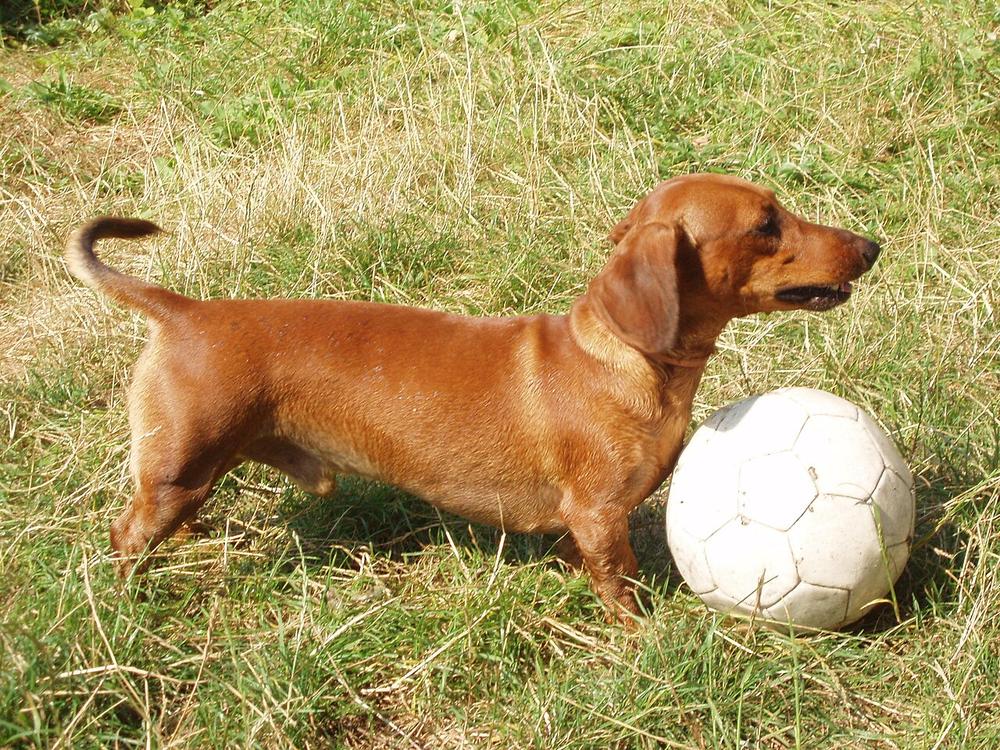
- Three coat types, smooth, long-haired and wire-haired, each in two sizes in the UK. The smooth coat is short, dense, shiny and harsh (FCI standard).Fédération Cynologique Internationale
- Energy
- ModerateThe Royal Kennel Club (UK)
- Indian heat
- Copes with carePDSA
- Flats
- A flat, with daily exerciseThe Royal Kennel Club (UK)
Dachshund care snapshot
| What | The rule | Source |
|---|---|---|
| Size | The Royal Kennel Club lists the standard Dachshund as medium and the miniature as small; UK miniatures preferably weigh under 5 kg. | The Royal Kennel Club (UK) |
| Exercise need | Up to 1 hour a day for both sizes, in the Royal Kennel Club's breed information. | The Royal Kennel Club (UK) |
| Alone-time tolerance | No kennel club rates it. PDSA advises that no dog should be left alone for more than 4 hours at a time, and suggests a sitter or walker for longer absences. | PDSA |
| Heat tolerance | Not flat-faced, so not in the highest-risk group for heatstroke, but PDSA lists obese, young, elderly and long-haired dogs as more at risk; long-haired Dachshunds need extra care. | PDSA |
| Shedding and coat | Smooth coat: short, sheds, grooming once a week (Royal Kennel Club). Long-haired and wire-haired coats need more brushing. | The Royal Kennel Club (UK) |
| Sociability with other dogs | Described in words only: the hound group is called dignified, aloof but trustworthy. Ask the owner how this dog behaves with others; it varies by dog. | The Royal Kennel Club (UK) |
Where does the Dachshund come from?
The Dachshund, also called the Dackel or Teckel, has been known in Germany since the Middle Ages. The FCI standard says short-legged dogs especially suited to hunting below ground were bred from the Bracke hounds, and the Dachshund grew from them. It was used to go to ground after badgers and rabbits and to track wounded game such as deer, and it also hunts above ground, giving tongue, flushing and tracking.
The oldest Dachshund club, the Deutsche Teckelklub, was founded in 1888. Germany breeds three sizes, the standard, the miniature and the rabbit Dachshund, told apart by chest measurement, in three coats, making nine varieties. The UK recognises two sizes in each coat, six varieties under one standard.
How did the Dachshund come to India?
No source we found records when or how the Dachshund came to India. What matters most here is its back. Around one in four Dachshunds develops intervertebral disc disease, and episodes can be set off by normal jumping and climbing, so the long staircases of buildings without lifts, high beds and sofas are the real risks in an Indian home. Ask your vet how to manage stairs for your dog.
It is not a flat-faced breed, but PDSA lists overweight, very young and old dogs as more at risk of heatstroke, so Indian summers still mean walks in the cool hours and a lean dog.
What care does a Dachshund need?
The three things that shape a good day for this breed.
Exercise
Up to an hour a day, says The Royal Kennel Club. A UK owner survey, DachsLife, found Dachshunds exercised for more than an hour a day had lower odds of disc disease, so keep up steady walks on a harness rather than stopping exercise. The Royal Kennel Club (UK)
Grooming
Once a week for the smooth coat, says The Royal Kennel Club; long-haired and wire-haired coats need more brushing. The Royal Kennel Club (UK)
Training
The FCI standard calls it friendly and lists it as a hunting dog with working trials. Teach it from puppyhood to wait to be lifted rather than jump off furniture or out of cars, as vet surgeons advise for dogs with disc disease. Canine Genetics and Epidemiology (2016) (abstract read via Europe PMC)study
How much should a Dachshund eat?
Daily calories for a healthy, neutered adult Dachshund, worked out from its weight with the formula vets use (70 x weight in kg to the power 0.75, then AAHA's factor for a neutered adult). Divide by the kcal per kg on your food's pack for grams a day, and adjust by body shape.
| Resting need (kcal a day) | Neutered adult (kcal a day) | |
|---|---|---|
| 4.5 kg AAHA (American Animal Hospital Association) | 220 | 300 to 350 |
| 8.3 kg | 340 | 480 to 550 |
| 12 kg | 450 | 630 to 720 |
Feed a complete and balanced food made for the dog's life stage, measured, and keep treats to no more than about 10% of the day's calories, as WSAVA advises. Vet surgeons list weight loss among the lifestyle changes for Dachshunds after a disc problem, so keep the dog at the lean end from the start. Keep onion and garlic (in most curries and dal), grapes and raisins, chocolate, coffee and chai, xylitol, salty snacks and cooked bones away from it; ASPCA says milk and other dairy can cause diarrhoea. Meals a day: 6 to 12 weeks, 4 a day; 3 to 6 months, 3 a day; 6 to 12 months, 2 a day; adult, 1 or 2 a day; VCA suggests at least 2. Puppies, kittens, working, pregnant and older animals need different amounts: ask your vet, or use Petym's food calculator.
Which illnesses is the Dachshund prone to, and how are they treated?
The conditions veterinary studies and breed surveys most often report in the Dachshund. Knowing the early signs means a vet sees it sooner.
See your vet first. This is general information from veterinary sources, not a diagnosis. Only a vet who has examined your pet can say what is wrong and prescribe treatment, and this page never gives a dose. Do not give your pet human medicine. If your pet seems very unwell, go to a 24-hour vet: find one in your city.
Intervertebral disc disease (IVDD)
Emergency: go to a vet nowDiscs between the spinal bones swell or burst and press on the spinal cord. It is strongly linked to the genes that give Dachshunds short legs; about one in four is affected, and vet surgeons say Dachshunds make up 45 to 70% of all cases, usually at 3 to 6 years of age. American College of Veterinary Surgeons
Signs to watch for
- Back or neck pain, yelping when picked up
- Not wanting to climb stairs or jump
- A wobbly, drunken walk with the back feet crossing
- Weak or paralysed back legs, sometimes with loss of bladder control
How a vet treats it
A vet may use X-rays, a CT scan or MRI. Mild first episodes may be managed with strict cage rest and pain medicines prescribed by the vet. A burst disc is generally treated as a surgical emergency, and surgery to remove bone over the spinal canal and relieve pressure is nearly always recommended. About a quarter of dogs later have another disc problem.
Prevention
Keep the dog lean, use a harness instead of a collar, stop jumping off furniture, and keep up regular exercise. For breeding dogs The Royal Kennel Club recommends spine screening under its IVDD scheme, and Science for Animal Welfare notes X-rays at about 2 years are used to screen.
Immune-mediated thrombocytopenia (IMT)
See a vet soonThe immune system destroys the platelets that help blood to clot. Science for Animal Welfare says long-haired Dachshunds are predisposed, especially in some family lines. Science for Animal Welfare (formerly UFAW)
Signs to watch for
- Tiny red spots or bruises, easiest to see on hairless, pale skin such as the belly
- Nosebleeds
- Bleeding in the mouth, or blood in the urine, stools or vomit
- Tiredness, weakness or fever
How a vet treats it
A vet finds a low platelet count with no other cause. Treatment is with drugs that suppress the immune system, most often corticosteroids, sometimes with other drugs; a few dogs need the spleen removed. About 70% of dogs improve, and some need lifelong treatment.
Progressive retinal atrophy (PRA)
Ask at a routine checkAn inherited degeneration of the retina. Merck lists Miniature Longhaired Dachshunds among breeds whose signs start at about 3 to 5 years, and The Royal Kennel Club lists a DNA test for one form in the miniature. Merck Veterinary Manual
Signs to watch for
- Night blindness first: hesitating in dim light or on stairs at night
- Bumping into things
- Gradual loss of sight over months to years
How a vet treats it
A vet examines the back of the eye and may confirm it with an electroretinogram. Merck says no effective treatment is available, so care focuses on helping the dog adapt at home.
Prevention
Buy from parents DNA-tested for PRA.
How does a Dachshund cope when you are away?
Usually well, if the house rules stay the same and the sitter treats the back as fragile.
Dachshunds sit in the Royal Kennel Club's hound group, and many are confident, vocal little dogs. What changes when you travel is the person, not the dog's body. A new sitter does not know that your dog is not allowed on the sofa, or that you always lift it into the car. Those small rules are what protect its spine, so they go at the top of the care sheet.
The UFAW review of genetic welfare problems says around 25% of Dachshunds will develop IVDD badly enough to need veterinary treatment, and that the condition is strongly linked to the genes that give the breed its short legs. A 2016 survey of UK Dachshund owners, DachsLife, put the share showing signs in their lifetime at about 19 to 24%. There is no genetic test, so every Dachshund is cared for as if it could be affected.
On time alone: PDSA's guidance is that dogs should not be left alone for more than 4 hours at a time. A Dachshund that barks or howls at the door, chews, or soils the house when left may be showing separation distress, which is worth raising at the meet and greet so the sitter can plan short absences.
What does a sitter's day with a Dachshund look like in an Indian summer?
Two short walks in the cool hours, measured meals at the owner's times, and no jumping all day.
6:00 to 7:00
First walk on a harness, before the road heats up. PDSA advises walking in the early morning or evening and testing the ground with your palm for 7 seconds. PDSA
After the walk
Breakfast as the owner wrote it, then a calm rest. Wipe paws and the long underbelly, which sits close to hot dusty ground.
Late morning to 4:00
Indoors in the coolest room. In heat-wave months (March to June in most of the plains) keep play gentle and indoors. India Meteorological Department
All day
Ramps or a lift for sofas and beds, a gate on the stairs if the owner uses one, and no games that end in a leap.
6:30 to 7:30 pm
Second walk once the sun is down and the pavement passes the palm test. Sniffing time counts as exercise for a hound.
Evening
Dinner, a short garden or terrace break before bed, and the day's photo update and log for the owner.
What health problems should a Dachshund sitter know?
Back pain is the one to know by heart. If any of these appear, the sitter calls the owner and the vet, in that order or at the same time.
If Reluctance to climb stairs or jump, yelping when picked up, standing with the head low and the back arched
These are early pain signs of IVDD. Stop all activity, keep the dog quiet and call the vet the same day. UFAW Science for Animal Welfare (genetic welfare problems of companion animals)
If Wobbly, "drunken" walking, knuckling of the back feet, or dragging the back legs
This is an emergency. Keep the dog still, carry it supported along its length and go to the nearest 24-hour vet. American College of Veterinary Surgeons
If Loss of bladder control alongside weak back legs
Also an emergency: the American College of Veterinary Surgeons lists it with loss of hind limb function in disc disease. American College of Veterinary Surgeons
If Squinting, cloudy eyes or bumping into things
The Royal Kennel Club lists eye screening and a DNA test for one form of progressive retinal atrophy for the miniature. Note it and tell the vet. The Royal Kennel Club (UK)
If Panting hard, drooling or wobbling after a walk on a hot day
Possible heatstroke: move to shade, cool with plenty of cool water and moving air, and call the vet. PDSA
Why do Dachshunds need a harness and no jumping?
Because the vet surgeons' advice after disc disease is a body harness, a lean weight and less jumping off furniture, and a sitter can follow all three from day one.
The American College of Veterinary Surgeons says the chondrodystrophoid breeds, Dachshunds first among them, account for most disc ruptures, and that Dachshunds make up 45 to 70% of cases. After surgery it recommends weight loss where needed, a body harness instead of a neck lead, and limiting jumping off furniture. UFAW notes that episodes can be set off by ordinary activities such as jumping and climbing.
The DachsLife survey found that Dachshunds exercised for more than an hour a day had lower odds of IVDD, so a sitter should not stop walks out of caution. The aim is steady, level exercise on a harness, not no exercise. Long staircases in old buildings and lift-less flats are the real risk in Indian cities: ask the owner whether the dog is carried up and down.
What should a sitter know about feeding a Dachshund?
Keep the owner's food, the owner's amounts and the owner's times. Weight is part of back care.
Do
- Weigh or level-measure each meal exactly as the care sheet says; a long back carries every extra gram. American College of Veterinary Surgeons
- Use part of the daily food as training rewards instead of adding extra treats.
- Keep fresh water in a heavy bowl in the coolest room, and a second bowl near the bed in summer.
- Log every meal, including anything left, so the owner sees appetite at a glance.
Don’t
- Do not change the food during the stay, even for a brand the dog seems to prefer.
- Do not share roti with ghee, biscuits, chai or sweets from the table: they add weight, and some Indian foods are unsafe for dogs.
- Do not give any medicine or supplement the owner has not written down, and never a human painkiller.
How does Dachshund care change with the Indian seasons?
Heat, rain and cold each change one part of the routine.
| Walks | Coat and skin | Watch for | |
|---|---|---|---|
| Summer (March to June) India Meteorological Department | Before 7:30 am and after sunset only | Brush long and wire coats; check the belly for heat rash | Heavy panting, flat lying on cool floors, refusing food |
| Monsoon (June to September) | Short walks between showers; avoid flooded lanes | Dry the belly, paws and ears after every walk | Ticks, damp skin, slipping on wet tiles and steps |
| Winter in the north (December to January) | Midday walks are fine; smooth coats may need a jacket | Less bathing; brush to spread oils | Stiffness on cold mornings, reluctance on stairs |
| Festival weeks (Diwali, Holi) | Walk early, before crackers start | Wash off colour with plain water | Hiding, shaking, trying to jump onto furniture to escape |
Petym's practical summary; the seasons follow IMD's description of the heat-wave period.
What should the owner leave for a Dachshund's sitter?
A short list, written down before the meet and greet.
- The house rules for furniture, beds and stairs, and whether the dog is carried.
- The harness, a spare lead, and any ramps or steps the dog already uses.
- The food, a measuring cup or scale, and the feeding times.
- Any back history: past episodes, the vet who treated them and any rest instructions.
- The vaccination card (DHPPi and rabies dates) and tick prevention dates.
- The regular vet's number and the nearest 24-hour vet on the city's list.
- What a normal bark, appetite and walk look like for this dog, so a change stands out.
Which Petym service suits a Dachshund?
Overnight sitting in your own home keeps the house rules and the furniture the dog already knows.
Usually the right fit
Overnight pet sitting
The sitter stays in your home, so the gates, ramps and no-sofa rules stay in place and the dog does not have to learn a new layout with new stairs.
Drop-in visits
For a single long day or a short trip with a calm adult Dachshund: walks, meals and a check that the dog is moving normally.
Dog walking
For working weeks: one steady harness walk in the cool hours keeps weight and muscle up.
Special-needs care
For a Dachshund recovering from a disc episode on strict rest or medicines, as the vet has written them.
Breeds with similar care needs to the Dachshund
Going away soon? Tell us your dates.
A checked local sitter feeds, walks and keeps your pet company at home, follows your care sheet to the letter and sends a photo every day. Petym is opening city by city: send your dates and we will tell you when a sitter can take them.
- Meet your sitter first, free
- PAN-checked, first-aid trained
- A photo every day
- Pay through Petym, never cash


Questions owners ask
How long can a Dachshund be left alone?
- PDSA's guidance for all dogs is no more than 4 hours at a time. Many Dachshunds bark or howl when bored, so for a full working day or a trip, plan a walker, drop-in visits or an overnight sitter who keeps the same routine and the same house rules.
What are the first signs of a back problem in a Dachshund?
- UFAW lists pain as often the first sign of IVDD: not wanting to climb stairs or jump, yelping when touched or lifted, and standing with the head low and the back arched. A sitter who sees these should stop all activity, keep the dog quiet and call the vet the same day.
Should a Dachshund wear a collar or a harness?
- A harness. The American College of Veterinary Surgeons recommends a body harness instead of a neck lead for dogs after disc surgery, and it is a sensible default for the breed. PDSA also suggests a harness for walks in hot weather while keeping an ID collar on.
Can a Dachshund cope with Indian summers?
- Yes, with planning. Dachshunds are not flat-faced, but heat still matters, especially for long-haired, overweight, young or old dogs. Walk before about 7:30 am and after sunset, test the road with your palm for 7 seconds, and keep the dog in the coolest room through the afternoon.
Is it safe for a sitter to let my Dachshund on the sofa?
- Only if you allow it and there is a ramp or step. UFAW notes that IVDD episodes can be set off by ordinary jumping and climbing, and vet surgeons advise less jumping off furniture after disc disease. Write your rule on the care sheet so the sitter follows it from the first evening.
How much exercise does a Dachshund need when I am away?
- The Royal Kennel Club gives up to an hour a day. A UK owner survey found that Dachshunds exercised for more than an hour daily had lower odds of disc disease, so keep walks going: two calm harness walks in the cool hours, with plenty of time to sniff.
What should a sitter do if my Dachshund cannot use its back legs?
- Treat it as an emergency. Keep the dog still, support its whole length when lifting, and go to the nearest 24-hour vet while calling the owner. Vet surgeons say the outlook is better when dogs are seen quickly and can still feel their legs.
Keep reading
Services that help
Free tools for this
Words on this page, explained
Keep exploring
Other dog breeds
- Akita
- Alaskan Malamute
- American Bully
- American Cocker Spaniel
- American Pit Bull Terrier
- Australian Shepherd
- Bakharwal dog
- Basset Hound
- Beagle
- Belgian Malinois
- Bernese Mountain Dog
- Bichon Frise
- Border Collie
- Boston Terrier
- Boxer
- Bull Terrier
- Bulldog
- Bullmastiff
- Cane Corso
- Caucasian Shepherd Dog
- Cavalier King Charles Spaniel
- Chihuahua
- Chippiparai
- Chow Chow
- Cocker Spaniel
- Dalmatian
- Dobermann
- Dogo Argentino
- English Mastiff
- English Springer Spaniel
- French Bulldog
- Gaddi Kutta (Gaddi dog)
- German Shepherd
- Golden Retriever
- Great Dane
- Greyhound
- Havanese
- Indian pariah dog (Indie)
- Indian Spitz
- Irish Setter
- Jack Russell Terrier
- Kangal
- Kanni
- Kombai
- Labrador Retriever
- Lhasa Apso
- Maltese
- Miniature Pinscher
- Miniature Schnauzer
- Mudhol Hound
- Neapolitan Mastiff
- Newfoundland
- Papillon
- Pekingese
- Pembroke Welsh Corgi
- Pomeranian
- Poodle
- Pug
- Rajapalayam
- Rampur Greyhound
- Rhodesian Ridgeback
- Rottweiler
- Saint Bernard
- Samoyed
- Shar Pei
- Shiba Inu
- Shih Tzu
- Siberian Husky
- Tibetan Mastiff
- Weimaraner
- West Highland White Terrier
- Whippet
- Yorkshire Terrier
Sources
Each source was opened and read on the date shown. How Petym checks its sources
- Fédération Cynologique Internationale: FCI standard No. 148: Dachshund (opens in a new tab)
- The Royal Kennel Club: Dachshund (Smooth Haired): breed standard (opens in a new tab)
- The Royal Kennel Club (UK): Dachshund (Smooth Haired) | Breeds A to Z | The Kennel Club (opens in a new tab)
- PDSA: Heatstroke in dogs (opens in a new tab)
- UFAW Science for Animal Welfare (genetic welfare problems of companion animals): Dachshunds: Intervertebral Disc Disease (IVDD) (opens in a new tab)
- American College of Veterinary Surgeons: Intervertebral Disc Disease (opens in a new tab)
Show all 18 sourcesShow fewer
- The Royal Kennel Club (UK): Dachshund (Min. Smooth Haired) | Breeds A-Z | Kennel Club (opens in a new tab)
- WSAVA: Frequently asked questions and myths (Global Nutrition Committee) (opens in a new tab)
- ASPCA Animal Poison Control: People foods to avoid feeding your pets (opens in a new tab)
- Merck Veterinary Manual: Puppy care (opens in a new tab)
- VCA Animal Hospitals: Feeding times and frequency for your dog (opens in a new tab)
- AAHA (American Animal Hospital Association): 2021 AAHA Nutrition and Weight Management Guidelines for Dogs and Cats: energy requirement calculations (Box 1, PDF) (opens in a new tab)
- Merck Veterinary Manual: Nutritional requirements of small animals (full review November 2023, updated September 2024) (opens in a new tab)
- Science for Animal Welfare (formerly UFAW): Dachshunds: immune-mediated thrombocytopenia (opens in a new tab)
- Merck Veterinary Manual: Disorders of the retina, choroid and optic disk in dogs (dog owners) (opens in a new tab)
- PDSA: Separation anxiety in dogs (opens in a new tab)
- India Meteorological Department: FAQ on heat wave (opens in a new tab)
- Canine Genetics and Epidemiology (2016) (abstract read via Europe PMC): DachsLife 2015: an investigation of lifestyle associations with the risk of intervertebral disc disease in Dachshunds (opens in a new tab)