Indian Spitz care: summer coat, barking and sitters
Updated By PetymFacts checked against official sources on
Quick answer
An Indian Spitz usually does well with a sitter at home if its routine stays the same. Treat it as a small, thick-coated dog in a hot country: a cool room in summer, walks before sunrise and after dark, brushing rather than shaving, and someone around often enough that it is not barking alone in the flat for hours.
There is no published breed standard or veterinary study for the Indian Spitz that Petym could find. The advice here comes from general sources, not breed data.
- Meet your sitter first, free
- PAN-checked, first-aid trained
- A photo every day
- Pay through Petym, never cash

- Origin
- India, where it is kept as a companion; how it was developed is not documentedVeterinary World (2019), ICAR-Indian Veterinary Research Institute, Izatnagarstudy
- Adult weight
- 7 to 18 kg (no breed standard gives a weight; this is the range of 24 healthy adult Indian Spitz dogs, aged 3 to 5 years, in an ICAR-IVRI study)Veterinary World (2019), ICAR-Indian Veterinary Research Institute, Izatnagarstudy
- Coat
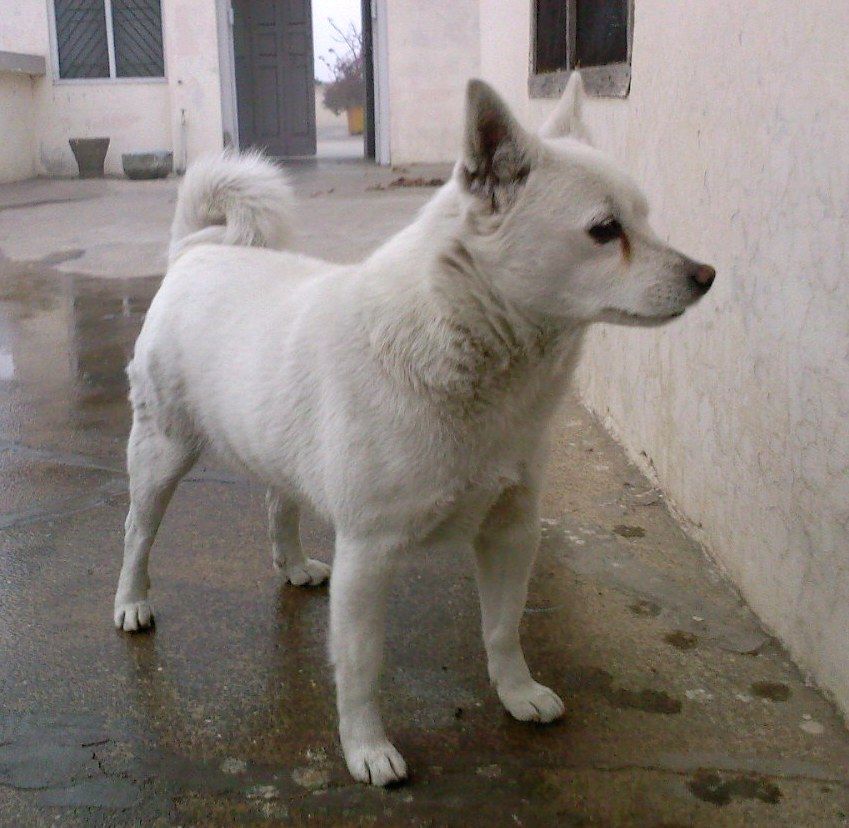
- A thick, fluffy coat, usually white. No published standard describes it. Texas A&M's vets say a thick coat helps a dog regulate its temperature, so brush it rather than shave it.Texas A&M College of Veterinary Medicine (Pet Talk, 16 June 2022)
- Energy
- Moderate
- Indian heat
- Copes with carePDSA
- Flats
- A flat, with daily exercise
Indian Spitz snapshot
| What | The rule | Source |
|---|---|---|
| Breed standard | None found. The Indian Spitz is not on ICAR-NBAGR's register of Indian dog breeds, and Petym found no standard from the Kennel Club of India, the FCI, The Royal Kennel Club or the AKC. | ICAR-National Bureau of Animal Genetic Resources |
| Size | No measured data. Owners generally know it as a small dog; ask your vet for your own dog's healthy weight. | Not stated |
| Coat | A thick, fluffy coat, usually white. Texas A&M's vets say a thick coat is insulation that helps a dog regulate its temperature, so brush it rather than shave it. | Texas A&M College of Veterinary Medicine (Pet Talk, 16 June 2022) |
| Exercise need | Not measured. In words: two walks a day in the cool hours and play at home. | Not stated |
| Alone-time tolerance | Not studied. PDSA's general advice for any dog is no more than 4 hours alone at a time. | PDSA |
| Health data | None for this dog. Small breeds such as the Pomeranian had higher odds of kneecap problems in a large UK study, so ask your vet to check. | Canine Genetics and Epidemiology (2016), RVC VetCompassstudy |
Where does the Indian Spitz come from?
Very little about the Indian Spitz's past is on record. Petym found no breed standard for it from The Kennel Club of India, the FCI, The Royal Kennel Club or the AKC, and no published history of where, when or from which dogs it was developed. Claims about its ancestry on shop and breeder websites are not backed by any source we could find, so this page does not repeat them.
What is published is veterinary. A 2019 study from the ICAR-Indian Veterinary Research Institute at Izatnagar describes the Indian Spitz as a member of the spitz family that has drawn great interest as a companion pet in India, and set reference values for heart scans in 24 healthy adult dogs weighing 7 to 18 kg. That study is the source of the weight range on this page; there is no published lifespan or height figure.
How did the Indian Spitz come to India?
The Indian Spitz lives almost entirely in India, mostly as a family house dog. It is not among the dog breeds registered by ICAR-NBAGR, whose list holds the Rajapalayam, Chippiparai, Mudhol Hound, Gaddi, Changkhi and Kombai, so it has no official status as an Indian breed. How it came to be kept so widely is not documented in any source we found.
For care, treat it as a small to medium dog with a thick coat in a hot country. PDSA lists thick-coated dogs among those most at risk of heatstroke, and tick-borne infection is common in Indian dogs: about half of 525 dogs tested in four Indian cities carried at least one.
What care does a Indian Spitz need?
The three things that shape a good day for this breed.
Exercise
No study has measured its needs. Two walks a day in the cool hours, before sunrise and after dark, with play at home, suit most dogs of this size. Test the road with the back of your hand before summer walks. Texas A&M College of Veterinary Medicine (Pet Talk, 16 June 2022)
Grooming
Brush to the skin several times a week, more in summer and the monsoon when the undercoat sheds, and dry the coat fully after rain. Texas A&M's vets advise against shaving a thick coat right down, since it can make some dogs less able to cope with heat. Check for ticks after every walk. The Royal Kennel Club
Training
No breed study exists. Many owners know it as an alert, vocal house dog, so reward-based training, early socialisation and short alone times help. PDSA lists barking, howling and destructive behaviour among signs that a dog is struggling when left alone. PDSA
How much should a Indian Spitz eat?
Daily calories for a healthy, neutered adult Indian Spitz, worked out from its weight with the formula vets use (70 x weight in kg to the power 0.75, then AAHA's factor for a neutered adult). Divide by the kcal per kg on your food's pack for grams a day, and adjust by body shape.
| Resting need (kcal a day) | Neutered adult (kcal a day) | |
|---|---|---|
| 7 kg AAHA (American Animal Hospital Association) | 300 | 420 to 480 |
| 12.5 kg | 470 | 650 to 740 |
| 18 kg | 610 | 860 to 980 |
Feed a complete and balanced dog food. WSAVA says a home-cooked diet of rice, roti, curd or chicken can be adequate only if it is complete and balanced, ideally formulated by a veterinarian specialised in nutrition, and that treats should stay under about 10% of the day's calories. A small dog gains weight quickly on biscuits and table scraps, so count every extra. Keep onion and garlic, chocolate, grapes and raisins, chai and coffee, salty snacks and anything with xylitol away from the dog, as the ASPCA advises. Change food slowly over several days; a sudden switch is a common cause of diarrhoea. Meals a day: puppy, 6 to 12 weeks, 4 a day; 3 to 6 months, 3 a day; 6 to 12 months, 2 a day; adult, 1 or 2 a day. Puppies, kittens, working, pregnant and older animals need different amounts: ask your vet, or use Petym's food calculator.
Which illnesses is the Indian Spitz prone to, and how are they treated?
The conditions veterinary studies and breed surveys most often report in the Indian Spitz. Knowing the early signs means a vet sees it sooner.
See your vet first. This is general information from veterinary sources, not a diagnosis. Only a vet who has examined your pet can say what is wrong and prescribe treatment, and this page never gives a dose. Do not give your pet human medicine. If your pet seems very unwell, go to a 24-hour vet: find one in your city.
Heatstroke
Emergency: go to a vet nowNo study covers this dog, but PDSA lists thick-coated, overweight, very old and very young dogs among those most at risk, and Indian summers are long. Heatstroke can progress very quickly. PDSA
Signs to watch for
- Panting and fast or difficult breathing
- Drooling, shaking, and pale or bright red gums
- Vomiting or diarrhoea
- Confusion, seizures or collapse
How a vet treats it
Move the dog somewhere cool, pour cold tap water over the body away from the nose and mouth, and go to a vet at once. PDSA says vets cool the dog quickly, may give a fluid drip, oxygen and medicines, and run blood and urine tests to protect the kidneys, brain, heart and lungs; severe cases stay in hospital for days.
Prevention
Keep the dog indoors in the coolest room through the day, walk only in the cool hours, keep it lean and brush out loose undercoat.
Slipping kneecap (patellar luxation)
See a vet soonThere is no study of the Indian Spitz. In over 210,000 dogs at English vet practices, small breeds had higher odds, with the Pomeranian, a small spitz-type breed, at 6.5 times the odds of crossbreds. The kneecap slides out of its groove when the knee bends. Canine Genetics and Epidemiology (2016), RVC VetCompassstudy
Signs to watch for
- Suddenly carrying a back leg for a few steps, a skip, then walking normally
- Lameness that becomes constant as it worsens
How a vet treats it
A vet diagnoses it by feeling an unstable kneecap, sometimes with x-rays. ACVS says a kneecap that causes no signs is monitored; surgery, usually considered from grade 2, can rebuild the soft tissues, deepen the groove or move the bony attachment of the kneecap.
Prevention
Keep the dog at a healthy weight and ask your vet to check the knees at routine visits.
Tick fever (canine monocytic ehrlichiosis)
See a vet soonNot a breed disease, but common in Indian dogs, and a thick coat hides ticks well. Merck says Ehrlichia canis is spread mainly by the brown dog tick; it was found in 20.6% of 525 dogs tested in four Indian cities. Merck Veterinary Manual
Signs to watch for
- Fever, dullness and loss of appetite
- Nosebleeds, bruising or other bleeding
- Swollen lymph nodes
How a vet treats it
A vet confirms it with blood smear examination, antibody tests or PCR. Merck names an antibiotic, doxycycline, as the drug of choice, given as a course over several weeks, with supportive care and transfusions for dogs with severe bleeding or anaemia.
Prevention
Check the coat to the skin after walks and keep up the tick preventive your vet recommends.
What is an Indian Spitz, officially?
Officially, nothing yet. It is a familiar dog without a written standard.
The Indian Spitz is one of the dogs most Indian families recognise on sight: small, fox-faced, fluffy and usually white, with a tail curled over the back and a loud voice at the door. Yet Petym found no published standard for it. It is not among the six breeds on ICAR-NBAGR's register of Indian dog breeds, the AKC has no page for it, and Petym found no Indian Spitz standard from the FCI, The Royal Kennel Club or, online, the Kennel Club of India.
No veterinary study of the breed's size, temperament, lifespan or health turned up either. So be careful with confident figures on websites and in pet shops, and with claims about which foreign breed it descends from. The useful questions for a sitter are practical ones: how big your own dog is, what it eats, how it reacts to the doorbell, and how it copes with heat.
Because so little is known, this page does what the Indian pariah dog and Rajapalayam pages do: it uses general, sourced dog care and says clearly where breed data is missing.
Leaving an Indian Spitz at home with a sitter
A small, alert house dog usually does best in its own home with one familiar person.
If your Spitz barks at footsteps in the corridor, a long day alone in a flat can bring complaints from neighbours while you are away. PDSA lists barking and howling, along with panting, trembling, destructive behaviour and toileting indoors, among signs that a dog is struggling when left alone. A sitter who stays overnight, or drops in several times a day, keeps those hours short.
At Petym's free meet and greet, show the sitter where the dog sleeps, which window it guards, and how you settle it when the bell rings. Leave a radio or fan on if you usually do, and close curtains on the side where the dog watches the street. Ask the sitter to mention barking in the daily photo update, so you hear about it before your neighbours do.
Small dogs slip through gaps. Check the gap under the main door and the society gate, and agree that the dog is picked up or leashed before any door opens.
Indian Spitz summer myths
You may have read
Shave a Spitz in summer and it will stay cool.
Myth
What the sources say
Texas A&M's veterinary college says a thick coat helps dogs regulate their temperature and that shaving can make some dogs less tolerant of heat. Regular brushing and a cool room do more good. Texas A&M College of Veterinary Medicine (Pet Talk, 16 June 2022)
You may have read
Small dogs do not get heatstroke.
Myth
What the sources say
Any dog can. PDSA lists heavy panting, drooling, weakness and collapse as signs and says to cool the dog and call a vet. PDSA
You may have read
A white coat reflects the heat, so midday walks are fine.
Myth
What the sources say
The pavement is the problem: if it is too hot for the back of your hand for seven seconds, it is too hot for paws. The Royal Kennel Club
You may have read
A Spitz that lives indoors does not need tick control.
Myth
What the sources say
Ticks come in on walks and on other dogs. In a survey of 525 dogs in four Indian cities, about half carried a tick-borne infection. Parasites & Vectors (2011)study
A summer day for an Indian Spitz with a sitter
Petym’s working from the official rules, no government publishes a total.
A sample plan for the hot months. Adjust it to your dog's own habits.
6 to 7 am
A 20 to 30 minute walk on a harness, on shaded or grassy ground where possible.
After the walk
Water, a quick brush to lift loose undercoat, and breakfast once the dog is calm.
Midday
Indoors in the coolest room with a fan or AC. AWBI's heat circular asks that animals be kept out of direct heat in extreme weather. Animal Welfare Board of India
Afternoon
Short indoor games: a sniffing hunt for kibble, a puzzle toy, a few minutes of training.
After sunset
The second walk once the road has cooled; check paws, ears and armpits for ticks afterwards. Merck Veterinary Manual
Evening
Dinner, a calm settle, and the daily photo update with a note on barking and appetite.
Health signs an Indian Spitz's sitter should act on
No breed-specific study exists. These are the problems most worth catching early in a small, thick-coated dog in India.
If Heavy panting that does not settle, drooling, wobbling or collapse on a hot day.
Heatstroke: move it somewhere cool, pour cool water over it, use a fan and go to the vet straight away. PDSA
If Skipping or holding up a back leg for a few steps, then walking normally. Kneecap problems (patellar luxation) were more common in small breeds in a UK study, and only a vet can tell what the cause is.
Note when it happens, tell the owner, and suggest a vet check. Canine Genetics and Epidemiology (2016), RVC VetCompassstudy
If Fever, dullness, pale gums or nosebleed after ticks were found.
Call the vet the same day and say ticks were found. Parasites & Vectors (2011)study
If Red, moist or smelly skin under a thick coat after rain or a bath.
Dry the area well, send the owner a photo, and call the vet if it spreads.
If Vomiting, diarrhoea or refusing food for more than a day.
Call the vet; keep the food exactly as the owner left it. PDSA
If Panic during Diwali crackers: hiding, trembling, trying to escape.
Keep doors and windows shut, give a quiet room, and never take the dog out during bursts.
Feeding and grooming an Indian Spitz
Do
- Write down the food, portions and times; small dogs gain weight fast on extra treats.
- Keep treats under about 10% of daily calories. WSAVA
- Brush to the skin several times a week in summer and the monsoon, and dry the coat fully after rain.
- Keep the same food all trip: a sudden switch is a common cause of diarrhoea. PDSA
Don’t
- No onion, garlic, grapes, raisins, chocolate or xylitol, and no sweets from the festival box. ASPCA Animal Poison Control
- Do not shave the coat to the skin without asking your vet and groomer. Texas A&M College of Veterinary Medicine (Pet Talk, 16 June 2022)
- Do not leave the dog on a sunny balcony while the flat is cleaned.
Which Petym service suits an Indian Spitz?
Barkers and homebodies
Overnight pet sitting
One sitter in your home keeps the routine and keeps the dog company at night.
Short trips, calm dogs
Drop-in visits
Several visits a day for feeding, walks and play, if your dog settles well alone.
Social dogs
Pet boarding
A stay in a sitter's home that has passed Petym's video walk-through, within its pet limit.
Breeds with similar care needs to the Indian Spitz
Going away soon? Tell us your dates.
A checked local sitter feeds, walks and keeps your pet company at home, follows your care sheet to the letter and sends a photo every day. Petym is opening city by city: send your dates and we will tell you when a sitter can take them.
- Meet your sitter first, free
- PAN-checked, first-aid trained
- A photo every day
- Pay through Petym, never cash


Questions owners ask
Is the Indian Spitz a recognised breed?
- Petym found no published standard for it. It is not on ICAR-NBAGR's register of Indian dog breeds, the American Kennel Club has no page for it, and Petym found no Indian Spitz standard from the FCI, The Royal Kennel Club or the Kennel Club of India online, as of October 2026.
Can an Indian Spitz handle Indian summers?
- With care. No study has measured its heat tolerance, but it is a small dog with a thick coat in a hot country. Keep it in a cool room through the day, walk only before sunrise and after dark, test the pavement with your hand, and watch for heavy panting.
Should I shave my Indian Spitz in summer?
- Not to the skin without advice. Texas A&M's veterinary college says a thick coat helps dogs regulate temperature and shaving can make some dogs less tolerant of heat. Brush often to clear the loose undercoat and ask your groomer about a tidy trim instead.
How long can an Indian Spitz be left alone?
- PDSA's general advice is no more than four hours at a time for any dog. A vocal small dog alone all day in a flat may bark at every sound, so arrange drop-in visits or a sitter on long days and trips.
Why does my Indian Spitz bark so much?
- No study explains it for this dog. Some dogs bark at sounds outside the door or window, and PDSA lists barking and howling among signs that a dog is struggling alone. Keep alone time short, block the view of the corridor or street, and ask a vet or qualified trainer if the barking is constant.
Do Indian Spitz dogs have knee problems?
- There is no study of this dog. A large UK study found slipping kneecaps (patellar luxation) more common in small breeds such as the Pomeranian. If your Spitz skips or holds up a back leg for a few steps, ask your vet to check its knees.
Keep reading
Services that help
Free tools for this
Words on this page, explained
Keep exploring
Other dog breeds
- Akita
- Alaskan Malamute
- American Bully
- American Cocker Spaniel
- American Pit Bull Terrier
- Australian Shepherd
- Bakharwal dog
- Basset Hound
- Beagle
- Belgian Malinois
- Bernese Mountain Dog
- Bichon Frise
- Border Collie
- Boston Terrier
- Boxer
- Bull Terrier
- Bulldog
- Bullmastiff
- Cane Corso
- Caucasian Shepherd Dog
- Cavalier King Charles Spaniel
- Chihuahua
- Chippiparai
- Chow Chow
- Cocker Spaniel
- Dachshund
- Dalmatian
- Dobermann
- Dogo Argentino
- English Mastiff
- English Springer Spaniel
- French Bulldog
- Gaddi Kutta (Gaddi dog)
- German Shepherd
- Golden Retriever
- Great Dane
- Greyhound
- Havanese
- Indian pariah dog (Indie)
- Irish Setter
- Jack Russell Terrier
- Kangal
- Kanni
- Kombai
- Labrador Retriever
- Lhasa Apso
- Maltese
- Miniature Pinscher
- Miniature Schnauzer
- Mudhol Hound
- Neapolitan Mastiff
- Newfoundland
- Papillon
- Pekingese
- Pembroke Welsh Corgi
- Pomeranian
- Poodle
- Pug
- Rajapalayam
- Rampur Greyhound
- Rhodesian Ridgeback
- Rottweiler
- Saint Bernard
- Samoyed
- Shar Pei
- Shiba Inu
- Shih Tzu
- Siberian Husky
- Tibetan Mastiff
- Weimaraner
- West Highland White Terrier
- Whippet
- Yorkshire Terrier
Sources
Each source was opened and read on the date shown. How Petym checks its sources
- Texas A&M College of Veterinary Medicine (Pet Talk, 16 June 2022): Time for a summer cut? Tips for warm weather dog grooming (opens in a new tab)
- PDSA: Heatstroke in dogs (opens in a new tab)
- ICAR-National Bureau of Animal Genetic Resources: Dog breeds of India (registered breeds and accession numbers) (opens in a new tab)
- The Royal Kennel Club: The danger of hot pavements (opens in a new tab)
- PDSA: Separation anxiety in dogs (opens in a new tab)
- Merck Veterinary Manual: Ticks of dogs (opens in a new tab)
Show all 18 sourcesShow fewer
- WSAVA: Frequently asked questions and myths (Global Nutrition Committee) (opens in a new tab)
- ASPCA Animal Poison Control: People foods to avoid feeding your pets (opens in a new tab)
- PDSA: Diarrhoea after a change of food (opens in a new tab)
- Merck Veterinary Manual: Puppy care (opens in a new tab)
- AAHA (American Animal Hospital Association): 2021 AAHA Nutrition and Weight Management Guidelines for Dogs and Cats: energy requirement calculations (Box 1, PDF) (opens in a new tab)
- Merck Veterinary Manual: Nutritional requirements of small animals (full review November 2023, updated September 2024) (opens in a new tab)
- American College of Veterinary Surgeons: Patellar Luxation (Dislocating Kneecap) in Dogs | ACVS (opens in a new tab)
- Merck Veterinary Manual: Ehrlichiosis in dogs (opens in a new tab)
- Animal Welfare Board of India: Request to ensure care and protection of animals from direct heat during extreme hot weather (4 May 2026) (opens in a new tab)
- Veterinary World (2019), ICAR-Indian Veterinary Research Institute, Izatnagar: Echocardiographic study of healthy Indian Spitz dogs with normal reference ranges for the breed (Bodh, Hoque and Saxena) (opens in a new tab)
- Parasites & Vectors (2011): A survey of canine tick-borne diseases in India (opens in a new tab)
- Canine Genetics and Epidemiology (2016), RVC VetCompass: The epidemiology of patellar luxation in dogs attending primary-care veterinary practices in England (opens in a new tab)