Kanni dog care in India: a hunting hound, heat and sitters
Updated By PetymFacts checked against official sources on
Quick answer
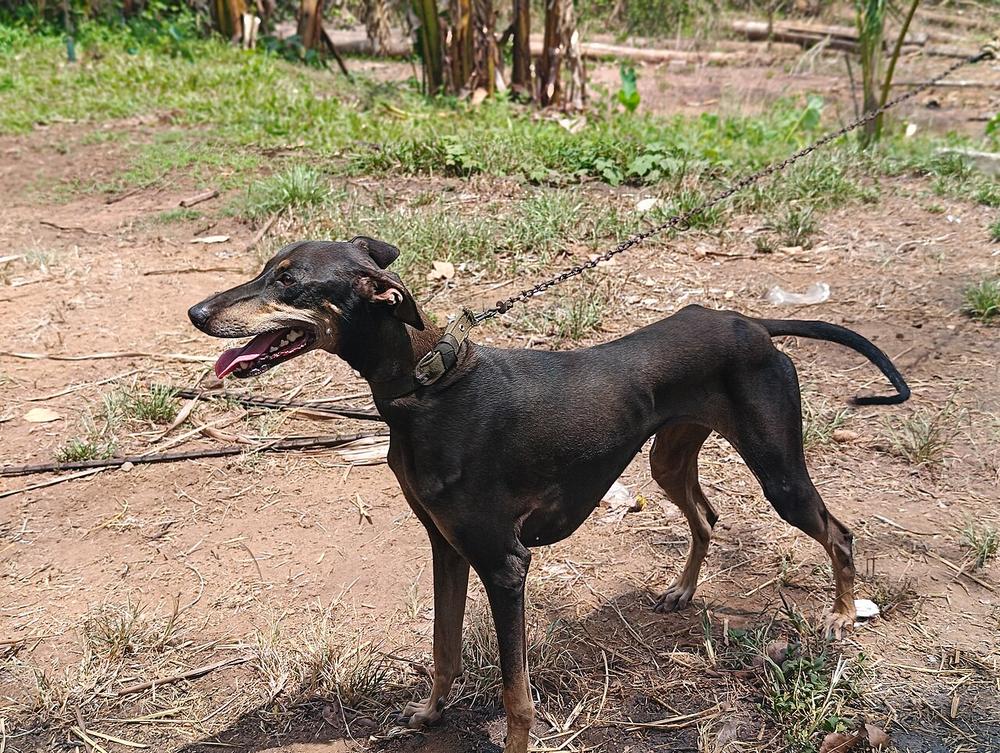
The Kanni is a slim, deep-chested hunting hound from Virudhunagar, Tuticorin and Tirunelveli in Tamil Nadu, described by researchers as obedient and loyal. When you travel, a sitter should keep it on a lead and harness on every walk, exercise it before sunrise and after dark, and keep its routine and food exactly as you leave them.
The Kanni is not on ICAR-NBAGR's register of dog breeds, and only one measured study of it has been published. Much of what is said about it online has no source.
- Meet your sitter first, free
- PAN-checked, first-aid trained
- A photo every day
- Pay through Petym, never cash

- Indian breed
- Developed in India
- Origin
- Virudhunagar, Tuticorin and Tirunelveli districts, southern Tamil NaduIndian Veterinary Journal (August 2013)study
- Adult weight
- 18.2 to 23.5 kg (No breed standard gives a weight. These are the average adult weights of females (18.15 kg) and males (23.5 kg) in a 2013 study of 81 dogs, not the full range.)Indian Veterinary Journal (August 2013)study
- Height
- 59.3 to 66.1 cm (Average height at the withers of adult females (59.3 cm) and males (66.1 cm) in the same study.)Indian Veterinary Journal (August 2013)study
- Coat
- Short. Black and tan, tan, cream and fawn were all seen in the breeding tract.Indian Veterinary Journal (August 2013)study
- Indian heat
- Copes with careAnimal Welfare Board of India
- Flats
- A flat, with daily exerciseIndian Veterinary Journal (August 2013)study
Kanni snapshot
| What | The rule | Source |
|---|---|---|
| Size | Medium. Adults averaged about 66 cm at the withers and 23.5 kg in males, about 59 cm and 18 kg in females, in a study of 81 dogs. | Indian Veterinary Journal (August 2013)study |
| Build | Slim, agile and lean, with a slender nose, deep chest and tucked-up belly suited to hunting. | Indian Veterinary Journal (August 2013)study |
| Coat | Short. Black and tan, tan, cream and fawn were all seen in the breeding tract. | Indian Veterinary Journal (August 2013)study |
| Exercise need | Not measured. A hound kept for hunting needs daily walks and a safe chance to stretch its legs, always on a lead or behind a secure fence. | Not stated |
| Alone-time tolerance | Not studied in this breed. PDSA's general advice is no more than 4 hours alone for any dog. | PDSA |
| Registered as a breed | No. ICAR-NBAGR's list of Indian dog breeds does not include the Kanni. | ICAR-National Bureau of Animal Genetic Resources |
Where does the Kanni come from?
The Kanni is a hunting hound of southern Tamil Nadu. A 2013 study in the Indian Veterinary Journal names Virudhunagar, Tuticorin and Tirunelveli districts as its intensive breeding tract, and describes a slim, agile dog with a lean body, a sharp, slender nose and a deep chest with a tucked-up belly, a build suited to hunting.
The dogs in that study were kept by agricultural labourers, whose traditional breeding, the authors write, helped conserve the breed's purity: bitches were kept indoors in season and mated only with a chosen male. The authors call the Kanni obedient and loyal, and suggest its long life in village communities helps it get along with children and family pets. They measured 81 dogs in Sevalpatty village of Virudhunagar and Thiruvengadam village of Tirunelveli in 2011, and class it as a mid-sized hound.
How did the Kanni come to India?
The Kanni is a native Indian breed that has never had to arrive: it developed in southern Tamil Nadu, and the 2013 study says it is slowly spreading among pet lovers across the state. An NBAGR methodology paper from 2016 lists it with the Combai, Chippiparai and Rajapalayam among the dog breeds of Tamil Nadu, and the Prime Minister named it among Indian breeds in his Mann Ki Baat address of 30 August 2020.
It is not, however, on ICAR-NBAGR's register of Indian dog breeds, which lists six breeds including the Kombai but not the Kanni, and we found no published Kennel Club of India standard. Much of what is written about it online has no source, so treat confident claims with care.
What care does a Kanni need?
The three things that shape a good day for this breed.
Exercise
No study has measured its exercise needs. It was bred to hunt by running, so plan two good walks a day in the cool hours on a harness and lead, and let it run only inside a fully fenced space. Indian Veterinary Journal (August 2013)study
Grooming
The coat is short and needs little work; the job that matters is a daily tick check, especially in the monsoon. Ticks were found on more than half the dogs in a four-city Indian survey. Parasites & Vectors (2011)study
Training
The 2013 study describes the Kanni as obedient and loyal. A hunting hound's chase instinct can override recall outside, so reward calm walking on the lead and do not rely on recall near roads. Indian Veterinary Journal (August 2013)study
How much should a Kanni eat?
Daily calories for a healthy, neutered adult Kanni, worked out from its weight with the formula vets use (70 x weight in kg to the power 0.75, then AAHA's factor for a neutered adult). Divide by the kcal per kg on your food's pack for grams a day, and adjust by body shape.
| Resting need (kcal a day) | Neutered adult (kcal a day) | |
|---|---|---|
| 18.2 kg AAHA (American Animal Hospital Association) | 620 | 860 to 990 |
| 20.9 kg | 680 | 960 to 1090 |
| 23.5 kg | 750 | 1050 to 1200 |
Feed a complete and balanced dog food, or a home-cooked diet only if a vet nutritionist has formulated it: the Merck Veterinary Manual says nutrition problems arise most often with unbalanced home-made diets. The 2013 study found young Kannis reach 85 to 90% of adult weight by about nine months, so puppies grow fast and need puppy food until your vet says to switch. A healthy Kanni is naturally lean with a tucked-up belly, as the study describes, so ask your vet what good body condition looks like before adding food. Keep onion, garlic, grapes, chocolate, salty food, milk and cooked bones out of its bowl, all on ASPCA's list of foods to avoid, and change foods slowly, as PDSA advises, to avoid an upset stomach. Meals a day: 6 to 12 weeks, 4 a day; 3 to 6 months, 3 a day; 6 to 12 months, 2 a day; adult, 1 or 2 a day. Puppies, kittens, working, pregnant and older animals need different amounts: ask your vet, or use Petym's food calculator.
Which illnesses is the Kanni prone to, and how are they treated?
The conditions veterinary studies and breed surveys most often report in the Kanni. Knowing the early signs means a vet sees it sooner.
See your vet first. This is general information from veterinary sources, not a diagnosis. Only a vet who has examined your pet can say what is wrong and prescribe treatment, and this page never gives a dose. Do not give your pet human medicine. If your pet seems very unwell, go to a 24-hour vet: find one in your city.
Heatstroke
Emergency: go to a vet nowNo study has looked at the Kanni's heat tolerance. Any dog can overheat, and PDSA says nearly three in four cases happen during play or exercise, which matters for a hound that sprints. PDSA
Signs to watch for
- Heavy panting and fast breathing
- Drooling or vomiting
- Bright red or very pale gums
- Weakness, wobbling or collapse
How a vet treats it
PDSA says start cooling at once with cool water over the body and moving air, then go to the vet, who cools the dog further, gives fluids by drip, runs blood and urine tests and may give oxygen and medicine to protect the organs.
Prevention
Walk before sunrise and after dark in summer, carry water, and stop at the first heavy panting. AWBI's heat circular asks owners to protect animals from direct heat.
Tick fever (ehrlichiosis)
See a vet soonA blood infection with Ehrlichia canis, spread mainly by the brown dog tick. It is not specific to the Kanni, but in a survey of dogs in four Indian cities ticks were found on more than half. Merck Veterinary Manual
Signs to watch for
- Fever and dullness
- Loss of appetite
- Nosebleeds or bruising
- Pale gums
How a vet treats it
Merck says vets diagnose it with blood tests such as serology and PCR, and treat it with a course of antibiotics, with supportive care and sometimes a blood or platelet transfusion for bleeding.
Prevention
Tick control as your vet advises and a daily check of the coat, ears and between the toes.
Bloat (gastric dilatation-volvulus, GDV)
Emergency: go to a vet nowThe stomach fills with gas and may twist. No study covers the Kanni, but ACVS lists deep-chested dogs as at risk, and the 2013 study describes the Kanni's deep chest. American College of Veterinary Surgeons
Signs to watch for
- Restlessness and stretching
- Drooling
- A swollen belly
- Retching without bringing anything up
- Later, weakness and collapse
How a vet treats it
A vet confirms it with abdominal X-rays, stabilises the dog with IV fluids and oxygen, decompresses the stomach with a tube, and operates to untwist it and attach it to the body wall (gastropexy).
Prevention
ACVS advises two or three smaller meals a day rather than one large meal for at-risk dogs.
What is actually known about the Kanni?
One morphometric study, a mention by the Prime Minister and a lot of folklore.
In 2011, researchers measured 81 Kanni dogs in Sevalpatty village of Virudhunagar district and Thiruvengadam village of Tirunelveli district. Their paper, published in the Indian Veterinary Journal in 2013, names Virudhunagar, Tuticorin and Tirunelveli as the breed's intensive breeding tract and says it is slowly spreading among pet lovers across Tamil Nadu. The dogs were kept by agricultural labourers, who mated their bitches only with chosen males.
The same authors describe the Kanni as obedient and loyal, and suggest that its long association with village life helps it get along with children and other family pets. That is the authors' view rather than a behaviour study, so judge your own dog. They also found that young Kannis reach 85 to 90% of adult weight by nine months, with growth slowing after 12 to 18 months.
An NBAGR paper from 2016 lists the Kanni with the Combai, Chippiparai and Rajapalayam as dog breeds of Tamil Nadu, and the Prime Minister named it among fabulous Indian breeds in his Mann Ki Baat address of 30 August 2020. It is not, however, among the six breeds ICAR-NBAGR has registered so far, and Petym found no published Kennel Club of India standard.
Why a Kanni must stay on the lead with a sitter
A dog built to chase can be across a road before anyone calls its name.
The 2013 study describes a lean, deep-chested body with a tucked-up belly, the build of a hound that hunts by running. Owners of hunting hounds know the result: a squirrel, a cat or a running child can trigger a sprint, and recall that works at home can vanish outside. A new person holding the lead makes that more likely, not less.
So the sitter's rule is simple: a well-fitted harness and lead on every walk, doors and the society gate closed before the dog is unclipped, and no off-lead running except in a fully fenced space you have used yourself. A narrow head can back out of a loose collar, so check the fit of the harness together at the meet and greet.
A Kanni that is bonded to its family may also be anxious when you leave. PDSA lists barking, howling, panting, trembling, destructive behaviour and toileting indoors among signs of separation anxiety. Ask the sitter to tell you about them in the daily photo update rather than scold the dog.
The Kanni in figures
The only measured figures for the breed, from 81 dogs in its home villages.
66.1 cm
average height at the withers of adult males (females 59.3 cm) Indian Veterinary Journal (August 2013)study
23.5 kg
average adult weight of males (females 18.15 kg) Indian Veterinary Journal (August 2013)study
85 %
of adult weight reached by about nine months, so puppies grow fast Indian Veterinary Journal (August 2013)study
81
dogs measured in Virudhunagar and Tirunelveli districts in 2011 Indian Veterinary Journal (August 2013)study
Kanni myths a sitter may hear
You may have read
Indian breeds never need vaccines or tick control.
Myth
What the sources say
Native dogs catch rabies, parvovirus and tick fever like any other. In a survey of 525 dogs in four Indian cities, ticks were found on more than half. Parasites & Vectors (2011)study
You may have read
A dog from Tamil Nadu cannot get heatstroke.
Myth
What the sources say
Any dog can overheat, especially after running on a hot day. AWBI's heat circular lists heavy panting, drooling, lethargy and collapse as warning signs. Animal Welfare Board of India
You may have read
Thin means underfed.
Myth
What the sources say
A healthy Kanni is naturally lean with a tucked-up belly, as the 2013 study describes. Ask your vet what a good body condition looks like for your dog before the sitter changes anything. Indian Veterinary Journal (August 2013)study
You may have read
A loyal dog can be trusted off the lead.
Myth
What the sources say
Loyalty does not stop a hound's chase. Keep the lead on outside a secure fence, whoever is walking.
When should a Kanni's sitter call the vet?
No published study covers the breed's health. These are the general emergencies that matter most for a lean, active dog in India.
If Heavy panting, drooling, wobbling or collapse after a walk or a run.
Heatstroke: cool place, cool water poured over the body, a fan, and straight to the vet. Animal Welfare Board of India
If Fever, tiredness, pale gums or nosebleed, especially after ticks were found.
Call the vet the same day. Check the ears, neck, armpits and toes after every walk. Merck Veterinary Manual
If A limp, torn nail or cut pad after a sprint on rough ground.
Stop exercise, send the owner a photo and call the vet if it bleeds, swells or the dog will not bear weight.
If Vomiting or diarrhoea for more than a day, or refusing food.
Call the vet and keep the food exactly as the owner left it. PDSA
If The dog slipped its collar and ran.
Call the owner at once, search the route calmly, and alert the society guards and neighbours. Do not chase into traffic.
Feeding and grooming a Kanni in Indian weather
A short coat and a lean frame make care simple. The sitter's job is to keep everything the same.
Do
- Write down the food, the portion and the times. Whether your Kanni eats rice and meat, roti or a commercial food, the sitter follows it and logs each meal.
- Keep the food unchanged for the whole trip: a sudden switch is a common cause of diarrhoea. PDSA
- Keep treats to about a tenth of the day's calories, so a lean dog stays lean rather than plump. WSAVA
- Give a quick brush or a wipe with a damp cloth after dusty or wet walks, and dry the paws and belly in the monsoon.
- Offer a soft bed: a thin-coated, bony dog finds a bare floor hard, and a North Indian winter cold.
Don’t
- No onion, garlic, grapes, raisins, chocolate or xylitol, and no cooked bones. ASPCA Animal Poison Control
- No hard running for an hour or so after a big meal; rest first, then exercise.
- Do not leave food bowls out in the sun, where flies and heat spoil them quickly.
Kanni sitter checklist
- Harness and lead, and a check that the dog cannot back out of them.
- What sets off a chase: cats, squirrels, bikes, running children.
- Door, gate and terrace rules, written down.
- Vaccination card (DHPPi, rabies), deworming dates and tick prevention.
- Food, portions and times; no onion or garlic in shared food. ASPCA Animal Poison Control
- Walk times and routes for the hot months, before sunrise and after dark.
- Your vet's number and the nearest 24-hour vet on Petym's city list.
Which Petym service fits a Kanni?
If Your Kanni is attached to the family and unsettled by change
Overnight pet sitting at home, so the dog keeps its own space and routine. Overnight sitting
If You work long days but are home at night
Dog walking at the same cool hours each day, always on the lead. Dog walking
If Your Kanni is relaxed with new people and has stayed away before
Pet boarding in a sitter's home that has passed Petym's video walk-through, with secure doors and gate. Home boarding
Breeds with similar care needs to the Kanni
Going away soon? Tell us your dates.
A checked local sitter feeds, walks and keeps your pet company at home, follows your care sheet to the letter and sends a photo every day. Petym is opening city by city: send your dates and we will tell you when a sitter can take them.
- Meet your sitter first, free
- PAN-checked, first-aid trained
- A photo every day
- Pay through Petym, never cash


Questions owners ask
Is the Kanni a recognised breed in India?
- Not by ICAR-NBAGR, whose register of Indian dog breeds does not include it. An NBAGR paper lists it among the dog breeds of Tamil Nadu, and the Prime Minister named it in Mann Ki Baat in 2020. Petym found no published Kennel Club of India standard for the Kanni.
Is a Kanni good with children and other pets?
- The authors of a 2013 study say the Kanni's long association with village life helps it get along with children and family pets, and describe it as obedient and loyal. That is their view, not a behaviour study. Supervise it with small pets, which a hunting hound may chase.
How big is a Kanni?
- In a study of 81 dogs in Virudhunagar and Tirunelveli, adult males averaged about 66 cm at the withers and 23.5 kg, and females about 59 cm and 18 kg. The researchers class it as a mid-sized hound.
Can a Kanni be walked off the lead?
- It is safest not to. The Kanni was bred as a hunting hound with a lean, fast build, and a chase can start in a second. A sitter should use a well-fitted harness and lead on every walk and let the dog run only inside a secure fence.
How long can a Kanni be left alone?
- There is no breed study. PDSA's general advice for any dog is no more than four hours at a time. On longer days, book a midday walk or a sitter, and ask them to note any barking, howling or destructive behaviour that could point to separation anxiety.
Does a Kanni cope with the Indian summer?
- It comes from hot southern Tamil Nadu, but no study has measured its heat tolerance and any dog can get heatstroke after running. Walk before sunrise and after dark in the hot months, keep water and shade available, and stop at the first heavy panting.
What should a Kanni eat while I am away?
- No source describes a special diet for the breed. Leave the food your dog already eats, with written portions and times, and ask the sitter to log each meal. Keep onion, garlic, grapes, chocolate and cooked bones away from it, and treats to about a tenth of daily calories.
Keep reading
- Chippiparai careIts close neighbour, a registered sighthound.
- Kombai care
- Rajapalayam care
- Mudhol Hound care
- Ticks and tick fever
- Heatstroke in dogs
- Dog walking
Services that help
Free tools for this
Words on this page, explained
Keep exploring
Other dog breeds
- Akita
- Alaskan Malamute
- American Bully
- American Cocker Spaniel
- American Pit Bull Terrier
- Australian Shepherd
- Bakharwal dog
- Basset Hound
- Beagle
- Belgian Malinois
- Bernese Mountain Dog
- Bichon Frise
- Border Collie
- Boston Terrier
- Boxer
- Bull Terrier
- Bulldog
- Bullmastiff
- Cane Corso
- Caucasian Shepherd Dog
- Cavalier King Charles Spaniel
- Chihuahua
- Chippiparai
- Chow Chow
- Cocker Spaniel
- Dachshund
- Dalmatian
- Dobermann
- Dogo Argentino
- English Mastiff
- English Springer Spaniel
- French Bulldog
- Gaddi Kutta (Gaddi dog)
- German Shepherd
- Golden Retriever
- Great Dane
- Greyhound
- Havanese
- Indian pariah dog (Indie)
- Indian Spitz
- Irish Setter
- Jack Russell Terrier
- Kangal
- Kombai
- Labrador Retriever
- Lhasa Apso
- Maltese
- Miniature Pinscher
- Miniature Schnauzer
- Mudhol Hound
- Neapolitan Mastiff
- Newfoundland
- Papillon
- Pekingese
- Pembroke Welsh Corgi
- Pomeranian
- Poodle
- Pug
- Rajapalayam
- Rampur Greyhound
- Rhodesian Ridgeback
- Rottweiler
- Saint Bernard
- Samoyed
- Shar Pei
- Shiba Inu
- Shih Tzu
- Siberian Husky
- Tibetan Mastiff
- Weimaraner
- West Highland White Terrier
- Whippet
- Yorkshire Terrier
Sources
Each source was opened and read on the date shown. How Petym checks its sources
- Animal Welfare Board of India: Request to ensure care and protection of animals from direct heat during extreme hot weather (4 May 2026) (opens in a new tab)
- Press Information Bureau, Prime Minister's Office: English rendering of PM's address in the 15th episode of Mann Ki Baat 2.0 on 30 August 2020 (read in a web-archive copy) (opens in a new tab)
- ICAR-National Bureau of Animal Genetic Resources: Dog breeds of India (registered breeds and accession numbers) (opens in a new tab)
- Merck Veterinary Manual: Nutritional requirements of small animals (full review November 2023, updated September 2024) (opens in a new tab)
- Merck Veterinary Manual: Puppy care (opens in a new tab)
- ASPCA Animal Poison Control: People foods to avoid feeding your pets (opens in a new tab)
Show all 17 sourcesShow fewer
- PDSA: Diarrhoea after a change of food (opens in a new tab)
- AAHA (American Animal Hospital Association): 2021 AAHA Nutrition and Weight Management Guidelines for Dogs and Cats: energy requirement calculations (Box 1, PDF) (opens in a new tab)
- PDSA: Heatstroke in dogs (opens in a new tab)
- Merck Veterinary Manual: Ehrlichiosis in dogs (opens in a new tab)
- American College of Veterinary Surgeons: Gastric dilatation-volvulus (opens in a new tab)
- PDSA: Separation anxiety in dogs (opens in a new tab)
- Merck Veterinary Manual: Ticks of dogs (opens in a new tab)
- WSAVA: Frequently asked questions and myths (Global Nutrition Committee) (opens in a new tab)
- Indian Veterinary Journal (August 2013): Morphometric characterization of Kanni dog: an indigenous hound breed of southern Tamil Nadu (KrishiKosh copy) (opens in a new tab)
- Journal of Livestock Biodiversity (2016), ICAR-NBAGR: A new methodology for characterization of dog genetic resources of India (opens in a new tab)
- Parasites & Vectors (2011): A survey of canine tick-borne diseases in India (opens in a new tab)