Whippet care in India: sprints, leashes and sitters
Updated By PetymFacts checked against official sources on
Quick answer
A Whippet is usually an easy guest: the FCI standard calls it gentle and affectionate, and AKC says it is calm indoors and rates it 5 of 5 with other dogs. The catch is the sprint: a Whippet chasing a cat outruns anyone, so it stays leashed outside fenced areas and runs only in secure spaces, in the cool hours.
Its fine, short coat and lean frame mean it needs shade in summer, warmth in a North Indian winter, and a sitter who does not mistake a fit Whippet for a hungry one.
- Meet your sitter first, free
- PAN-checked, first-aid trained
- A photo every day
- Pay through Petym, never cash

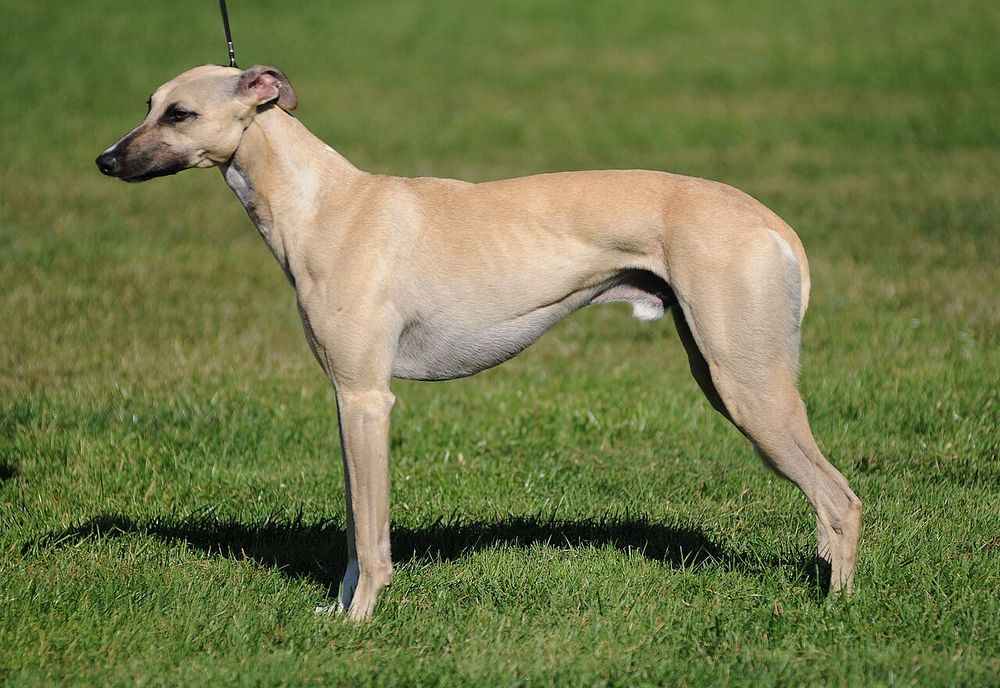
- Origin
- Great BritainFédération Cynologique Internationale
- Adult weight
- 11 to 18 kg (PDSA's average range; the FCI standard gives heights only)PDSA
- Height
- 44 to 51 cm (FCI standard: bitches 44 to 47 cm, dogs 47 to 51 cm)Fédération Cynologique Internationale
- Coat
- Fine, short and close, in any colour or mix of colours except merle.Fédération Cynologique Internationale
- Energy
- ModerateThe Royal Kennel Club
- Indian heat
- Copes with careFédération Cynologique Internationale
- Flats
- A flat, with daily exerciseThe Royal Kennel Club
Whippet snapshot for a sitter
| What | The rule | Source |
|---|---|---|
| Size | The FCI standard gives 47 to 51 cm at the shoulder for dogs and 44 to 47 cm for bitches; AKC gives 25 to 40 pounds. The Royal Kennel Club classes it as small. | Fédération Cynologique Internationale |
| Exercise need | Up to 1 hour a day, says The Royal Kennel Club. AKC calls Whippets sprinters by nature, needing vigorous runs as well as walks. | The Royal Kennel Club |
| Off-leash safety | Always keep a Whippet on lead outside a fenced area, says AKC. | American Kennel Club |
| Coat | Fine, short and close (FCI). AKC scores grooming need 1 of 5 and shedding 2 of 5: a weekly brush is enough. | Fédération Cynologique Internationale |
| With other dogs and people | AKC scores it 5 of 5 with other dogs and with young children, and 1 of 5 for barking. | American Kennel Club |
| Life expectancy | 12 to 15 years, says AKC. The Royal Kennel Club gives over 12 years. | American Kennel Club |
Where does the Whippet come from?
Dogs of Whippet type were common in the Middle Ages, says The Royal Kennel Club, and 21st-century genetic studies indicate the breed descends from the Greyhound. By the 19th century it was a distinct breed, used to hunt small game and control vermin. PDSA notes it was once thought of as a poor man's Greyhound.
The Victorians turned the chase into a gambling sport, and Whippet racing spread through the northern mining areas, Wales, London and the Midlands. Today the breed is popular in the show ring and as a gentle family companion. The FCI places it among the short-haired sighthounds, dogs bred to hunt by sight.
How did the Whippet come to India?
No source we found documents when the Whippet first reached India, and we found no Indian breed club or registration figure for it. Imported breeds arrive as personal pets or through breeders: from 25 April 2016 the Directorate General of Foreign Trade barred importing dogs for commercial breeding, and on 6 June 2023 the Madras High Court set that notification aside on a petition by the Kennel Club of India and the Madras Canine Club. India has its own sighthounds, such as the Rampur Greyhound, but the Whippet is a separate British breed.
What care does a Whippet need?
The three things that shape a good day for this breed.
Exercise
Up to 1 hour a day, says The Royal Kennel Club; PDSA says a minimum of an hour, split into walks, with off-lead running only in a secure, fenced area. In summer, keep runs to dawn and after dark. The Royal Kennel Club
Grooming
PDSA says a weekly brush is usually more than enough for the short coat. The thin skin cuts easily on sharp objects, so check for scrapes after runs, and give a warm bed in a North Indian winter. PDSA
Training
A sighthound bred to chase small game by sight will go after a cat or squirrel before it hears you. Practise recall only in fenced spaces and keep it on a lead elsewhere. The Royal Kennel Club
How much should a Whippet eat?
Daily calories for a healthy, neutered adult Whippet, worked out from its weight with the formula vets use (70 x weight in kg to the power 0.75, then AAHA's factor for a neutered adult). Divide by the kcal per kg on your food's pack for grams a day, and adjust by body shape.
| Resting need (kcal a day) | Neutered adult (kcal a day) | |
|---|---|---|
| 11 kg AAHA (American Animal Hospital Association) | 420 | 590 to 680 |
| 14.5 kg | 520 | 730 to 830 |
| 18 kg | 610 | 860 to 980 |
PDSA recommends splitting a Whippet's daily food into two meals and keeping treats under 10% of daily calories, as extra can unbalance the diet. Choose a food labelled complete for your dog's life stage, as WSAVA's guidance advises. A Whippet is naturally lean, so ask your vet to show you how to body condition score it rather than judging by eye. Keep onion, garlic, grapes, raisins, tamarind, chocolate, salty snacks and xylitol away, and go easy on milk, which can upset the gut. Ask your vet how much to feed; the energy table on this page gives a starting range. Meals a day: 6 to 12 weeks, 4 a day, puppy food; 3 to 6 months, 3 a day, puppy food; 6 to 12 months, 2 a day, puppy food; adult, 2 a day. Puppies, kittens, working, pregnant and older animals need different amounts: ask your vet, or use Petym's food calculator.
Which illnesses is the Whippet prone to, and how are they treated?
The conditions veterinary studies and breed surveys most often report in the Whippet. Knowing the early signs means a vet sees it sooner.
See your vet first. This is general information from veterinary sources, not a diagnosis. Only a vet who has examined your pet can say what is wrong and prescribe treatment, and this page never gives a dose. Do not give your pet human medicine. If your pet seems very unwell, go to a 24-hour vet: find one in your city.
Mitral valve disease
See a vet soonA heart condition in which the valve weakens and lets blood flow back into the heart. PDSA lists it among the Whippet's health problems; Merck calls degenerative valve disease the most common heart disease in dogs. PDSA
Signs to watch for
- A heart murmur the vet hears, often before any other sign
- Tiring easily or not wanting to exercise
- Coughing
- Fast or difficult breathing, or fainting
How a vet treats it
A vet diagnoses it with an examination, chest X-rays and an echocardiogram (heart scan), and may ask you to count your dog's breathing rate while it sleeps. Merck says that when heart failure begins, vets use medicines such as ACE inhibitors and diuretics to control fluid on the lungs, with other heart drugs and oxygen as needed.
Progressive retinal atrophy
Ask at a routine checkA group of inherited diseases in which the retina slowly degenerates. PDSA lists it among the Whippet's eye problems. PDSA
Signs to watch for
- Night blindness first, such as reluctance to go out in the dark
- Bumping into things in dim light
- Dilated pupils or eye shine
- Gradual loss of sight over months or years
How a vet treats it
A vet examines the back of the eye and can confirm it with electroretinography, a test of the eye's electrical responses. Merck says no effective treatment is available, so care focuses on helping the dog adapt to sight loss.
Prevention
Merck notes DNA tests exist for many breeds to find carriers before breeding.
Heatstroke
Emergency: go to a vet nowAny dog can overheat when exercised hard in heat, and exercise was the most common trigger in a large UK study. A Whippet's bursts of sprinting in Indian summer make this the risk to plan for. Scientific Reports (2020)study
Signs to watch for
- Heavy panting and fast breathing
- Drooling or vomiting
- Bright red or pale gums
- Weakness or collapse
How a vet treats it
Cool the dog with cold water away from the nose and mouth and go to the nearest vet. Vets cool the dog, may give a fluid drip and, in severe cases, oxygen, medication and hospital care.
Prevention
Sprint only in the cool hours, carry water and stop at the first heavy panting.
What is a Whippet like to look after?
Quiet and cuddly indoors, explosive outdoors. Plan for both halves.
The Royal Kennel Club traces the Whippet to the Greyhound and to Victorian England, where it hunted small game and later raced in the mining towns of the North. The FCI standard calls it an ideal companion, highly adaptable at home and in sport, gentle, affectionate and even-tempered. AKC describes a dog that is calm in the house, saving its energy for explosive bursts of running, ideally in a large, securely fenced area. Its barking score is the lowest on AKC's scale, which neighbours in a housing society will appreciate.
For a sitter, that means a dog that spends much of the day asleep on the softest thing in the room and then needs a real run. AKC suggests several vigorous fetch or frisbee sessions a week, regular walks, or play with another dog in a safely fenced space. Young Whippets are smart and mischievous and, says AKC, can jump and climb, so a puppy or adolescent must be safely confined when no one is watching. A sociable adult often enjoys a sitter's home with another calm dog, and PDSA's general advice still applies: no more than 4 hours alone at a time.
The Whippet on AKC's 1 to 5 trait scale
Scores from AKC's breed page that explain why Whippets are easy in a flat but need careful walks.
5 of 5
good with other dogs American Kennel Club
5 of 5
affectionate with family American Kennel Club
4 of 5
energy level American Kennel Club
1 of 5
barking level American Kennel Club
1 of 5
coat grooming frequency American Kennel Club
Giving a Whippet a safe run in an Indian city
Petym’s working from the official rules, no government publishes a total.
Petym's suggested plan for a sitter. The aim is a few minutes of full speed without any chance of a chase into traffic.
Pick the space the owner uses
A fully fenced ground, a closed society lawn or a tennis court with the gate shut. Walk the fence line first for gaps and broken mesh.
Leash on the way there
A well-fitted harness or the owner's sighthound collar, never a loose collar a narrow head can slip. Cats, squirrels and pigeons are everywhere on Indian streets.
Check the ground
No glass, stones or wire, and not a surface hot enough to burn: the back of your hand on it for seven seconds. The Royal Kennel Club
Let it go, gates closed
A few sprints, fetch with a ball or a frisbee, or play with a dog it knows, as AKC suggests. American Kennel Club
Cool down
A slow walk, water and shade. Look over the thin skin for scrapes and the pads for cuts.
Home and rest
Feed after the dog has calmed down. Most Whippets then sleep for hours.
Whippet myths that trip up sitters
You may have read
A Whippet that shows its ribs is underfed.
Myth
What the sources say
AKC says a healthy adult Whippet should show two to four vertebrae, without hipbones sunk in fat, and will look skinny to people used to heavier breeds. American Kennel Club
You may have read
Whippets need hours of running every day.
Myth
What the sources say
The Royal Kennel Club gives up to 1 hour a day. AKC says several vigorous sessions a week plus regular walks can be enough; they are sprinters, not marathon dogs. The Royal Kennel Club
You may have read
A gentle Whippet can be trusted off the leash.
Myth
What the sources say
AKC says always keep a Whippet on lead when not in a fenced area. Gentleness indoors says nothing about the urge to chase. American Kennel Club
You may have read
A short coat means no care at all.
Myth
What the sources say
Grooming is light, but AKC still advises regular ear checks and frequent nail trims if they do not wear down on their own. American Kennel Club
Feeding a Whippet: dos and don'ts
AKC stresses lifelong portion control: the Whippet frame is not built to carry extra weight.
Do
- Measure meals exactly as the owner writes them, and keep the same food for the whole stay. PDSA
- Judge condition by feel and by AKC's guide: a few visible vertebrae, no dimples of fat over the hips. American Kennel Club
- Count treats in the day's food; WSAVA suggests under about 10% of calories. WSAVA
- Feed after exercise, once the dog has cooled and settled.
Don’t
- Do not add extra food because the dog looks thin; ask the owner first. American Kennel Club
- Do not feed cooked bones, onion, garlic, grapes, chocolate or xylitol. ASPCA Animal Poison Control
- Do not leave food on a low counter: Whippets jump and climb. American Kennel Club
- Do not exercise hard straight after a big meal.
Heat, cold and festivals with a Whippet
Whippets were not reported separately in the large UK study of heat-related illness, but its larger relative, the Greyhound, had 4.26 times the odds of a Labrador. So assume the risk is real for a dog built to sprint. In the hot months, runs happen only at dawn or after sunset, on shaded ground, with water and a long cool-down; midday is for sleeping under the fan. Stop at once for heavy panting, stumbling or drooling, cool the dog and call the vet.
The fine, short coat and lean body give little protection the other way, too. In a Delhi, Lucknow or Chandigarh winter, give a warm bed off the floor and a blanket, and a dog coat for early walks if your Whippet shivers. Thin skin also shows scrapes from bushes and fences, and ticks are easy to spot on a short coat: check after every walk. At Diwali, keep the dog indoors and leashed on any toilet trip; a startled sighthound that slips its collar can be gone in seconds.
Whippet health signs a sitter should report
If Panting hard, wobbling or collapsing after a run on a warm morning.
Shade, cool water poured over the body, a fan, and call the vet. PDSA
If Tiring quickly, coughing or fainting. Responsible breeders screen for cardiac disease in the breed.
Stop exercise and call the vet the same day. American Kennel Club
If Not responding to sounds, or cloudy or sore eyes. AKC lists deafness and eye disorders among breed screening.
Note it and tell the owner; see the vet if it is new or the eye is painful. American Kennel Club
If A cut, tear or scrape on the thin skin after running through bushes or a fence.
Clean small wounds; call the vet for anything gaping or bleeding.
If Fever, dullness or loss of appetite days after ticks were found.
Call the vet the same day: about half the dogs in a survey in four Indian cities carried a tick-borne infection. Parasites & Vectors (2011)study
If Shivering, curling up tight and refusing to go out on cold mornings.
Warm bed, blanket and a coat. If the dog is also dull or not eating, call the vet.
Whippet sitter checklist
- The fenced places where the dog is allowed to run, and the rule: leashed everywhere else.
- Harness or sighthound collar, checked for fit, and a spare leash.
- Meal amounts and times, and a photo of the dog at its right weight so the sitter knows what lean looks like.
- Soft bedding and, in winter, a blanket and coat.
- Cats, community dogs and squirrels on the usual route, and which lanes to avoid.
- Tick prevention product and next due date.
- Collar tag, microchip number and a recent photo for a lost-dog alert.
- Your vet's number and the nearest 24-hour vet on Petym's list for your city.
Which Petym service suits a Whippet?
Whippets are sociable and calm indoors, so most services work if runs are safe.
Often a good fit
Pet boarding
A calm sitter's home, perhaps with another friendly dog, within the home's pet limit and after a free meet and greet.
Overnight pet sitting
The sitter stays in your home, so the dog keeps its sofa, its routine and the run space it knows.
Doggy day care
Company and play with other dogs on workdays for a sociable adult.
Dog walking
A leashed midday walk to break up a long day, timed to avoid the heat.
Breeds with similar care needs to the Whippet
Going away soon? Tell us your dates.
A checked local sitter feeds, walks and keeps your pet company at home, follows your care sheet to the letter and sends a photo every day. Petym is opening city by city: send your dates and we will tell you when a sitter can take them.
- Meet your sitter first, free
- PAN-checked, first-aid trained
- A photo every day
- Pay through Petym, never cash


Questions owners ask
Is a Whippet good for a flat in India?
- Often, yes. AKC says Whippets are calm in the house and scores barking 1 of 5, so they suit flats and housing societies. They need regular walks and some safe sprints in a fenced space, done in the cool hours, plus a soft bed and warmth in winter.
How much exercise does a Whippet need?
- The Royal Kennel Club says up to 1 hour a day. AKC suggests regular walks plus several vigorous sessions a week, such as fetch or play with another dog in a fenced area. Whippets are sprinters: short bursts of speed matter more than long distances.
Can a Whippet be let off the leash?
- Only in a securely fenced area. AKC says always keep a Whippet on lead elsewhere. Whippets were bred to chase small game by sight and can reach full speed after a cat or squirrel before anyone reacts, which on Indian roads is dangerous.
Why does my Whippet look so thin?
- A fit Whippet is lean. AKC says a healthy adult should show two to four vertebrae, without hipbones sunk in fat, and will look skinny to people used to heavier breeds. Extra weight strains its frame. Ask your vet to check body condition rather than feeding more.
Do Whippets feel the cold?
- Many do. The FCI standard describes a fine, short, close coat, and Whippets carry little body fat. In North Indian winters, give a warm bed off the floor, a blanket and a coat for early walks, and watch for shivering.
How long can a Whippet be left alone?
- PDSA's general advice is no more than 4 hours at a time. Whippets are affectionate and sociable, and many sleep through quiet hours, but a long day alone without a run is hard on them. A midday walk or a sitter's home with company helps.
Are Whippets good with other dogs and children?
- AKC scores the breed 5 of 5 both with other dogs and with young children, and the FCI standard describes a gentle, affectionate, even disposition. Small pets such as cats or rabbits are a different matter: introduce carefully and never leave them unsupervised together.
Keep reading
- Dog care hub
- Winter pet care in North India
- Summer pet care in India
- Pet boarding in a sitter's home
- What to pack for pet boarding
- Chippiparai careAn Indian sighthound with the same chase instinct.
- How long can you leave a dog alone?
Services that help
Free tools for this
Words on this page, explained
Keep exploring
Other dog breeds
- Akita
- Alaskan Malamute
- American Bully
- American Cocker Spaniel
- American Pit Bull Terrier
- Australian Shepherd
- Bakharwal dog
- Basset Hound
- Beagle
- Belgian Malinois
- Bernese Mountain Dog
- Bichon Frise
- Border Collie
- Boston Terrier
- Boxer
- Bull Terrier
- Bulldog
- Bullmastiff
- Cane Corso
- Caucasian Shepherd Dog
- Cavalier King Charles Spaniel
- Chihuahua
- Chippiparai
- Chow Chow
- Cocker Spaniel
- Dachshund
- Dalmatian
- Dobermann
- Dogo Argentino
- English Mastiff
- English Springer Spaniel
- French Bulldog
- Gaddi Kutta (Gaddi dog)
- German Shepherd
- Golden Retriever
- Great Dane
- Greyhound
- Havanese
- Indian pariah dog (Indie)
- Indian Spitz
- Irish Setter
- Jack Russell Terrier
- Kangal
- Kanni
- Kombai
- Labrador Retriever
- Lhasa Apso
- Maltese
- Miniature Pinscher
- Miniature Schnauzer
- Mudhol Hound
- Neapolitan Mastiff
- Newfoundland
- Papillon
- Pekingese
- Pembroke Welsh Corgi
- Pomeranian
- Poodle
- Pug
- Rajapalayam
- Rampur Greyhound
- Rhodesian Ridgeback
- Rottweiler
- Saint Bernard
- Samoyed
- Shar Pei
- Shiba Inu
- Shih Tzu
- Siberian Husky
- Tibetan Mastiff
- Weimaraner
- West Highland White Terrier
- Yorkshire Terrier
Sources
Each source was opened and read on the date shown. How Petym checks its sources
- Fédération Cynologique Internationale: FCI-Standard No 162: Whippet (opens in a new tab)
- PDSA: Whippet (opens in a new tab)
- The Royal Kennel Club: Whippet: breed information (opens in a new tab)
- Directorate General of Foreign Trade, Ministry of Commerce and Industry: Notification No. 3/2015-2020 (25 April 2016): policy conditions on import of dogs; import of commercial dogs for breeding not permitted (opens in a new tab)
- WSAVA Global Nutrition Committee: Guidelines on selecting pet foods (updated 10 March 2021) (opens in a new tab)
- WSAVA Global Nutrition Committee: Body condition score chart: dogs (June 2025) (opens in a new tab)
Show all 23 sourcesShow fewer
- Merck Veterinary Manual: Puppy care (opens in a new tab)
- ASPCA Animal Poison Control: People foods to avoid feeding your pets (opens in a new tab)
- Merck Veterinary Manual: Garlic and onion (Allium spp) toxicosis in animals (opens in a new tab)
- Merck Veterinary Manual: Grape, raisin, and tamarind (Vitis spp, Tamarindus spp) toxicosis in dogs (full review September 2024) (opens in a new tab)
- AAHA (American Animal Hospital Association): 2021 AAHA Nutrition and Weight Management Guidelines for Dogs and Cats: energy requirement calculations (Box 1, PDF) (opens in a new tab)
- Merck Veterinary Manual: Nutritional requirements of small animals (full review November 2023, updated September 2024) (opens in a new tab)
- Merck Veterinary Manual: Acquired heart and blood vessel disorders in dogs (dog owners) (opens in a new tab)
- Merck Veterinary Manual: Disorders of the retina, choroid and optic disk in dogs (dog owners; updated September 2024) (opens in a new tab)
- PDSA: Heatstroke in dogs (opens in a new tab)
- American Kennel Club: Whippet dog breed information (opens in a new tab)
- PDSA: Separation anxiety in dogs (opens in a new tab)
- PDSA: Diarrhoea after a change of food (opens in a new tab)
- WSAVA: Frequently asked questions and myths (Global Nutrition Committee) (opens in a new tab)
- The Royal Kennel Club: The danger of hot pavements (opens in a new tab)
- Scientific Reports (2020): Incidence and risk factors for heat-related illness in UK dogs (opens in a new tab)
- Parasites & Vectors (2011): A survey of canine tick-borne diseases in India (opens in a new tab)
- SCC Online: Madras High Court sets aside notification banning import of dogs for commercial activities (13 June 2023) (opens in a new tab)