Rottweiler care in India: exercise, heat and notes for your sitter
Updated By PetymFacts checked against official sources on
Quick answer
A Rottweiler can do well with a sitter it has met and come to trust. The Royal Kennel Club calls it strong, intelligent and protective, and puts its exercise need at more than 2 hours a day. A sitter must be confident handling a big dog, keep it lean, and walk it only in the cool hours.
Rottweilers are heavy dogs: median adult weight in a UK study was 48.5 kg for males. Weight and exercise in the heat were the biggest risk factors for heat-related illness in a large UK study, so a sitter's plan starts there.
- Meet your sitter first, free
- PAN-checked, first-aid trained
- A photo every day
- Pay through Petym, never cash

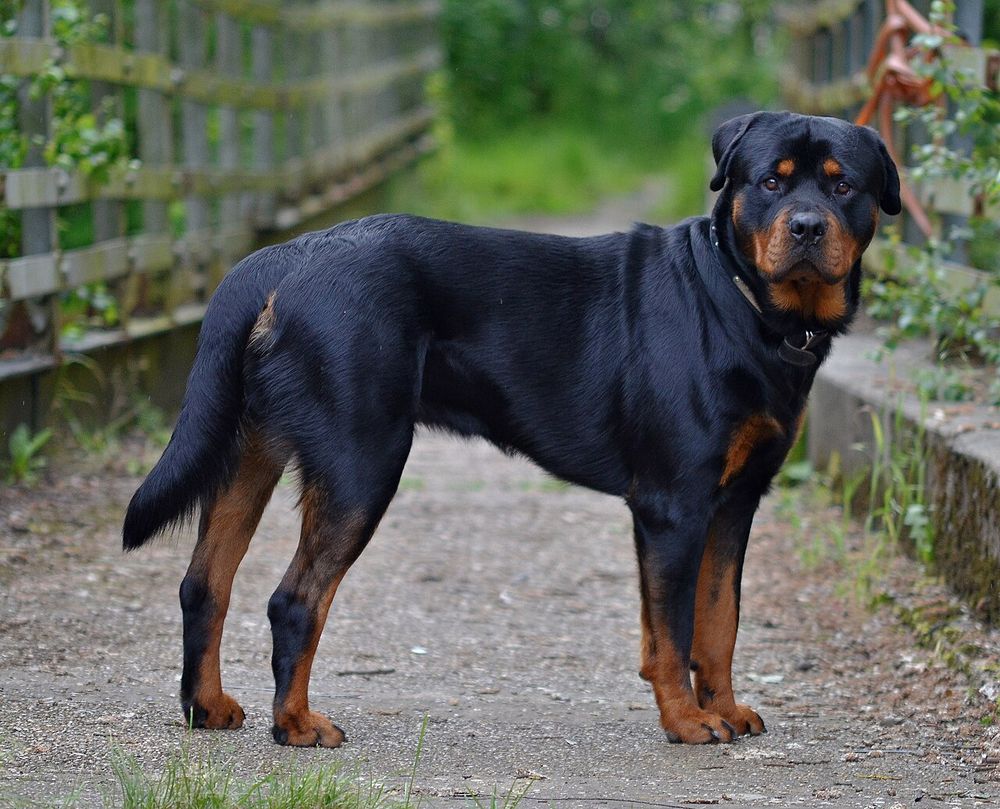
- Origin
- Rottweil, south-west Germany, from Roman drovers' dogsFédération Cynologique Internationale
- Adult weight
- 36 to 61 kg (AKC: males 95 to 135 lb, females 80 to 100 lb, converted to kg)American Kennel Club
- Height
- 56 to 68 cm (FCI standard: males 61 to 68 cm, females 56 to 63 cm at the withers)Fédération Cynologique Internationale
- Lifespan
- 9 to 10 yearsAmerican Kennel Club
- Coat
- Short, coarse, flat outer coat with an undercoat on the neck and thighs; black with rust markings. Sheds moderately, more heavily twice a year.American Kennel Club
- Energy
- HighThe Royal Kennel Club
- Indian heat
- Copes with careScientific Reports (2020)study
- Flats
- Needs spaceThe Royal Kennel Club
Rottweiler snapshot
| What | The rule | Source |
|---|---|---|
| Size | Large. AKC gives a height of 24 to 27 inches for males and 22 to 25 inches for females. | American Kennel Club |
| Exercise need | More than 2 hours a day, says The Royal Kennel Club. | The Royal Kennel Club |
| Alone-time tolerance | Not scored by kennel clubs. AKC describes a protector within the family circle. PDSA's general limit for any dog is 4 hours alone. | PDSA |
| Heat tolerance | No higher odds than the Labrador in a large UK study, but dogs over 50 kg had the highest odds of heat-related illness of any weight group. | Scientific Reports (2020)study |
| Coat and shedding | Short coat that sheds; groom once a week. | The Royal Kennel Club |
| With other dogs | AKC places it in the middle of its scale (3 of 5) for getting on with other dogs. Introductions need care and a confident handler. | American Kennel Club |
Where does the Rottweiler come from?
The Rottweiler is one of the oldest working breeds, and its story starts with the Roman army. The FCI standard describes herding and driving dogs that marched over the Alps with the Roman legions, guarding the soldiers and driving the cattle they took along as food. AKC adds that the Romans bred these drovers from Asian mastiff types.
In the region of Rottweil, a livestock market town in south-west Germany, those dogs mixed with local dogs. Cattle dealers and butchers bred them purely for work: to drive and guard herds and to protect their owners and money on the road home, which earned them the name Rottweil butcher's dog. The Royal Kennel Club notes that farmers tied their money bags to the dog's collar for safety.
When railways took over cattle transport in the 1800s, the breed nearly lost its job. It was tested for police work at the start of the twentieth century and, says the FCI standard, officially recognised as a police dog in 1910. The first German breed standard was drawn up in 1901, and AKC admitted the Rottweiler to its stud book in 1931. AKC also notes Rottweilers were among the first guide dogs for blind people.
How did the Rottweiler come to India?
No source we found records when the first Rottweilers came to India, so its arrival is not documented here. It is now a familiar breed in Indian cities: Ahmedabad's municipal registration figures reported in August 2026 counted 356 Rottweilers, ninth among named breeds. Police forces use it too: a 2020 PTI report listed Rottweilers in the Kolkata Police dog squad. Since 2016 India's foreign trade rules allow dogs to be imported only as pets with a pet book, for research or for defence and police use, not for commercial breeding.
The breed sits in the middle of India's dangerous-dog debate. A central government letter of 12 March 2024 named the Rottweiler among breeds it called ferocious; the Delhi High Court set that circular aside on 16 April 2024 and asked for a fresh consultation. Some cities still single it out: Gurugram's order of 23 June 2026 reproduces the 2024 list and requires owners of those breeds to register the dog and use a leash, chain lead and muzzle outside the home. In July 2025 Goa's cabinet cleared a bill proposing a ban on importing, selling and breeding Rottweilers. Check your city's current rules and your housing society's bye-laws before you bring one home.
What care does a Rottweiler need?
The three things that shape a good day for this breed.
Exercise
The Royal Kennel Club suggests more than 2 hours of exercise a day. AKC says the breed loves walking, trotting and swimming with its people and does well at tracking, herding and obedience work. In Indian summers, do the long walks at dawn and after dark. The Royal Kennel Club
Grooming
Brush once a week and bathe now and then; expect heavier shedding twice a year. AKC advises brushing the teeth and trimming the nails weekly. American Kennel Club
Training
Start early: AKC calls socialisation, puppy classes and consistent, fair and firm training key, and warns that rough play can encourage aggression. Rottweilers are people dogs that do badly when isolated, says AKC, and are intelligent and keen to please, though some are stubborn. The Royal Kennel Club
How much should a Rottweiler eat?
Daily calories for a healthy, neutered adult Rottweiler, worked out from its weight with the formula vets use (70 x weight in kg to the power 0.75, then AAHA's factor for a neutered adult). Divide by the kcal per kg on your food's pack for grams a day, and adjust by body shape.
| Resting need (kcal a day) | Neutered adult (kcal a day) | |
|---|---|---|
| 36 kg AAHA (American Animal Hospital Association) | 1030 | 1440 to 1650 |
| 48.5 kg | 1290 | 1800 to 2060 |
| 61 kg | 1530 | 2140 to 2440 |
Feed a complete and balanced dog food suited to the dog's life stage; Merck notes that nutritional problems arise most often from unbalanced homemade diets, so a home-cooked diet of rice, roti and meat needs to be formulated by a veterinary nutritionist. AKC warns that Rottweilers tend to put on weight, and overweight or obesity was the second most common problem in a UK study of 5,321 Rottweilers (7.06%). Weigh food, count treats, and keep fresh water out at all times. Rottweilers are deep-chested, and ACVS advises two to three smaller meals a day rather than one large meal for dogs at risk of bloat. Keep onion, garlic, grapes, tamarind, chocolate and salty snacks out of reach, and go easy on milk and curd if they upset the stomach: ASPCA notes dairy can cause diarrhoea. Large-breed puppies grow for longer, so ask your vet when to move to adult food. Meals a day: 6 to 12 weeks, 4 a day; 3 to 6 months, 3 a day; 6 to 12 months, 2 a day; adult, 2 a day, or 3 smaller meals. Puppies, kittens, working, pregnant and older animals need different amounts: ask your vet, or use Petym's food calculator.
Which illnesses is the Rottweiler prone to, and how are they treated?
The conditions veterinary studies and breed surveys most often report in the Rottweiler. Knowing the early signs means a vet sees it sooner.
See your vet first. This is general information from veterinary sources, not a diagnosis. Only a vet who has examined your pet can say what is wrong and prescribe treatment, and this page never gives a dose. Do not give your pet human medicine. If your pet seems very unwell, go to a 24-hour vet: find one in your city.
Osteosarcoma (bone cancer)
See a vet soonAn aggressive cancer of the bone-forming cells, usually in the long bones of the legs. Science for Animal Welfare says Rottweilers are about five times more likely than the average dog to develop it, with estimates of 5 to 12% of the breed affected. Science for Animal Welfare (formerly UFAW)
Signs to watch for
- Lameness that does not settle, often in a front leg
- A swelling on a leg bone that may feel warm
- Pain when the leg is touched
- Later, weight loss, poor appetite or breathing trouble if it spreads to the lungs
How a vet treats it
A vet confirms it with X-rays and a biopsy, and checks the chest for spread. Treatment named by Science for Animal Welfare includes amputation or limb-sparing surgery, chemotherapy, radiotherapy and pain relief prescribed by the vet; newer options such as immunotherapy are offered by specialist oncologists. The outlook is poor, so the vet will talk through quality of life.
Prevention
There is no genetic test. Buy from breeders who avoid breeding from dogs with affected relatives.
Elbow dysplasia
See a vet soonA group of developmental elbow problems, most often a fragmented medial coronoid process, that lead to arthritis. Studies cited by Science for Animal Welfare estimate 33 to 55% of Rottweilers are affected, though not all show signs. Science for Animal Welfare (formerly UFAW)
Signs to watch for
- Stiffness after rest
- Front-leg lameness, often worse after exercise
- The foot or leg held turned outwards
- Signs often begin in the first year
How a vet treats it
X-rays may miss it, so a vet may use CT scans and arthroscopy (keyhole surgery), which can diagnose and treat at once. Treatment includes rest, pain relief prescribed by the vet, often long term, and surgery.
Prevention
Choose a puppy whose parents were elbow-scored under a screening scheme; affected dogs should not be bred from.
Cranial cruciate ligament rupture
See a vet soonA tear of the main stabilising ligament in the knee, usually after slow degeneration. Science for Animal Welfare reports Rottweilers are several times more likely to be affected than other breeds, often younger and in both hind legs. Science for Animal Welfare (formerly UFAW)
Signs to watch for
- Sudden lameness in a hind leg, sometimes not putting the foot down at all
- On-and-off lameness that improves with rest and returns after exercise
- Thigh muscle loss and a swollen knee
How a vet treats it
A vet examines the knee, often under sedation, and may take X-rays. For dogs over 20 kg surgery is considered essential: options named include extracapsular stabilisation, tibial plateau levelling osteotomy (TPLO) and tibial tuberosity advancement, with pain-relieving medication and physiotherapy.
Prevention
Obesity may make it more likely, so keep the dog lean.
Hip dysplasia
Ask at a routine checkA loose, unstable hip joint that wears and becomes arthritic. AKC lists hip and elbow dysplasia among the breed's inherited problems, and ACVS says it is most common in large breeds, with heredity the biggest risk factor. American Kennel Club
Signs to watch for
- Reluctance to rise, jump or climb stairs
- Shifting weight onto the front legs
- Loss of muscle on the hind legs
- Hip pain; some dogs show no obvious signs
How a vet treats it
A vet uses specially positioned hip X-rays and feels the joint, usually under light sedation. ACVS names keeping the dog lean, lead walks only, anti-inflammatory drugs prescribed by the vet, omega-3 fatty acids and physical therapy, and surgery such as pelvic osteotomy, total hip replacement or femoral head ostectomy depending on age.
Prevention
ACVS says keeping a dog slim for life is the most effective long-term step, and that rapid growth from overfeeding can make it worse.
Ear infection (otitis externa)
See a vet soonInflammation of the ear canal. It was the third most common disorder in UK Rottweilers (6.14%), and the breed had 1.67 times the odds of crossbreeds in a large UK study. Canine Genetics and Epidemiology (2017), RVC VetCompassstudy
Signs to watch for
- Head shaking and scratching at the ears
- A bad smell or discharge
- Red, swollen or painful ear
How a vet treats it
A vet looks into the canal with an otoscope and checks a swab of the discharge. Merck describes cleaning and drying by the vet, often under anaesthesia if painful, then ear drops that combine antibiotics, antifungals and anti-inflammatories, sometimes with tablets or injections, continued until rechecks show it has cleared.
Prevention
Check ears regularly, keep them dry after baths, and clean only as your vet directs. Merck warns against cotton swabs and home remedies.
How a Rottweiler handles a sitter
Trust first. A Rottweiler that has met the sitter with its family is a different dog from one meeting a stranger at the door.
AKC describes the Rottweiler as a gentle playmate and protector within the family, watching the outside world with self-assured aloofness. That aloofness is why a sitter should never just arrive with a key. Petym starts every first booking with a free meet and greet: use it for a walk together, with you handing the leash over partway, and for the sitter to feed a meal while you are in the room.
Be open about behaviour. In a UK study of 5,321 Rottweilers, aggression was the most commonly recorded disorder, in 7.46% of dogs, and more common in males (9.36%) than females (5.47%). Most Rottweilers are not aggressive, but a sitter needs to know if yours has growled at visitors, guards food or toys, or reacts to other dogs. If it has, a home sitter who does not bring other dogs is usually the right fit, and a qualified behaviourist is the right person to help long term.
On time alone, PDSA advises no more than 4 hours at a stretch. A bored, under-exercised Rottweiler can be destructive, and a big dog barking at the door is hard on neighbours in a housing society.
What vets recorded in 5,321 UK Rottweilers
From a Royal Veterinary College VetCompass study. These are the problems a sitter is most likely to notice.
7.46 %
had aggression recorded, the most common disorder Canine Genetics and Epidemiology (2017), RVC VetCompassstudy
7.06 %
were overweight or obese Canine Genetics and Epidemiology (2017), RVC VetCompassstudy
6.14 %
had an outer ear infection (otitis externa) Canine Genetics and Epidemiology (2017), RVC VetCompassstudy
4.69 %
had degenerative joint disease Canine Genetics and Epidemiology (2017), RVC VetCompassstudy
9 years
median lifespan; neoplasia (cancer) caused 33% of deaths Canine Genetics and Epidemiology (2017), RVC VetCompassstudy
A day of exercise for a Rottweiler in Indian heat
Petym’s working from the official rules, no government publishes a total.
A sample plan for the hot months that gives a big dog its work without the midday sun.
Soon after sunrise
The long walk: 50 to 60 minutes at a steady pace, on soil or grass where you can, with water. A Rottweiler is heavy, so slow down early on warm mornings.
After the walk
Rest and water. Breakfast only once the dog has cooled down and settled.
Mid-morning
Training games indoors: sit, down, stay and wait at the door, with pieces of the day's food as rewards.
Midday to late afternoon
Indoors, in the coolest room. Toilet breaks on shaded ground only; check the road with your palm first.
Late afternoon
A chew or a food puzzle toy to keep the dog busy before the evening walk.
After sunset
The second long walk, 45 to 60 minutes, once the road has cooled. Dinner afterwards, a short brush, and the daily photo update.
Rottweiler health signs a sitter should report
Notice, record, tell the owner and call the vet. A sitter never diagnoses or treats.
If Restless, retching with nothing coming up, a swollen or tight belly, drooling, often after a meal. Signs of bloat (GDV), which affects large, deep-chested dogs.
An emergency: go to the nearest 24-hour vet straight away and call the owner on the way. American College of Veterinary Surgeons
If Sudden lameness on a back leg, often after a twist or a jump. Cranial cruciate ligament rupture is on the breed's genetic welfare list.
Stop exercise, keep the dog calm and call the vet. Science for Animal Welfare (formerly UFAW)
If A limp that comes and goes, a swelling on a leg bone, or pain when a leg is touched. Science for Animal Welfare says Rottweilers are five times more likely than the average dog to develop osteosarcoma, a painful bone cancer.
Do not wait for it to pass: tell the owner and call the vet. Science for Animal Welfare (formerly UFAW)
If Tiring quickly, coughing, fast breathing at rest or fainting. Dilated cardiomyopathy, a heart muscle disease, is on the breed's list.
Call the vet the same day; collapse is an emergency. Science for Animal Welfare (formerly UFAW)
If Stiffness after rest, or trouble with stairs. Elbow dysplasia and degenerative joint disease are common in the breed.
Short walks on soft ground and a call to the vet. Science for Animal Welfare (formerly UFAW)
If Heavy panting that will not settle, drooling, weakness or collapse after a walk.
Heatstroke: cool water poured over the body away from the face, a breeze, then the vet at once. PDSA
Heat, weight and ticks: India notes for a big dog
In the UK heatstroke study, every weight band over 10 kg had higher odds of heat-related illness than smaller dogs, and dogs over 50 kg had the highest odds. Being at or above the breed's average weight raised the odds again, and exercise was the main trigger. A large male Rottweiler sits near that top weight band, so in Delhi, Nagpur or Hyderabad in May the long walk must happen at dawn, and the evening walk waits until the road has cooled. The India Meteorological Department's colour-coded heat warnings, at mausam.imd.gov.in, are worth checking before planning the day.
Keep the dog lean. WSAVA's nutrition committee suggests treats stay under about 10% of daily calories, and a sitter should measure every meal. Split the food into the meals the owner uses: the American College of Veterinary Surgeons lists one large meal a day and eating very fast among the risk factors for bloat. Ticks are common on Indian dogs: in a survey of 525 dogs in four Indian cities, ticks were found on 53%. Check the ears, neck, armpits and between the toes after every walk.
Handling a Rottweiler in a flat and society
Do
- Keep the dog on a short, strong leash in common areas, lifts and the society gate, and wait for an empty lift.
- Use the owner's commands and routine exactly, from the door to the bowl.
- Put the dog in a separate room before opening the door to deliveries, cleaners or guests.
- Give daily exercise and training: AWBI notes that neglecting to exercise a dog kept chained or closely confined is cruelty under Section 11(1)(g) of the Prevention of Cruelty to Animals Act, 1960. Animal Welfare Board of India
Don’t
- Do not let unfamiliar dogs rush up to greet; cross the road or turn away calmly.
- Do not punish a growl. It is a warning; step back and tell the owner.
- Do not take a bowl, bone or toy away by hand if the dog guards it; trade it for a treat.
- Do not feed chocolate, grapes, raisins, onion, garlic or xylitol. ASPCA Animal Poison Control
Rottweiler sitter checklist
- Behaviour notes: visitors, other dogs, food or toy guarding, and what the dog does when worried.
- Leash, collar or harness, and whether the dog is used to a muzzle for vet visits.
- Commands the dog knows and the words the family uses.
- Meal amounts, number of meals and times, and the treat allowance.
- Any medicines exactly as the vet's label says, logged by the sitter at each dose.
- Tick prevention product and next due date.
- The society's pet rules and the safest walking times and routes.
- The vet's number and the nearest 24-hour vet on Petym's city list.
Which Petym service fits a Rottweiler?
If Your Rottweiler guards the home or is wary of strangers or dogs
Overnight pet sitting in your home, with one sitter the dog has met. No other dogs involved. Overnight sitting
If You are out all day on workdays
Dog walking at midday, so the dog is not alone for long stretches. Dog walking
If Your dog is relaxed with new people and other dogs
Pet boarding in a vetted sitter's home with space and a pet limit. Home boarding
If Your dog has a joint, heart or post-surgery care plan
Special-needs pet care, with the vet's plan followed and logged. Special-needs care
Breeds with similar care needs to the Rottweiler
Going away soon? Tell us your dates.
A checked local sitter feeds, walks and keeps your pet company at home, follows your care sheet to the letter and sends a photo every day. Petym is opening city by city: send your dates and we will tell you when a sitter can take them.
- Meet your sitter first, free
- PAN-checked, first-aid trained
- A photo every day
- Pay through Petym, never cash


Questions owners ask
Can a Rottweiler be left with a pet sitter?
- Yes, once it knows and trusts the sitter. Petym starts every first booking with a free meet and greet: walk together, hand over the leash and let the sitter feed a meal while you are there. Tell the sitter honestly about guarding or reactions to visitors and other dogs.
How long can a Rottweiler be left alone?
- PDSA's general advice is no more than 4 hours at a time for any dog. A Rottweiler needs more than 2 hours of exercise a day and close contact with its family, so on long days arrange a midday walk or a sitter rather than leaving it alone in a flat.
Do Rottweilers handle Indian heat?
- With care. Rottweilers did not have higher odds than Labradors in a large UK heatstroke study, but heavy dogs did: dogs over 50 kg had the highest odds of any weight group. Walk at dawn and after dark in the hot months, keep the dog lean, and give it a cool room through the day.
What health problems are common in Rottweilers?
- In a UK study the most common were aggression, overweight, ear infections and joint disease, and cancer caused a third of deaths. Science for Animal Welfare also lists cruciate ligament rupture, dilated cardiomyopathy, elbow dysplasia and osteosarcoma. A sitter reports limping, tiring or swelling and calls the vet.
How long do Rottweilers live?
- The median lifespan in a study of UK Rottweilers was 9.0 years, and The Royal Kennel Club lists a lifespan of under 10 years. That makes regular vet check-ups, weight control and early reporting of lumps, limps or tiredness especially important.
Is a Rottweiler good with other dogs at boarding?
- It depends on the dog. AKC places the breed in the middle of its scale for getting on with other dogs. A Rottweiler that is relaxed with other dogs may enjoy a sitter's home; one that is wary is usually better with a sitter at home and no other dogs.
What is bloat, and why should a Rottweiler's sitter know it?
- Bloat, or gastric dilatation-volvulus, is when the stomach fills with gas and can twist. The American College of Veterinary Surgeons says it mainly affects large, deep-chested dogs and needs a vet immediately. Signs are restlessness, retching with nothing coming up and a swollen belly.
Keep reading
Services that help
Free tools for this
Words on this page, explained
Keep exploring
Other dog breeds
- Akita
- Alaskan Malamute
- American Bully
- American Cocker Spaniel
- American Pit Bull Terrier
- Australian Shepherd
- Bakharwal dog
- Basset Hound
- Beagle
- Belgian Malinois
- Bernese Mountain Dog
- Bichon Frise
- Border Collie
- Boston Terrier
- Boxer
- Bull Terrier
- Bulldog
- Bullmastiff
- Cane Corso
- Caucasian Shepherd Dog
- Cavalier King Charles Spaniel
- Chihuahua
- Chippiparai
- Chow Chow
- Cocker Spaniel
- Dachshund
- Dalmatian
- Dobermann
- Dogo Argentino
- English Mastiff
- English Springer Spaniel
- French Bulldog
- Gaddi Kutta (Gaddi dog)
- German Shepherd
- Golden Retriever
- Great Dane
- Greyhound
- Havanese
- Indian pariah dog (Indie)
- Indian Spitz
- Irish Setter
- Jack Russell Terrier
- Kangal
- Kanni
- Kombai
- Labrador Retriever
- Lhasa Apso
- Maltese
- Miniature Pinscher
- Miniature Schnauzer
- Mudhol Hound
- Neapolitan Mastiff
- Newfoundland
- Papillon
- Pekingese
- Pembroke Welsh Corgi
- Pomeranian
- Poodle
- Pug
- Rajapalayam
- Rampur Greyhound
- Rhodesian Ridgeback
- Saint Bernard
- Samoyed
- Shar Pei
- Shiba Inu
- Shih Tzu
- Siberian Husky
- Tibetan Mastiff
- Weimaraner
- West Highland White Terrier
- Whippet
- Yorkshire Terrier
Sources
Each source was opened and read on the date shown. How Petym checks its sources
- Fédération Cynologique Internationale: FCI-Standard No 147: Rottweiler (15 June 2018) (opens in a new tab)
- American Kennel Club: Rottweiler dog breed information (opens in a new tab)
- The Royal Kennel Club: Rottweiler: breed information (opens in a new tab)
- Directorate General of Foreign Trade, Ministry of Commerce and Industry: Notification No. 3/2015-2020 (25 April 2016): policy conditions on import of dogs; import of commercial dogs for breeding not permitted (opens in a new tab)
- High Court of Delhi (order downloaded from the court's server, hosted by LiveLaw): Sikander Singh Thakur v. Union of India, W.P.(C) 4374/2024 and connected matters, order of 16 April 2024 (opens in a new tab)
- Municipal Corporation Gurugram: Office order on registration and control of pet dogs (23 June 2026) (opens in a new tab)
Show all 32 sourcesShow fewer
- Merck Veterinary Manual: Puppy care (opens in a new tab)
- Merck Veterinary Manual: Nutritional requirements of small animals (full review November 2023, updated September 2024) (opens in a new tab)
- American College of Veterinary Surgeons: Gastric dilatation-volvulus (opens in a new tab)
- ASPCA Animal Poison Control: People foods to avoid feeding your pets (opens in a new tab)
- Merck Veterinary Manual: Garlic and onion (Allium spp) toxicosis in animals (opens in a new tab)
- Merck Veterinary Manual: Grape, raisin, and tamarind (Vitis spp, Tamarindus spp) toxicosis in dogs (full review September 2024) (opens in a new tab)
- AAHA (American Animal Hospital Association): 2021 AAHA Nutrition and Weight Management Guidelines for Dogs and Cats: energy requirement calculations (Box 1, PDF) (opens in a new tab)
- Science for Animal Welfare (formerly UFAW): Rottweiler: osteosarcoma (opens in a new tab)
- Science for Animal Welfare (formerly UFAW): Rottweiler: elbow dysplasia (fragmented medial coronoid process) (opens in a new tab)
- Science for Animal Welfare (formerly UFAW): Rottweiler: cranial cruciate ligament rupture (opens in a new tab)
- American College of Veterinary Surgeons: Canine Hip Dysplasia (opens in a new tab)
- Merck Veterinary Manual: Ear infections and otitis externa in dogs (opens in a new tab)
- Science for Animal Welfare (formerly UFAW): Rottweiler: genetic welfare problems (opens in a new tab)
- India Meteorological Department: FAQ on heat wave (opens in a new tab)
- WSAVA: Frequently asked questions and myths (Global Nutrition Committee) (opens in a new tab)
- Merck Veterinary Manual: Ticks of dogs (opens in a new tab)
- PDSA: Separation anxiety in dogs (opens in a new tab)
- PDSA: Heatstroke in dogs (opens in a new tab)
- Animal Welfare Board of India: Circular and guidelines for pet owners (1 June 2020) (opens in a new tab)
- Scientific Reports (2020): Incidence and risk factors for heat-related illness in UK dogs (opens in a new tab)
- Canine Genetics and Epidemiology (2017), RVC VetCompass: Rottweilers under primary veterinary care in the UK: demography, mortality and disorders (abstract read) (opens in a new tab)
- Canine Medicine and Genetics (2021), Royal Veterinary College: Frequency and predisposing factors for canine otitis externa in the UK (opens in a new tab)
- Parasites & Vectors (2011): A survey of canine tick-borne diseases in India (opens in a new tab)
- Telangana Today (IANS): Ahmedabad registers nearly 20,000 pet dogs; Labradors remain the city's most popular breed (5 Aug 2026) (opens in a new tab)
- The Tribune (PTI): Kolkata Police to induct dog breed that tracked Osama bin Laden (13 February 2020) (opens in a new tab)
- The Goan: Goa Cabinet clears Animal Breeding Bill 2025; proposes ban on pitbulls, rottweilers (9 July 2025) (opens in a new tab)