Papillon care in India: a tiny dog's safety, games and sitters
Updated By PetymFacts checked against official sources on
Quick answer
A Papillon is a small, bright, people-loving toy dog that usually warms to a sitter quickly. What a sitter must know: it is very small and can be hurt by a fall from a sofa, a kick or a bigger dog, it needs daily games as well as short walks, and it can bark a lot when bored or alone.
AKC gives a weight of 5 to 10 pounds and a life expectancy of 14 to 16 years, so many Papillons stay with their families well into their teens.
- Meet your sitter first, free
- PAN-checked, first-aid trained
- A photo every day
- Pay through Petym, never cash

- Origin
- France and BelgiumFédération Cynologique Internationale
- Adult weight
- 1.5 to 5 kg (FCI: under 2.5 kg, or 2.5 to 4.5 kg for males and 2.5 to 5 kg for females, with a minimum of 1.5 kg)Fédération Cynologique Internationale
- Height
- 20 to 28 cm (AKC gives 8 to 11 inches; the FCI standard gives about 28 cm)American Kennel Club
- Lifespan
- 14 to 16 yearsAmerican Kennel Club
- Coat
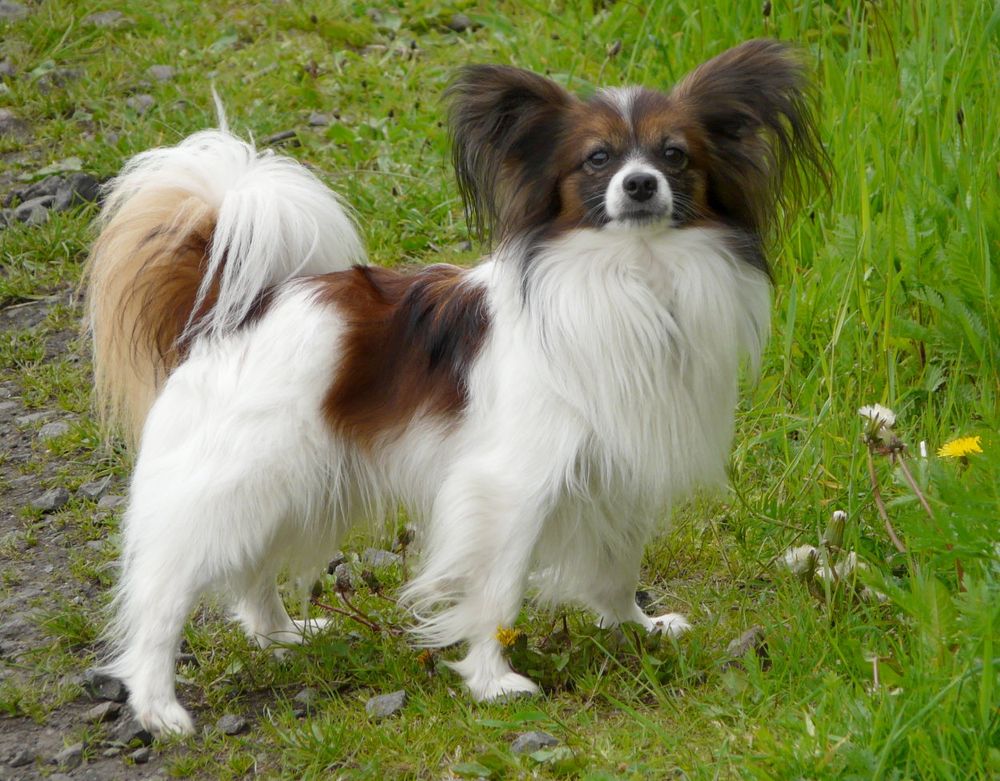
- Long, wavy and glossy, with no undercoat: short on the face, with a ruff on the neck, fringed ears and feathered thighs.Fédération Cynologique Internationale
- Energy
- ModerateThe Royal Kennel Club
- Indian heat
- Copes with careScientific Reports (2020)study
- Flats
- Suits a flatThe Royal Kennel Club
Papillon snapshot for a sitter
| What | The rule | Source |
|---|---|---|
| Size | Small, says The Royal Kennel Club. AKC gives 8 to 11 inches and 5 to 10 pounds; the FCI standard gives about 28 cm at the withers. | American Kennel Club |
| Exercise need | Up to 30 minutes a day (The Royal Kennel Club), but AKC rates energy 4 of 5 and mental stimulation needs 5 of 5: play matters as much as walks. | The Royal Kennel Club |
| Alone-time tolerance | Low. AKC calls the Papillon a companion dog at heart that may be unhappy and develop unwanted behaviour if left alone for long periods. | American Kennel Club |
| Coat | Long, wavy and glossy, without an undercoat (FCI). AKC says it needs surprisingly little grooming. | Fédération Cynologique Internationale |
| Barking | AKC rates barking 5 of 5, the top of its scale, and watchdog nature 4 of 5. | American Kennel Club |
| With people | AKC rates openness to strangers 5 of 5 and good with young children 5 of 5, but warns a child can easily hurt so small a dog. | American Kennel Club |
| Lifespan | 14 to 16 years (AKC); over 12 years (The Royal Kennel Club). | American Kennel Club |
Where does the Papillon come from?
The Papillon is a Continental Toy Spaniel, and the FCI standard gives its origin as France and Belgium. The Royal Kennel Club says it was also known as the dwarf spaniel and was a favourite of European royal courts: Madame de Pompadour and Queen Marie Antoinette both owned them.
The breed comes in two varieties with the same body and coat. The Papillon, French for butterfly, has erect ears set like open wings; the Phalène, named for a moth, has drop ears. The FCI covers both under one standard and lists the breed's use simply as toy. The Royal Kennel Club adds that it is highly intelligent and does well in obedience and agility.
How did the Papillon come to India?
No source we found records when or how the Papillon reached India; its arrival here is not documented. The Kennel Club of India registers pedigree dogs of recognised breeds through its single-dog and litter forms.
As a dog under 10 kg it starts with an advantage in Indian heat: in a UK study of 905,543 dogs, dogs under 10 kg had the lowest odds of heat-related illness. It suits flat life, as The Royal Kennel Club rates it for a flat or apartment with no garden needed. The AKC rates its barking at 5 of 5, which a sitter or neighbour in a housing society will notice.
What care does a Papillon need?
The three things that shape a good day for this breed.
Exercise
Up to 30 minutes a day, says The Royal Kennel Club, but the AKC rates its energy 4 of 5 and its need for mental stimulation 5 of 5, so add fetch, food puzzles and short training games to the walks. The Royal Kennel Club
Grooming
More than once a week (The Royal Kennel Club): brush behind the ears and on the thighs, where mats form. The AKC says nails grow quickly and the dewclaw can pierce the leg, and that regular tooth brushing is vital for the breed. American Kennel Club
Training
The Royal Kennel Club calls it highly intelligent and successful in obedience and agility. The AKC says it is a companion at heart that may be unhappy and develop unwanted habits if left alone for long. Train with short, rewarding sessions and teach a quiet cue early. The Royal Kennel Club
How much should a Papillon eat?
Daily calories for a healthy, neutered adult Papillon, worked out from its weight with the formula vets use (70 x weight in kg to the power 0.75, then AAHA's factor for a neutered adult). Divide by the kcal per kg on your food's pack for grams a day, and adjust by body shape.
| Resting need (kcal a day) | Neutered adult (kcal a day) | |
|---|---|---|
| 1.5 kg AAHA (American Animal Hospital Association) | 90 | 130 to 150 |
| 3.3 kg | 170 | 240 to 270 |
| 5 kg | 230 | 330 to 370 |
Feed a complete and balanced small-breed food, with puppy food until adulthood, as the Merck Veterinary Manual advises. A Papillon's whole day of calories is small, so a few biscuits or a piece of roti from the table is a large share: keep treats under about 10% of daily calories, as WSAVA suggests. Never give onion or garlic, grapes, raisins or tamarind, chocolate, or anything sweetened with xylitol. The energy table below gives the daily calories for this weight range; ask your vet to fine-tune the amount. Meals a day: 6 to 12 weeks, 4 a day; 3 to 6 months, 3 a day; 6 to 12 months, 2 a day; adult, 2 a day. Puppies, kittens, working, pregnant and older animals need different amounts: ask your vet, or use Petym's food calculator.
Which illnesses is the Papillon prone to, and how are they treated?
The conditions veterinary studies and breed surveys most often report in the Papillon. Knowing the early signs means a vet sees it sooner.
See your vet first. This is general information from veterinary sources, not a diagnosis. Only a vet who has examined your pet can say what is wrong and prescribe treatment, and this page never gives a dose. Do not give your pet human medicine. If your pet seems very unwell, go to a 24-hour vet: find one in your city.
Patellar luxation (slipping kneecap)
Ask at a routine checkThe kneecap slips out of its groove. In a VetCompass study, Toy group breeds had 3.7 times the odds of breeds outside the Kennel Club groups, and dogs under 10 kg had 2.8 times the odds of dogs of 10 to 19.9 kg. The AKC lists it among the Papillon's screened conditions. Canine Genetics and Epidemiology (2016), RVC VetCompassstudy
Signs to watch for
- Skipping on a back leg for a few steps, then walking normally
- Holding a back leg up
- Bow legs in a young puppy
How a vet treats it
A vet feels the kneecap move during an orthopaedic exam and may take x-rays. ACVS says kneecaps that slip without signs are usually monitored, while surgery to deepen the groove and realign the kneecap is most often considered from grade 2 upward.
Prevention
Keep the dog lean and use a ramp or lift it down from beds and sofas.
Progressive retinal atrophy (PRA)
Ask at a routine checkAn inherited degeneration of the retina. Merck lists the Papillon among breeds in which signs appear at 3 to 5 years, and The Royal Kennel Club recommends a DNA test for the Papillon form (pap-PRA) before breeding. Merck Veterinary Manual
Signs to watch for
- Night blindness first
- Bumping into things in dim light
- Cloudy eyes later, as cataracts form
How a vet treats it
A vet examines the back of the eye and may confirm it with electroretinography. Merck says no effective treatment is available, so care is about helping the dog live well with failing sight: a stable layout at home and a lead on walks.
Prevention
Buy from DNA-tested parents.
Dental disease
Ask at a routine checkTartar and gum infection that loosen teeth. Merck says small-breed dogs usually have more problems with periodontitis than large breeds, and the AKC calls regular tooth brushing vital for the Papillon. Merck Veterinary Manual
Signs to watch for
- Bad breath
- Red or purple, swollen gums
- Dropping food or chewing on one side
How a vet treats it
The vet may take x-rays of the jaw to check bone loss. Merck says gum disease is treated with a thorough professional cleaning above and below the gum line under anaesthesia, and extractions are often needed in periodontitis.
Prevention
Merck recommends daily tooth brushing at home.
Von Willebrand disease
See a vet soonAn inherited bleeding disorder caused by a faulty clotting factor. Merck calls it the most common inherited bleeding disorder in dogs, and The Royal Kennel Club recommends a DNA test for it (vWD1) in Papillons. Merck Veterinary Manual
Signs to watch for
- Bleeding gums or nosebleeds
- Blood in the urine
- Heavy bleeding after an injection, surgery or a torn nail
How a vet treats it
Laboratory tests confirm it. Merck says active bleeding may need a transfusion of whole blood or plasma, and some dogs with type 1 disease respond to a medicine called desmopressin. Tell any vet before surgery or dental work.
Prevention
Buy from DNA-tested parents.
Papillon or Phalène: the same breed, two ear types
If your dog has drop ears, this page is still for you.
The FCI standard covers the Continental Toy Spaniel in two varieties: the Papillon, with erect ears set high and open like a butterfly's wings, and the Phalène, with hanging ears. The Royal Kennel Club explains the names: papillon is French for butterfly, and the drop-eared Phalène is named after the folded wings of a moth. Both share the same size, coat and care needs.
The breed was a favourite of European royal courts, but the Royal Kennel Club also calls it highly intelligent and successful in obedience and agility. That is the part a sitter needs to plan for. A Papillon is not an ornament: it wants to learn, play and be with its people.
How long can a Papillon be left alone?
Not for long days. It is a companion breed, and many bark when lonely.
AKC describes the Papillon as a companion dog at heart that may be unhappy and develop unwanted behaviour if left alone for long periods, and rates its barking at the top of its 1 to 5 scale. In a flat with thin walls and close neighbours that combination shows up fast. PDSA's general advice is no more than 4 hours alone for any dog, and it lists barking, whining, toileting indoors, drooling and trembling among the signs of separation distress.
The good news is that AKC also says a Papillon can bond with other pets as well as people and is very open to strangers. A sitter who sits on the floor at the meet and greet and lets the dog come over usually makes a friend in minutes. On a working day, a drop-in visit with a game of fetch in the corridor can break a long stretch alone; for a trip, a sitter living in the home keeps the dog company and the noise down.
Why a sitter watches a Papillon's knees and jumps
AKC lists slipping kneecaps among the breed's screened conditions. A large VetCompass study shows how size and type affect the risk.
3.7 x
the odds of patellar luxation for Kennel Club Toy group dogs, against breeds outside the Kennel Club groups Canine Genetics and Epidemiology (2016), RVC VetCompassstudy
2.8 x
the odds for dogs under 10 kg compared with dogs of 10 to 19.9 kg Canine Genetics and Epidemiology (2016), RVC VetCompassstudy
1.3 %
of all dogs in the study had patellar luxation diagnosed Canine Genetics and Epidemiology (2016), RVC VetCompassstudy
14 to 16 years
AKC's life expectancy for the Papillon American Kennel Club
Keeping a toy dog safe in an Indian home
AKC warns that Papillons are tough and gutsy but very small. Most injuries happen at home.
Do
- Lift the dog down from sofas and beds, or use a ramp or step, and block steep stairs. AKC says owners must be careful around stairs and furniture. American Kennel Club
- Watch where you step and close doors slowly; a small dog follows you everywhere.
- Keep it on a leash and pick it up when a big dog or a pack of community dogs approaches. AKC notes Papillons do not seem to realise how small they are. American Kennel Club
- Check the balcony grille, gate gaps and the space under the main door: a very small dog fits through surprising gaps.
Don’t
- Do not let visiting children carry the dog; AKC says a small child can hurt a Papillon very easily. American Kennel Club
- Do not leave it alone with a large dog, even a friendly one.
- Do not leave small objects, chicken bones or medicines on low tables. ASPCA Animal Poison Control
- Do not walk it on a hot road in the afternoon: test with the back of your hand for seven seconds. The Royal Kennel Club
A Papillon's day of play, step by step
Petym’s working from the official rules, no government publishes a total.
AKC rates this breed 5 of 5 for mental stimulation needs. A short walk plus games keeps it content. Petym's suggested plan for a sitter.
Early walk
Fifteen minutes in the cool morning, on a harness rather than a collar, with time to sniff the compound garden.
Breakfast puzzle
Part of the measured breakfast in a food toy or scattered on a mat, so the dog works for it.
Fetch in the hallway
A small soft ball thrown down a corridor. AKC says a Papillon quickly learns to bring it back for another throw. American Kennel Club
A short training game
Five minutes of tricks the owner uses, such as sit, spin or touch, rewarded with tiny treats.
Rest
Quiet time in its bed with the curtains drawn on hot afternoons.
Evening walk and check
A second short walk after sunset, then a look at paws, ears and the hair behind the ears and on the thighs, where mats form.
Papillon health signs a sitter should report
Note it, tell the owner, and call the vet for anything sudden.
If Skipping on a back leg, holding it up for a few steps, then walking normally: a sign of a kneecap slipping. AKC lists patellar luxation for the breed.
Tell the owner and note how often it happens. Call the vet if the dog is in pain or will not use the leg. American College of Veterinary Surgeons
If Crying, limping or not using a leg after a jump or fall from furniture.
Keep the dog still and call the vet. The Royal Kennel Club describes the breed as elegant and fine boned. The Royal Kennel Club
If Bad breath, red gums or dropping food. AKC calls regular tooth brushing vital for this breed.
Follow the owner's brushing routine and note it for the vet. American Kennel Club
If A long dewclaw curling towards the leg. AKC says Papillon nails grow quickly and the dewclaw can pierce the leg.
Tell the owner; a vet or groomer can trim it. American Kennel Club
If Cloudy eyes, bumping into things, or coughing and tiring easily. The breed club notes eye and heart disease.
Not usually an emergency unless sudden; tell the owner so they can see the vet. American Kennel Club
If Heavy panting, drooling or weakness on a hot day.
Dogs under 10 kg had the lowest heatstroke odds in a UK study, but any dog can overheat. Shade, cool water and the vet. Scientific Reports (2020)study
Papillon sitter checklist
- Harness and leash, and the rule about picking the dog up near big dogs.
- Furniture it may jump off, the ramp or steps it uses, and doors to keep shut.
- Meal portions, treat allowance and the food toys it likes.
- Tooth-brushing routine and the comb for behind the ears and the thighs.
- What sets off barking, and what calms it: a radio, a covered window, a chew.
- Tick prevention product and next due date.
- The vet's number and the nearest 24-hour vet on Petym's list for your city.
Which Petym service suits a Papillon?
Often the right fit
Overnight pet sitting
The sitter stays in your home: company most of the time, the same furniture rules and no big dogs to dodge.
Drop-in visits
A game, a toilet break and a short walk on a long workday.
Pet boarding
In a sitter's home without large dogs, after a free meet and greet; ask about the pet limit.
Doggy day care
Only where small dogs are kept apart from large ones.
Breeds with similar care needs to the Papillon
Going away soon? Tell us your dates.
A checked local sitter feeds, walks and keeps your pet company at home, follows your care sheet to the letter and sends a photo every day. Petym is opening city by city: send your dates and we will tell you when a sitter can take them.
- Meet your sitter first, free
- PAN-checked, first-aid trained
- A photo every day
- Pay through Petym, never cash


Questions owners ask
Is a Papillon good for a flat in India?
- Yes, in size: The Royal Kennel Club lists it as suited to a flat, with up to 30 minutes of exercise a day. But AKC rates its barking 5 of 5, so plan games and company to keep it calm, and make the flat safe for a very small dog.
How long can a Papillon be left alone?
- Short spells only. AKC calls it a companion dog at heart that may be unhappy and develop unwanted behaviour if left alone for long periods, and PDSA's general limit is 4 hours. On long days, book a drop-in visit or a home sitter.
Does a Papillon shed or need much grooming?
- It sheds, but grooming is light. The coat has no undercoat, and AKC says grooming every month or so is fine, with a quick comb behind the ears, inside the hind legs and on the thighs where mats form. Brush the teeth regularly.
Is a Papillon good with children?
- AKC rates it 5 of 5 with young children, but warns a small child can hurt a Papillon very easily. Supervise every visit, keep children seated when they hold the dog, and never let them carry it around.
Do Papillons cope with Indian heat?
- Better than heavy, thick-coated breeds: dogs under 10 kg had the lowest odds of heat-related illness in a large UK study. They can still overheat, so walk in the cool hours, check the road with your hand and keep water and shade available.
What health problems do Papillons have?
- AKC lists slipping kneecaps (patellar luxation), an open fontanel in some puppies, and eye and heart disease. Toy dogs had 3.7 times the odds of patellar luxation in a UK study. Prevent falls, brush the teeth, and call your vet about limping.
Papillon or Phalène: what is the difference?
- Only the ears. The FCI standard treats both as varieties of the Continental Toy Spaniel: the Papillon has erect, butterfly-like ears and the Phalène has drooping ears, named after a moth's folded wings. Care needs are the same.
Keep reading
- Dog care hub
- Separation anxiety in dogs
- Pets in housing societies
- Chihuahua careAnother toy dog with knee risks.
- Pomeranian careA small dog with fragile legs.
- Drop-in visits
- Meet and greet checklist
Services that help
Free tools for this
Words on this page, explained
Keep exploring
Other dog breeds
- Akita
- Alaskan Malamute
- American Bully
- American Cocker Spaniel
- American Pit Bull Terrier
- Australian Shepherd
- Bakharwal dog
- Basset Hound
- Beagle
- Belgian Malinois
- Bernese Mountain Dog
- Bichon Frise
- Border Collie
- Boston Terrier
- Boxer
- Bull Terrier
- Bulldog
- Bullmastiff
- Cane Corso
- Caucasian Shepherd Dog
- Cavalier King Charles Spaniel
- Chihuahua
- Chippiparai
- Chow Chow
- Cocker Spaniel
- Dachshund
- Dalmatian
- Dobermann
- Dogo Argentino
- English Mastiff
- English Springer Spaniel
- French Bulldog
- Gaddi Kutta (Gaddi dog)
- German Shepherd
- Golden Retriever
- Great Dane
- Greyhound
- Havanese
- Indian pariah dog (Indie)
- Indian Spitz
- Irish Setter
- Jack Russell Terrier
- Kangal
- Kanni
- Kombai
- Labrador Retriever
- Lhasa Apso
- Maltese
- Miniature Pinscher
- Miniature Schnauzer
- Mudhol Hound
- Neapolitan Mastiff
- Newfoundland
- Pekingese
- Pembroke Welsh Corgi
- Pomeranian
- Poodle
- Pug
- Rajapalayam
- Rampur Greyhound
- Rhodesian Ridgeback
- Rottweiler
- Saint Bernard
- Samoyed
- Shar Pei
- Shiba Inu
- Shih Tzu
- Siberian Husky
- Tibetan Mastiff
- Weimaraner
- West Highland White Terrier
- Whippet
- Yorkshire Terrier
Sources
Each source was opened and read on the date shown. How Petym checks its sources
- Fédération Cynologique Internationale: FCI-Standard No 77: Continental Toy Spaniel (Papillon and Phalène) (opens in a new tab)
- American Kennel Club: Papillon dog breed information (opens in a new tab)
- The Royal Kennel Club: Papillon: breed information (opens in a new tab)
- The Kennel Club of India: KCI Form C/1: application for registration of a single dog (opens in a new tab)
- Merck Veterinary Manual: Puppy care (opens in a new tab)
- WSAVA: Frequently asked questions and myths (Global Nutrition Committee) (opens in a new tab)
Show all 20 sourcesShow fewer
- Merck Veterinary Manual: Garlic and onion (Allium spp) toxicosis in animals (opens in a new tab)
- Merck Veterinary Manual: Grape, raisin, and tamarind (Vitis spp, Tamarindus spp) toxicosis in dogs (full review September 2024) (opens in a new tab)
- ASPCA Animal Poison Control: People foods to avoid feeding your pets (opens in a new tab)
- VCA Animal Hospitals: Feeding times and frequency for your dog (opens in a new tab)
- AAHA (American Animal Hospital Association): 2021 AAHA Nutrition and Weight Management Guidelines for Dogs and Cats: energy requirement calculations (Box 1, PDF) (opens in a new tab)
- Merck Veterinary Manual: Nutritional requirements of small animals (full review November 2023, updated September 2024) (opens in a new tab)
- American College of Veterinary Surgeons: Patellar Luxation (Dislocating Kneecap) in Dogs | ACVS (opens in a new tab)
- Merck Veterinary Manual: Disorders of the retina, choroid and optic disk in dogs (dog owners; updated September 2024) (opens in a new tab)
- Merck Veterinary Manual: Dental disorders of dogs (dog owners; full review May 2018, updated October 2025) (opens in a new tab)
- Merck Veterinary Manual: Bleeding disorders of dogs (dog owners; updated June 2026) (opens in a new tab)
- PDSA: Separation anxiety in dogs (opens in a new tab)
- The Royal Kennel Club: The danger of hot pavements (opens in a new tab)
- Scientific Reports (2020): Incidence and risk factors for heat-related illness in UK dogs (opens in a new tab)
- Canine Genetics and Epidemiology (2016), RVC VetCompass: The epidemiology of patellar luxation in dogs attending primary-care veterinary practices in England (opens in a new tab)