Gaddi Kutta care in India: heat, flats and sitters
Updated By PetymFacts checked against official sources on
Quick answer
The Gaddi dog is a black, thick-coated flock guardian of the Gaddi shepherds of Himachal Pradesh, registered as an Indian breed by ICAR-NBAGR in 2025. Researchers describe it as territorial, dominant and reserved, and say it is not suited to apartment living. With a sitter it needs a cool home, one trusted person and careful handling of visitors.
It was shaped by Himalayan pastures, not the plains in May. No study has measured how it copes with Indian summer heat, so plan for it.
- Meet your sitter first, free
- PAN-checked, first-aid trained
- A photo every day
- Pay through Petym, never cash

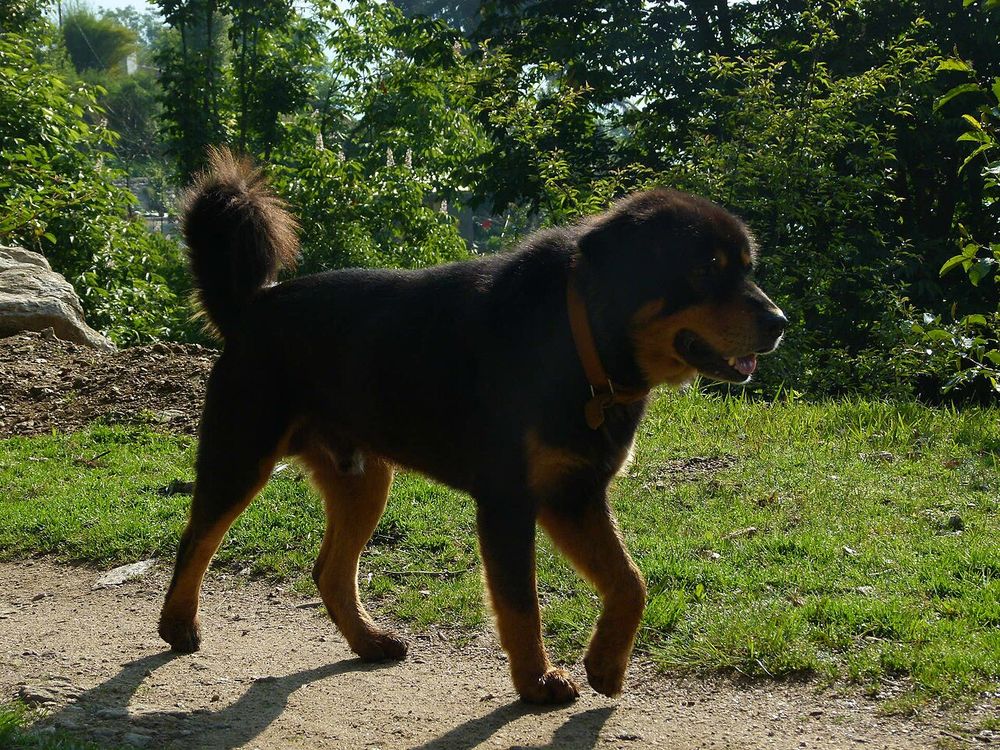
- Indian breed
- Developed in India
- Origin
- Himachal Pradesh, India (western Himalayas)ICAR-National Bureau of Animal Genetic Resources
- Adult weight
- 28 to 40 kg (2022 field study: adult females 28 to 35 kg, adult males 32 to 40 kg)Indian Journal of Animal Sciences (2022), CSK Himachal Pradesh Agricultural Universitystudy
- Height
- 56 to 61 cm (Average height at the withers in the 2022 study: about 56 cm for females, 61 cm for males)Indian Journal of Animal Sciences (2022), CSK Himachal Pradesh Agricultural Universitystudy
- Coat
- Mostly black, sometimes with white on the feet, tail or trunk, or brown. A solid mane, a thick undercoat with a double coat around the throat and shoulders, and a fluffy tail curled over the back.Indian Journal of Animal Sciences (2022), CSK Himachal Pradesh Agricultural Universitystudy
- Energy
- HighIndian Journal of Animal Sciences (2022), CSK Himachal Pradesh Agricultural Universitystudy
- Indian heat
- Copes with carePDSA
Gaddi dog snapshot
| What | The rule | Source |
|---|---|---|
| Size | In the 2022 study, adult males averaged 38.7 kg and about 61 cm (24 inches) at the withers, females 32.3 kg and about 56 cm. The authors call it medium-sized and less bulky than a Tibetan Mastiff. | Indian Journal of Animal Sciences (2022), CSK Himachal Pradesh Agricultural Universitystudy |
| Registered as a breed | Yes, by ICAR-NBAGR, with accession number INDIA_DOG_0600_GADDI_19004 and Himachal Pradesh as its home tract. | ICAR-National Bureau of Animal Genetic Resources |
| Temperament | Territorial, dominant and reserved; very alert to wild animals and unknown people. | Indian Journal of Animal Sciences (2022), CSK Himachal Pradesh Agricultural Universitystudy |
| Flat living | Not suitable, the study's authors write, because of its dominant and territorial nature. | Indian Journal of Animal Sciences (2022), CSK Himachal Pradesh Agricultural Universitystudy |
| Coat | Mostly black, sometimes with white on the feet, tail or trunk, or brown. A solid mane, a thick undercoat and a fluffy tail curled over the back. | Indian Journal of Animal Sciences (2022), CSK Himachal Pradesh Agricultural Universitystudy |
| Alone-time tolerance | Not studied. PDSA's general advice for any dog is no more than 4 hours alone at a time. | PDSA |
Where does the Gaddi Kutta (Gaddi dog) come from?
The Gaddi dog is the working dog of the Gaddi, transhumant shepherds of sheep and goats who take their name from Gadderan, the Bharmour area of Himachal Pradesh. A 2022 study by CSK Himachal Pradesh Agricultural University says there are many stories about its origin, but the most likely is that the Gaddi shepherds developed it themselves on their migrations through the Himalayan ranges. The study calls it native to Himachal Pradesh, Uttarakhand and Jammu.
The dog may be related to the Tibetan Mastiff, the authors write, but it grew apart through its use: longer legs, higher hocks, less bulk and more agility, suited to long migrations from high pastures to the foothills. Its double coat around the throat and shoulders lets it cross glaciers and stand snowstorms, and its thick, arched neck protects it from predators. Almost every flock in the study had at least two Gaddi dogs, and some had six.
Its job was, and is, to guard the flock. The dogs sleep beside the sheep and goats, look sleepy, and respond at once to wild predators or strangers. The study also describes a smaller, friendlier landrace that shepherds call baan or van Gaddi, which it says is not true to type.
How did the Gaddi Kutta (Gaddi dog) come to India?
The Gaddi is an Indian breed from the start. ICAR-NBAGR's Breed Registration Committee approved it at its meeting of 6 January 2025, it was gazette notified on 15 April 2025, and it carries accession number INDIA_DOG_0600_GADDI_19004 with Himachal Pradesh as its home. NBAGR lists it in the Chamba, Kangra, Kullu, Mandi, Lahaul and Spiti and Kinnaur districts, mainly reared as a guarding dog.
Most Gaddi dogs still live with migrating flocks, and shepherds do not follow a strict vaccination or deworming schedule, the 2022 study found. Some people keep them as guard or companion dogs in the foothills, which the authors say takes earnest effort from the start. A 2023 Tribune (PTI) report said the central armed police forces were trialling the Gaddi, with other Indian breeds, as working dogs.
What care does a Gaddi Kutta (Gaddi dog) need?
The three things that shape a good day for this breed.
Exercise
It was bred to walk with flocks on long Himalayan migrations, so it needs long daily walks and a job to do; no study gives an hour figure. In the plains, walk only before sunrise and after dark in summer. Indian Journal of Animal Sciences (2022), CSK Himachal Pradesh Agricultural Universitystudy
Grooming
The thick undercoat and mane shed and trap damp. Brush often, especially as the seasons turn and in the monsoon, and dry the coat to the skin after rain. Do not shave a double coat. Texas A&M College of Veterinary Medicine (Pet Talk, 16 June 2022)
Training
The 2022 study calls the Gaddi territorial, dominant and reserved, very alert to wild animals and strangers, and not suited to apartment living. Training as a guard or companion takes earnest effort and care from puppyhood. Indian Journal of Animal Sciences (2022), CSK Himachal Pradesh Agricultural Universitystudy
How much should a Gaddi Kutta (Gaddi dog) eat?
Daily calories for a healthy, neutered adult Gaddi Kutta (Gaddi dog), worked out from its weight with the formula vets use (70 x weight in kg to the power 0.75, then AAHA's factor for a neutered adult). Divide by the kcal per kg on your food's pack for grams a day, and adjust by body shape.
| Resting need (kcal a day) | Neutered adult (kcal a day) | |
|---|---|---|
| 28 kg AAHA (American Animal Hospital Association) | 850 | 1190 to 1360 |
| 34 kg | 990 | 1380 to 1580 |
| 40 kg | 1110 | 1560 to 1780 |
On the migration routes, shepherds feed their dogs what they cook for themselves: maize roti, flatbread, goat milk or cheese and sometimes rice, mostly twice a day, with mutton or chicken now and then; growing pups and nursing mothers get goat milk. At home, WSAVA's advice is a complete and balanced diet, since home-cooked food can lack nutrients unless a vet nutritionist has designed it. The energy table on this page gives a starting point for an adult's daily calories. If your dog eats rotis or rice from the family kitchen, keep onion and garlic out of anything it shares, and no grapes, raisins, chocolate or xylitol, as ASPCA warns. Keep a heavy, thick-coated dog lean: a UK study found dogs heavier than their breed mean were at greater risk of heat-related illness. Meals a day: 6 to 12 weeks, 4 a day; 3 to 6 months, 3 a day; 6 to 12 months, 2 a day; adult, 2 a day, as shepherds feed them. Puppies, kittens, working, pregnant and older animals need different amounts: ask your vet, or use Petym's food calculator.
Which illnesses is the Gaddi Kutta (Gaddi dog) prone to, and how are they treated?
The conditions veterinary studies and breed surveys most often report in the Gaddi Kutta (Gaddi dog). Knowing the early signs means a vet sees it sooner.
See your vet first. This is general information from veterinary sources, not a diagnosis. Only a vet who has examined your pet can say what is wrong and prescribe treatment, and this page never gives a dose. Do not give your pet human medicine. If your pet seems very unwell, go to a 24-hour vet: find one in your city.
Heatstroke
Emergency: go to a vet nowNo study has measured heat tolerance in the Gaddi. PDSA lists thick-coated and long-haired dogs among those at greater risk, and the breed was shaped by Himalayan cold, not the plains in May. PDSA
Signs to watch for
- Heavy panting that does not settle
- Drooling, vomiting or diarrhoea
- Weakness, wobbling or collapse
- Confusion or seizures
How a vet treats it
PDSA says cool the dog at once with cool water over the body and moving air, then get to the vet. A vet keeps cooling the dog and may give fluids through a drip, oxygen and other medicines, with blood tests for organ damage.
Prevention
Walk in the cool hours only, give a cool room and plenty of water, keep the undercoat brushed out and keep the dog lean.
Hot spots and skin problems
See a vet soonShepherds told researchers that skin problems were not very frequent and came mostly in the lower, warmer part of the migration. VCA says matted coats that trap water after rain are linked to hot spots, red, oozing sores that can spread within hours. Indian Journal of Animal Sciences (2022), CSK Himachal Pradesh Agricultural Universitystudy
Signs to watch for
- A red, moist, smelly patch, often hidden under thick fur
- Licking, chewing or scratching one spot
How a vet treats it
A vet clips the hair around the sore and cleans it, applies topical antibiotics and drying treatment, may prescribe oral antibiotics and anti-itch or anti-inflammatory medicine, and fits a cone to stop licking. The underlying cause, such as fleas or allergy, is treated too.
Prevention
Brush out loose undercoat and dry the coat to the skin after rain or a bath.
Ticks and tick-borne disease
See a vet soonA dense coat hides ticks well, and ticks were found on 53% of dogs in a survey of four Indian cities. Ticks spread diseases such as ehrlichiosis and can cause anaemia when heavy. Parasites & Vectors (2011)study
Signs to watch for
- Ticks on the ears, neck, armpits or toes
- A red or swollen bite site
- Dullness, fever or pale gums
How a vet treats it
A vet removes ticks and recommends an anti-tick product suited to the dog, and tests for tick-borne disease even after only a few ticks. Merck says a heavily infested dog should see a vet promptly and may need a clinic stay.
Prevention
Check the coat after every walk and keep tick prevention up to date as your vet advises.
Canine parvovirus
Emergency: go to a vet nowA highly contagious virus causing severe vomiting and diarrhoea, most common in unvaccinated puppies. The 2022 study found shepherds do not follow a strict vaccination schedule, so a Gaddi pup's history may be incomplete. Cornell University College of Veterinary Medicine
Signs to watch for
- Tiredness and loss of appetite
- Vomiting
- Diarrhoea, often with blood
- Weakness and dehydration
How a vet treats it
A vet confirms it with a quick faecal test. Cornell says treatment is ideally in hospital: intravenous fluids, the cornerstone of care, with anti-nausea medicine, pain relief and antibiotics against secondary infection. Most dogs do not survive without treatment.
Prevention
Vaccination is the main protection. Ask your vet to bring a new Gaddi dog's vaccines up to date.
Where the Gaddi dog comes from
A working dog of the transhumant Gaddi shepherds, now one of India's registered dog breeds.
ICAR-NBAGR's newsletter says the Gaddi dog is found in the Chamba, Kangra, Kullu, Mandi, Lahaul-Spiti and Kinnaur districts of Himachal Pradesh, takes its name from the Gaddi tribe and is mainly reared as a guarding dog. NBAGR's Breed Registration Committee approved it on 6 January 2025, and it was gazette notified on 15 April 2025, making it the fourth Indian dog breed on the register after the Rajapalayam, Chippiparai and Mudhol Hound.
A 2022 study by scientists at CSK Himachal Pradesh Agricultural University, Palampur, followed shepherds on their migration routes through the Dhauladhar range. Almost every flock had at least two Gaddi dogs. The dogs travel with the sheep and goats from alpine pastures to the foothills, sleep beside the flock, and respond at once to predators or strangers. Their mane and thick coat around the throat and shoulders, the authors write, let them cross glaciers and withstand snowstorms.
Down To Earth reported in January 2025 that the population may be under 1,000 dogs, a figure Petym could not confirm from a primary source. The study notes that local mixing with Tibetan Mastiff types is widespread, so a puppy sold as Gaddi may not look or behave like the dogs on the migration routes.
Can a Gaddi dog live in a city flat with a sitter?
The researchers say it is not suited to apartment living. If yours does live in one, the sitter's plan has to allow for that.
The 2022 study is unusually direct: because the Gaddi dog is very alert to wild animals and unknown persons, it can be a problem for visitors, and being very dominant and territorial it is not suitable for apartment living. It also says that keeping one as a guard or companion in the foothills takes earnest effort and training from the start.
For a sitter, that means a careful introduction and no surprises. Use Petym's free meet and greet at home, with you present, and plan a second visit if you can. The sitter should arrive with you, sit quietly and let the dog approach. Deliveries, cleaners and guests are kept out of the dog's space for the whole trip, and the dog is never left loose in a common corridor or garden.
Overnight sitting in your own home is usually the only sensible choice. Moving a territorial guardian into a stranger's house, with other dogs and new smells, invites conflict.
A Himalayan dog through the Indian year
No study has measured heat tolerance in this breed. This plan is Petym's, built on the study and on general heat advice.
| March to June | Monsoon | October to February | |
|---|---|---|---|
| Walks | Before sunrise and after dark only; short and slow | Between showers; avoid flooded lanes | The easiest season; longer walks are fine |
| Home | The coolest room, a fan or AC, water in heavy bowls | Dry bedding off the floor; dry the coat to the skin | A draught-free corner; most Gaddi dogs enjoy the cold |
| Coat Texas A&M College of Veterinary Medicine (Pet Talk, 16 June 2022) | Brush out loose undercoat often; do not shave to the skin | Check under the mane for damp, smelly skin | Brush weekly; expect a heavy shed as seasons turn |
| Watch for | Heavy panting, drooling, collapse | Ticks, hot spots under the coat | Stiffness in older dogs |
Petym's working, based on the sources on this page. Heat risk rises with weight: a large UK study found dogs over 50 kg at greater risk of heat-related illness.
Health signs a Gaddi dog's sitter should act on
Shepherds told researchers that skin problems were not very frequent and occurred mostly in the lower, warmer part of the migration. The plains in summer are lower and warmer still.
If Heavy panting that does not settle, thick drool, a bright red tongue, wobbling or collapse.
Heatstroke: cool room, cool water poured over the body, a fan, and the nearest 24-hour vet straight away. PDSA
If Red, moist or smelly skin under the mane or thick coat, or constant scratching.
Part the coat, photograph it, tell the owner and call the vet. The study notes skin trouble mostly in the lower, warmer tract. Indian Journal of Animal Sciences (2022), CSK Himachal Pradesh Agricultural Universitystudy
If Fever, dullness or pale gums after ticks, which hide easily in a dense coat.
Call the vet the same day. Check the ears, neck, armpits and toes after every walk. Merck Veterinary Manual
If Vomiting, diarrhoea or not eating, in a dog whose vaccines may be incomplete. Shepherds in the study did not follow a strict vaccination or deworming schedule.
Call the vet and take the vaccination card. Ask your vet to bring vaccines up to date before you travel. Indian Journal of Animal Sciences (2022), CSK Himachal Pradesh Agricultural Universitystudy
If A bite or wound after a scuffle with another dog.
Keep the dog apart, call the owner and have any bite checked by a vet.
Feeding a Gaddi dog: what shepherds do and what a sitter should do
On the migration routes, the dogs eat what the shepherds cook. At home, keep to the food you already give.
Do
- Know the tradition: shepherds in the study fed maize roti, flatbread, goat milk or cheese and sometimes rice, twice a day, with mutton or chicken now and then. Indian Journal of Animal Sciences (2022), CSK Himachal Pradesh Agricultural Universitystudy
- Write down your dog's own food, portions and times, and ask the sitter to log each meal.
- Keep the food unchanged for the whole stay. PDSA
- Keep the dog lean: the UK heat study found higher bodyweight relative to the breed mean raised the risk of heat-related illness. Scientific Reports (2020)study
Don’t
- No onion or garlic in shared rotis, dal or sabzi, and no grapes, raisins, chocolate or xylitol. ASPCA Animal Poison Control
- Do not feed near other pets or take the bowl away from a dog that guards its food.
- Do not exercise hard in the heat right after a meal.
Gaddi dog sitter checklist
- How the dog behaves at the door and gate, with visitors, and with other dogs.
- Which rooms are its territory, and where visitors must not go.
- Leash, collar and any muzzle it accepts for vet visits.
- The coolest room, the AC or fan settings, and what to do in a power cut.
- Brush and comb, and how often to use them in the hot months.
- Vaccination card, deworming and tick prevention dates.
- Your vet's number and the nearest 24-hour vet on Petym's city list.
Which Petym service suits a Gaddi dog?
If Your Gaddi dog guards the home and distrusts strangers
Overnight pet sitting at home with one sitter it has met. No other dogs, no guests. Overnight sitting
If You are away by day but home at night
Dog walking at dawn and after dark with the same walker. Dog walking
If Your dog needs medicines or is recovering from illness
Special-needs pet care, with the vet's plan followed and logged. Special-needs care
Breeds with similar care needs to the Gaddi Kutta (Gaddi dog)
Going away soon? Tell us your dates.
A checked local sitter feeds, walks and keeps your pet company at home, follows your care sheet to the letter and sends a photo every day. Petym is opening city by city: send your dates and we will tell you when a sitter can take them.
- Meet your sitter first, free
- PAN-checked, first-aid trained
- A photo every day
- Pay through Petym, never cash


Questions owners ask
Is the Gaddi dog a registered Indian breed?
- Yes. ICAR-NBAGR registered the Gaddi dog from Himachal Pradesh at its Breed Registration Committee meeting of 6 January 2025, with accession number INDIA_DOG_0600_GADDI_19004, and it was gazette notified on 15 April 2025. It was the fourth Indian dog breed on the register.
Is a Gaddi dog good for a flat?
- Researchers who studied the breed say it is not suitable for apartment living, because it is very dominant and territorial and very alert to unknown people. If yours lives in a flat, keep visitors out of its space, walk it at quiet times and choose a sitter who stays in your home.
Can a Gaddi dog survive the Indian summer?
- No study has measured its heat tolerance. It is a thick-coated dog bred for Himalayan pastures, and a large UK study found heavier dogs at greater risk of heat-related illness. Keep it in the coolest room, walk only before sunrise and after dark, and watch closely for heavy panting.
Should I shave my Gaddi dog in summer?
- Not to the skin. Texas A&M's veterinary college says a thick coat helps a dog regulate its temperature and that shaving can make some dogs less tolerant of heat. Brushing out the loose undercoat often, and a cool room, help more. Ask your groomer and vet about a trim.
Is the Gaddi dog the same as a Tibetan Mastiff?
- No. The 2022 study says the Gaddi dog may be related to the Tibetan Mastiff but has longer legs, higher hocks, less bulk and more agility. It also warns that mixing with mastiff types is common, so some dogs sold as Gaddi are hard to tell apart.
How big is a Gaddi dog?
- In the 2022 study, adult males averaged 38.7 kg and about 61 cm at the withers, and females 32.3 kg and about 56 cm. The authors give a range of 32 to 40 kg for adult males and 28 to 35 kg for females.
Are Gaddi dogs used by the security forces?
- A PTI report in October 2023 said trials of the Gaddi, alongside the Rampur Hound, Bakharwal, Himachali Shepherd and Tibetan Mastiff, were under way at training centres of the CRPF, SSB, ITBP and BSF. Petym found no later official report of the outcome.
Keep reading
- Bakharwal dog careIts Himalayan cousin from Jammu and Kashmir.
- Tibetan Mastiff care
- Summer pet care in India
- Keeping a dog cool in a power cut
- Pets in housing societies
- Meet and greet checklist
- Overnight pet sitting
Services that help
Free tools for this
Words on this page, explained
Keep exploring
Other dog breeds
- Akita
- Alaskan Malamute
- American Bully
- American Cocker Spaniel
- American Pit Bull Terrier
- Australian Shepherd
- Bakharwal dog
- Basset Hound
- Beagle
- Belgian Malinois
- Bernese Mountain Dog
- Bichon Frise
- Border Collie
- Boston Terrier
- Boxer
- Bull Terrier
- Bulldog
- Bullmastiff
- Cane Corso
- Caucasian Shepherd Dog
- Cavalier King Charles Spaniel
- Chihuahua
- Chippiparai
- Chow Chow
- Cocker Spaniel
- Dachshund
- Dalmatian
- Dobermann
- Dogo Argentino
- English Mastiff
- English Springer Spaniel
- French Bulldog
- German Shepherd
- Golden Retriever
- Great Dane
- Greyhound
- Havanese
- Indian pariah dog (Indie)
- Indian Spitz
- Irish Setter
- Jack Russell Terrier
- Kangal
- Kanni
- Kombai
- Labrador Retriever
- Lhasa Apso
- Maltese
- Miniature Pinscher
- Miniature Schnauzer
- Mudhol Hound
- Neapolitan Mastiff
- Newfoundland
- Papillon
- Pekingese
- Pembroke Welsh Corgi
- Pomeranian
- Poodle
- Pug
- Rajapalayam
- Rampur Greyhound
- Rhodesian Ridgeback
- Rottweiler
- Saint Bernard
- Samoyed
- Shar Pei
- Shiba Inu
- Shih Tzu
- Siberian Husky
- Tibetan Mastiff
- Weimaraner
- West Highland White Terrier
- Whippet
- Yorkshire Terrier
Sources
Each source was opened and read on the date shown. How Petym checks its sources
- ICAR-National Bureau of Animal Genetic Resources: NBAGR Newsletter, January to June 2025 (Gaddi and Changkhi dog registration, gazette notification of 15 April 2025) (opens in a new tab)
- PDSA: Heatstroke in dogs (opens in a new tab)
- Texas A&M College of Veterinary Medicine (Pet Talk, 16 June 2022): Time for a summer cut? Tips for warm weather dog grooming (opens in a new tab)
- WSAVA: Frequently asked questions and myths (Global Nutrition Committee) (opens in a new tab)
- ASPCA Animal Poison Control: People foods to avoid feeding your pets (opens in a new tab)
- Merck Veterinary Manual: Puppy care (opens in a new tab)
Show all 19 sourcesShow fewer
- AAHA (American Animal Hospital Association): 2021 AAHA Nutrition and Weight Management Guidelines for Dogs and Cats: energy requirement calculations (Box 1, PDF) (opens in a new tab)
- Merck Veterinary Manual: Nutritional requirements of small animals (full review November 2023, updated September 2024) (opens in a new tab)
- VCA Animal Hospitals: Hot spots in dogs (updated 10 July 2026) (opens in a new tab)
- Merck Veterinary Manual: Ticks of dogs (opens in a new tab)
- Cornell University College of Veterinary Medicine: Parvovirus: transmission to treatment (Riney Canine Health Center) (opens in a new tab)
- ICAR-National Bureau of Animal Genetic Resources: Dog breeds of India (registered breeds and accession numbers) (opens in a new tab)
- PDSA: Separation anxiety in dogs (opens in a new tab)
- PDSA: Diarrhoea after a change of food (opens in a new tab)
- Indian Journal of Animal Sciences (2022), CSK Himachal Pradesh Agricultural University: Phenotypic characterization and documentation of Gaddi dog of western Himalayan region of India (opens in a new tab)
- Scientific Reports (2020): Incidence and risk factors for heat-related illness in UK dogs (opens in a new tab)
- Parasites & Vectors (2011): A survey of canine tick-borne diseases in India (opens in a new tab)
- The Tribune (PTI): Forget foreign breeds, Indian canines to help CAPFs take a bite out of crime (24 October 2023) (opens in a new tab)
- Down To Earth: Gaddi dog of the Himalayas recognised by ICAR-NBAGR Karnal (9 January 2025) (opens in a new tab)