Jack Russell Terrier care in India: exercise, heat and time alone
Updated By PetymFacts checked against official sources on
Quick answer
A Jack Russell is small but needs at least an hour of exercise a day, and PDSA says it should never be left alone for more than four hours. While you travel, it needs a sitter who walks it early and late to avoid Indian heat, keeps it on lead around cats and squirrels, and checks every gate and gap.
The breed is lively, bold and fearless, with a strong prey drive and a love of digging. It is also long-lived: in a UK study it had the longest life expectancy of the breeds analysed.
- Meet your sitter first, free
- PAN-checked, first-aid trained
- A photo every day
- Pay through Petym, never cash

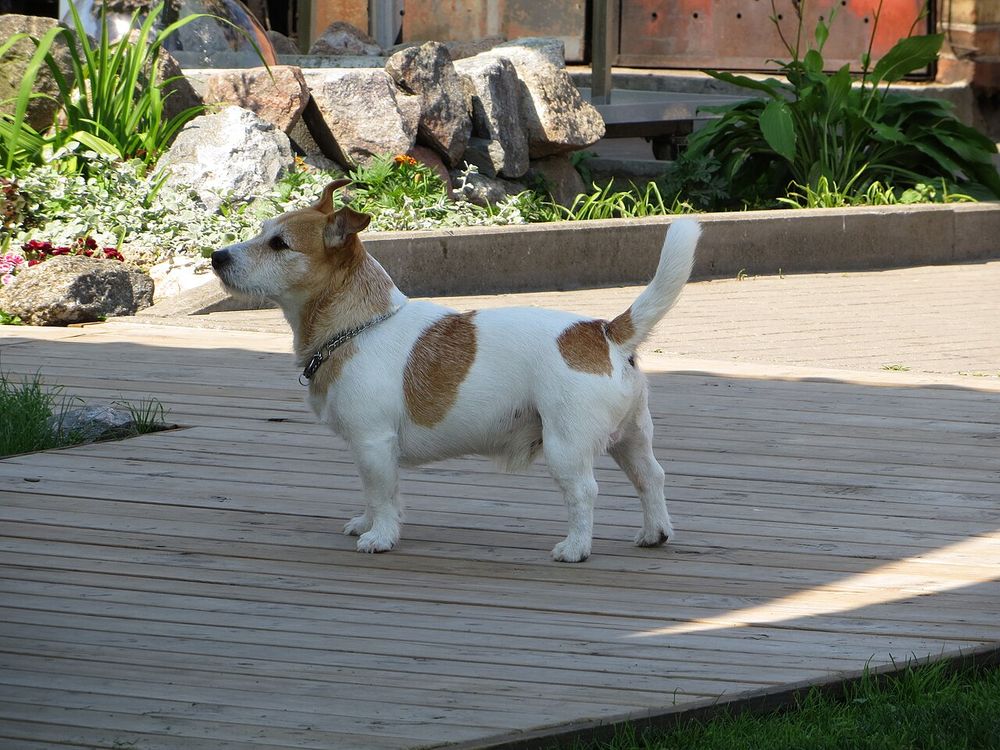
- Origin
- England, with the modern breed developed in Australia (FCI)Fédération Cynologique Internationale
- Adult weight
- 5 to 6 kg (the FCI standard's rule of about 1 kg for every 5 cm of height)Fédération Cynologique Internationale
- Height
- 25 to 30 cm (ideal height at the withers)Fédération Cynologique Internationale
- Coat
- Smooth, broken or rough, and weatherproof. White must predominate, with black or tan markings. It sheds; a weekly brush is enough, and rough coats may need hand-stripping.Fédération Cynologique Internationale
- Energy
- HighPDSA
- Indian heat
- Copes with careScientific Reports (2020)study
- Flats
- A flat, with daily exerciseThe Royal Kennel Club
Jack Russell Terrier at a glance
| What | The rule | Source |
|---|---|---|
| Size | Small: 25 to 30 cm at the withers, with about 1 kg for every 5 cm of height, so roughly 5 to 6 kg. | Fédération Cynologique Internationale |
| Exercise | At least an hour a day, according to PDSA; the Kennel Club says up to an hour. | PDSA |
| Alone-time tolerance | Low to moderate: PDSA says a Jack Russell should never be left alone for more than four hours. | PDSA |
| Heat tolerance | Not a high-risk breed in the UK heat-illness study, but small dogs close to hot ground still need early and late walks. | Scientific Reports (2020)study |
| Coat and shedding | Short, smooth, broken or rough; sheds. A weekly brush is enough. | The Royal Kennel Club |
| Sociability | Lively, alert and friendly but quietly confident; strong prey drive towards small animals. | Fédération Cynologique Internationale |
Where does the Jack Russell Terrier come from?
The FCI standard says the Jack Russell originated in England in the 1800s through the Reverend John Russell, who developed a strain of Fox Terriers to run with his foxhounds and go to ground to bolt the fox and other quarry from their dens. Two types grew from his dogs: the taller, squarer Parson Russell Terrier and the shorter, slightly longer Jack Russell Terrier.
The Royal Kennel Club says many of these working terriers were taken to Australia in the 1960s and 1970s, where a show type developed; the FCI recognised the Australian type in 1991 and names Australia as the country of development. The Royal Kennel Club recognised the breed only in 2016. PDSA notes that Jack Russells have always been mainly working dogs, and the FCI describes a good working terrier and an excellent companion: lively, alert, bold and fearless, friendly but quietly confident. It is long-lived: in a UK study of dogs that died between 2016 and 2020, Jack Russells had the longest life expectancy at birth of the 18 breeds analysed, 12.7 years; PDSA gives over 10 years.
How did the Jack Russell Terrier come to India?
No source we could find records when or how the Jack Russell came to India. It is a pedigree breed from Britain and Australia, and pedigree dogs in India are registered with The Kennel Club of India on its single-dog and litter forms.
What is documented suits Indian city life: The Royal Kennel Club lists the breed as suited to a flat, and PDSA gives at least an hour of exercise a day. It is not among the high-risk breeds in the UK heat-illness study, where flat-faced breeds and the Chow Chow were, but a small dog walks close to hot tarmac, so summer walks belong before sunrise and after dark.
What care does a Jack Russell Terrier need?
The three things that shape a good day for this breed.
Exercise
At least an hour a day, says PDSA, split between walks and off-lead running in a secure area, plus play and training. PDSA warns of a high prey drive and a talent for squeezing through small gaps, so keep it on a lead near roads, community dogs and cats. PDSA
Grooming
A weekly brush is plenty, says PDSA; shedding rises in spring and autumn, and rough-coated dogs may need professional stripping. Check for ticks after walks. PDSA
Training
PDSA says Jack Russells respond really well to positive, reward-based training from a young age, with the whole household consistent and early socialisation. Give it jobs: sniffing games, puzzle toys and short training sessions use up a terrier's drive. PDSA
How much should a Jack Russell Terrier eat?
Daily calories for a healthy, neutered adult Jack Russell Terrier, worked out from its weight with the formula vets use (70 x weight in kg to the power 0.75, then AAHA's factor for a neutered adult). Divide by the kcal per kg on your food's pack for grams a day, and adjust by body shape.
| Resting need (kcal a day) | Neutered adult (kcal a day) | |
|---|---|---|
| 5 kg AAHA (American Animal Hospital Association) | 230 | 330 to 370 |
| 5.5 kg | 250 | 350 to 400 |
| 6 kg | 270 | 380 to 430 |
PDSA advises a complete, balanced dog food, with portions set with your vet, two meals a day at regular times and a gap between eating and exercise. Treats should stay under 10% of the daily calories, and meals should be cut back on days with more treats. A 5 to 6 kg dog needs very little extra to gain weight. From the Indian kitchen, keep onion and garlic, chocolate, grapes and raisins, chai and coffee, salty snacks and anything with xylitol away from the dog, as the ASPCA advises. Change foods slowly over several days to avoid diarrhoea. Meals a day: puppy, 6 to 12 weeks, 4 a day; 3 to 6 months, 3 a day; 6 to 12 months, 2 a day; adult, 2 a day. Puppies, kittens, working, pregnant and older animals need different amounts: ask your vet, or use Petym's food calculator.
Which illnesses is the Jack Russell Terrier prone to, and how are they treated?
The conditions veterinary studies and breed surveys most often report in the Jack Russell Terrier. Knowing the early signs means a vet sees it sooner.
See your vet first. This is general information from veterinary sources, not a diagnosis. Only a vet who has examined your pet can say what is wrong and prescribe treatment, and this page never gives a dose. Do not give your pet human medicine. If your pet seems very unwell, go to a 24-hour vet: find one in your city.
Primary lens luxation (PLL)
Emergency: go to a vet nowAn inherited, painful eye condition in which the lens slips out of place because its supporting fibres weaken. Cornell names the Jack Russell among predisposed terriers; it usually appears between three and eight years, and The Royal Kennel Club lists a DNA test for it. Cornell University College of Veterinary Medicine (Riney Canine Health Center)
Signs to watch for
- A red, painful eye, squinting or keeping it shut
- A sudden change in the size or shape of the pupil
- A cloudy or enlarged eye, more tears or pawing at the eye
- Loss of vision
How a vet treats it
A vet examines the eye and measures the pressure inside it; a specialist may use an eye ultrasound. Cornell says a lens that moves forward is an emergency because it can quickly cause glaucoma: the vet starts medicine to lower eye pressure and refers the dog to an eye specialist, and surgery to remove the lens is the usual treatment, often with long-term eye drops.
Prevention
DNA testing of breeding dogs for the ADAMTS17 variant. Ask the breeder for the parents' PLL results.
Slipping kneecap (patellar luxation)
See a vet soonThe kneecap slides out of its groove when the knee bends. In English primary-care records 1.7% of Jack Russells had it, with 1.5 times the odds of crossbred dogs. Canine Genetics and Epidemiology (2016), Royal Veterinary Collegestudy
Signs to watch for
- Suddenly carrying a back leg for a few steps, a skip, then walking normally
- Lameness that becomes constant as it worsens
How a vet treats it
A vet diagnoses it by feeling an unstable kneecap, sometimes with x-rays. ACVS says a kneecap that causes no signs is monitored; surgery, usually considered from grade 2, can rebuild the soft tissues, deepen the groove or move the bony attachment of the kneecap.
Prevention
Keep the dog lean and have the knees checked at routine visits.
Legg-Calve-Perthes disease
See a vet soonThe head of the thigh bone, the ball of the hip, dies back from a poor blood supply. Merck says it usually affects young small-breed dogs, especially terriers, between 4 and 11 months old, and is often on both sides. PDSA lists it for the breed. Merck Veterinary Manual
Signs to watch for
- Hind leg lameness in a young dog
- Wasting of the thigh muscles
- Pain when the hip is moved
How a vet treats it
A vet confirms it on x-rays. Merck says the recommended treatment is surgery to remove the femoral head and neck (FHO), followed early by physical therapy; total hip replacement is another option. Rest alone fully works in fewer than a quarter of dogs, and the outlook after surgery is excellent.
Congenital deafness
Ask at a routine checkIn 1,009 Jack Russells tested with the BAER hearing test, 3.57% were deaf in one ear and 0.50% in both. Deafness was linked to white coat colour and to the parents' hearing, which points to an inherited form. The Veterinary Journal (2012)study
Signs to watch for
- Not waking or turning to sounds
- Startling when touched from behind
- Deafness in one ear often shows no clear sign
How a vet treats it
A vet or specialist confirms it with a BAER hearing test. It is lifelong and has no treatment; care is about a lead near roads, hand signals and waking the dog gently.
Prevention
Breeding from BAER-tested dogs. Ask the breeder whether the puppy was tested.
How long can a Jack Russell be left alone?
No more than four hours at a time, PDSA says. For a trip, that means someone has to come in several times a day or stay.
The FCI standard describes the Jack Russell as a lively, alert and active terrier, bold and fearless, bred as a working terrier able to go to ground after quarry. PDSA adds the details owners know well: a high prey drive, a love of chasing, running and digging, and barking when excited. A bored terrier left alone for a long day will usually find a job, and the job may be your sofa cushions or the door frame.
PDSA's separation anxiety guidance says dogs should not be left alone for more than four hours at a time, and suggests a pet sitter or dog walker for longer absences. Its signs of separation anxiety include barking, whining and howling, toileting in the house, destructive chewing or digging at items, panting and trembling. A sitter who sees these should tell you, not punish the dog.
In a housing society, the barking matters for another reason: neighbours. A Jack Russell that is walked properly and has company for most of the day is much quieter than one left alone from morning to evening.
A walking plan for a Jack Russell in Indian heat
An hour a day, split around the coolest parts of the day. The sitter tests the ground before every walk.
Early morning (before about 8 am in summer)
The main walk, 30 to 40 minutes, on lead. Sniffing time counts: let the dog explore at its own pace for part of it. The Royal Kennel Club
Before stepping out
Place the back of your hand on the road or pavement for seven seconds. If it is too hot for your hand, it is too hot for paws. The Royal Kennel Club
Midday
Indoors only in summer: a short toilet break in shade, fresh water, and a game such as a scent search for part of its food. The Animal Welfare Board of India names burns from hot surfaces among summer risks. Animal Welfare Board of India
Late afternoon
Play indoors or in a shaded, fenced space: tug, fetch in a corridor, or a food puzzle.
Evening (after sunset)
The second walk, 20 to 30 minutes. Choose grass over tarmac where you can. The Royal Kennel Club
Bedtime
A last toilet break, a check of water bowls, and doors and gates locked.
What should a sitter watch for on walks?
Do
- Keep the dog on a secure lead and harness outside the home. PDSA says Jack Russells have a high prey drive and love to chase. PDSA
- Check gates, grilles and balcony gaps before the first walk; PDSA notes they can squeeze through the smallest gap. PDSA
- Pick a route away from community dogs' territory and colony cats, and cross the road if a group of street dogs is ahead.
- Carry water for both of you on the evening walk in summer.
- Check for ticks after every walk, especially in the monsoon.
Don’t
- Do not walk on hot tarmac in the middle of the day. The Royal Kennel Club
- Do not let the dog off lead in an unfenced park, however good its recall at home.
- Do not leave it tied outside a shop or in a parked car.
- Do not let it dig in society gardens or flower beds treated with chemicals.
Which health problems should a Jack Russell's sitter know about?
The breed is generally long-lived, but some inherited conditions are linked to it. A sitter notices and calls; the vet decides.
If A suddenly red, painful, cloudy or bulging eye, squinting or rubbing at the face. Primary lens luxation is an inherited eye condition in the breed, with a DNA test.
Treat as an emergency and go to the vet the same day. Do not wait for the owner to return. The Royal Kennel Club
If Skipping on a back leg for a few steps, or holding a leg up then carrying on. Jack Russells had higher odds of patellar luxation than crossbreeds in a UK study.
Note when it happens and tell the owner; call the vet if the dog is lame for more than a few steps or seems in pain. Canine Genetics and Epidemiology (2016), Royal Veterinary Collegestudy
If A young dog, under about a year, lame on a back leg. Merck says aseptic necrosis of the femoral head (Legg-Calvé-Perthes) affects young small-breed dogs, especially terriers, between 4 and 11 months.
Call the vet. Rest the dog and do not walk it far until it has been seen. Merck Veterinary Manual
If Wobbliness, a stumbling or high-stepping walk, or poor balance. The Kennel Club lists DNA tests for late-onset ataxia and spinocerebellar ataxia in the breed.
Call the vet and tell the owner. Keep the dog away from stairs and balconies. The Royal Kennel Club
If Not responding to its name or to sounds. Congenital deafness was found in about 4% of Jack Russells tested in one study, and was linked to white coat colour.
Not an emergency if known. Ask the owner how the dog is called; a deaf dog must never be off lead. The Veterinary Journal (2012)study
If Heavy panting, drooling, wobbling, vomiting or collapse on a hot day.
Heatstroke: move the dog to a cool place, pour plenty of cool water over it, use a fan, and go to the vet at once. Animal Welfare Board of India
Jack Russell health in numbers
12.72 years
Life expectancy at birth for Jack Russells in a UK study, the longest of the breeds analysed Scientific Reports (2022), Royal Veterinary College VetCompassstudy
1.7 %
Share of Jack Russells with patellar luxation in English primary-care records Canine Genetics and Epidemiology (2016), Royal Veterinary Collegestudy
4 hours
The most PDSA says a Jack Russell should be left alone PDSA
Does a Jack Russell cope with Indian heat?
Better than many breeds, on the evidence available. In a large UK study of heat-related illness in dogs, the Jack Russell did not have significantly higher odds than the Labrador, while flat-faced breeds such as the Pug and Bulldog, and the thick-coated Chow Chow, did. That was a UK study, though, and no Indian data exists. A small dog walks close to a road surface that can be far hotter than the air.
The Animal Welfare Board of India's 2026 heat advisory names dehydration, heatstroke and burns from hot surfaces as summer risks for dogs, asks for shade throughout the day and clean water in stable bowls that cannot be knocked over, and lists excessive panting, lethargy, drooling, a rapid heartbeat and collapse as signs that need a vet straight away.
In the monsoon, the problems change: wet paws, ticks and muddy walks. A short coat dries quickly, but the sitter should still towel the dog after wet walks and check between its toes and in its ears.
Feeding a Jack Russell while you are away
Keep the food, the amounts and the times exactly as they are, and write them down. A sudden change of food is a common cause of diarrhoea, and a sitter should never switch brands because a shop has run out: leave enough for the trip and a few days more.
Many Jack Russells are keen on food. If you use part of the daily ration for training or food puzzles, tell the sitter, and ask them to take treats out of the day's food rather than adding them. Keep foods toxic to dogs out of reach. ASPCA Animal Poison Control warns that grapes and raisins can lead to kidney damage, xylitol can cause low blood sugar and liver damage, darker chocolate carries greater risk, and onion and garlic can damage red blood cells. Mithai, chocolate gifts and guests' snacks around Diwali are a common source, so ask the sitter to keep the kitchen and dining table clear.
Jack Russell sitter checklist
- Vet and nearest 24-hour vet details, with the vaccination card (DHPPi, rabies) and tick prevention dates.
- Lead, harness, poo bags and a towel by the door.
- Walk times and routes, and which areas to avoid because of street dogs or cats.
- Which gaps, gates and balcony grilles the dog has tried before. PDSA
- Food, amounts and times, plus the treat allowance.
- Toys and games the dog likes, and which ones it destroys.
- Whether the dog is deaf in one or both ears, and how it is called if so. The Veterinary Journal (2012)study
- What the dog does when anxious, and the plan if it barks for long periods.
Which Petym service suits a Jack Russell?
Trips of a night or more
Overnight pet sitting
A sitter stays in your home, so the dog is not alone for long stretches and keeps its own routine, walks and bed.
Workdays
Dog walking
One or two walks in the cooler hours on days you are out for long. Suits a dog that is fine at night with you home.
Long days
Doggy day care
A day in a sitter's home with company and play, for a terrier that struggles alone.
If home is not an option
Pet boarding
Your dog stays in a sitter's home that Petym has checked, with secure doors and gates.
Breeds with similar care needs to the Jack Russell Terrier
Going away soon? Tell us your dates.
A checked local sitter feeds, walks and keeps your pet company at home, follows your care sheet to the letter and sends a photo every day. Petym is opening city by city: send your dates and we will tell you when a sitter can take them.
- Meet your sitter first, free
- PAN-checked, first-aid trained
- A photo every day
- Pay through Petym, never cash


Questions owners ask
How long can I leave a Jack Russell alone?
- PDSA says a Jack Russell should never be left alone for more than four hours. For longer days, arrange a dog walker or day care; for trips, a sitter who stays in your home or visits often. Signs that the dog is struggling include barking, chewing, digging and toileting indoors.
How much exercise does a Jack Russell need?
- At least an hour a day, according to PDSA. In Indian summers, split it into an early morning walk and an evening walk after sunset, with indoor games in between. Test the road with the back of your hand for seven seconds before you go out.
Can a Jack Russell live in a flat in India?
- Yes. The Kennel Club lists the breed as suited to a flat or apartment. It needs proper daily exercise and mental work, secure doors and balcony grilles, and someone at home or a walker during long working days so that it does not bark through the day.
Is a Jack Russell good in Indian heat?
- It is not among the high-risk breeds in the UK heat-illness study, where flat-faced and very thick-coated breeds were. But no Indian data exists, and any dog can get heatstroke. Walk early and late, avoid hot tarmac, and keep shade and water available all day.
What health problems do Jack Russells have?
- PDSA and the Kennel Club name primary lens luxation, patellar luxation, Legg-Calvé-Perthes disease and two forms of ataxia, and a study found congenital deafness linked to white coat colour. The breed is long-lived. A sitter should treat a sudden painful eye as an emergency and report lameness or wobbliness.
Should my Jack Russell go off lead with a sitter?
- Not outside a fully fenced area. PDSA says the breed has a high prey drive and can squeeze through the smallest gap. Indian streets have cats, squirrels, community dogs and traffic, and a terrier that bolts after one can be lost or hurt in seconds.
Which Petym service is right for my Jack Russell?
- For a trip of a night or more, overnight pet sitting in your home, so the dog is not alone for long. For workdays, dog walking or doggy day care. Choose pet boarding only if the sitter's home has secure gates and doors, which you can see for yourself at the free meet and greet.
Keep reading
Services that help
- Overnight pet sittingA sitter sleeps in your home and keeps your pet's routine going.
- Dog walking30 or 60 minute one-to-one walks, your dog only, at your dog's times.
- Doggy day care in a sitter's homeDaytime care for your dog in a sitter's home while you work.
- Pet boarding in a sitter's homeYour pet stays in a checked sitter's home, not a kennel.
Free tools for this
Words on this page, explained
Keep exploring
Other dog breeds
- Akita
- Alaskan Malamute
- American Bully
- American Cocker Spaniel
- American Pit Bull Terrier
- Australian Shepherd
- Bakharwal dog
- Basset Hound
- Beagle
- Belgian Malinois
- Bernese Mountain Dog
- Bichon Frise
- Border Collie
- Boston Terrier
- Boxer
- Bull Terrier
- Bulldog
- Bullmastiff
- Cane Corso
- Caucasian Shepherd Dog
- Cavalier King Charles Spaniel
- Chihuahua
- Chippiparai
- Chow Chow
- Cocker Spaniel
- Dachshund
- Dalmatian
- Dobermann
- Dogo Argentino
- English Mastiff
- English Springer Spaniel
- French Bulldog
- Gaddi Kutta (Gaddi dog)
- German Shepherd
- Golden Retriever
- Great Dane
- Greyhound
- Havanese
- Indian pariah dog (Indie)
- Indian Spitz
- Irish Setter
- Kangal
- Kanni
- Kombai
- Labrador Retriever
- Lhasa Apso
- Maltese
- Miniature Pinscher
- Miniature Schnauzer
- Mudhol Hound
- Neapolitan Mastiff
- Newfoundland
- Papillon
- Pekingese
- Pembroke Welsh Corgi
- Pomeranian
- Poodle
- Pug
- Rajapalayam
- Rampur Greyhound
- Rhodesian Ridgeback
- Rottweiler
- Saint Bernard
- Samoyed
- Shar Pei
- Shiba Inu
- Shih Tzu
- Siberian Husky
- Tibetan Mastiff
- Weimaraner
- West Highland White Terrier
- Whippet
- Yorkshire Terrier
Sources
Each source was opened and read on the date shown. How Petym checks its sources
- Fédération Cynologique Internationale: FCI standard No. 345: Jack Russell Terrier (8 October 2012) (opens in a new tab)
- PDSA: Jack Russell Terrier (opens in a new tab)
- The Royal Kennel Club: Jack Russell Terrier: breeds A to Z (opens in a new tab)
- The Kennel Club of India: KCI Form C/1: application for registration of a single dog (opens in a new tab)
- The Kennel Club of India: KCI Form C: application for registration of more than one dog from the same litter (opens in a new tab)
- The Royal Kennel Club: The danger of hot pavements (opens in a new tab)
Show all 20 sourcesShow fewer
- ASPCA Animal Poison Control: People foods to avoid feeding your pets (opens in a new tab)
- PDSA: Diarrhoea after a change of food (opens in a new tab)
- Merck Veterinary Manual: Puppy care (opens in a new tab)
- AAHA (American Animal Hospital Association): 2021 AAHA Nutrition and Weight Management Guidelines for Dogs and Cats: energy requirement calculations (Box 1, PDF) (opens in a new tab)
- Merck Veterinary Manual: Nutritional requirements of small animals (full review November 2023, updated September 2024) (opens in a new tab)
- Cornell University College of Veterinary Medicine (Riney Canine Health Center): Primary lens luxation (opens in a new tab)
- American College of Veterinary Surgeons: Patellar Luxation (Dislocating Kneecap) in Dogs | ACVS (opens in a new tab)
- Merck Veterinary Manual: Aseptic necrosis of the femoral head in dogs (opens in a new tab)
- PDSA: Separation anxiety in dogs (opens in a new tab)
- Animal Welfare Board of India: Request to ensure care and protection of animals from direct heat during extreme hot weather (4 May 2026) (opens in a new tab)
- Scientific Reports (2020): Incidence and risk factors for heat-related illness in UK dogs (opens in a new tab)
- Scientific Reports (2022), Royal Veterinary College VetCompass: Life tables of annual life expectancy and mortality for companion dogs in the United Kingdom (PubMed record read) (opens in a new tab)
- Canine Genetics and Epidemiology (2016), Royal Veterinary College: The epidemiology of patellar luxation in dogs attending primary-care veterinary practices in England (opens in a new tab)
- The Veterinary Journal (2012): Congenital deafness in Jack Russell terriers: prevalence and association with phenotype (abstract read) (opens in a new tab)