Neapolitan Mastiff care in India: heat, folds and your sitter
Updated By PetymFacts checked against official sources on
Quick answer
A Neapolitan Mastiff needs a sitter who keeps it cool, clean and calm. The AKC says this big, heavily built breed overheats easily, is wary with strangers and steady with its family. In India that means a cool room all day, short walks at dawn and after dark, daily fold care, and a meet and greet first.
The breed's loose skin and heavy lips mean towels, not just a water bowl. Bloat and eye problems are the health issues a sitter most needs to recognise.
- Meet your sitter first, free
- PAN-checked, first-aid trained
- A photo every day
- Pay through Petym, never cash

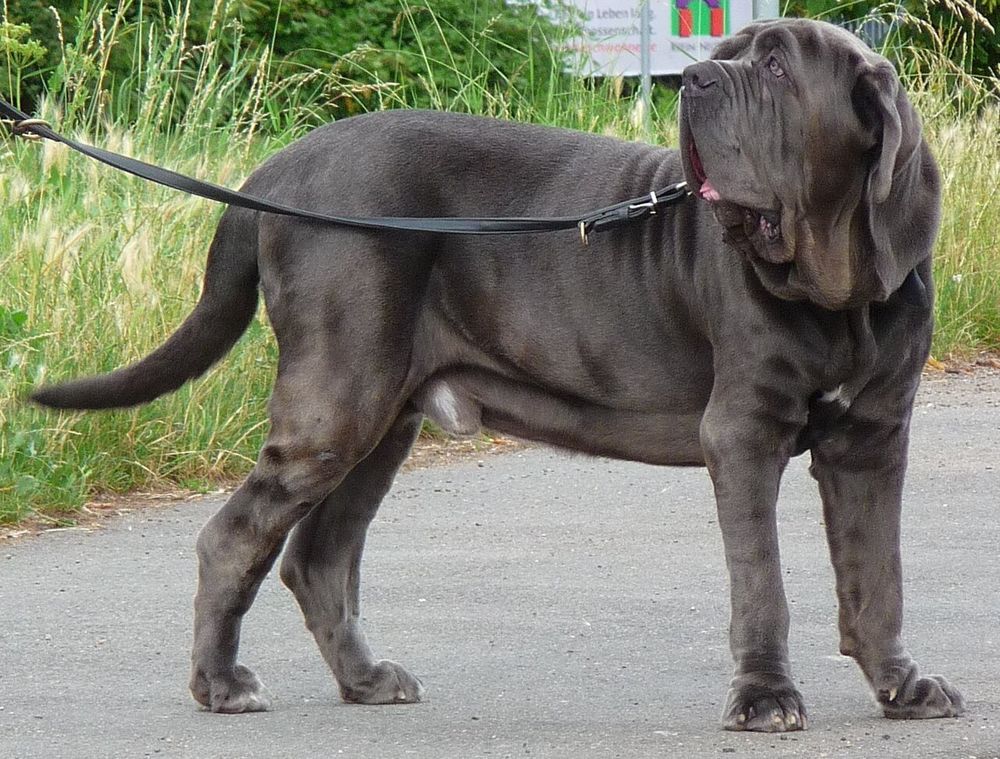
- Origin
- Naples and the countryside around Vesuvius, southern ItalyFédération Cynologique Internationale
- Adult weight
- 50 to 70 kg (females 50 to 60 kg, males 60 to 70 kg (FCI standard))Fédération Cynologique Internationale
- Height
- 60 to 75 cm (females 60 to 68 cm, males 65 to 75 cm at the withers)Fédération Cynologique Internationale
- Lifespan
- 7 to 9 yearsAmerican Kennel Club
- Coat
- Short, hard and dense, no longer than 1.5 cm, over loose skin with deep folds on the head and a double dewlap. Grey, lead grey, black, brown, fawn and deep fawn, which may be brindled.Fédération Cynologique Internationale
- Energy
- LowAmerican Kennel Club
- Indian heat
- Struggles in heatAmerican Kennel Club
- Flats
- Needs spaceThe Royal Kennel Club
Neapolitan Mastiff snapshot
| What | The rule | Source |
|---|---|---|
| Size | Giant. The AKC gives 26 to 31 inches and about 150 pounds (68 kg) for males, 24 to 29 inches and about 110 pounds for females. | American Kennel Club |
| Exercise need | Up to 1 hour a day, says The Royal Kennel Club; the AKC rates its energy 2 out of 5. | The Royal Kennel Club |
| Heat | The AKC says it is a big, heavily built breed that overheats easily, so be careful in warm weather. | American Kennel Club |
| With people | Wary with strangers; sweet, placid and steady among loved ones (AKC). | American Kennel Club |
| Coat and drool | Short coat, groom once a week (Royal Kennel Club). The AKC gives drooling its top score, 5 out of 5. | The Royal Kennel Club |
| Lifespan | Under 10 years (Royal Kennel Club); the AKC gives 7 to 9 years. | The Royal Kennel Club |
Where does the Neapolitan Mastiff come from?
The FCI standard traces the Neapolitan Mastiff to the great Roman mastiff that the writer Columella described in the first century AD. Spread across Europe with the Roman legions it fought beside, that dog is held to be the ancestor of many European mastiff breeds. The Royal Kennel Club repeats the tradition that the breed led Roman legions into war.
The type survived for centuries in the countryside at the foot of Vesuvius and around Naples, kept as a guard of farms and property. After the Second World War a group of enthusiasts set out to rebuild it: the FCI says it has been re-selected since 1947, and The Royal Kennel Club says the Italian painter Piero Scanziani refined it and that it was first shown in Naples in 1946.
It is still bred to guard. The FCI standard lists its use as protection and guard dog and describes it as steady and loyal, not aggressive, vigilant and majestic.
How did the Neapolitan Mastiff come to India?
No source we found records when or how the Neapolitan Mastiff reached India. It lives here as a rare imported guard breed, and the Kennel Club of India registers pedigree dogs of recognised breeds through its single-dog and litter forms.
The breed has come up in India's breed rules. The March 2024 central letter asking states to stop the import, breeding and sale of breeds judged ferocious had a single "Mastiffs (Boerbulls)" entry, which Gurugram's June 2026 order reprints, and it did not name the Neapolitan Mastiff. The Delhi High Court set the circular aside on 16 April 2024, and the Animal Welfare Board of India issued a public notice on reports of a breed ban in March 2024. Check your city's registration rules before you bring one home.
What care does a Neapolitan Mastiff need?
The three things that shape a good day for this breed.
Exercise
Up to 1 hour a day, says The Royal Kennel Club, and the AKC rates its energy 2 out of 5. The AKC warns that lots of running and quick turns can damage the joints, so keep walks slow and short, at dawn and after dark in summer. The Royal Kennel Club
Grooming
Brush the short coat once a week (The Royal Kennel Club). The AKC says you will need a towel to dry the face and lips after every meal or drink, and the folds need wiping and drying daily. American Kennel Club
Training
The AKC says the breed is wary with strangers, does not respond well to harsh training, and needs an encouraging, rewarding atmosphere; breed experts advise against tug-of-war and wrestling with a growing Mastino. Most settle into calm adults by three or four years old. The Royal Kennel Club
How much should a Neapolitan Mastiff eat?
Daily calories for a healthy, neutered adult Neapolitan Mastiff, worked out from its weight with the formula vets use (70 x weight in kg to the power 0.75, then AAHA's factor for a neutered adult). Divide by the kcal per kg on your food's pack for grams a day, and adjust by body shape.
| Resting need (kcal a day) | Neutered adult (kcal a day) | |
|---|---|---|
| 50 kg AAHA (American Animal Hospital Association) | 1320 | 1840 to 2110 |
| 60 kg | 1510 | 2110 to 2410 |
| 70 kg | 1690 | 2370 to 2710 |
Feed a complete and balanced food made for large or giant breeds. Merck says large and giant breed dogs can take almost 2 years to become adults, so ask your vet when to switch from puppy food. The American College of Veterinary Surgeons warns that rapid weight gain from excess nutrition can worsen hip dysplasia, which matters in a breed that grows this fast. Split the day's food into at least two meals and keep exercise away from mealtimes: ACVS links a single large meal once a day and fast eating to bloat in deep-chested dogs. Keep the dog lean, since heavier dogs had higher odds of heat illness in a large UK study, hold treats under about 10% of daily calories (WSAVA), and never feed onion, garlic, grapes, raisins, tamarind, chocolate or xylitol. Meals a day: 6 to 12 weeks, 4 a day; 3 to 6 months, 3 a day; 6 months to about 2 years, 2 to 3 a day; ask your vet when to move to adult food; adult, 2 a day, never one large meal. Puppies, kittens, working, pregnant and older animals need different amounts: ask your vet, or use Petym's food calculator.
Which illnesses is the Neapolitan Mastiff prone to, and how are they treated?
The conditions veterinary studies and breed surveys most often report in the Neapolitan Mastiff. Knowing the early signs means a vet sees it sooner.
See your vet first. This is general information from veterinary sources, not a diagnosis. Only a vet who has examined your pet can say what is wrong and prescribe treatment, and this page never gives a dose. Do not give your pet human medicine. If your pet seems very unwell, go to a 24-hour vet: find one in your city.
Bloat (gastric dilatation-volvulus)
Emergency: go to a vet nowThe stomach fills with gas and can twist on itself. ACVS says deep-chested, large and giant breeds are at higher risk, and the AKC warns that bloat can affect the Neapolitan Mastiff. American College of Veterinary Surgeons
Signs to watch for
- An anxious look or looking at the belly
- Retching with nothing coming up
- A swollen belly
- Collapse
How a vet treats it
ACVS calls it life-threatening and in need of immediate attention. The vet confirms it with abdominal x-rays, stabilises the dog with intravenous fluids and oxygen, releases the gas, often with a stomach tube, then operates to untwist the stomach and fix it to the body wall (gastropexy).
Prevention
Several smaller meals instead of one large one, slow eating, and no hard exercise around meals. ACVS says many surgeons recommend a preventive gastropexy for at-risk breeds, often done at spay or neuter.
Cherry eye
See a vet soonThe tear gland of the third eyelid pops out of the inner corner of the eye. PDSA says it is especially common in mastiffs, and the AKC says it often occurs in this breed. PDSA
Signs to watch for
- A red swelling in the inner corner of the eye
- Rubbing the eye
- Discharge or conjunctivitis
How a vet treats it
PDSA says surgery to stitch the gland back into place is the most common treatment, with eye drops to keep the dog comfortable before and after. Removing the gland is now rarely done because it can cause dry eye.
Hip and elbow dysplasia
See a vet soonLoose, badly formed joints that wear and become arthritic. ACVS says hip dysplasia is most common in large breeds, and The Royal Kennel Club recommends hip and elbow scoring before breeding a Neapolitan Mastiff. American College of Veterinary Surgeons
Signs to watch for
- Limping or stiffness after rest
- Reluctance to rise, jump or climb stairs
- Weight shifted onto the front legs
- Thinner muscles on the hind legs
How a vet treats it
A vet diagnoses it with hip x-rays and a hands-on joint check, sometimes under sedation. ACVS lists keeping the dog lean, gentle lead walks, physiotherapy, anti-inflammatory pain relief prescribed by the vet with blood tests for long-term use, and surgery, from pelvic procedures in young dogs to a total hip replacement.
Prevention
Buy from parents with hip and elbow scores, keep a growing puppy lean, and avoid running, quick turns and jumping off steps.
Heatstroke
Emergency: go to a vet nowThe AKC says this big, heavily built breed overheats easily, and PDSA lists giant breeds and obese dogs among those most at risk. American Kennel Club
Signs to watch for
- Heavy panting that will not settle
- Drooling, vomiting or diarrhoea
- Pale or very red gums, weakness or collapse
How a vet treats it
First aid at once: cool area, cool water over the body away from the nose and mouth, a breeze, then the vet. PDSA says vets cool the dog with cold water, fans and, if needed, a fluid drip, and severe cases may need oxygen, medication or anaesthesia.
Prevention
A cool or air-conditioned room through the day, walks only at dawn and after dark, a lean body and a plan for power cuts.
What kind of dog is the Mastino?
An ancient guard type, rebuilt in Naples after the Second World War, and still bred mainly to watch.
The Royal Kennel Club tells how the Neapolitan Mastiff's forebears were used as fighting dogs and dogs of war, and that it first reached the show ring in Naples, its home, in 1946. The painter Piero Scanziani is credited with stabilising the modern breed. Today, the club says, breeders aim to keep breed type while reducing the exaggeration of loose skin.
The AKC calls it a huge, powerful guarder whose looks have intimidated intruders since ancient Rome, wary with strangers but sweet, placid and steady among loved ones. It says most adults are calm and sleep a lot, while puppies and adolescents are active, curious and strong, and most settle into laid-back adult behaviour by three or four years old.
For an Indian owner, three things follow. The dog needs real protection from heat. It needs a person who will clean its face and folds every day. And it needs its sitter introduced, not simply sent.
Introducing a Neapolitan Mastiff to its sitter
A watchful giant should meet the sitter with you in the room, on its own ground.
The AKC rates the breed 5 out of 5 for protective nature and in the middle of its scale for openness to strangers. Use Petym's free meet and greet to let the dog see you welcome the sitter. The sitter sits, talks quietly to you, and lets the dog come to sniff. A second short visit, with the sitter feeding one meal, is worth the trouble for a guarding breed.
Training matters too. The AKC says Neapolitans do not respond well to harsh training and need an encouraging, rewarding atmosphere, and that breed experts advise against tug-of-war and wrestling, which teach a growing Mastino that it is stronger than its people. Tell the sitter which words your dog knows and which games are off limits.
On time alone, PDSA advises no more than four hours at a stretch for any dog. A Mastino left alone on a hot afternoon in a flat without power is at real risk, so plan for power cuts too.
Keeping a Mastino comfortable in Indian weather
The AKC's warning that the breed overheats easily shapes the whole year.
| Summer | Monsoon | Winter | |
|---|---|---|---|
| Walks American Kennel Club | 10 to 20 minutes at dawn and after dark; stop at heavy panting | Short loops between showers on non-slip ground | Longer gentle walks are fine |
| Folds and face American Kennel Club | Wipe and dry the folds and lips after every meal and drink | Dry folds fully; damp folds smell and can get sore | Daily wipe, dry well |
| Home | AC or the coolest room; a plan for power cuts | Dry bedding off the floor | A thick bed away from draughts |
| Floors | Rugs or mats on slippery tiles for a heavy dog | Wipe paws to avoid slipping indoors | Same: no sliding on marble |
Petym's plan, based on the AKC's care notes and general heat advice. Walk lengths are a guide, not a kennel club figure.
Neapolitan Mastiff health signs a sitter should know
The AKC lists the problems that affect the breed. A sitter spots them early and calls the vet.
If A red, swollen lump in the inner corner of the eye. The AKC says this cherry eye often occurs in the breed and is usually fixed with a minor vet procedure.
Not usually an emergency: tell the owner, keep the dog from rubbing it, and book a vet visit. American Kennel Club
If Retching with nothing coming up, restlessness, heavy drooling and a swollen belly. The AKC warns bloat can affect all deep-chested dogs.
An emergency: the nearest 24-hour vet immediately, calling the owner on the way. American Kennel Club
If Panting that will not settle, a dark tongue, staggering or lying down and refusing to move in the heat.
Heatstroke: shade, cool water poured over the body, a fan, then the vet at once. PDSA
If Limping or stiffness, or a young dog that is suddenly lame. The AKC mentions hip and elbow dysplasia and growing pains (panosteitis) in young Mastini.
Rest on soft ground and call the vet. American Kennel Club
If Tiring quickly, coughing or fainting. Cardiac disease is on the AKC's list, and breeders screen hearts.
Call the vet the same day; collapse is an emergency. American Kennel Club
If Red, smelly or moist skin inside a fold.
Clean and dry it gently, photograph it for the owner, and call the vet if it is sore or spreading.
Daily care for a Mastino: dos and don'ts
Do
- Keep a towel by the water bowl: the AKC says you will need one to dry the face and lips after every meal or drink. American Kennel Club
- Check and gently clean the eyes and ears with a damp cloth when needed. American Kennel Club
- Feed in the number of meals the owner uses; the American College of Veterinary Surgeons lists one large daily meal and fast eating among bloat risk factors. American College of Veterinary Surgeons
- Keep it lean: higher bodyweight for the breed raised the risk of heat-related illness in a large UK study. Scientific Reports (2020)study
Don’t
- No running, quick turns or rough play: the AKC says the joints can be easily damaged. American Kennel Club
- No jumping off steps or racing down stairs, especially for a young dog. American Kennel Club
- No exercise in the afternoon heat, and no car waits with the engine off.
- No onion, garlic, grapes, raisins, chocolate or xylitol. ASPCA Animal Poison Control
Does India's 2024 breed letter cover the Neapolitan Mastiff?
It does not name the breed. Its single mastiff entry reads "Mastiffs (Boerbulls)".
A March 2024 letter from the Department of Animal Husbandry and Dairying asked states to stop the import, breeding and sale of breeds an expert committee had judged ferocious. Gurugram's municipal order of June 2026, which reprints the list, shows a "Mastiffs (Boerbulls)" entry and no mention of the Neapolitan Mastiff by name. Petym cannot say how any particular city would read that entry.
Two High Courts struck the 2024 circular down within days of each other: Karnataka on 10 April and Delhi on 16 April 2024, the latter after the Union agreed to hear objections before any new notification. As of 21 October 2026 Petym had found no fresh notification. If you keep a Mastino, ask your municipal corporation about registration and leash rules, and read Petym's banned breeds page.
Neapolitan Mastiff sitter checklist
- Towels and fold wipes, and how you clean the face, folds and eyes.
- Cool room, AC settings and the power-cut plan.
- Bloat signs and the nearest 24-hour vet, with a vehicle that can carry a giant dog. American College of Veterinary Surgeons
- Meals, portions and times, and no exercise around meals.
- Commands the dog knows, and games that are not allowed.
- Strong leash and collar or harness, and lift and gate rules.
- Vaccination card, tick prevention dates and any eye or joint medicines.
Which Petym service suits a Neapolitan Mastiff?
Most Mastini
Overnight pet sitting
A sitter the dog has met lives in your home, where the AC, the routine and the floors are already right.
Eyes, joints, heart
Special-needs pet care
For a dog with drops, joint medicines or a heart plan, followed and logged.
Short, cool walks
Dog walking
Brief walks at dawn and after dark from a walker who can manage a giant dog.
Breeds with similar care needs to the Neapolitan Mastiff
Going away soon? Tell us your dates.
A checked local sitter feeds, walks and keeps your pet company at home, follows your care sheet to the letter and sends a photo every day. Petym is opening city by city: send your dates and we will tell you when a sitter can take them.
- Meet your sitter first, free
- PAN-checked, first-aid trained
- A photo every day
- Pay through Petym, never cash


Questions owners ask
Can a Neapolitan Mastiff live in India's climate?
- Only with real effort in summer. The AKC says the breed overheats easily and owners must be careful in warm weather. Keep it in an air-conditioned or cool room through the day, walk briefly at dawn and after dark, and have a plan for power cuts.
Is a Neapolitan Mastiff good with strangers?
- Not usually at first. The AKC describes it as wary with strangers and sweet and steady with its family, and rates it 5 out of 5 for protective nature. Introduce a sitter at home with you present, and keep guests away during the stay.
What is cherry eye in a Neapolitan Mastiff?
- Cherry eye is a red, swollen lump in the inner corner of the eye, where tissue pushes out and becomes inflamed. The AKC says it often occurs in the breed and that in most cases there is no permanent damage after a minor vet procedure. Tell your vet if you see it.
How long do Neapolitan Mastiffs live?
- The AKC gives a life expectancy of 7 to 9 years, and The Royal Kennel Club lists under 10 years. Regular vet checks, a lean body and early attention to limping, eye trouble or breathing changes help a short-lived giant breed.
How much exercise does a Neapolitan Mastiff need?
- Not much. The Royal Kennel Club says up to an hour a day and the AKC rates its energy 2 out of 5. The AKC warns against lots of running and quick turns, which can damage joints, and says the breed overheats easily.
How long can a Neapolitan Mastiff be left alone?
- PDSA's general advice for any dog is no more than four hours alone at a time. For a Mastino, the bigger risk is heat: a power cut on a summer afternoon can make a closed flat dangerous, so arrange a sitter who can act.
Is the Neapolitan Mastiff banned in India?
- Petym found no national ban in force on 21 October 2026. The March 2024 central list included "Mastiffs (Boerbulls)" but did not name the Neapolitan Mastiff, and the circular was struck down by the Karnataka and Delhi High Courts in April 2024. Check your local rules.
Keep reading
- English Mastiff care
- Saint Bernard care
- Bulldog careAnother breed with folds that need daily care.
- Banned dog breeds in India
- Keeping a dog cool in a power cut
- Heatstroke in dogs
- Overnight pet sitting
Services that help
Free tools for this
Words on this page, explained
Keep exploring
Other dog breeds
- Akita
- Alaskan Malamute
- American Bully
- American Cocker Spaniel
- American Pit Bull Terrier
- Australian Shepherd
- Bakharwal dog
- Basset Hound
- Beagle
- Belgian Malinois
- Bernese Mountain Dog
- Bichon Frise
- Border Collie
- Boston Terrier
- Boxer
- Bull Terrier
- Bulldog
- Bullmastiff
- Cane Corso
- Caucasian Shepherd Dog
- Cavalier King Charles Spaniel
- Chihuahua
- Chippiparai
- Chow Chow
- Cocker Spaniel
- Dachshund
- Dalmatian
- Dobermann
- Dogo Argentino
- English Mastiff
- English Springer Spaniel
- French Bulldog
- Gaddi Kutta (Gaddi dog)
- German Shepherd
- Golden Retriever
- Great Dane
- Greyhound
- Havanese
- Indian pariah dog (Indie)
- Indian Spitz
- Irish Setter
- Jack Russell Terrier
- Kangal
- Kanni
- Kombai
- Labrador Retriever
- Lhasa Apso
- Maltese
- Miniature Pinscher
- Miniature Schnauzer
- Mudhol Hound
- Newfoundland
- Papillon
- Pekingese
- Pembroke Welsh Corgi
- Pomeranian
- Poodle
- Pug
- Rajapalayam
- Rampur Greyhound
- Rhodesian Ridgeback
- Rottweiler
- Saint Bernard
- Samoyed
- Shar Pei
- Shiba Inu
- Shih Tzu
- Siberian Husky
- Tibetan Mastiff
- Weimaraner
- West Highland White Terrier
- Whippet
- Yorkshire Terrier
Sources
Each source was opened and read on the date shown. How Petym checks its sources
- Fédération Cynologique Internationale: FCI-Standard No 197: Mastino Napoletano (Neapolitan Mastiff), 17 December 2015 (opens in a new tab)
- American Kennel Club: Neapolitan Mastiff: dog breed information (opens in a new tab)
- The Royal Kennel Club: Neapolitan Mastiff: breeds A to Z (opens in a new tab)
- The Kennel Club of India: KCI Form C/1: application for registration of a single dog (opens in a new tab)
- Municipal Corporation Gurugram: Office order on registration and control of pet dogs (23 June 2026) (opens in a new tab)
- High Court of Delhi (order downloaded from the court's server, hosted by LiveLaw): Sikander Singh Thakur v. Union of India, W.P.(C) 4374/2024 and connected matters, order of 16 April 2024 (opens in a new tab)
Show all 20 sourcesShow fewer
- Animal Welfare Board of India: Public notice on news reports of a ban on dog breeds (19 March 2024) (opens in a new tab)
- Merck Veterinary Manual: Puppy care (opens in a new tab)
- American College of Veterinary Surgeons: Canine Hip Dysplasia (opens in a new tab)
- American College of Veterinary Surgeons: Gastric dilatation-volvulus (opens in a new tab)
- WSAVA: Frequently asked questions and myths (Global Nutrition Committee) (opens in a new tab)
- Merck Veterinary Manual: Garlic and onion (Allium spp) toxicosis in animals (opens in a new tab)
- Merck Veterinary Manual: Grape, raisin, and tamarind (Vitis spp, Tamarindus spp) toxicosis in dogs (full review September 2024) (opens in a new tab)
- ASPCA Animal Poison Control: People foods to avoid feeding your pets (opens in a new tab)
- AAHA (American Animal Hospital Association): 2021 AAHA Nutrition and Weight Management Guidelines for Dogs and Cats: energy requirement calculations (Box 1, PDF) (opens in a new tab)
- Merck Veterinary Manual: Nutritional requirements of small animals (full review November 2023, updated September 2024) (opens in a new tab)
- PDSA: Cherry eye in dogs (April 2026) (opens in a new tab)
- PDSA: Heatstroke in dogs (opens in a new tab)
- PDSA: Separation anxiety in dogs (opens in a new tab)
- Scientific Reports (2020): Incidence and risk factors for heat-related illness in UK dogs (opens in a new tab)