Dogo Argentino in India: rules, deafness and your sitter
Updated By PetymFacts checked against official sources on
Quick answer
A Dogo Argentino needs a strong sitter, experienced with powerful dogs. The AKC rates its energy 5 out of 5, and about a quarter of Dogos in a US study were deaf in one or both ears. Keep it leashed and contained, exercise it at dawn and after dark, and tell the sitter how your dog hears.
The breed is on the Centre's March 2024 list of breeds called ferocious. Two High Courts struck that circular down, but some cities still regulate listed breeds.
- Meet your sitter first, free
- PAN-checked, first-aid trained
- A photo every day
- Pay through Petym, never cash

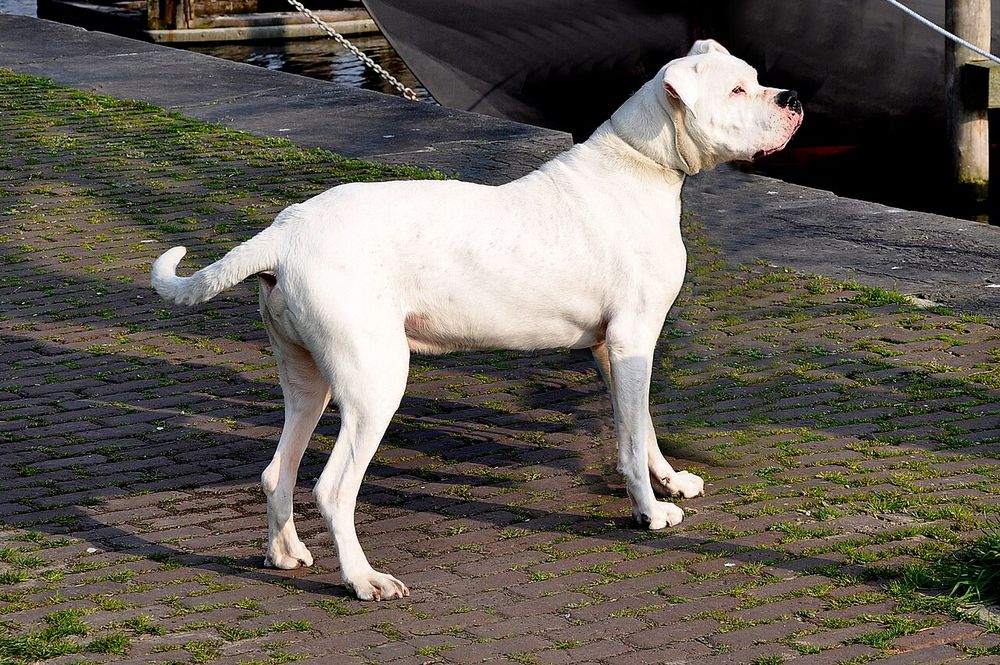
- Origin
- Córdoba province, ArgentinaFédération Cynologique Internationale
- Adult weight
- 40 to 45 kg (males about 40 to 45 kg, females 40 to 43 kg (FCI); the AKC gives 80 to 100 lb)Fédération Cynologique Internationale
- Height
- 60 to 68 cm (males 60 to 68 cm, females 60 to 65 cm)Fédération Cynologique Internationale
- Lifespan
- 9 to 15 yearsAmerican Kennel Club
- Coat
- Short, smooth and entirely white, about 1.5 to 2 cm long, with at most one dark patch on the head. The FCI says density varies with climate.Fédération Cynologique Internationale
- Energy
- Very highAmerican Kennel Club
- Indian heat
- Copes with careScientific Reports (2020)study
- Flats
- Needs spaceAmerican Kennel Club
Dogo Argentino snapshot
| What | The rule | Source |
|---|---|---|
| Size | Large. The FCI standard gives 60 to 68 cm and about 40 to 45 kg for males, 60 to 65 cm and 40 to 43 kg for females. | Fédération Cynologique Internationale |
| Bred for | Big-game hunting in packs, after wild boar and puma (AKC; FCI). | American Kennel Club |
| Energy | The AKC rates energy 5 out of 5 and suggests walks several times a day. | American Kennel Club |
| Hearing | In 811 US Dogos tested, 20.35% were deaf in one ear and 5.43% in both, about one in four overall. | Veterinary Record (2021), Louisiana State University School of Veterinary Medicinestudy |
| Coat | Short, smooth and entirely white, about 1.5 to 2 cm long, with at most one dark patch on the head (FCI). | Fédération Cynologique Internationale |
| India's 2024 list | Named on the 12 March 2024 central letter, as reproduced by Gurugram in 2026. | Municipal Corporation Gurugram |
Where does the Dogo Argentino come from?
The FCI standard says the breed is native to the province of Córdoba in Argentina and was created by Dr Antonio Nores Martínez, a surgeon (1907 to 1956). He started from the Old Fighting Dog of Córdoba, itself a cross of bulldogs and bull terriers, and crossed it with the English Bulldog, Great Dane, Pyrenean Mastiff, Bull Terrier, Boxer, Pointer, Dogue de Bordeaux and Irish Wolfhound, selecting only completely white dogs.
By 1947 the breed was fixed, and its standard was presented that year at the Hunters' Club in Buenos Aires. Its job was to hunt in packs after wild boar, peccaries, pumas and other predators of farms and livestock across Argentina, which needed strength, a good nose and courage. The FCI also insists it should never be aggressive towards people.
The AKC describes it as a pack-hunting dog for big game with the strength, intelligence and quick responsiveness of a serious athlete, and recognised it in 2020.
How did the Dogo Argentino come to India?
No source we could find records when the Dogo Argentino first came to India. What is documented is its legal position. The Department of Animal Husbandry and Dairying's letter of 12 March 2024, as reproduced in Municipal Corporation Gurugram's order of 23 June 2026, named the Dogo Argentino among breeds an expert committee called ferocious and dangerous, and AWBI's notice of 19 March 2024 records that local bodies were asked not to license the import, breeding or sale of listed breeds.
The Delhi High Court set that circular aside on 16 April 2024, and its order records that the Karnataka High Court had quashed it on 10 April 2024. Some cities still regulate listed breeds: Gurugram's 2026 order requires them to be registered and walked on a leash, chain lead and muzzle. Check your corporation's rules before you bring one home.
What care does a Dogo Argentino need?
The three things that shape a good day for this breed.
Exercise
The AKC rates its energy 5 out of 5 and suggests play in a fenced yard or walks several times a day, plus swimming, hiking, retrieving and dog sports, with indoor games such as hide-and-seek. In India, keep hard exercise to dawn and after dark. American Kennel Club
Grooming
Weekly grooming and an occasional bath; trim the strong, fast-growing nails regularly, check the ears for wax and brush the teeth (AKC). Fédération Cynologique Internationale
Training
A powerful hunting dog with strong drive, which the FCI standard says must never be aggressive towards people. Early, steady training and a handler who can physically manage a 40 kg dog matter; a deaf Dogo learns hand signals. Veterinary Record (2021), Louisiana State University School of Veterinary Medicinestudy
How much should a Dogo Argentino eat?
Daily calories for a healthy, neutered adult Dogo Argentino, worked out from its weight with the formula vets use (70 x weight in kg to the power 0.75, then AAHA's factor for a neutered adult). Divide by the kcal per kg on your food's pack for grams a day, and adjust by body shape.
| Resting need (kcal a day) | Neutered adult (kcal a day) | |
|---|---|---|
| 40 kg AAHA (American Animal Hospital Association) | 1110 | 1560 to 1780 |
| 42.5 kg | 1170 | 1630 to 1860 |
| 45 kg | 1220 | 1700 to 1950 |
The AKC says to feed a formula made for a large breed through each life stage and to work with your vet or breeder on how often to feed a puppy and on the adult diet. WSAVA's advice is a complete and balanced food from a maker that can show its nutrition expertise. Clean, fresh water should always be available. The FCI standard asks for a broad, deep chest, and ACVS lists deep-chested and large dogs fed one large meal a day as at risk of bloat, so split the day's food into two or three meals. From the Indian kitchen, keep onion, garlic, grapes, chocolate, chai and coffee away from the dog, and change foods gradually. Meals a day: puppy to 12 weeks, 4 a day; 3 to 6 months, 3 a day; 6 to 12 months, 2 a day; adult, 2 to 3 a day, not one large meal. Puppies, kittens, working, pregnant and older animals need different amounts: ask your vet, or use Petym's food calculator.
Which illnesses is the Dogo Argentino prone to, and how are they treated?
The conditions veterinary studies and breed surveys most often report in the Dogo Argentino. Knowing the early signs means a vet sees it sooner.
See your vet first. This is general information from veterinary sources, not a diagnosis. Only a vet who has examined your pet can say what is wrong and prescribe treatment, and this page never gives a dose. Do not give your pet human medicine. If your pet seems very unwell, go to a 24-hour vet: find one in your city.
Congenital deafness
Ask at a routine checkPigment-linked deafness is common in white dogs. In a 2021 study of 811 US Dogos, 20.35% were deaf in one ear and 5.43% in both, and dogs without a dark head patch were more often deaf. The FCI lists deafness as a disqualifying fault. Veterinary Record (2021), Louisiana State University School of Veterinary Medicinestudy
Signs to watch for
- Not responding to its name or to loud sounds
- Sleeping very deeply
- One-sided deafness often shows no clear sign
How a vet treats it
A vet or specialist confirms it with a BAER hearing test, one of the AKC's recommended screenings for the breed. Science for Animal Welfare says this kind of congenital deafness is lifelong with no treatment, so care is about safe handling, a lead near roads and hand signals.
Prevention
Buy from parents BAER-tested as hearing in both ears, and ask for the puppy's own result.
Hip dysplasia
See a vet soonAn abnormal development of the hip joint in large dogs that leads to arthritis. The AKC lists hip evaluation among recommended screenings for the Dogo. Merck Veterinary Manual
Signs to watch for
- Lameness that is worse after exercise
- A bunny-hopping gait
- Stiffness and reluctance to run or jump
How a vet treats it
A vet diagnoses it on x-rays. The Merck Veterinary Manual lists weight control, less exercise on hard surfaces, physical therapy and anti-inflammatory drugs prescribed by the vet, and surgery up to total hip replacement for some dogs.
Prevention
Choose a puppy from hip-screened parents, keep the dog lean and do not over-exercise a growing puppy.
Bloat (gastric dilatation-volvulus)
Emergency: go to a vet nowThe stomach fills with gas and may twist. ACVS lists deep-chested and large breeds as at risk, and the Dogo's standard calls for a broad, deep chest. American College of Veterinary Surgeons
Signs to watch for
- Restlessness and stretching
- Retching without bringing anything up
- Drooling and a swollen belly
- Weakness or collapse
How a vet treats it
An emergency. Vets stabilise the dog with intravenous fluids and oxygen, release the gas with a stomach tube, then operate to untwist the stomach and stitch it to the body wall (gastropexy).
Prevention
Two or three smaller meals a day. ACVS says many surgeons recommend a preventive gastropexy for at-risk dogs, which can be done during spay or neuter surgery.
Heatstroke
Emergency: go to a vet nowNot a breed disease, but a real risk for a large, very energetic dog in Indian heat: in a large UK study, dogs over 10 kg had higher odds of heat-related illness than small dogs, and exercise was the main trigger. PDSA
Signs to watch for
- Heavy panting and fast breathing
- Drooling, bright red or very pale gums
- Weakness, confusion, seizures or collapse
How a vet treats it
Move the dog into shade, pour cool water over the body and go to a vet at once. PDSA says vets cool the dog, may give a fluid drip, oxygen and medicines to protect the organs, and run blood tests.
Prevention
Hard exercise only in the cool hours, water on every walk, and a cool room through the day.
Is the Dogo Argentino banned in India?
It was listed by the Centre in 2024. The list was struck down by two High Courts, and local rules vary.
The Department of Animal Husbandry and Dairying's letter of 12 March 2024, as reproduced in Municipal Corporation Gurugram's order of 23 June 2026, names the Dogo Argentino among breeds an expert committee called ferocious and dangerous for human life. AWBI's notice of 19 March 2024 records that local bodies were asked not to license the import, breeding or sale of the listed breeds.
That circular did not last in the courts. The Karnataka High Court quashed it on 10 April 2024, and on 16 April 2024 the Delhi High Court set it aside, directing that written objections be invited before any final notification. Petym found no fresh national notification by 21 October 2026. Gurugram, however, still requires owners of listed breeds to register them and use a leash, chain lead and muzzle outside the home, and other cities may act too.
For context only: in the United Kingdom, GOV.UK lists the Dogo Argentino as one of the banned types of dog. That is UK law and does not apply in India. If you own a Dogo here, check your corporation's rules and read Petym's page on banned dog breeds in India.
What kind of dog does a sitter take on?
A powerful, athletic hunting dog that the breed standard says must never be aggressive towards people.
The AKC describes the Dogo Argentino as a pack-hunting dog bred to pursue big game such as wild boar and puma, with the strength, intelligence and quick responsiveness of a serious athlete. The FCI standard calls it agile, strong, robust and especially brave, and adds that it should never be aggressive toward humans, a point judges observe severely. The AKC rates it 4 out of 5 for openness to strangers but only 3 out of 5 with other dogs.
In practice that means a sitter must plan for strength and drive. A Dogo that sees a cat, a community dog or a goat may lunge hard, and some Dogos do not get on with other dogs. Use Petym's free meet and greet to watch your dog on the leash with the sitter, check that the sitter can hold it, and agree on routes and times that avoid other dogs.
Tell the sitter about any history with other animals or people, and whether your dog is used to a muzzle. In cities that regulate listed breeds, the sitter must follow the same rules you do.
Deafness in the Dogo Argentino
From a 2021 Veterinary Record study of hearing tests (BAER) in 811 US Dogos. Deafness is also a disqualifying fault in the FCI standard.
25.77 %
deaf in one or both ears Veterinary Record (2021), Louisiana State University School of Veterinary Medicinestudy
20.35 %
deaf in one ear only, which owners can easily miss Veterinary Record (2021), Louisiana State University School of Veterinary Medicinestudy
5.43 %
deaf in both ears Veterinary Record (2021), Louisiana State University School of Veterinary Medicinestudy
811
dogs tested; those without a dark head patch were more often deaf Veterinary Record (2021), Louisiana State University School of Veterinary Medicinestudy
Caring for a deaf or partly deaf Dogo
A dog that cannot hear a shout or a horn depends entirely on its handler outside.
Do
- Ask your vet about a BAER hearing test, one of the AKC's recommended screenings for the breed, and tell the sitter the result. American Kennel Club
- Teach the sitter your hand signals, and how you wake the dog gently: a touch on the shoulder or a stamp on the floor, not a sudden grab.
- Keep a deaf dog on the leash in every open space; it cannot hear traffic or a recall.
- Approach from the front, where the dog can see you coming.
Don’t
- Do not startle a sleeping deaf dog from behind.
- Do not rely on a voice command in an emergency.
- Do not assume a dog hears normally because it responds at home; one-sided deafness is common in the breed. Veterinary Record (2021), Louisiana State University School of Veterinary Medicinestudy
Burning off a Dogo's energy in Indian heat
Petym’s working from the official rules, no government publishes a total.
A sample day for a sitter in the hot months. A high-energy dog still needs its work, just not at noon.
Before sunrise
The longest walk, 45 minutes or so at a steady pace on a strong leash, with water. Check the road with the back of a hand first. The Royal Kennel Club
Morning
Rest, water, then breakfast once the dog has cooled.
Late morning
Ten minutes of training indoors: sit, down, wait at the door, hand signals for a deaf dog.
Midday to 5 pm
Indoors in the coolest room. AWBI's heat circular warns against exposing animals to direct heat in extreme weather. Animal Welfare Board of India
Late afternoon
A sniffing game, a food puzzle or a hard chew to use up mental energy.
After dark
A second long walk on quiet routes away from other dogs, then dinner and the daily photo update.
Health and safety signs a Dogo's sitter should act on
The AKC calls the breed healthy with few genetic problems; breeders test hips, hearts and hearing. These are the situations that need action.
If Heavy panting, drooling, wobbling or collapse after exercise on a warm day.
Heatstroke: shade, cool water poured over the body, a fan, and the vet at once. Animal Welfare Board of India
If Limping, stiffness or reluctance to jump. The AKC lists hip evaluation among breed screenings.
Rest the dog and call the vet. American Kennel Club
If Tiring quickly, coughing or fainting. Cardiac exams are on the AKC's list too.
Call the vet the same day; collapse is an emergency. American Kennel Club
If Red, itchy or sore skin, or ear wax building up. The AKC advises regular ear checks to prevent infection.
Photograph it for the owner and call the vet if it spreads or smells. American Kennel Club
If A fight with another dog, or a bite to a person.
Separate safely without putting hands near mouths, secure the dog, get medical help for any person, and call the owner.
If Fever or dullness after ticks.
Call the vet the same day. In a survey of 525 dogs in four Indian cities, ticks were found on more than half. Parasites & Vectors (2011)study
Dogo Argentino sitter checklist
- Behaviour history with dogs, cats, children and visitors, including any bites.
- Hearing status from the vet, and the hand signals the dog knows. Veterinary Record (2021), Louisiana State University School of Veterinary Medicinestudy
- Strong collar or harness, leash, and muzzle if your city requires one for listed breeds. Municipal Corporation Gurugram
- Registration papers if your corporation requires them.
- Exercise plan for the hot months, with routes that avoid other dogs.
- Food, portions and times; no onion, garlic, grapes or chocolate. ASPCA Animal Poison Control
- Vaccination card, tick prevention dates and the nearest 24-hour vet.
Which Petym service suits a Dogo Argentino?
If Your Dogo is wary of other dogs or strangers
Overnight pet sitting at home, with one experienced sitter it has met and no other dogs. Overnight sitting
If You work long days and your dog is calm with its walker
Dog walking at dawn and after dark, on quiet routes, following your city's rules for listed breeds. Dog walking
If Your dog is recovering from surgery or on medicines
Special-needs pet care, with the vet's plan followed and logged. Special-needs care
Breeds with similar care needs to the Dogo Argentino
Going away soon? Tell us your dates.
A checked local sitter feeds, walks and keeps your pet company at home, follows your care sheet to the letter and sends a photo every day. Petym is opening city by city: send your dates and we will tell you when a sitter can take them.
- Meet your sitter first, free
- PAN-checked, first-aid trained
- A photo every day
- Pay through Petym, never cash


Questions owners ask
Is the Dogo Argentino banned in India?
- Not clearly. It is on the Centre's 12 March 2024 list of ferocious breeds, but the Karnataka High Court quashed that circular on 10 April 2024 and the Delhi High Court set it aside on 16 April 2024. Petym found no fresh national notification by 21 October 2026. Check your city's rules.
Are Dogo Argentinos often deaf?
- Deafness is common in the breed. A 2021 Veterinary Record study of 811 US Dogos found about a quarter deaf in one or both ears, and dogs without a dark head patch were more often affected. The FCI standard treats deafness as a disqualifying fault. Ask your vet about a BAER hearing test.
How much exercise does a Dogo Argentino need?
- A lot. The AKC rates its energy 5 out of 5 and suggests walks several times a day plus games and training. In Indian summers, move the exercise to before sunrise and after dark, and use indoor training and food puzzles through the hot hours.
Is a Dogo Argentino good with other dogs?
- Not always. The AKC rates it 3 out of 5 for getting on with other dogs, and it was bred to hunt in packs after big game. A Dogo that is wary of dogs should stay at home with a sitter, with walks on quiet routes and no visiting dogs.
Is the Dogo Argentino banned in other countries?
- In the UK, GOV.UK lists the Dogo Argentino among banned types of dog, alongside the Pit Bull Terrier, Japanese Tosa, Fila Brasileiro and XL Bully. That is UK law only. In India, the 2024 central list was struck down in Delhi and Karnataka, and local rules vary.
How long can a Dogo Argentino be left alone?
- PDSA's general advice is no more than four hours at a time for any dog. A high-energy dog left for long hours is more likely to chew, bark or try to escape, so book a walker or sitter on long days.
Keep reading
Services that help
Free tools for this
Words on this page, explained
Keep exploring
Other dog breeds
- Akita
- Alaskan Malamute
- American Bully
- American Cocker Spaniel
- American Pit Bull Terrier
- Australian Shepherd
- Bakharwal dog
- Basset Hound
- Beagle
- Belgian Malinois
- Bernese Mountain Dog
- Bichon Frise
- Border Collie
- Boston Terrier
- Boxer
- Bull Terrier
- Bulldog
- Bullmastiff
- Cane Corso
- Caucasian Shepherd Dog
- Cavalier King Charles Spaniel
- Chihuahua
- Chippiparai
- Chow Chow
- Cocker Spaniel
- Dachshund
- Dalmatian
- Dobermann
- English Mastiff
- English Springer Spaniel
- French Bulldog
- Gaddi Kutta (Gaddi dog)
- German Shepherd
- Golden Retriever
- Great Dane
- Greyhound
- Havanese
- Indian pariah dog (Indie)
- Indian Spitz
- Irish Setter
- Jack Russell Terrier
- Kangal
- Kanni
- Kombai
- Labrador Retriever
- Lhasa Apso
- Maltese
- Miniature Pinscher
- Miniature Schnauzer
- Mudhol Hound
- Neapolitan Mastiff
- Newfoundland
- Papillon
- Pekingese
- Pembroke Welsh Corgi
- Pomeranian
- Poodle
- Pug
- Rajapalayam
- Rampur Greyhound
- Rhodesian Ridgeback
- Rottweiler
- Saint Bernard
- Samoyed
- Shar Pei
- Shiba Inu
- Shih Tzu
- Siberian Husky
- Tibetan Mastiff
- Weimaraner
- West Highland White Terrier
- Whippet
- Yorkshire Terrier
Sources
Each source was opened and read on the date shown. How Petym checks its sources
- Fédération Cynologique Internationale: FCI standard No. 292: Dogo Argentino (opens in a new tab)
- American Kennel Club: Dogo Argentino: dog breed information (opens in a new tab)
- Municipal Corporation Gurugram: Office order on registration and control of pet dogs (23 June 2026) (opens in a new tab)
- Animal Welfare Board of India: Public notice on news reports of a ban on dog breeds (19 March 2024) (opens in a new tab)
- High Court of Delhi (order downloaded from the court's server, hosted by LiveLaw): Sikander Singh Thakur v. Union of India, W.P.(C) 4374/2024 and connected matters, order of 16 April 2024 (opens in a new tab)
- WSAVA Global Nutrition Committee: Guidelines on selecting pet foods (updated 10 March 2021) (opens in a new tab)
Show all 22 sourcesShow fewer
- American College of Veterinary Surgeons: Gastric dilatation-volvulus (opens in a new tab)
- ASPCA Animal Poison Control: People foods to avoid feeding your pets (opens in a new tab)
- PDSA: Diarrhoea after a change of food (opens in a new tab)
- Merck Veterinary Manual: Puppy care (opens in a new tab)
- AAHA (American Animal Hospital Association): 2021 AAHA Nutrition and Weight Management Guidelines for Dogs and Cats: energy requirement calculations (Box 1, PDF) (opens in a new tab)
- Merck Veterinary Manual: Nutritional requirements of small animals (full review November 2023, updated September 2024) (opens in a new tab)
- UFAW Science for Animal Welfare (genetic welfare problems of companion animals): Dalmatian: Deafness (opens in a new tab)
- Merck Veterinary Manual: Hip dysplasia (dog owners) (opens in a new tab)
- PDSA: Heatstroke in dogs (opens in a new tab)
- GOV.UK: Controlling your dog in public: banned dogs (opens in a new tab)
- The Royal Kennel Club: The danger of hot pavements (opens in a new tab)
- Animal Welfare Board of India: Request to ensure care and protection of animals from direct heat during extreme hot weather (4 May 2026) (opens in a new tab)
- PDSA: Separation anxiety in dogs (opens in a new tab)
- Scientific Reports (2020): Incidence and risk factors for heat-related illness in UK dogs (opens in a new tab)
- Veterinary Record (2021), Louisiana State University School of Veterinary Medicine: Congenital sensorineural deafness in Dogo Argentino dogs: prevalence and phenotype associations (abstract read) (opens in a new tab)
- Parasites & Vectors (2011): A survey of canine tick-borne diseases in India (opens in a new tab)