Rhodesian Ridgeback in India: rules, exercise and your sitter
Updated By PetymFacts checked against official sources on
Quick answer
A Rhodesian Ridgeback needs a sitter who can give it more than two hours of exercise a day, as The Royal Kennel Club advises, without the midday sun. The AKC warns of a very strong prey drive and an independent, sometimes domineering streak. Keep it leashed outside secure fencing and walk it at dawn and after dark.
The breed is on the Centre's March 2024 list of breeds called ferocious. Two High Courts struck that circular down, but some cities still regulate listed breeds.
- Meet your sitter first, free
- PAN-checked, first-aid trained
- A photo every day
- Pay through Petym, never cash

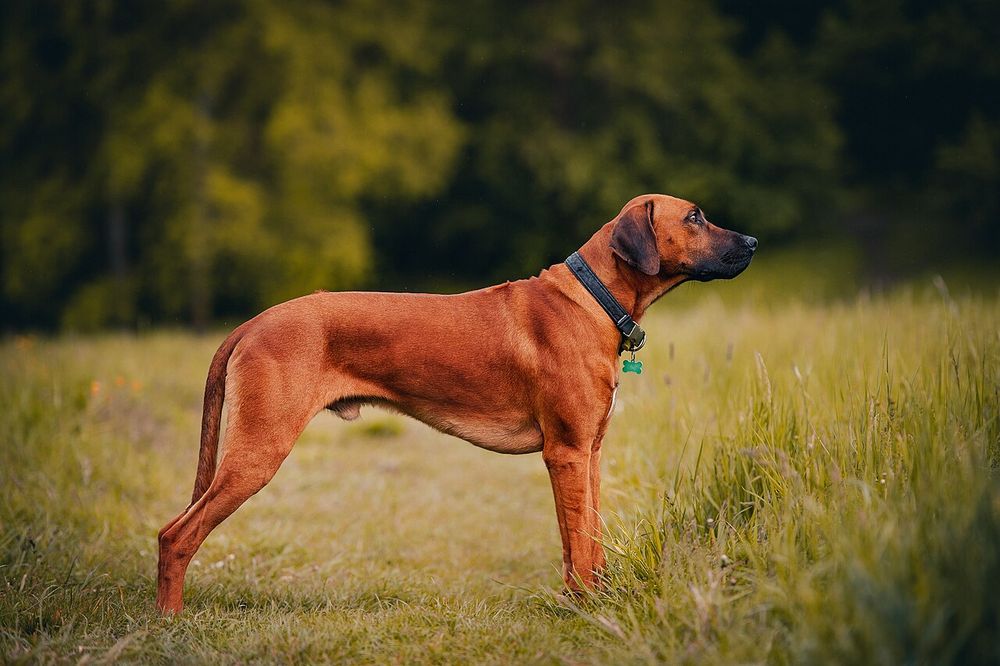
- Origin
- Southern Africa (the Cape Colony, later Rhodesia, now Zimbabwe)Fédération Cynologique Internationale
- Adult weight
- 32 to 39 kg (AKC gives about 70 pounds for females and 85 pounds for males. The FCI standard gives 32 kg for females and 36.5 kg for males.)American Kennel Club
- Height
- 61 to 69 cm (FCI: males 63 to 69 cm, females 61 to 66 cm at the withers.)Fédération Cynologique Internationale
- Lifespan
- 10 to 12 yearsAmerican Kennel Club
- Coat
- Short, dense, sleek and glossy, light to red wheaten, with the ridge of hair growing the opposite way along the spine.Fédération Cynologique Internationale
- Energy
- Very highThe Royal Kennel Club
- Indian heat
- Copes with carePDSA
- Flats
- Needs spaceThe Royal Kennel Club
Rhodesian Ridgeback snapshot
| What | The rule | Source |
|---|---|---|
| Size | Large. The AKC gives 25 to 27 inches and about 85 pounds (39 kg) for males, 24 to 26 inches and about 70 pounds for females. | American Kennel Club |
| Exercise need | More than 2 hours a day, says The Royal Kennel Club. | The Royal Kennel Club |
| Prey drive | Very strong: the AKC says a Ridgeback should always be in a safely enclosed area when off leash. | American Kennel Club |
| Temperament | Dignified and affectionate, protective of loved ones, but strong-willed, independent and sometimes domineering; the AKC says it can be too much hound for a novice. | American Kennel Club |
| Coat | Short and wheaten, groomed once a week; the ridge is hair growing the opposite way along the spine (Royal Kennel Club). | The Royal Kennel Club |
| India's 2024 list | Named on the 12 March 2024 central letter, as reproduced by Gurugram in 2026. | Municipal Corporation Gurugram |
Where does the Rhodesian Ridgeback come from?
The FCI standard, supplied by the kennel clubs of Southern Africa and Zimbabwe, calls the Rhodesian Ridgeback the only registered breed indigenous to southern Africa. Its forebears go back to the Cape Colony, where the early settlers' dogs were crossed with the semi-domesticated, ridged hunting dogs of the Khoikhoi people. The ridge, hair growing in the reverse direction along the spine, is the breed's mark, and The Royal Kennel Club notes folklore held that a well-defined ridge showed courage.
Its original work was tracking game. Hunting in twos and threes, the "Lion Dog" tracked lions and, with great agility, held them at bay until the hunter arrived; The Royal Kennel Club says it was used largely for this in Rhodesia, now Zimbabwe. The first standard was drafted by F. R. Barnes in Bulawayo in 1922, based on the Dalmatian's, and approved by the South African Kennel Union in 1926. The FCI describes the breed as dignified, intelligent and aloof with strangers, but neither aggressive nor shy.
How did the Rhodesian Ridgeback come to India?
No source we found records how or when the Rhodesian Ridgeback came to India, so its arrival is not documented. Its legal status is the documented part. The Department of Animal Husbandry and Dairying's letter of 12 March 2024, as reproduced in Municipal Corporation Gurugram's order of 23 June 2026, lists it among breeds an expert committee called ferocious. The Delhi High Court set that circular aside on 16 April 2024 and asked the government to hear objections before any final notification.
Rules still differ by city: Gurugram's order requires owners of listed breeds to register them and to use a leash, chain lead and muzzle outside private premises. Check your corporation's rules before you bring one home. In Indian heat, its need for more than two hours of exercise a day has to fit into the cool hours.
What care does a Rhodesian Ridgeback need?
The three things that shape a good day for this breed.
Exercise
More than 2 hours a day, says The Royal Kennel Club. In Indian summers, split it into a long walk before sunrise and another after dark, on a lead outside secure fencing because of its strong prey drive. The Royal Kennel Club
Grooming
Once a week for the short coat (Royal Kennel Club). Check along the ridge and spine for any small opening or tuft of hair, a sign of dermoid sinus, and see a vet if it swells. Science for Animal Welfare (formerly UFAW)
Training
The FCI calls it dignified, intelligent and aloof with strangers. It was bred to track game and hold it at bay until the hunter arrived, so start training early, stay consistent and reward calm behaviour around strangers. Fédération Cynologique Internationale
How much should a Rhodesian Ridgeback eat?
Daily calories for a healthy, neutered adult Rhodesian Ridgeback, worked out from its weight with the formula vets use (70 x weight in kg to the power 0.75, then AAHA's factor for a neutered adult). Divide by the kcal per kg on your food's pack for grams a day, and adjust by body shape.
| Resting need (kcal a day) | Neutered adult (kcal a day) | |
|---|---|---|
| 32 kg AAHA (American Animal Hospital Association) | 940 | 1320 to 1510 |
| 35.5 kg | 1020 | 1430 to 1630 |
| 39 kg | 1090 | 1530 to 1750 |
The FCI standard asks for a very deep chest, and ACVS lists deep-chested and large dogs among those at risk of bloat (gastric dilatation-volvulus), with one large meal a day and fast eating linked to higher risk. So feed an adult Ridgeback two or three smaller meals a day, never one big one. Merck notes large breeds can take almost two years to become adults and that too much calcium harms growing large dogs, so feed a complete and balanced puppy food without added calcium until your vet says to switch. Use the energy table below as a starting point and adjust it with your vet by body condition. Keep onion and garlic, grapes and raisins, tamarind, chocolate, salty snacks, xylitol, milk and cooked bones out of its bowl. Meals a day: 6 to 12 weeks, 4 a day; 3 to 6 months, 3 a day; 6 months to adult (up to about 2 years), 2 a day; adult, 2 to 3 smaller meals a day. Puppies, kittens, working, pregnant and older animals need different amounts: ask your vet, or use Petym's food calculator.
Which illnesses is the Rhodesian Ridgeback prone to, and how are they treated?
The conditions veterinary studies and breed surveys most often report in the Rhodesian Ridgeback. Knowing the early signs means a vet sees it sooner.
See your vet first. This is general information from veterinary sources, not a diagnosis. Only a vet who has examined your pet can say what is wrong and prescribe treatment, and this page never gives a dose. Do not give your pet human medicine. If your pet seems very unwell, go to a 24-hour vet: find one in your city.
Dermoid sinus
See a vet soonA tube-like pocket of skin along the midline of the back that can reach deep tissue and, in the worst type, the membrane round the spinal cord. The same gene change that makes the ridge predisposes to it; about 8 to 10% of Swedish Ridgebacks were estimated to be affected. Science for Animal Welfare (formerly UFAW)
Signs to watch for
- A small opening or tuft of hair along the spine
- Swelling, pain or an abscess that drains pus
- In deep infections: fever, wobbly walking or weak back legs
How a vet treats it
A vet finds it by looking and feeling along the back, and may confirm its depth with contrast X-rays. Science for Animal Welfare says treatment is surgery to close the sinus, with treatment of any infection; spread to the spinal cord is serious.
Prevention
Most can be found at birth; ask the breeder whether the puppy was checked. Affected dogs should not be bred.
Bloat (gastric dilatation-volvulus, GDV)
Emergency: go to a vet nowThe stomach fills with gas and can twist. ACVS lists deep-chested and large dogs as at risk, and the Ridgeback's standard calls for a very deep chest. American College of Veterinary Surgeons
Signs to watch for
- Restlessness and looking at the belly
- Drooling
- A swollen belly
- Retching without bringing anything up
- Later, panting, weakness or collapse
How a vet treats it
ACVS calls it life-threatening and says it needs immediate care: the vet confirms it on X-rays, stabilises the dog with IV fluids and oxygen, decompresses the stomach and operates to untwist it and fix it to the body wall (gastropexy).
Prevention
Two or three smaller meals a day rather than one; ask your vet about a preventive gastropexy, which ACVS says many surgeons recommend for at-risk breeds.
Haemophilia B
See a vet soonA rare inherited bleeding disorder caused by a lack of clotting factor IX. Ridgebacks carry a mutation that causes a severe form; it is X-linked, so males are mostly affected. Science for Animal Welfare (formerly UFAW)
Signs to watch for
- Bleeding that goes on after an injury, surgery or gum disease
- Bruising or swollen joints and lameness
- Nosebleeds or blood in urine or stool
- Usually seen before 6 months of age
How a vet treats it
A vet confirms it with clotting tests and a factor IX measurement; a DNA test can detect the Ridgeback mutation. There is no cure. Science for Animal Welfare says a vet may give antifibrinolytic medicines to stop bleeding and blood transfusions for severe anaemia.
Prevention
Ask the breeder for DNA test results on the parents; carriers and affected dogs should not be bred.
Where does the Rhodesian Ridgeback stand under India's dog rules?
On the 2024 central list, which two High Courts struck down; city rules may still apply.
The 12 March 2024 letter from the Department of Animal Husbandry and Dairying, as reproduced in Municipal Corporation Gurugram's order of 23 June 2026, includes the Rhodesian Ridgeback among breeds an expert committee described as ferocious and dangerous for human life.
The Karnataka High Court quashed the circular on 10 April 2024, and the Delhi High Court set it aside on 16 April 2024, asking the government to invite objections before any final notification. Petym found none issued by 21 October 2026. Gurugram's order nonetheless requires owners of listed breeds to register them and use a leash, chain lead and muzzle when the dog is outside private premises.
Rules differ by city, and a sitter must follow the same rules you do. Ask your corporation, and read Petym's page on banned dog breeds in India for the full timeline.
What kind of dog is a Ridgeback for a sitter?
A fast, independent hunting hound that bonds closely with its people.
The Royal Kennel Club says the breed was developed in South Africa as a scent hound and, in Rhodesia (now Zimbabwe), was used to track lions and hold them at bay until hunters arrived. The AKC calls it a Renaissance hound, famous for tracking and baying lions but never killing them, and says today's owners must be ready for its independence and strong prey drive.
The AKC describes Ridgebacks as faithful, protective of their loved ones and meltingly affectionate with those they trust, but strong-willed, independent and sometimes domineering, needing a firm but fair hand. It says the Ridgeback needs to live indoors with its family. For a sitter, that means a dog that may test a new person's boundaries, and that will not cope well with long hours alone.
Use Petym's free meet and greet to walk the dog together, hand over the lead partway, and show the sitter your commands and rewards. PDSA's general advice is no more than four hours alone for any dog, and a Ridgeback with two hours of exercise to burn should not spend the day in an empty flat.
Two hours of exercise for a Ridgeback in Indian summer
Petym’s working from the official rules, no government publishes a total.
A sample plan that meets The Royal Kennel Club's figure without exercise in the hottest hours.
5:30 am
A brisk hour on a strong leash, or off lead only inside a fully fenced ground the owner uses. Water on the walk. American Kennel Club
After the walk
Rest and water, then breakfast once the dog has cooled down.
Late morning
A short scent game: hide pieces of the day's food around a room for the dog to track.
Midday to 5 pm
Indoors in the coolest room. Toilet breaks on shaded ground; test the road with the back of a hand. The Royal Kennel Club
After sunset
A second hour of walking once the road has cooled, on routes that avoid cats and community dogs.
Night
Nails and coat checked, and the daily photo update to the owner.
The ridge, and the dermoid sinus that can come with it
The breed's trademark is linked to a birth defect a sitter should know about.
- The ridge
- A stripe of hair along the spine that grows in the opposite direction to the rest of the coat. The Royal Kennel Club
- What causes it
- A 2007 Nature Genetics study found the ridge is caused by a dominant mutation, a duplication involving three fibroblast growth factor (FGF) genes. Nature Genetics (2007), Swedish University of Agricultural Sciencesstudy
- Dermoid sinus
- A tube-like opening in the skin, occasionally present at birth, which breeders feel for in puppies (AKC). The same ridge mutation predisposes dogs to it. American Kennel Club
- Why a sitter cares
- A dog with a known or repaired sinus may have a scar or opening along the neck or back that the owner should point out. Swelling, discharge or pain there needs a vet.
Health signs a Ridgeback's sitter should report
The AKC and The Royal Kennel Club list the conditions breeders screen for. A sitter notices, tells the owner and calls the vet.
If A swelling, discharge or sore spot along the spine or neck, especially where a dermoid sinus was found or removed.
Do not squeeze it; photograph it for the owner and call the vet. American Kennel Club
If Twitching, jerking or any seizure-like episode. The Royal Kennel Club recommends a DNA test for juvenile myoclonic epilepsy in the breed.
Time it, film it if you can, keep the dog safe, and call the vet. The Royal Kennel Club
If Limping or stiffness. Hips and elbows are screened for dysplasia in the breed.
Rest and call the vet. The Royal Kennel Club
If Weight gain, low energy or coat changes. The AKC lists thyroid function among breed screenings.
Note it in the daily update and suggest a vet check. American Kennel Club
If Heavy panting, drooling or collapse after exercise in the heat.
Heatstroke: shade, cool water over the body, a fan, and the vet at once. PDSA
If Retching with nothing coming up and a swollen belly.
Possible bloat in a large, deep-chested dog: the nearest 24-hour vet immediately. American College of Veterinary Surgeons
Handling a Ridgeback: dos and don'ts
Do
- Keep it leashed outside a safely enclosed area: the AKC stresses its very strong prey drive. American Kennel Club
- Follow your city's rules for listed breeds; in Gurugram, a leash, chain lead and muzzle outside the home. Municipal Corporation Gurugram
- Use positive, consistent training; the AKC recommends positive reinforcement. American Kennel Club
- Use a nail grinder if the dog resists clippers, as the AKC says many Ridgebacks do. American Kennel Club
Don’t
- Do not leave food on counters: an independent hound helps itself.
- Do not let it meet unfamiliar dogs nose to nose on the lead in narrow lanes.
- Do not skip exercise in summer; move it to the cool hours instead.
- Do not feed onion, garlic, grapes, raisins, chocolate or xylitol. ASPCA Animal Poison Control
Rhodesian Ridgeback sitter checklist
- Behaviour notes: cats, small animals, other dogs and visitors.
- Strong leash and harness, and the muzzle and registration papers if your city requires them. Municipal Corporation Gurugram
- The exercise plan, routes and any fenced ground the dog may run in.
- Commands, hand signals and rewards the dog knows.
- Any history of dermoid sinus surgery, seizures or thyroid medicine.
- Food, portions and times, and where food is kept out of reach.
- Vaccination card, tick prevention dates and the nearest 24-hour vet.
Which Petym service fits a Rhodesian Ridgeback?
If Your Ridgeback is protective at home or wary of other dogs
Overnight pet sitting in your home, with one sitter it has met and no visiting dogs. Overnight sitting
If You work long days
Dog walking twice a day in the cool hours, so the dog gets its two hours. Dog walking
If Your dog is sociable and has stayed away before
Pet boarding in a sitter's home with secure fencing, inside local rules for listed breeds. Home boarding
Breeds with similar care needs to the Rhodesian Ridgeback
Going away soon? Tell us your dates.
A checked local sitter feeds, walks and keeps your pet company at home, follows your care sheet to the letter and sends a photo every day. Petym is opening city by city: send your dates and we will tell you when a sitter can take them.
- Meet your sitter first, free
- PAN-checked, first-aid trained
- A photo every day
- Pay through Petym, never cash


Questions owners ask
Is the Rhodesian Ridgeback banned in India?
- Not clearly. It is on the Centre's 12 March 2024 list of ferocious breeds, but the Karnataka High Court quashed that circular on 10 April 2024 and the Delhi High Court set it aside on 16 April 2024. Petym found no fresh notification by 21 October 2026. Some cities regulate listed breeds.
How much exercise does a Rhodesian Ridgeback need?
- The Royal Kennel Club says more than two hours a day. In Indian summers, split it into a long walk before sunrise and another after dark, with scent games indoors in between, and keep the dog on a lead outside secure fencing because of its strong prey drive.
Can a Rhodesian Ridgeback be let off the lead?
- Only in a safely enclosed area, the AKC says, because of its very strong prey drive. A Ridgeback that sees a cat, a squirrel or a running dog may chase it at speed. A sitter should keep it leashed on every walk.
What is dermoid sinus in Ridgebacks?
- A dermoid sinus is a tube-like opening in the skin, occasionally present at birth. A 2007 Nature Genetics study found the mutation that causes the ridge also predisposes dogs to it, and the AKC says experienced breeders feel puppies for it. Any swelling or discharge along the back needs a vet.
Is a Rhodesian Ridgeback good with a pet sitter?
- Usually, with a confident sitter it has met. The AKC describes the breed as affectionate with those it trusts but strong-willed and sometimes domineering, and protective of its family. Introduce the sitter at home, hand over the lead with you there, and share your commands.
How long can a Rhodesian Ridgeback be left alone?
- PDSA's general advice is no more than four hours alone at a time for any dog. The AKC says the Ridgeback needs to live indoors with its family, and a dog needing two hours of exercise will not settle well alone all day. Book a walker or sitter.
How long do Rhodesian Ridgebacks live?
- The Royal Kennel Club lists a lifespan of over 10 years, and the AKC gives 10 to 12 years. Breeders screen for hip and elbow dysplasia, thyroid and eye problems, and test for juvenile myoclonic epilepsy and degenerative myelopathy.
Keep reading
- Banned dog breeds in India
- Dogo Argentino careAnother athletic hunting dog on the 2024 list.
- Rottweiler care
- Dobermann care
- Why does my dog chase bikes?
- Dog walking rules in public places
- Dog walking
Services that help
Free tools for this
Words on this page, explained
Keep exploring
Other dog breeds
- Akita
- Alaskan Malamute
- American Bully
- American Cocker Spaniel
- American Pit Bull Terrier
- Australian Shepherd
- Bakharwal dog
- Basset Hound
- Beagle
- Belgian Malinois
- Bernese Mountain Dog
- Bichon Frise
- Border Collie
- Boston Terrier
- Boxer
- Bull Terrier
- Bulldog
- Bullmastiff
- Cane Corso
- Caucasian Shepherd Dog
- Cavalier King Charles Spaniel
- Chihuahua
- Chippiparai
- Chow Chow
- Cocker Spaniel
- Dachshund
- Dalmatian
- Dobermann
- Dogo Argentino
- English Mastiff
- English Springer Spaniel
- French Bulldog
- Gaddi Kutta (Gaddi dog)
- German Shepherd
- Golden Retriever
- Great Dane
- Greyhound
- Havanese
- Indian pariah dog (Indie)
- Indian Spitz
- Irish Setter
- Jack Russell Terrier
- Kangal
- Kanni
- Kombai
- Labrador Retriever
- Lhasa Apso
- Maltese
- Miniature Pinscher
- Miniature Schnauzer
- Mudhol Hound
- Neapolitan Mastiff
- Newfoundland
- Papillon
- Pekingese
- Pembroke Welsh Corgi
- Pomeranian
- Poodle
- Pug
- Rajapalayam
- Rampur Greyhound
- Rottweiler
- Saint Bernard
- Samoyed
- Shar Pei
- Shiba Inu
- Shih Tzu
- Siberian Husky
- Tibetan Mastiff
- Weimaraner
- West Highland White Terrier
- Whippet
- Yorkshire Terrier
Sources
Each source was opened and read on the date shown. How Petym checks its sources
- Fédération Cynologique Internationale: FCI standard No. 146: Rhodesian Ridgeback (6 June 2025, PDF) (opens in a new tab)
- American Kennel Club: Rhodesian Ridgeback: dog breed information (opens in a new tab)
- The Royal Kennel Club: Rhodesian Ridgeback: breeds A to Z (opens in a new tab)
- PDSA: Heatstroke in dogs (opens in a new tab)
- Municipal Corporation Gurugram: Office order on registration and control of pet dogs (23 June 2026) (opens in a new tab)
- High Court of Delhi (order downloaded from the court's server, hosted by LiveLaw): Sikander Singh Thakur v. Union of India, W.P.(C) 4374/2024 and connected matters, order of 16 April 2024 (opens in a new tab)
Show all 17 sourcesShow fewer
- Science for Animal Welfare (formerly UFAW): Rhodesian Ridgeback: dermoid sinus (opens in a new tab)
- American College of Veterinary Surgeons: Gastric dilatation-volvulus (opens in a new tab)
- Merck Veterinary Manual: Puppy care (opens in a new tab)
- Merck Veterinary Manual: Nutritional requirements of small animals (full review November 2023, updated September 2024) (opens in a new tab)
- ASPCA Animal Poison Control: People foods to avoid feeding your pets (opens in a new tab)
- Merck Veterinary Manual: Grape, raisin, and tamarind (Vitis spp, Tamarindus spp) toxicosis in dogs (full review September 2024) (opens in a new tab)
- AAHA (American Animal Hospital Association): 2021 AAHA Nutrition and Weight Management Guidelines for Dogs and Cats: energy requirement calculations (Box 1, PDF) (opens in a new tab)
- Science for Animal Welfare (formerly UFAW): Rhodesian Ridgeback: haemophilia B (opens in a new tab)
- PDSA: Separation anxiety in dogs (opens in a new tab)
- The Royal Kennel Club: The danger of hot pavements (opens in a new tab)
- Nature Genetics (2007), Swedish University of Agricultural Sciences: Duplication of FGF3, FGF4, FGF19 and ORAOV1 causes hair ridge and predisposition to dermoid sinus in Ridgeback dogs (abstract read) (opens in a new tab)