Chippiparai dog care: walks, heat and time alone
Updated By PetymFacts checked against official sources on
Quick answer
The Chippiparai is a registered Indian sighthound from southern Tamil Nadu, kept for hunting, guarding and as a family's pride. Records describe it as obedient and easy to train. While you travel, it does best at home with a sitter it has met, walked on a secure lead in the coolest hours, with shade and water all day.
Very little has been published about its health, exercise needs or lifespan, so this page sticks to what ICAR-NBAGR and TANUVAS researchers have recorded and to general care that suits any lean, active dog.
- Meet your sitter first, free
- PAN-checked, first-aid trained
- A photo every day
- Pay through Petym, never cash

- Indian breed
- Developed in India
- Origin
- Southern Tamil Nadu, India (Tirunelveli breeding tract)TANUVAS authors (2015), KrishiKosh repositorystudy
- Adult weight
- 13.6 to 32.5 kg (adults, ICAR-NBAGR)ICAR-National Bureau of Animal Genetic Resources
- Height
- 54 to 76 cm (females 54 to 70 cm, males 60 to 76 cm at the withers, ICAR-NBAGR)ICAR-National Bureau of Animal Genetic Resources
- Coat
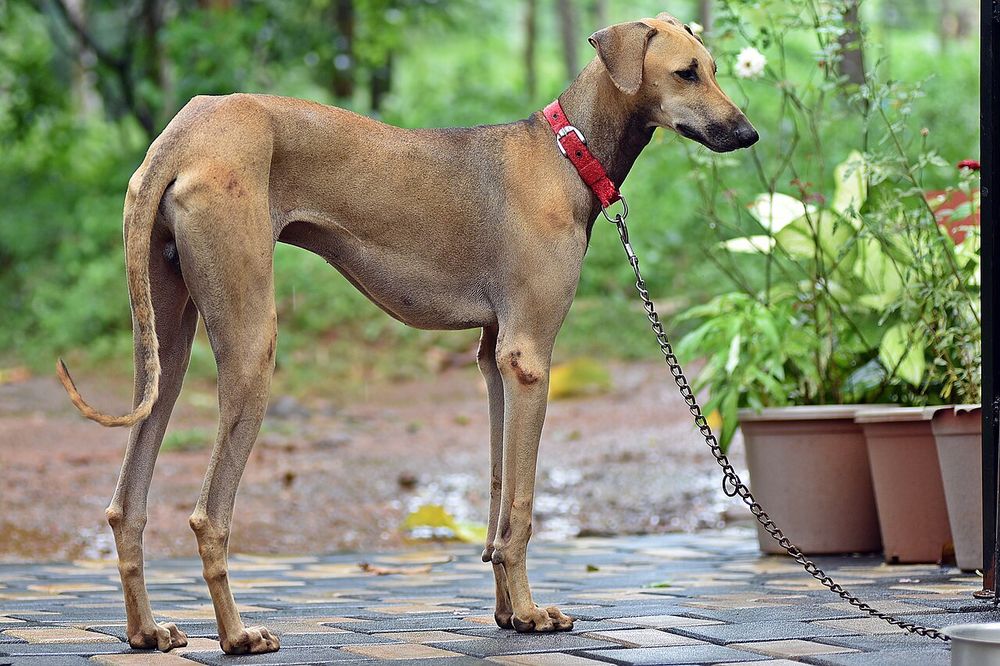
- Short, from fawn to dark brown, brownish black or black, with black nostrils and eyes (ICAR-NBAGR).ICAR-National Bureau of Animal Genetic Resources
- Indian heat
- Copes with careAnimal Welfare Board of India
- Flats
- Needs spaceTANUVAS authors (2015), KrishiKosh repositorystudy
Chippiparai at a glance
| What | The rule | Source |
|---|---|---|
| Size | NBAGR records 60 to 76 cm at the withers in males and 54 to 70 cm in females, and 13.6 to 32.5 kg as adults. | ICAR-National Bureau of Animal Genetic Resources |
| Exercise | Not measured. It is a sighthound kept for hunting; no source gives a daily amount. | TANUVAS authors (2015), KrishiKosh repositorystudy |
| Alone-time tolerance | Not studied for this breed. PDSA's general advice is no more than four hours alone at a time. | PDSA |
| Heat tolerance | Not studied. It is native to hot southern Tamil Nadu, but there is no measured data on the breed and heat. | ICAR-National Bureau of Animal Genetic Resources |
| Coat and shedding | Short coat, fawn to dark brown, brownish black or black, with black nostrils and eyes. | ICAR-National Bureau of Animal Genetic Resources |
| Sociability | NBAGR records it as high in obedience and easy to train. No study describes how it behaves with strangers, children or other pets. | ICAR-National Bureau of Animal Genetic Resources |
Where does the Chippiparai come from?
The Chippiparai is a sighthound from southern Tamil Nadu, a dog that hunts by sight and speed. TANUVAS researchers describe it as medium-sized, with a broad chest and a tucked-up abdomen, and give Tirunelveli district as its breeding tract. ICAR-NBAGR records it mainly in the Thoothukudi, Tirunelveli, Virudhunagar and Madurai districts, kept for hunting and guarding, and also as a hobby and a source of pride.
Local names overlap. NBAGR gives Kanni and Vettainaai, Tamil for hunting dog, as other names, though the 2020 Mann Ki Baat address listed Kanni and Chippiparai separately. When NBAGR researchers surveyed breeders they also recorded local beliefs, such as the idea that dogs with erect ears are more alert and aggressive, which no study has shown.
No source we found dates the breed's beginnings or explains how it was first bred. Researchers at Madras Veterinary College found that Chippiparai dogs had higher red blood cell values than other dogs and suggested this may reflect running, hunting and a hot climate, and possibly descent from other sighthounds.
How did the Chippiparai come to India?
The Chippiparai is one of the few Indian dog breeds registered by ICAR-National Bureau of Animal Genetic Resources, with accession number INDIA_DOG_1800_CHIPPIPARAI_19002, and NBAGR estimated its population at about 6,000 dogs. In the Mann Ki Baat address of 30 August 2020 the Prime Minister named it among Indian breeds that cost less to raise and suit the Indian environment, and the October 2025 Mann Ki Baat booklet says the Border Security Force is exploring native breeds including the Kanni and Chippiparai.
Most Chippiparais still live in their home districts in Tamil Nadu. A dog in a city flat needs the same things it had there: room to run in a safe, fenced space, shade and water through the day, and regular tick checks, since a TANUVAS case report found tick-borne blood parasites in a Chippiparai from Tirunelveli.
What care does a Chippiparai need?
The three things that shape a good day for this breed.
Exercise
No study gives a daily amount. It is a hunting sighthound, so plan a long walk in the cool hours and, where possible, a run in a fully fenced space; it may chase anything that moves. TANUVAS authors (2015), KrishiKosh repositorystudy
Grooming
The short coat needs little more than a weekly brush, which is also the time for a full tick check. No source sets a grooming schedule for the breed. ICAR-National Bureau of Animal Genetic Resources
Training
ICAR-NBAGR records the breed as high in obedience and easy to train. Short, reward-based sessions in the cool part of the day suit it. Animal Welfare Board of India
How much should a Chippiparai eat?
Daily calories for a healthy, neutered adult Chippiparai, worked out from its weight with the formula vets use (70 x weight in kg to the power 0.75, then AAHA's factor for a neutered adult). Divide by the kcal per kg on your food's pack for grams a day, and adjust by body shape.
| Resting need (kcal a day) | Neutered adult (kcal a day) | |
|---|---|---|
| 13.6 kg AAHA (American Animal Hospital Association) | 500 | 690 to 790 |
| 23.1 kg | 740 | 1030 to 1180 |
| 32.5 kg | 950 | 1330 to 1520 |
No study describes what Chippiparais are traditionally fed. Feed a complete and balanced food made for the dog's life stage; WSAVA says a home-cooked diet can be adequate only if it is complete and balanced, ideally formulated by a vet trained in nutrition, so plain rice and curd alone will not do. Keep treats to no more than about 10% of the day's calories. A lean, tucked-up outline is normal for the breed, so ask your vet what a healthy weight looks like for your dog rather than judging by eye. Keep onion and garlic, grapes and raisins, chocolate, coffee and chai, xylitol, salty snacks and cooked bones away from it. Meals a day: 6 to 12 weeks, 4 a day; 3 to 6 months, 3 a day; 6 to 12 months, 2 a day; adult, 1 or 2 a day; VCA suggests at least 2. Puppies, kittens, working, pregnant and older animals need different amounts: ask your vet, or use Petym's food calculator.
Which illnesses is the Chippiparai prone to, and how are they treated?
The conditions veterinary studies and breed surveys most often report in the Chippiparai. Knowing the early signs means a vet sees it sooner.
See your vet first. This is general information from veterinary sources, not a diagnosis. Only a vet who has examined your pet can say what is wrong and prescribe treatment, and this page never gives a dose. Do not give your pet human medicine. If your pet seems very unwell, go to a 24-hour vet: find one in your city.
Tick fever: babesiosis and hepatozoonosis
See a vet soonNo inherited disease has been documented for the Chippiparai, and a TANUVAS case report calls the breed generally sturdy. The same report found Babesia and Hepatozoon blood parasites, both carried by the brown dog tick, in a Chippiparai from Tirunelveli. Indian Journal of Animal Research (2021), TANUVAS Veterinary College and Research Institute, Tirunelvelistudy
Signs to watch for
- Fever and tiredness
- Loss of appetite and weight
- Pale or yellow gums
- Dark or red urine in later stages
How a vet treats it
A vet confirms it with a blood smear or a PCR test. A vet may use medicines that kill Babesia, called babesiacides, with supportive care such as fluids, and a blood transfusion can be lifesaving in a very anaemic dog.
Prevention
Tick control and daily tick checks, though Merck notes tick control cannot be relied on alone to stop transmission.
Ehrlichiosis
See a vet soonA tick-borne infection spread mainly by the brown dog tick. In a survey of 525 dogs in four Indian cities, ticks were found on 53%. Merck Veterinary Manual
Signs to watch for
- Fever
- Nosebleeds, bruising or blood in the stool
- Swollen lymph nodes
- Weight loss in long-standing cases
How a vet treats it
A vet tests with blood smears, antibody tests or PCR, and often starts treatment while waiting for results. Merck names doxycycline, an antibiotic, as the drug of choice, with supportive care and blood or platelet transfusions for severe cases.
Prevention
Check for ticks after every walk and use the tick prevention your vet recommends.
Heatstroke
Emergency: go to a vet nowThe Chippiparai comes from hot plains, but no one has measured its heat tolerance, and the Animal Welfare Board of India warns that dogs are vulnerable to heatstroke in extreme heat. Most cases happen during exercise, which matters for a dog bred to sprint. Animal Welfare Board of India
Signs to watch for
- Heavy panting and fast breathing
- Drooling, vomiting or diarrhoea
- Weakness or collapse
- Confusion or seizures
How a vet treats it
Start cooling at once with cool water and moving air, then go to the vet. A vet cools the dog, may give a fluid drip, oxygen and medicines, and checks the organs with blood tests.
Prevention
No running games in the heat of the day, shade and clean water always, and the ground tested with your palm before walks.
Parvovirus
Emergency: go to a vet nowA severe, infectious gut virus that strikes unvaccinated dogs, mostly puppies aged about 6 weeks to 6 months. It survives a long time in the environment. Cornell University College of Veterinary Medicine
Signs to watch for
- Lethargy and loss of appetite
- Vomiting
- Foul diarrhoea, often with blood
- Weakness and dehydration
How a vet treats it
A vet tests a stool or rectal swab. Treatment centres on a fluid drip, with medicines for vomiting, nausea and pain, antibiotics against secondary infection and deworming; ideally in hospital. Cornell says most dogs will not survive without treatment.
Prevention
A full puppy vaccination course from about 8 weeks, with boosters as your vet advises, and no dog parks until the course is done.
What is known about the Chippiparai?
It is one of only three Indian dog breeds registered by ICAR-NBAGR, with accession number INDIA_DOG_1800_CHIPPIPARAI_19002.
NBAGR's breed page says the Chippiparai is mainly found in the Thoothukudi, Tirunelveli, Virudhunagar and Madurai districts of Tamil Nadu, with an estimated population of about 6,000 dogs. It is kept mainly for guarding and hunting, and also as a hobby and a source of pride. NBAGR records the dogs as high in obedience and easy to train. With so few dogs, yours may well be the first Chippiparai your sitter has met, which is one more reason for a proper introduction before the trip.
A 2015 study by TANUVAS scientists describes the Chippiparai as a medium-sized sighthound whose breeding tract is Tirunelveli district, with a fawn coat, black nostrils, black eyes, a broad chest and a tucked-up abdomen. The adult dogs it measured averaged about 60 cm at the withers.
The Chippiparai has also reached national attention. In the Mann Ki Baat address of 30 August 2020, the Prime Minister named it among Indian breeds that cost less to raise and are better adapted to the Indian environment. The October 2025 Mann Ki Baat booklet says exploring more native breeds, including the Kanni and Chippiparai, is on the Border Security Force's radar. We found no record of the breed in active service with the BSF or any other force.
Chippiparai, Kanni or vettainaai?
The names overlap, and the sources do not agree on all of them.
- Chippiparai
- The registered breed name, from the area of Tamil Nadu where the dogs were bred. ICAR-National Bureau of Animal Genetic Resources
- Kanni
- NBAGR says the Chippiparai is also called Kanni, meaning virgin. The 2020 Mann Ki Baat address lists Kanni and Chippiparai as separate breeds, so local usage clearly varies. ICAR-National Bureau of Animal Genetic Resources
- Vettainaai
- Tamil for hunting dog; NBAGR gives it as another name for the Chippiparai. ICAR-National Bureau of Animal Genetic Resources
- Sighthound
- A dog that hunts by sight and speed rather than scent. TANUVAS researchers describe the Chippiparai as a medium-sized sighthound. TANUVAS authors (2015), KrishiKosh repositorystudy
Does ear shape tell you a Chippiparai's temperament?
You may have read
A Chippiparai with straight, erect ears will always be more alert, more active and more aggressive.
Myth
What the sources say
NBAGR researchers recorded this as a myth among Chippiparai breeders. No study has shown that ear shape predicts behaviour. Judge your dog by how it actually behaves. Journal of Livestock Biodiversity (2016), ICAR-NBAGRstudy
You may have read
An Indian breed cannot get heatstroke.
Myth
What the sources say
Any dog can. The Animal Welfare Board of India warns that dogs are vulnerable to dehydration, heatstroke and burns from hot surfaces in extreme heat. Animal Welfare Board of India
You may have read
A lean dog is an underfed dog.
Myth
What the sources say
TANUVAS researchers describe a broad chest and a tucked-up abdomen as part of the breed's look. Ask your vet what a healthy weight looks like for your dog rather than judging by eye. TANUVAS authors (2015), KrishiKosh repositorystudy
Is a Chippiparai at risk in Indian heat?
No one has measured it. The breed is native to the hot plains of southern Tamil Nadu, and the 2020 Mann Ki Baat address described Indian breeds as better adapted to the Indian environment, but that is a general statement, not data on heat illness.
The nearest evidence comes from another sighthound in another country. In a large UK study of heat-related illness, the Greyhound had about four times the odds of a Labrador, and flat-faced and very thick-coated breeds were also at higher risk. That does not tell us about the Chippiparai, but it is a reason not to assume a lean, short-coated hunting dog is safe in the heat, especially when it sprints.
Practical rules follow. Walks before the sun is high and after it sets. Test the ground with the back of a hand for seven seconds. Shade and clean water in stable bowls throughout the day, as the Animal Welfare Board of India asks. And no running games in the afternoon.
A day with a Chippiparai: the sitter's route
Dawn walk
The main walk, on a secure harness and lead, before the ground heats up. Sighthounds react to movement at a distance, so the sitter scans ahead for cats, goats and community dogs. The Royal Kennel Club
Breakfast and rest
Food exactly as the owner left it, then rest on a soft bed in the coolest room. PDSA
Midday
Indoors or in deep shade, water topped up in bowls that cannot tip over. No exercise. Animal Welfare Board of India
Afternoon
Short training games with part of the day's food. NBAGR describes the breed as easy to train. ICAR-National Bureau of Animal Genetic Resources
Evening walk
After sunset, on grass where possible. A run is only safe in a fully fenced space, never in an open ground or by a road. The Royal Kennel Club
Night
Tick check, last toilet break, gates and terrace doors locked, daily photo update sent.
What health signs should a Chippiparai's sitter know?
No inherited diseases have been documented for the breed in the sources we found. These are the general warning signs any sitter should act on.
If Heavy panting, drooling, lethargy, a fast heartbeat or collapse in the heat.
Heatstroke: move the dog somewhere cool, pour plenty of cool water over it, use a fan and go to the vet at once. Animal Welfare Board of India
If A cut or torn skin after a run or a scramble through bushes or a fence.
Press a clean cloth on any bleeding, call the owner and see the vet for anything deep or gaping.
If Fever, tiredness, pale gums or poor appetite after ticks were found.
Call the vet the same day and tell them about the ticks.
If Vomiting, diarrhoea or refusing food for more than a day.
Call the vet. Keep the food exactly as the owner left it. PDSA
If Limping after a sprint, or reluctance to put weight on a leg.
Rest the dog, no more running, and call the vet if it does not improve within the day.
If Barking, howling, chewing or toileting indoors when left alone.
Signs of separation anxiety, per PDSA. Do not scold; tell the owner and shorten time alone. PDSA
Feeding notes
No source describes a breed-specific diet. Write down what your dog eats, whether a commercial food or a home-cooked meal, the amounts and the times, and ask the sitter to follow it and log every meal. Do not let a sitter change the food; a sudden change is a common cause of diarrhoea.
Keep foods toxic to dogs out of reach. ASPCA Animal Poison Control warns that grapes and raisins can lead to kidney damage, xylitol can cause low blood sugar and liver damage, and onion and garlic can damage red blood cells. Many Indian leftovers contain onion and garlic, so a sitter should never share the family's food with the dog.
Chippiparai sitter checklist
- A meet and greet at home before the first booking, so the dog knows the sitter.
- A well-fitting harness and lead; the dog is never let off lead outside a fenced space.
- Walk times for the season and a route away from busy roads and livestock.
- A soft bed or blanket in the coolest room.
- Vet and 24-hour vet details, vaccination card (DHPPi, rabies) and tick prevention dates.
- Food, amounts and times; nothing with onion or garlic. ASPCA Animal Poison Control
- How the dog reacts to strangers and to other dogs, in your words.
Which Petym service suits a Chippiparai?
If You are away overnight or longer
Overnight pet sitting in your home, with a sitter the dog has met. Overnight sitting
If You work long days but are home at night
Dog walking at dawn and after dark, with the same walker each time. Dog walking
If Your dog is relaxed with new people and other dogs
Pet boarding in a checked sitter's home can work; meet the sitter first. Home boarding
Breeds with similar care needs to the Chippiparai
Going away soon? Tell us your dates.
A checked local sitter feeds, walks and keeps your pet company at home, follows your care sheet to the letter and sends a photo every day. Petym is opening city by city: send your dates and we will tell you when a sitter can take them.
- Meet your sitter first, free
- PAN-checked, first-aid trained
- A photo every day
- Pay through Petym, never cash


Questions owners ask
Is the Chippiparai a recognised breed?
- Yes, in India. ICAR-NBAGR has registered it as an Indian dog breed from Tamil Nadu, with accession number INDIA_DOG_1800_CHIPPIPARAI_19002. It is not listed by the FCI or the UK's Kennel Club. NBAGR estimates the population at about 6,000 dogs.
What is the Chippiparai's temperament?
- NBAGR records the breed as high in obedience and easy to train, and kept for guarding and hunting. No published study describes how it behaves with strangers, children or other pets, so tell your sitter what your own dog is like and introduce them before the trip.
Is a Kanni the same as a Chippiparai?
- Sources disagree. NBAGR says the Chippiparai is also called Kanni, and gives vettainaai, meaning hunting dog, as another name. The 2020 Mann Ki Baat address lists Kanni and Chippiparai separately. Local usage in Tamil Nadu varies.
Can a Chippiparai be left alone?
- No study has looked at the breed. PDSA's general guidance is that dogs should not be left alone for more than four hours at a time. For trips, overnight sitting in your home keeps the dog's routine; for long workdays, a dog walker.
Can a Chippiparai be let off lead?
- Only in a fully fenced space. It is a sighthound kept for hunting, and sighthounds react to movement at a distance. On Indian streets, with cats, goats, community dogs and traffic, a dog that sprints after something can be hurt or lost.
What should I tell a sitter about my Chippiparai?
- Everything the research cannot: how your dog reacts to strangers, other dogs, cats and traffic, how much it walks, where it sleeps and what it eats. Add your vet's details, the vaccination card and tick prevention dates. Petym's free meet and greet is the place to go through it, with the dog present.
Does a Chippiparai cope with Indian summers?
- It is native to hot southern Tamil Nadu, but its heat tolerance has never been measured. In a UK study, the Greyhound, another sighthound, had higher odds of heat-related illness. Walk early and late, avoid hot ground, and keep shade and water available all day.
Keep reading
- Dogs: caring for a dog while you are away
- Rajapalayam careTamil Nadu's white sighthound.
- Mudhol Hound careKarnataka's registered sighthound.
- Heatstroke in dogs
- Dog walking
- Indian foods dogs can eat
Services that help
Free tools for this
Words on this page, explained
Keep exploring
Other dog breeds
- Akita
- Alaskan Malamute
- American Bully
- American Cocker Spaniel
- American Pit Bull Terrier
- Australian Shepherd
- Bakharwal dog
- Basset Hound
- Beagle
- Belgian Malinois
- Bernese Mountain Dog
- Bichon Frise
- Border Collie
- Boston Terrier
- Boxer
- Bull Terrier
- Bulldog
- Bullmastiff
- Cane Corso
- Caucasian Shepherd Dog
- Cavalier King Charles Spaniel
- Chihuahua
- Chow Chow
- Cocker Spaniel
- Dachshund
- Dalmatian
- Dobermann
- Dogo Argentino
- English Mastiff
- English Springer Spaniel
- French Bulldog
- Gaddi Kutta (Gaddi dog)
- German Shepherd
- Golden Retriever
- Great Dane
- Greyhound
- Havanese
- Indian pariah dog (Indie)
- Indian Spitz
- Irish Setter
- Jack Russell Terrier
- Kangal
- Kanni
- Kombai
- Labrador Retriever
- Lhasa Apso
- Maltese
- Miniature Pinscher
- Miniature Schnauzer
- Mudhol Hound
- Neapolitan Mastiff
- Newfoundland
- Papillon
- Pekingese
- Pembroke Welsh Corgi
- Pomeranian
- Poodle
- Pug
- Rajapalayam
- Rampur Greyhound
- Rhodesian Ridgeback
- Rottweiler
- Saint Bernard
- Samoyed
- Shar Pei
- Shiba Inu
- Shih Tzu
- Siberian Husky
- Tibetan Mastiff
- Weimaraner
- West Highland White Terrier
- Whippet
- Yorkshire Terrier
Sources
Each source was opened and read on the date shown. How Petym checks its sources
- ICAR-National Bureau of Animal Genetic Resources: Chippiparai dog (read in a web-archive copy) (opens in a new tab)
- Animal Welfare Board of India: Request to ensure care and protection of animals from direct heat during extreme hot weather (4 May 2026) (opens in a new tab)
- Press Information Bureau, Prime Minister's Office: English rendering of PM's address in the 15th episode of Mann Ki Baat 2.0 on 30 August 2020 (read in a web-archive copy) (opens in a new tab)
- ICAR-National Bureau of Animal Genetic Resources: Dog breeds of India (registered breeds and accession numbers) (opens in a new tab)
- Central Bureau of Communication, Government of India: Mann Ki Baat (English), October 2025 edition (opens in a new tab)
- WSAVA: Frequently asked questions and myths (Global Nutrition Committee) (opens in a new tab)
Show all 25 sourcesShow fewer
- ASPCA Animal Poison Control: People foods to avoid feeding your pets (opens in a new tab)
- Merck Veterinary Manual: Puppy care (opens in a new tab)
- VCA Animal Hospitals: Feeding times and frequency for your dog (opens in a new tab)
- AAHA (American Animal Hospital Association): 2021 AAHA Nutrition and Weight Management Guidelines for Dogs and Cats: energy requirement calculations (Box 1, PDF) (opens in a new tab)
- Merck Veterinary Manual: Nutritional requirements of small animals (full review November 2023, updated September 2024) (opens in a new tab)
- Merck Veterinary Manual: Babesiosis in animals (opens in a new tab)
- Merck Veterinary Manual: Ehrlichiosis in dogs (opens in a new tab)
- PDSA: Heatstroke in dogs (opens in a new tab)
- Cornell University College of Veterinary Medicine: Parvovirus: transmission to treatment (Riney Canine Health Center) (opens in a new tab)
- ICAR-National Bureau of Animal Genetic Resources: New breeds registered (read in a web-archive copy) (opens in a new tab)
- PDSA: Separation anxiety in dogs (opens in a new tab)
- The Royal Kennel Club: The danger of hot pavements (opens in a new tab)
- PDSA: Diarrhoea after a change of food (opens in a new tab)
- TANUVAS authors (2015), KrishiKosh repository: Chippiparai breed of dogs in Tamil Nadu: an assessment of physical and performance characteristics (abstract read) (opens in a new tab)
- Journal of Livestock Biodiversity (2016), ICAR-NBAGR: A new methodology for characterization of dog genetic resources of India (opens in a new tab)
- Indian Journal of Veterinary and Animal Sciences Research (2019), TANUVAS Madras Veterinary College: Selective red cell variables in Chippiparai hound breeds of Tamil Nadu: a pilot study in 30 dogs (abstract read) (opens in a new tab)
- Indian Journal of Animal Research (2021), TANUVAS Veterinary College and Research Institute, Tirunelveli: Clinico-pathological diagnosis of transmissible venereal tumour with Hepatozoon canis and Babesia canis infection in a Chippiparai dog (abstract read) (opens in a new tab)
- Parasites & Vectors (2011): A survey of canine tick-borne diseases in India (opens in a new tab)
- Scientific Reports (2020): Incidence and risk factors for heat-related illness in UK dogs (opens in a new tab)