Miniature Pinscher care in India: energy, barking and alone time
Updated By PetymFacts checked against official sources on
Quick answer
A Miniature Pinscher is a small, fearless, high-energy dog that thinks it is a guard dog. AKC rates its energy, barking and watchdog nature all at 5 of 5. A sitter needs to give it two brisk walks and play every day, keep doors and gates shut, and expect it to bark at every sound in the corridor.
Its short coat is easy to care for, but its knees and hips need watching: AKC's breed club lists patellar luxation and Legg-Calvé-Perthes disease as the major health concerns.
- Meet your sitter first, free
- PAN-checked, first-aid trained
- A photo every day
- Pay through Petym, never cash

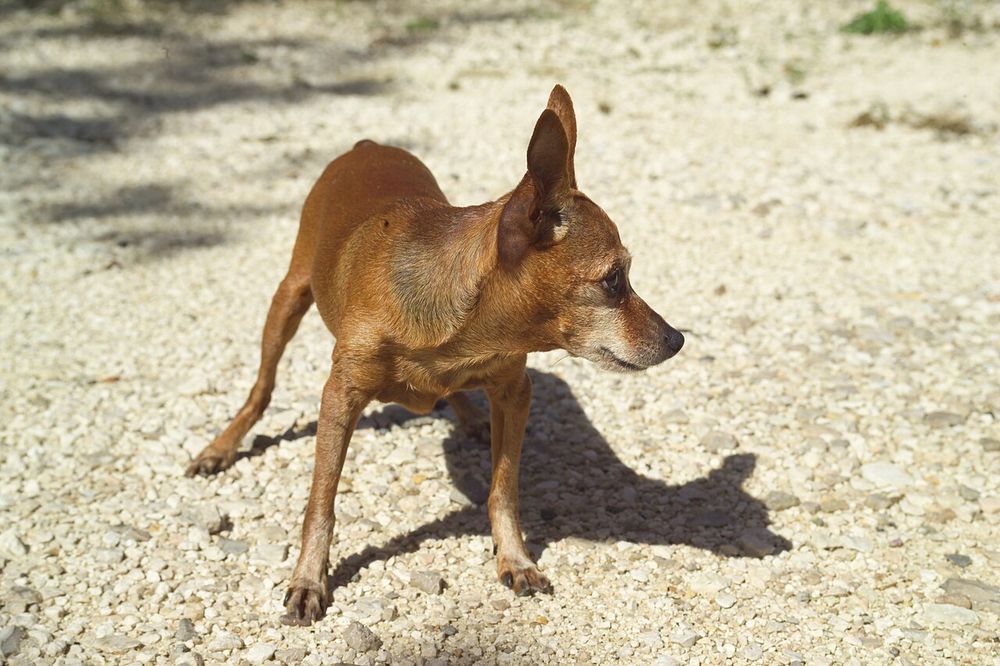
- Origin
- GermanyFédération Cynologique Internationale
- Adult weight
- 4 to 6 kg (FCI standard, dogs and bitches; AKC gives 8 to 10 pounds)Fédération Cynologique Internationale
- Height
- 25 to 30 cm (dogs and bitches; AKC gives 10 to 12.5 inches)Fédération Cynologique Internationale
- Lifespan
- 12 to 16 yearsAmerican Kennel Club
- Coat
- Short, dense, smooth and shiny, in deer red to dark red-brown or black and tan. It sheds; a weekly once-over with a soft brush or hound glove keeps it tidy.Fédération Cynologique Internationale
- Energy
- HighAmerican Kennel Club
- Indian heat
- Copes with carePDSA
- Flats
- Suits a flatThe Royal Kennel Club
Miniature Pinscher snapshot
| What | The rule | Source |
|---|---|---|
| Size | Small, says The Royal Kennel Club. The FCI standard gives 25 to 30 cm and 4 to 6 kg; AKC gives 10 to 12.5 inches and 8 to 10 pounds. | Fédération Cynologique Internationale |
| Exercise need | Up to 30 minutes a day, says The Royal Kennel Club; AKC rates energy 5 of 5 and says a couple of good walks every day. | American Kennel Club |
| Barking and guarding | AKC rates barking 5 of 5 and watchdog or protective nature 5 of 5. | American Kennel Club |
| Coat | Short and dense, smooth, close and shiny (FCI). A weekly once-over with a soft brush or hound glove (AKC). | Fédération Cynologique Internationale |
| Temperament | Lively, spirited, self assured and evenly tempered (FCI). AKC adds that Min Pins can be independent and test their owner's limits. | Fédération Cynologique Internationale |
| With children | AKC rates it 3 of 5 with young children and 4 of 5 with other dogs. | American Kennel Club |
| Lifespan | 12 to 16 years (AKC); over 12 years (The Royal Kennel Club). | American Kennel Club |
Where does the Miniature Pinscher come from?
The Miniature Pinscher, or Zwergpinscher, is German. The Royal Kennel Club describes it as a miniaturised version of the German Pinscher, a farm breed used for vermin control, and says the small variety also started out as a ratter before becoming a family companion. The first breed club was formed in Germany in 1895.
The FCI standard says Miniature Pinschers were kept in large numbers by the turn of the 20th century, and the German stud book for 1925 already held some 1,300 entries; breeders kept only two colour types, black with lighter markings and solid red to red-brown. AKC says the exact origin is murky, but breed historians accept a mix of Dachshund and Italian Greyhound, with the German Pinscher as another likely ingredient. Despite the name and the look, it is not a small Dobermann.
AKC recognised the breed in 1925, and the Royal Kennel Club says it did not reach the UK until the 1950s. In the USA and the UK it has been bred with a high-stepping "hackney" action, which differs from the standard of its home country.
How did the Miniature Pinscher come to India?
The sources we checked do not document how or when the Miniature Pinscher came to India, and we found no account from the Kennel Club of India or an Indian breed club, so we do not give a date. It is not among the nine breeds named in Ahmedabad's 2026 pet registration figures, which were led by the Labrador, German Shepherd and Shih Tzu.
Its short, close coat carries no heavy undercoat, but it is a busy, athletic dog, and PDSA advises walking every dog in the early morning or evening and keeping exercise light on hot days. The Royal Kennel Club lists a flat as a suitable home, which suits Indian apartment life as long as the dog's energy gets two proper outings a day.
What care does a Miniature Pinscher need?
The three things that shape a good day for this breed.
Exercise
The Royal Kennel Club gives up to 30 minutes a day, but AKC calls the Min Pin very active and athletic and recommends a couple of good walks every day, plus play such as chasing a ball. In Indian summers keep the walks to early morning and after sunset. The Royal Kennel Club
Grooming
AKC says the short, hard coat needs only a weekly once-over with a soft brush or hound glove. Trim the nails regularly, because overlong nails are uncomfortable, and brush the teeth often with a dog toothpaste. American Kennel Club
Training
AKC describes Min Pins as very smart and loving with their families but independent, and likely to test their owner's limits, so it recommends obedience training, early socialisation and puppy classes. The FCI standard calls the breed lively, spirited, self-assured and even-tempered. Fédération Cynologique Internationale
How much should a Miniature Pinscher eat?
Daily calories for a healthy, neutered adult Miniature Pinscher, worked out from its weight with the formula vets use (70 x weight in kg to the power 0.75, then AAHA's factor for a neutered adult). Divide by the kcal per kg on your food's pack for grams a day, and adjust by body shape.
| Resting need (kcal a day) | Neutered adult (kcal a day) | |
|---|---|---|
| 4 kg AAHA (American Animal Hospital Association) | 200 | 280 to 320 |
| 5 kg | 230 | 330 to 370 |
| 6 kg | 270 | 380 to 430 |
Feed a complete and balanced dog food made for the dog's life stage (puppy, adult or senior), as WSAVA and AKC advise; a home-cooked diet is only adequate when it is complete and balanced, which WSAVA says means a recipe formulated by a veterinarian specialised in nutrition and regular vet checks. AKC notes that some dogs gain weight easily and that too many training treats cause obesity; WSAVA says treats should stay under about 10% of the day's calories. The energy table on this page gives the daily calories; ask your vet to check the amount against your dog's body condition. ASPCA lists onions and garlic (in most dal, sabzi and gravy), grapes and raisins, chocolate, xylitol in sugar-free sweets and gum, salty snacks and milk among the foods to avoid, and warns that cooked bones can injure or block the gut. AKC says clean, fresh water should be available at all times. Meals a day: puppy, from weaning to about 6 months, 3 to 4 a day; 6 to 12 months, Fewer as it grows, down to 2 a day; adult, 2 a day. Puppies, kittens, working, pregnant and older animals need different amounts: ask your vet, or use Petym's food calculator.
Which illnesses is the Miniature Pinscher prone to, and how are they treated?
The conditions veterinary studies and breed surveys most often report in the Miniature Pinscher. Knowing the early signs means a vet sees it sooner.
See your vet first. This is general information from veterinary sources, not a diagnosis. Only a vet who has examined your pet can say what is wrong and prescribe treatment, and this page never gives a dose. Do not give your pet human medicine. If your pet seems very unwell, go to a 24-hour vet: find one in your city.
Patellar luxation (slipping kneecap)
See a vet soonThe kneecap slips out of its groove when the knee bends. A study of US veterinary teaching hospital records, cited in RVC research, found the Miniature Pinscher at substantially increased risk, and AKC lists it among the conditions responsible breeders test for. Canine Genetics and Epidemiology (2016), RVC VetCompassstudy
Signs to watch for
- Suddenly carrying a back leg for a few steps, a "skip"
- Shaking or stretching the leg before using it again
- Limping that becomes more frequent over time
How a vet treats it
A vet diagnoses it by feeling an unstable kneecap, sometimes with X-rays or a CT scan. ACVS says cases without symptoms are usually monitored, especially in small dogs, and surgery to realign the kneecap is mostly considered from grade 2 upwards, followed by several weeks of rest.
Prevention
ACVS advises that dogs diagnosed with patellar luxation should not be bred.
Legg-Calve-Perthes disease (aseptic necrosis of the femoral head)
See a vet soonThe ball of the hip joint loses its blood supply and collapses. Merck says it generally occurs in young miniature and small-breed dogs between 4 and 11 months old, often in both hips; AKC lists it among the conditions Min Pin breeders test for. Merck Veterinary Manual
Signs to watch for
- Limping on a back leg in a young dog
- Thinning of the thigh muscles
- Pain or a grating feel when the hip is moved
How a vet treats it
A vet confirms it with X-rays of the hips. Merck says the treatment of choice is surgery to remove the femoral head and neck (femoral head and neck ostectomy), or total hip replacement in selected cases, and that the outlook after surgery is excellent.
Dental disease
Ask at a routine checkPlaque hardens into tartar and infects the gums and the tissue holding the teeth. Merck lists toy breeds as a risk factor, and AKC advises brushing a Min Pin's teeth often. Merck Veterinary Manual
Signs to watch for
- Bad breath
- Yellow or brown tartar on the teeth
- Red, swollen or bleeding gums
- Loose or missing teeth
How a vet treats it
A vet examines the mouth, probes the gums and takes dental X-rays. Merck says treatment includes professional dental cleaning and cleaning of the root surfaces and gum pockets.
Prevention
Brushing with a toothpaste made for dogs, which Merck says removes plaque, and regular vet check-ups, as AKC advises.
Not a small Dobermann: what the Min Pin was bred for
Word for word
Lively, spirited, self assured and evenly tempered. These qualities make him an agreeable family and companion dog.
The Royal Kennel Club describes the Min Pin as a miniaturised version of the German Pinscher, used for vermin control, with the miniature also working as a ratter before it became a family companion. It is a separate, older breed, not a shrunken Dobermann. That ratter's past explains a lot: the speed, the alertness, the urge to chase anything small that moves, and the confidence to take on a dog five times its size.
How long can a Miniature Pinscher be left alone?
An adult can rest for a few hours after a good walk, but a bored Min Pin finds noisy ways to pass the time.
AKC calls the Min Pin very active and athletic, and rates its need for mental stimulation at 5 of 5. Leave it alone in a flat all day without exercise and the energy goes into barking at the lift, digging at cushions or racing the length of the corridor. PDSA's general advice is no more than 4 hours alone for any dog, and it lists barking, whining, toileting indoors, drooling and trembling as signs of separation distress.
In a housing society, the barking is often what neighbours notice first. A walk before the owner leaves, a food toy, the curtains drawn on a window that faces the corridor and a midday visit on long days all help. If the barking is constant or the dog is distressed, talk to your vet or a qualified behaviourist; shouting at a Min Pin usually just adds to the noise.
AKC also notes that Min Pins are smart but independent and may test the limits, so a new sitter should keep the owner's rules exactly: the same cues, the same off-limits sofa, the same mealtimes. A dog that discovers the sitter's rules are softer will try them all.
Miniature Pinscher myths, checked
You may have read
Small dog, so a stroll round the building is enough.
Myth
What the sources say
AKC rates the breed's energy 5 of 5 and recommends a couple of good walks every day, plus play such as chasing tennis balls. American Kennel Club
You may have read
It is a miniature Dobermann.
Myth
What the sources say
The Royal Kennel Club describes it as a miniaturised German Pinscher, a vermin hunter whose first breed club formed in Germany in 1895. The Royal Kennel Club
You may have read
Short coat means no grooming at all.
Myth
What the sources say
Grooming is light, but not nothing: AKC advises a weekly brush and regular nail trims, and teeth brushed often. American Kennel Club
You may have read
Mange on a Min Pin puppy will spread to the family.
Myth
What the sources say
CAPC says demodectic mange is not contagious between dogs and is not transmitted to people. It still needs a vet's diagnosis. Companion Animal Parasite Council
A Min Pin walk that actually tires it out
Petym’s working from the official rules, no government publishes a total.
Petym's suggested routine for a sitter, morning and evening in the cool hours.
Harness on indoors
Fit the harness before the door opens. A Min Pin that hears the leash may bolt for the gap.
Door and lift control
Pick the dog up or keep it close in the lift and lobby, away from delivery bikes and the watchman's stick.
Brisk loop
Twenty minutes at a quick pace on the shaded side of the lane. Test the road with the back of your hand for seven seconds first. The Royal Kennel Club
Chase game
A few minutes of fetch with a small ball in a safe, enclosed spot, as AKC suggests for this playful breed. American Kennel Club
Calm past other dogs
Cross the road or step aside from community dogs. A Min Pin often challenges dogs far bigger than itself.
Home check
Water, then a quick look at paws and coat for ticks, and a note of any skipping or limping on a back leg.
Miniature Pinscher health signs a sitter should report
Note it, tell the owner, and call the vet for anything sudden or painful.
If Skipping or hopping on a back leg for a few strides. The breed club lists patellar luxation as a major concern.
Note when it happens and tell the owner; call the vet if the dog is in pain. American College of Veterinary Surgeons
If A young dog, roughly 4 to 11 months old, limping on a back leg, with a thinner thigh and pain when the hip moves.
Call the vet. The Merck Veterinary Manual describes this as Legg-Calvé-Perthes disease of young small-breed dogs; surgery has an excellent recovery. Merck Veterinary Manual
If Patches of hair loss, often on the face or legs of a puppy, with little itching.
Ask the vet; demodectic mange needs a diagnosis. CAPC says the localised form usually shows in puppies under 6 months. Companion Animal Parasite Council
If Neck pain, crying when picked up, reluctance to lower the head to the bowl. AKC lists cervical disc disease among screened conditions.
Call the vet the same day; lift the dog with support under the chest and hindquarters. American Kennel Club
If A seizure: stiffening, paddling, drooling, loss of awareness. AKC lists epilepsy.
Keep it away from stairs and hard edges, time the seizure and call the vet. American Kennel Club
If Ate something it should not have: chocolate, a xylitol gum, grapes or a sweet from a guest.
Call the vet straight away with what and how much was eaten. Do not wait for signs. ASPCA Animal Poison Control
A Min Pin through the Indian seasons
| Hot months | Monsoon | Winter in North India | |
|---|---|---|---|
| Walks | Dawn and after dark; short and brisk | Between showers; dry the coat and paws | Midday walks are pleasant |
| Indoors | A cool room, water in two places, games instead of long walks | Indoor fetch and food puzzles on wet days | A warm bed off the floor, away from draughts |
| Watch for | Heavy panting after play | Ticks and damp skin | Shivering on cold mornings |
| Noise PDSA | Holi crowds and colours | Ganesh Chaturthi drums | Diwali crackers: a closed room and a hiding place |
Petym's practical plan, based on the sources on this page. Fireworks advice follows PDSA's guidance on dogs and fireworks.
Miniature Pinscher sitter checklist
- Harness and leash, and the escape points: the main door, the balcony grille, the society gate.
- What it barks at, and the owner's cue for quiet.
- House rules: furniture, sleeping place, and how it is fed.
- How it behaves with other dogs, and which neighbours' dogs to avoid.
- Any knee, hip or neck problems, and medicines with the vet's written plan.
- Tick prevention product and next due date.
- The vet's number and the nearest 24-hour vet on Petym's list for your city.
Which Petym service suits a Miniature Pinscher?
An energetic, sociable Min Pin often does well with people around; a territorial one may prefer home.
Often a good fit
Pet boarding
A sitter's home with people around, inside the home's pet limit, after a free meet and greet. Ask about gaps in gates and grilles.
Overnight pet sitting
For a Min Pin that guards its home or barks in new places.
Dog walking
A brisk midday walk on long workdays.
Drop-in visits
A play session and a toilet break between your hours away.
Breeds with similar care needs to the Miniature Pinscher
Going away soon? Tell us your dates.
A checked local sitter feeds, walks and keeps your pet company at home, follows your care sheet to the letter and sends a photo every day. Petym is opening city by city: send your dates and we will tell you when a sitter can take them.
- Meet your sitter first, free
- PAN-checked, first-aid trained
- A photo every day
- Pay through Petym, never cash


Questions owners ask
Is a Miniature Pinscher good for an Indian flat?
- In size, yes: The Royal Kennel Club lists it as suited to a flat. But AKC rates its energy and barking at 5 of 5, so it needs two good walks and play every day, and neighbours will hear it. Plan exercise in the cool hours and games indoors.
How long can a Min Pin be left alone?
- PDSA's general advice is no more than 4 hours at a time. A well-exercised adult may rest for that long, but a bored Min Pin often barks or chews. On long days, book a walk or drop-in visit, and leave a food toy.
Is the Miniature Pinscher a small Dobermann?
- No. The Royal Kennel Club describes it as a miniaturised German Pinscher, used as a ratter, with its first breed club formed in Germany in 1895. It looks a little like a Dobermann but is its own breed with its own history.
Why does my Miniature Pinscher bark so much?
- It was bred as an alert little ratter, and AKC rates both its barking and watchdog nature at 5 of 5. Exercise, mental games, a covered corridor window and calm, consistent cues help. Talk to your vet or a qualified behaviourist if the barking is constant.
What health problems do Miniature Pinschers have?
- AKC's breed club names patellar luxation, Legg-Calvé-Perthes disease of the hip and demodectic mange as the major concerns, and AKC also lists cervical disc disease, epilepsy, thyroid, heart and eye problems. Call your vet about any limping, neck pain or hair loss.
Are Miniature Pinschers good with children?
- AKC rates them 3 of 5 with young children. They are small and can be hurt by rough handling. Supervise visits, teach children to sit to stroke the dog, and give it a place to retreat.
Do Min Pins feel the cold in North Indian winters?
- Many small, short-coated dogs appreciate warmth on cold mornings. Give a warm bed off the floor and away from draughts, and watch for shivering. Your vet can advise if your dog is old, thin or unwell.
Keep reading
- Dog care hub
- Diwali fireworks and pets
- Pets in housing societies
- Dobermann careThe big dog it is often mistaken for.
- Jack Russell Terrier careAnother small, bold ratter.
- Pet boarding in a sitter's home
- Leaving your dog for a week
Services that help
Free tools for this
Words on this page, explained
Keep exploring
Other dog breeds
- Akita
- Alaskan Malamute
- American Bully
- American Cocker Spaniel
- American Pit Bull Terrier
- Australian Shepherd
- Bakharwal dog
- Basset Hound
- Beagle
- Belgian Malinois
- Bernese Mountain Dog
- Bichon Frise
- Border Collie
- Boston Terrier
- Boxer
- Bull Terrier
- Bulldog
- Bullmastiff
- Cane Corso
- Caucasian Shepherd Dog
- Cavalier King Charles Spaniel
- Chihuahua
- Chippiparai
- Chow Chow
- Cocker Spaniel
- Dachshund
- Dalmatian
- Dobermann
- Dogo Argentino
- English Mastiff
- English Springer Spaniel
- French Bulldog
- Gaddi Kutta (Gaddi dog)
- German Shepherd
- Golden Retriever
- Great Dane
- Greyhound
- Havanese
- Indian pariah dog (Indie)
- Indian Spitz
- Irish Setter
- Jack Russell Terrier
- Kangal
- Kanni
- Kombai
- Labrador Retriever
- Lhasa Apso
- Maltese
- Miniature Schnauzer
- Mudhol Hound
- Neapolitan Mastiff
- Newfoundland
- Papillon
- Pekingese
- Pembroke Welsh Corgi
- Pomeranian
- Poodle
- Pug
- Rajapalayam
- Rampur Greyhound
- Rhodesian Ridgeback
- Rottweiler
- Saint Bernard
- Samoyed
- Shar Pei
- Shiba Inu
- Shih Tzu
- Siberian Husky
- Tibetan Mastiff
- Weimaraner
- West Highland White Terrier
- Whippet
- Yorkshire Terrier
Sources
Each source was opened and read on the date shown. How Petym checks its sources
- Fédération Cynologique Internationale: FCI-Standard No 185: Miniature Pinscher (Zwergpinscher) (opens in a new tab)
- American Kennel Club: Miniature Pinscher dog breed information (opens in a new tab)
- PDSA: Heatstroke in dogs (opens in a new tab)
- The Royal Kennel Club: Miniature Pinscher: breed information (opens in a new tab)
- WSAVA: Frequently asked questions and myths (Global Nutrition Committee) (opens in a new tab)
- ASPCA Animal Poison Control: People foods to avoid feeding your pets (opens in a new tab)
Show all 19 sourcesShow fewer
- VCA Animal Hospitals: Feeding times and frequency for your dog (opens in a new tab)
- Merck Veterinary Manual: Puppy care (opens in a new tab)
- AAHA (American Animal Hospital Association): 2021 AAHA Nutrition and Weight Management Guidelines for Dogs and Cats: energy requirement calculations (Box 1, PDF) (opens in a new tab)
- Merck Veterinary Manual: Nutritional requirements of small animals (full review November 2023, updated September 2024) (opens in a new tab)
- American College of Veterinary Surgeons: Patellar Luxation (Dislocating Kneecap) in Dogs | ACVS (opens in a new tab)
- Merck Veterinary Manual: Aseptic necrosis of the femoral head in dogs (opens in a new tab)
- Merck Veterinary Manual: Periodontal disease in small animals (full review February 2024, updated April 2025) (opens in a new tab)
- Companion Animal Parasite Council: Demodex spp. (opens in a new tab)
- PDSA: Separation anxiety in dogs (opens in a new tab)
- PDSA: Dogs and fireworks (opens in a new tab)
- The Royal Kennel Club: The danger of hot pavements (opens in a new tab)
- Canine Genetics and Epidemiology (2016), RVC VetCompass: The epidemiology of patellar luxation in dogs attending primary-care veterinary practices in England (opens in a new tab)
- Telangana Today (IANS): Ahmedabad registers nearly 20,000 pet dogs; Labradors remain the city's most popular breed (5 Aug 2026) (opens in a new tab)