Sphynx cat care in India: sun, skin, heat and sitters
Updated By PetymFacts checked against official sources on
Quick answer
A Sphynx can stay at home while you travel, but it needs more company than most cats, so plan long visits or a sitter who stays overnight. With no coat, its skin burns easily in Indian sun and gets oily, so keep it indoors away from bright windows and keep up its baths and ear cleaning.
The breed is linked to an inherited heart disease (HCM) and a muscle disorder, and a UK study found the shortest life expectancy of the breeds it measured. A sitter should know the breathing signs that mean an urgent vet visit.
- Meet your sitter first, free
- PAN-checked, first-aid trained
- A photo every day
- Pay through Petym, never cash

- Origin
- Toronto, Ontario, CanadaThe Cat Fanciers' Association
- Adult weight
- 2.7 to 5 kg (GCCF: females 6 to 8 lb, males 8 to 11 lb.)Governing Council of the Cat Fancy
- Coat
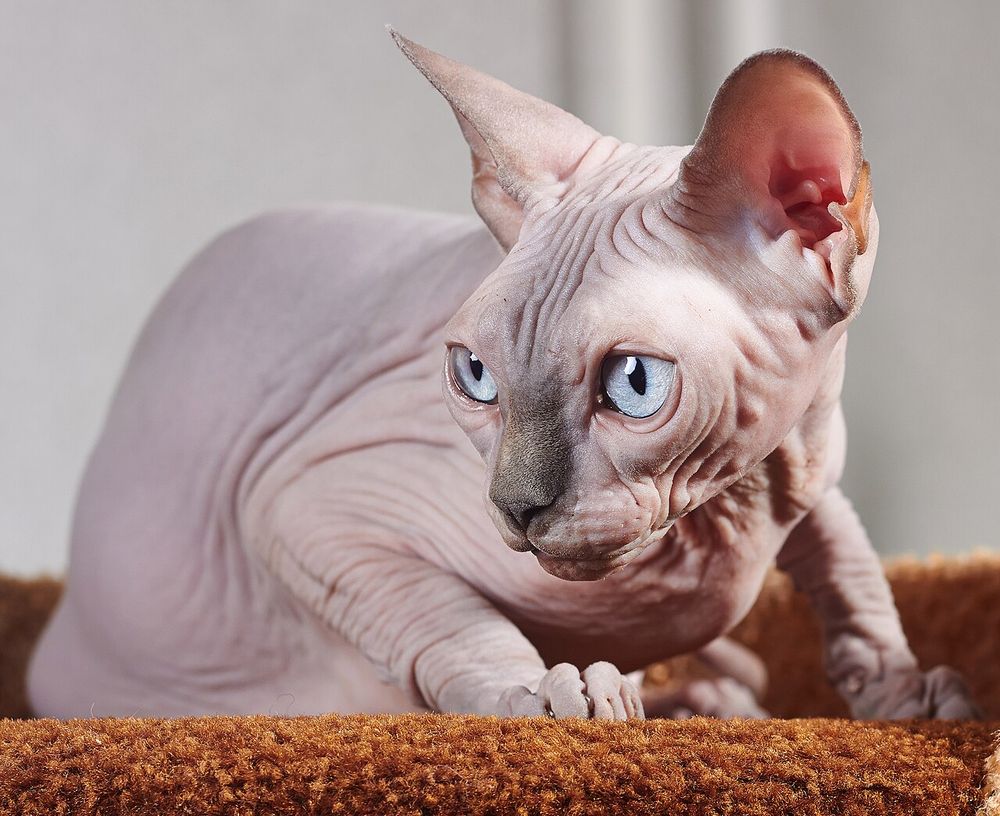
- Not always totally hairless: CFA says skin texture and the degree of hairlessness vary, with some short hair usually on the nose, ears and tail. The skin is oily and wrinkled on parts of the head, body and legs.The Cat Fanciers' Association
- Energy
- HighThe Cat Fanciers' Association
- Indian heat
- Copes with careGoverning Council of the Cat Fancy
- Flats
- Suits a flatGoverning Council of the Cat Fancy
Sphynx cat at a glance
| What | The rule | Source |
|---|---|---|
| Size | Medium-sized and substantial, not fragile; CFA says males are usually larger than females. | The Cat Fanciers' Association |
| Temperament | Curious, outgoing and very intelligent; CFA says it follows people from room to room, chattering. | The Cat Fanciers' Association |
| Alone-time tolerance | Low for a cat. GCCF says owners often find the breed very sociable and that it hates being alone. | Governing Council of the Cat Fancy |
| Sun and heat | Burns easily: GCCF says Sphynx are kept indoors because they can easily get burnt by the sun. | Governing Council of the Cat Fancy |
| Skin care | High. With no coat to absorb body oils, the skin needs regular bathing, and the ears and feet collect wax and dirt. | Governing Council of the Cat Fancy |
| Health to watch | HCM is strongly suspected to be inherited in the breed; skin yeast, ear infections and a muscle disorder are also reported. | International Cat Care |
Where does the Sphynx cat come from?
The Sphynx began with a spontaneous mutation. CFA says a domestic cat gave birth to a hairless kitten in Toronto, Canada, in 1966, and GCCF records that the first Sphynx kitten, born in Ontario that year, was called Prune. The hairlessness turned out to be a natural recessive gene, and breeders built the line by outcrossing to normal-coated cats.
Two more hairless cats with the same mutation, named Epidermis and Dermis, appeared in Minnesota in 1975. CFA says they were bred to American Shorthairs and Devon Rex cats and joined the growing gene pool. CFA accepted the Sphynx for registration in 1998 and gave it championship status in 2002. GCCF notes that the first Sphynx to enter the UK, a four-year-old female called Tulip, came from Holland.
How did the Sphynx cat come to India?
No source we could find records when or how the Sphynx reached India; it is an imported breed and its arrival here is not documented. What matters for an Indian home is sun and heat. GCCF says Sphynx are indoor cats because they burn easily in the sun, and International Cat Care says cats with no hair, and cats in hotter climates, are at higher risk of severe sunburn.
A Sphynx in an Indian flat lives indoors, away from bright windows and balconies in the middle of the day, and needs a warm, covered bed in an air-conditioned room or a north Indian winter, because CFA calls the breed a body heat magnet that seeks out warmth.
What care does a Sphynx cat need?
The three things that shape a good day for this breed.
Exercise
CFA describes a lively, curious, very intelligent cat that thrives on company and does not do well left alone for long. Daily play with wand toys and climbing space indoors keep it busy; GCCF says it can go outside only under supervision, ideally on a harness. The Cat Fanciers' Association
Grooming
With no coat to absorb body oils, CFA says the oily skin needs regular bathing, which most Sphynx seem to enjoy, GCCF adds. GCCF notes the ears and feet collect wax and dirt, so check and clean them, and keep the cat out of strong sun. Governing Council of the Cat Fancy
Training
CFA's standard calls the Sphynx sweet-tempered and amenable to handling, which helps with the regular baths and ear care it needs. GCCF suggests a harness for any supervised time outdoors, and CFA says the breed thrives with other cats, especially other Sphynx. The Cat Fanciers' Association
How much should a Sphynx cat eat?
Daily calories for a healthy, neutered adult Sphynx cat, worked out from its weight with the formula vets use (70 x weight in kg to the power 0.75, then AAHA's factor for a neutered adult). Divide by the kcal per kg on your food's pack for grams a day, and adjust by body shape.
| Resting need (kcal a day) | Neutered adult (kcal a day) | |
|---|---|---|
| 2.7 kg AAHA (American Animal Hospital Association) | 150 | 180 to 210 |
| 3.9 kg | 190 | 230 to 270 |
| 5 kg | 230 | 280 to 330 |
Feed a complete and balanced cat food for the cat's life stage; Cornell says foods carrying an AAFCO nutritional guarantee are complete and balanced. GCCF says Sphynx usually need a slightly higher calorie intake than other breeds, so treat the energy table as a starting point and let your vet set the amount from your cat's body condition. Keep fresh water out at all times. Milk is not recommended for cats, Cornell says, because many are lactose-intolerant, and onion and garlic in Indian cooking can damage a cat's red blood cells, according to ASPCA. Keep lilies out of the house: International Cat Care warns they can cause kidney failure in cats. Meals a day: kitten to 6 months, 3 a day; 6 months to 1 year, 2 a day; adult, from about 1 year, 1 or 2 a day. Puppies, kittens, working, pregnant and older animals need different amounts: ask your vet, or use Petym's food calculator.
Which illnesses is the Sphynx cat prone to, and how are they treated?
The conditions veterinary studies and breed surveys most often report in the Sphynx cat. Knowing the early signs means a vet sees it sooner.
See your vet first. This is general information from veterinary sources, not a diagnosis. Only a vet who has examined your pet can say what is wrong and prescribe treatment, and this page never gives a dose. Do not give your pet human medicine. If your pet seems very unwell, go to a 24-hour vet: find one in your city.
Hypertrophic cardiomyopathy (HCM)
See a vet soonThe muscular walls of the heart thicken and it pumps less well. International Cat Care says HCM is strongly suspected to be inherited in the Sphynx, GCCF says it has been reported in young to middle-aged Sphynx, and Cornell lists the breed among those in which it is more common. International Cat Care
Signs to watch for
- Often none: many cats with HCM do not appear ill
- Laboured, rapid or open-mouth breathing
- Lethargy
- Sudden pain or paralysis in the back legs from a blood clot
How a vet treats it
Cornell says HCM is diagnosed by echocardiography, an ultrasound scan of the heart, after high blood pressure and an overactive thyroid are ruled out. It has no known cure, but a vet may prescribe medication to control the heart rate, relieve congestion on the lungs and help prevent blood clots.
Prevention
CFA says testing for HCM has been instrumental in the breed: ask the breeder for the parents' heart scan results.
Hereditary myopathy
See a vet soonAn inherited, recessive muscle weakness caused by a mutation in the COLQ gene, which leaves too little of an enzyme where nerves meet muscles. UFAW says signs start between 3 and 23 weeks of age and often settle by about 9 months. UFAW (Science for Animal Welfare)
Signs to watch for
- Trouble holding the head up, or head bobbing
- Tiring quickly with play
- A high-stepping front-leg gait
- Difficulty swallowing, gagging or choking on food
How a vet treats it
Diagnosis is difficult because signs vary; a vet may take muscle samples under anaesthesia. UFAW says there is no curative treatment, and affected cats can be fed by hand or from a raised platform to reduce the risk of choking.
Prevention
A DNA test detects affected and carrier cats in Sphynx and Devon Rex; breeders should not mate two carriers.
Sunburn and sun-related skin cancer
See a vet soonWith no coat to block sunlight, a Sphynx can burn badly. International Cat Care says repeated sun exposure raises the risk of squamous cell carcinoma, a common skin cancer that can be painful and life-threatening if untreated. International Cat Care
Signs to watch for
- Red, irritated skin after sun
- Scabs or sores on the ears or nose that do not heal
How a vet treats it
Contact your vet straight away for severe sunburn, as International Cat Care advises: treatment is likely to be needed. A sore that will not heal needs a vet's examination to rule out skin cancer.
Prevention
Keep the cat indoors, as GCCF advises, and out of direct midday sun. If your vet suggests sunscreen, use only one made for pets and labelled safe for cats.
Can a Sphynx be left alone at home?
For short spells, yes. For a trip of several days, a Sphynx needs more human time than the usual two short visits.
The GCCF breed page says owners often find the Sphynx very sociable and that the breed hates being alone. CFA describes a cat that is anything but shy and keeps up a stream of chatter as it follows you around the house. That is a lovely cat to live with and a hard cat to leave with a full bowl and a quick scoop of the litter.
Cats Protection suggests a sitter who visits at least twice a day for any cat. For a Sphynx, make each visit long enough for play and lap time, or book overnight pet sitting so someone is in the home through the evening and night. Ask the sitter to log how the cat eats and behaves at every visit: a cat that eats less or hides more than usual is telling them something.
A second friendly cat can help with company, but only if the two already get on. Never add a new cat just before a trip: International Cat Care lists changes to the home among the common causes of stress in cats.
Is Indian sun dangerous for a hairless cat?
Yes. Sunburn is the most obvious risk for a Sphynx in India, and it can happen indoors next to a bright window.
GCCF says Sphynx are usually kept indoors because they can easily get burnt by the sun, and that they can go out only under supervision, weather permitting, ideally on a harness. International Cat Care says cats with white, thin or no hair are at higher risk of sunburn, and that cats in hotter climates may be at increased risk. In much of India the sun through a south or west window from late morning to late afternoon is strong for most of the year, not only in summer.
Ask your sitter not to take a Sphynx onto a balcony or terrace, and to draw curtains or blinds on windows the cat likes to lie in. If your vet has recommended a pet sunscreen for the ears or nose, write it on the care sheet; International Cat Care says to use only products made for pets that are labelled safe for cats, and to ask the vet if unsure. Human sunscreen is not a substitute.
Red, sore or flaky skin is a reason to call the vet promptly, as International Cat Care advises for visible sunburn. Scabs or sores on the ears or nose that do not heal also need a vet, because they can be an early sign of skin cancer.
Do Sphynx cats feel the cold in an air-conditioned flat?
The skin of a Sphynx feels warm, but GCCF says the cat's temperature is no higher than any other cat's, that it does not need extra heat, and that extra heat will only make it sweat more. CFA calls the breed a body heat magnet that will spend hours pressed against a person. Without a person to lie on, it looks for the warmest spot in the house.
That matters when the flat is left with the air conditioner on for a hot cat, or in a north Indian winter in an unheated home. Leave a covered bed or a soft blanket the cat can burrow into, away from the AC's direct airflow, and tell your sitter which room you keep the cat in. No source sets a room temperature for the breed; if you are unsure, ask your vet what suits your cat.
How should a sitter clean a Sphynx's skin and ears?
The way you do it, and no other way. Write your routine down step by step.
Wipe or bath, as you do it
GCCF says body oils build up because there is no coat and that bathing removes them; CFA says the skin is very oily and needs regular bathing. Most owners have a set day. On a trip of more than a week, the sitter keeps that day only if you have shown them how. Governing Council of the Cat Fancy
Dry and warm straight after
A towel straight away and a warm room until the skin is dry. A damp hairless cat under a fan or AC chills quickly.
Ears
GCCF says the ears get very dirty with wax. Clean only the visible part, with the product and method you use, and never push anything into the canal. Governing Council of the Cat Fancy
Feet and nail folds
Wax and dirt also gather between the toes and around the claws, GCCF notes. A soft damp cloth is enough between baths. Governing Council of the Cat Fancy
Look while you clean
International Cat Care lists increased yeast (Malassezia) on the skin and ear infections among the problems seen in the breed. Greasy brown patches, a smell, redness, head shaking or scratching at an ear are reasons to tell the owner and call the vet. International Cat Care
Which Sphynx health signs need a vet, and how fast?
A sitter does not diagnose. These are the problems the sources link to the breed and what to do if you see them.
If Fast, laboured or open-mouth breathing, or a cat that is suddenly flat and quiet. International Cat Care says HCM is strongly suspected to be inherited in the Sphynx, and Cornell lists the breed among those in which it is more common.
Emergency: go to the nearest 24-hour vet now. Open-mouth breathing in a cat is never normal. Cornell University College of Veterinary Medicine
If Sudden pain or weakness in the back legs, crying, cold back feet or dragging the legs. Cornell says clots from a diseased heart most often block blood flow to the hind legs.
Emergency: go to the vet straight away and call the owner on the way. Cornell University College of Veterinary Medicine
If A young cat that cannot hold its head up, tires quickly, or chokes or gags on food. UFAW describes an inherited muscle disorder in the Sphynx with these signs, and notes a risk of choking.
Call the vet the same day. If the cat is choking or struggling to breathe, go now. Feed exactly as the owner's plan says, from the raised dish if one is used. UFAW (Science for Animal Welfare)
If Red, sore or peeling skin after sun, or a sore on an ear tip or the nose that will not heal.
Call the vet promptly, as International Cat Care advises for visible sunburn. Keep the cat out of the sun meanwhile. International Cat Care
If Panting, drooling, bright red or very pale gums, or wobbling on a hot day or in a power cut.
Heatstroke: cool the cat gently with cool, not icy, water and a fan, then go to the vet at once. PDSA
If Little or no food eaten over two visits, or a whole day.
Call the vet. A cat that stops eating for a few days can develop a serious liver disease. University of Illinois College of Veterinary Medicine
How long do Sphynx cats live?
A 2024 Royal Veterinary College VetCompass study of 7,936 UK cats that died in 2019 built the first life tables for UK companion cats. Average life expectancy at birth was 11.74 years for all cats. The Sphynx had the shortest of the breeds reported, at 6.68 years, with a wide range of uncertainty (4.53 to 8.83 years) because the number of Sphynx in the study was small. Burmese and Birman cats had the longest, at about 14.4 years.
A short average does not mean your own cat will have a short life, and the study does not give causes for the breed. It is a reason to keep up regular vet checks, to ask your vet whether a heart scan is sensible for your cat, and to choose a sitter who will act on breathing changes rather than wait for you to come home.
Feeding a Sphynx while you travel
CFA notes that a Sphynx's needs usually revolve around attention or food, and many owners find their cat loud about mealtimes. Keep the food, the amounts and the times exactly as they are, and leave enough for the whole trip plus a few days. PDSA says a sudden change of food commonly causes diarrhoea, which on bare skin is messy and sore.
If your vet has diagnosed the muscle disorder, UFAW says feeding by hand or from a raised platform can lower the risk of choking: write the exact method on the care sheet. Do not let a sitter make up for your absence with extra treats or table food, and keep lilies out of the house while you are away: International Cat Care lists them among the plants that are dangerous to cats.
Sphynx care through the Indian year
| Main risk | What the sitter does | |
|---|---|---|
| Summer (March to June) Governing Council of the Cat Fancy | Sunburn by windows, heat in a power cut | Blinds drawn on sunny windows, no balcony time, extra water bowls, a cool room and the inverter plan |
| Monsoon (June to September) International Cat Care | Humid air, slow-drying skin after a bath, skin yeast | Dry the cat fully after any wash; report greasy patches, smell or redness |
| Diwali and wedding season | Noise stress in a cat that hates being alone | Windows shut, more time with the cat in the evenings, hiding places left open |
| Winter (north India) The Cat Fanciers' Association | A warmth-seeking cat in an unheated flat | A covered bed off the floor, away from draughts; never a heater the cat can touch |
Which Petym service suits a Sphynx?
Most cats do best at home. For a Sphynx, the question is how much company it gets there.
Most Sphynx
Overnight pet sitting
A sitter stays in your home, so the cat has evening and night company, someone to notice breathing changes and someone there in a power cut.
Short trips
Drop-in visits
Two or three long visits a day with play, food, litter and skin and ear care as your plan says, plus a daily photo update. Suits a confident adult on a trip of a few days.
Diagnosed heart or muscle disease
Special-needs care
For a Sphynx on heart medicine or a special feeding routine, with every dose and meal given and logged as written.
Breeds with similar care needs to the Sphynx cat
Going away soon? Tell us your dates.
A checked local sitter feeds, walks and keeps your pet company at home, follows your care sheet to the letter and sends a photo every day. Petym is opening city by city: send your dates and we will tell you when a sitter can take them.
- Meet your sitter first, free
- PAN-checked, first-aid trained
- A photo every day
- Pay through Petym, never cash

Questions owners ask
Can I leave my Sphynx cat alone for a weekend?
- Not without visits, and ideally not with short ones. GCCF says owners often find Sphynx very sociable and that they hate being alone. Book a sitter who spends real time with the cat at least twice a day, or one who stays overnight, and keep the cat out of strong sun while you are away.
Can a Sphynx cat live in India's heat?
- Indoors, with care, yes. The bigger risk is sunburn: GCCF says Sphynx can easily get burnt by the sun, and International Cat Care says cats with no hair in hot climates are at higher risk. Keep the cat away from sunny windows and balconies, and plan for heat in a power cut.
Do Sphynx cats need baths?
- Yes, regularly. CFA says the skin is very oily and needs regular bathing, and GCCF says body oils build up without a coat to absorb them. The ears and feet also collect wax and dirt. A sitter should bathe a Sphynx only if you have shown them how, and dry it fully afterwards.
Is a Sphynx cat hypoallergenic?
- No. GCCF says plainly that the Sphynx is not a hypoallergenic cat. CFA says bathing helps reduce the allergens on the skin, but people with cat allergies can still react. If a sitter or family member has a cat allergy, tell them before they agree to look after the cat.
What heart problem do Sphynx cats get?
- Hypertrophic cardiomyopathy (HCM), a thickening of the heart muscle. International Cat Care says it is strongly suspected to be inherited in the breed, and Cornell lists the Sphynx among breeds in which it is more common. Fast or open-mouth breathing, or sudden back-leg pain, is an emergency for the nearest vet.
How long do Sphynx cats live?
- In a 2024 VetCompass study of UK cats, the Sphynx had the shortest average life expectancy of the breeds reported, 6.68 years, against 11.74 years for all cats. The range was wide because few Sphynx were included. Regular vet checks and quick action on breathing changes matter for this breed.
Should a Sphynx go to a cattery or stay home with a sitter?
- Home is usually easier. Cats Protection says cats are less stressed in their own surroundings, and a Sphynx's sun protection, warmth and skin routine are simpler to keep up at home. A cattery can work if staff will keep the cat warm, out of the sun and give it plenty of company.
Keep reading
- Cats: caring for a cat while you are away
- Devon Rex careA close relative with a thin coat and the same muscle disorder test.
- How long can a cat be left alone?
- Drop-in visits vs overnight sitting
- Overnight pet sitting
- Summer pet care in India
- Cat-proofing a balcony
Services that help
Free tools for this
Words on this page, explained
Keep exploring
Sources
Each source was opened and read on the date shown. How Petym checks its sources
- The Cat Fanciers' Association: Sphynx (opens in a new tab)
- Governing Council of the Cat Fancy: Sphynx (opens in a new tab)
- International Cat Care: Should I use sunscreen on my cat? (first published 17 June 2024, updated 26 September 2025) (opens in a new tab)
- Cornell Feline Health Center: Feeding your cat (updated 30 April 2026) (opens in a new tab)
- Cornell Feline Health Center: How often should you feed your cat? (opens in a new tab)
- ASPCA Animal Poison Control: People foods to avoid feeding your pets (opens in a new tab)
Show all 18 sourcesShow fewer
- International Cat Care: Cats and poisons (opens in a new tab)
- AAHA (American Animal Hospital Association): 2021 AAHA Nutrition and Weight Management Guidelines for Dogs and Cats: energy requirement calculations (Box 1, PDF) (opens in a new tab)
- Merck Veterinary Manual: Nutritional requirements of small animals (full review November 2023, updated September 2024) (opens in a new tab)
- International Cat Care: Sphynx (first published 21 March 2025, updated 26 September 2025) (opens in a new tab)
- Cornell University College of Veterinary Medicine: Hypertrophic cardiomyopathy (Cornell Feline Health Center) (opens in a new tab)
- UFAW (Science for Animal Welfare): Sphynx: hereditary myopathy (opens in a new tab)
- PDSA: Heatstroke in cats (opens in a new tab)
- Cats Protection: Going on holiday without your cat (opens in a new tab)
- International Cat Care: Stress in cats (opens in a new tab)
- University of Illinois College of Veterinary Medicine: Hepatic lipidosis: a serious problem when cats stop eating (opens in a new tab)
- PDSA: Diarrhoea after a change of food (opens in a new tab)
- Journal of Feline Medicine and Surgery (2024), Royal Veterinary College VetCompass: Life tables of annual life expectancy and risk factors for mortality in cats in the UK (abstract read via Europe PMC) (opens in a new tab)