Bombay cat care in India: origin, health and sitters
Updated By PetymFacts checked against official sources on
Quick answer
A Bombay is an affectionate, moderately active black pedigree cat that settles at home with a sitter visiting at least twice a day. Despite the name, CFA says it was developed in Kentucky, USA, in 1966. Its short glossy coat needs little brushing; the sitter's job is company, a cool room and spotting weakness early.
Bombays come from Burmese lines, so they share some Burmese inherited problems: an episodic potassium disorder that causes muscle weakness, heart disease, and in some lines a short-faced head shape linked to a lethal defect in kittens.
- Meet your sitter first, free
- PAN-checked, first-aid trained
- A photo every day
- Pay through Petym, never cash

- Origin
- Kentucky, United StatesThe Cat Fanciers' Association
- Adult weight
- 3.5 to 7 kg (GCCF figures for the Asian group, which includes the black Bombay: females about 3.5 to 5.5 kg, males about 5 to 7 kg. CFA gives no weight, only that the cat feels heavier than it looks.)Governing Council of the Cat Fancy
- Lifespan
- 16 to 18 yearsGoverning Council of the Cat Fancy
- Coat
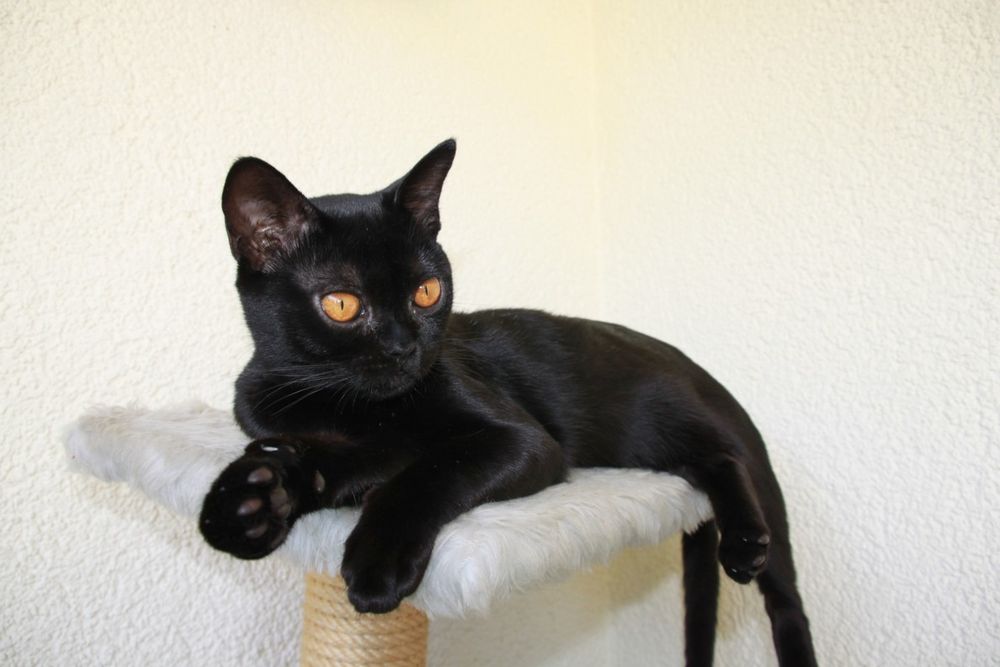
- Very short, dense and close-lying, always black, with a satin texture and what CFA calls a patent-leather sheen. Shedding is moderate to minimal.The Cat Fanciers' Association
- Energy
- ModerateThe Cat Fanciers' Association
- Indian heat
- Copes with carePDSA
- Flats
- Suits a flatThe Cat Fanciers' Association
Bombay cat at a glance
| What | The rule | Source |
|---|---|---|
| Origin | Developed in 1966 by Nikki Horner, a Kentucky breeder, from the American Shorthair and the Burmese; CFA says the name was inspired by India's black leopards and the city of Bombay. | The Cat Fanciers' Association |
| Size | Medium and muscular; CFA says it feels heavier than it looks. GCCF gives about 5 to 7 kg for males in the Asian group, females lighter. | Governing Council of the Cat Fancy |
| Activity | Moderate. CFA describes the breed as neither hyperactive nor placid, fond of toys and laps. | The Cat Fanciers' Association |
| Alone-time tolerance | Settles at home with a sitter at least twice a day; a people-focused cat that wants company at each visit. | Cats Protection |
| Grooming | Low: CFA says brushing two or three times a month with a rubber curry brush is usually enough, plus wiping teary eyes. | The Cat Fanciers' Association |
| Lifespan | GCCF gives about 16 to 18 years for the Asian group, which includes the black Bombay. | Governing Council of the Cat Fancy |
Where does the Bombay cat come from?
The Bombay is an American breed, not an Indian one. CFA says Kentucky breeder Nikki Horner started it in 1966 by mating a black American Shorthair male to a Burmese female. The name was inspired by the black leopards of India and the city of Bombay.
CFA accepted the Bombay for registration in 1970 and for championship status in 1976, and the first Bombay to win a national award did so in 1982. Its Burmese side gives it the solid, heavier-than-it-looks body; its American Shorthair side gives the jet black colour.
In the UK the name is used differently. GCCF counts the Bombay as the black variety of the Asian Self, part of the Asian group of Burmese-type cats that grew from a Chinchilla Persian and Burmese mating; all five Asian varieties had GCCF championship status by 2003.
How did the Bombay cat come to India?
Only the name is Indian. No source we found records when the first pedigree Bombays came to India or how many live here, so treat any claim that the breed is native, or common, with care. A sleek black cat from an Indian street or household is a random-bred domestic cat, not a Bombay, unless it comes with registration papers from a cat fancy such as CFA or GCCF.
Living in an Indian flat, a Bombay needs what any indoor cat needs in an Indian summer. PDSA says cats should always have shade and water and should never be left in a hot, poorly ventilated room, so keep it out of direct sun through windows and plan for power cuts.
What care does a Bombay cat need?
The three things that shape a good day for this breed.
Exercise
CFA describes the Bombay as neither hyperactive nor placid, intelligent and fond of toys, so daily play with a wand toy keeps it busy indoors. The Cat Fanciers' Association
Grooming
CFA says a rubber curry brush two or three times a month is usually enough, and that some Bombays have teary eyes that need regular wiping with a soft damp cloth. The Cat Fanciers' Association
Training
Both parent breeds are intelligent, CFA says, and the Bombay follows in their footsteps; daily play with toys gives that brain something to do. The Cat Fanciers' Association
How much should a Bombay cat eat?
Daily calories for a healthy, neutered adult Bombay cat, worked out from its weight with the formula vets use (70 x weight in kg to the power 0.75, then AAHA's factor for a neutered adult). Divide by the kcal per kg on your food's pack for grams a day, and adjust by body shape.
| Resting need (kcal a day) | Neutered adult (kcal a day) | |
|---|---|---|
| 3.5 kg AAHA (American Animal Hospital Association) | 180 | 210 to 250 |
| 5.3 kg | 240 | 290 to 340 |
| 7 kg | 300 | 360 to 420 |
Feed a complete and balanced commercial cat food labelled for the cat's life stage, with clean water always available. Cornell says obesity is the most common nutrition problem in cats and raises the risk of arthritis and diabetes, keeps treats to a small share of the day's food, and advises against milk, raw meat and home-made diets unless a vet recommends a recipe. Keep onions, garlic, chocolate, grapes, very salty food and dairy away from the cat, as ASPCA lists them among foods to avoid; that rules out most leftovers from an Indian kitchen, such as dal tadka, curry or a saucer of milk. A Bombay with inherited low potassium may be on a supplement from the vet: give it only as the vet wrote it. Meals a day: kitten to 6 months, 3 a day; 6 months to 1 year, 2 a day; adult, from about 1 year, 1 or 2 a day. Puppies, kittens, working, pregnant and older animals need different amounts: ask your vet, or use Petym's food calculator.
Which illnesses is the Bombay cat prone to, and how are they treated?
The conditions veterinary studies and breed surveys most often report in the Bombay cat. Knowing the early signs means a vet sees it sooner.
See your vet first. This is general information from veterinary sources, not a diagnosis. Only a vet who has examined your pet can say what is wrong and prescribe treatment, and this page never gives a dose. Do not give your pet human medicine. If your pet seems very unwell, go to a 24-hour vet: find one in your city.
Inherited hypokalaemia (low blood potassium)
See a vet soonLow potassium in the blood weakens the muscles. International Cat Care lists the Bombay among the Burmese-related breeds with an inherited form, usually first seen in kittens of 2 to 6 months, and GCCF says hypokalaemia is the one inherited problem so far found in the Asian group. International Cat Care
Signs to watch for
- Muscle weakness that comes and goes
- The neck held drooped, chin towards the chest
- Struggling to stand or walk
- Episodes after exercise, stress or cold weather
How a vet treats it
A vet diagnoses it with a blood test that measures potassium, and may run further tests for the cause. Treatment is usually potassium supplementation, often given by drip first and then by mouth as a liquid, powder or tablet if it is needed long term, with repeat blood tests to set it.
Prevention
A DNA test for the WNK4 gene is available, and ICC says breeding cats from Burmese-related breeds should be tested before breeding. Keep an affected cat warm in a north Indian winter, since cold can bring on an episode.
Hypertrophic cardiomyopathy (HCM)
See a vet soonThe heart muscle walls thicken, so the heart works less well. CFA says HCM, the most common heart problem in cats, has been found in Bombays, and responsible breeders test before breeding. The Cat Fanciers' Association
Signs to watch for
- Often no signs at all until late
- Laboured, fast or open-mouth breathing
- Tiredness
- Sudden pain or paralysis in the back legs from a blood clot
How a vet treats it
Cornell says a vet diagnoses HCM with echocardiography, an ultrasound scan of the heart, after ruling out high blood pressure and an overactive thyroid; chest X-rays and an ECG may help. Treatment aims to control the heart rate, relieve congestion in the lungs and prevent clots, with medicine given by mouth or by injection.
Prevention
Ask whether the breeder screens breeding cats, and ask your vet whether a heart check suits your cat.
Burmese head defect (carrier status)
Ask at a routine checkA gene change in ALX1, inherited from the Burmese side, causes a lethal skull and face malformation in kittens that get two copies. In the study that found the gene, 43 of 133 Bombays tested carried one copy; a carrier is healthy but can pass it on. Developmental Biology (2016), University of Missouri, UC Davis and othersstudy
Signs to watch for
- Only in newborn kittens with two copies: severe malformation of the face and skull, obvious from birth
How a vet treats it
UFAW says there is no treatment: affected kittens cannot eat, drink or breathe normally and a vet puts them to sleep humanely. Carriers need no treatment.
Prevention
A DNA test identifies carriers. It matters if you plan to breed: never mate two carriers, and ask a breeder for results before you buy.
Is the Bombay cat from India?
No. The name is Indian; the breed is American.
CFA's history of the breed says Nikki Horner, a breeder in Kentucky, set out in 1966 to combine the American Shorthair and the Burmese into a new cat, and that the name was inspired by the black leopards of India and the city of Bombay. CFA accepted the breed for registration in 1970. In the UK, GCCF registers the black cat of the Asian Self group as the Bombay, an Asian being a Burmese-type cat in other coats.
This matters in India because black cats are everywhere here, and a sleek black kitten sold as a Bombay may be a much-loved Indian street cat or a cross. Indian domestic cats are not a pedigree breed at all; the Indian cat page explains what is and is not known about them. If you paid for a pedigree, ask the breeder for registration papers and any health test results, and keep copies for your vet.
Either way, the care while you are away is much the same for any healthy black short-haired cat. What changes for a true Bombay is the short list of inherited conditions it carries from its Burmese side, which a sitter should know about.
Bombay, Asian Self or black Indie: the words explained
- Bombay (CFA)
- The American breed developed from the American Shorthair and the Burmese, always black, with a coat CFA likens to patent leather. The Cat Fanciers' Association
- Bombay (GCCF)
- In the UK, the black variety of the Asian Self and Tortie group, a Burmese-type cat. Governing Council of the Cat Fancy
- Asian group
- Five related GCCF varieties: Self, Smoke, Shaded or Burmilla, Tabby, and the semi-longhaired Tiffanie. Governing Council of the Cat Fancy
- Black Indian cat
- A random-bred domestic cat from India's street and household population that happens to be black. Not a registered breed. Animal Genetics (2013), UC Davisstudy
What is a Bombay like to live with?
CFA calls the Bombay part cat, part dog and part clown: affectionate and playful, fond of toys, laps and its people, often head-butting and snuggling at night. GCCF describes the Asian group as lively, outgoing people cats. For a sitter this is good news. A Bombay usually meets visitors, eats in front of them and lets itself be checked over, so changes are easier to notice than in a shy cat.
The flip side is that a people cat notices an empty home. Cats Protection suggests a sitter visit at least twice a day for any cat left at home. Ask yours to stay long enough for a lap or a game at each visit. A Bombay that suddenly hides, refuses its favourite toy or stops greeting the sitter is telling them something.
GCCF notes that Asians mature sexually young and advises early neutering. If your young Bombay is not yet neutered, tell the sitter: an entire cat left alone may call loudly, spray, or try hard to get out of a window or balcony door.
Which health problems should a Bombay's sitter know about?
These are the problems the breed sources name. A sitter's job is to notice and call; the vet decides what they mean.
If Sudden muscle weakness, a wobbly walk, or the head and neck hanging down with the chin towards the chest. International Cat Care lists the Bombay among breeds with inherited hypokalaemia, low blood potassium that comes in episodes.
Call the vet the same day; a cat that cannot lift its head or stand is urgent. ICC says episodes can be brought on by exercise, stress or cold weather, so tell the vet what happened before. International Cat Care
If Fast or open-mouth breathing, unusual tiredness, or sudden pain or weakness in the back legs. CFA says hypertrophic cardiomyopathy has been found in the breed.
Emergency: go to the vet now. Do not wait to see if it passes. Cornell University College of Veterinary Medicine
If Eyes that water more than usual, look red or cloudy, or stay half-closed. CFA says some Bombays have overly teary eyes that need regular wiping.
Wipe gently with a soft damp cloth as the owner shows you. Redness, cloudiness or squinting means a call to the vet. The Cat Fanciers' Association
If Noisy breathing or trouble eating in a very short-faced Bombay.
Call the vet. The CFA standard penalises a nose break that interferes with breathing or tearing, a sign breeders know the risk. The Cat Fanciers' Association
If Eating little or nothing for a day. ICC lists a poor appetite among causes of low potassium too, as well as a risk in itself.
Call the vet; a cat that stops eating also risks a serious liver disease. University of Illinois College of Veterinary Medicine
If Straining in the tray, crying, little or no urine.
A possible blocked bladder, an emergency more common in males. Go to the vet now. Cornell University College of Veterinary Medicine
What is the Burmese head defect, and does it affect Bombays?
A study published in Developmental Biology in 2016 (online in December 2015), by researchers at the University of Missouri, UC Davis and other universities, found the gene variant behind the Burmese head defect and included Bombay cats among the affected cases. The authors report that the Bombay, Singapura, Asian and Burmilla breeds are derived from the Burmese. A kitten with two copies of the variant has a severe defect of the face and skull and is stillborn or dies soon after birth. A cat with one copy is healthy but has a shorter, more rounded head, the look some breeders selected for.
For an owner, this is mostly a breeding question: the authors note that laboratories already offer a genetic test, so a breeder can test cats before mating. For an adult pet Bombay it means only that its face may be shorter than a street cat's. If that shows as noisy breathing or constant tearing, put it on the care sheet so the sitter knows what is normal for your cat.
Handling a Bombay: do and don't
Do
- Offer a lap or a game at each visit; CFA says the breed loves toys and its people. The Cat Fanciers' Association
- Keep the flat at a steady temperature in a north Indian winter: ICC names cold weather among triggers of weak spells in cats with inherited hypokalaemia. International Cat Care
- Give any potassium supplement or other medicine exactly as the vet's plan says, and log it. International Cat Care
- Wipe teary eyes with a soft damp cloth if the owner asks. The Cat Fanciers' Association
Don’t
- Do not push long, hard play on a cat that seems weak; ICC says exercise can bring on an episode. International Cat Care
- Do not change the food or add new treats. PDSA
- Do not give any human medicine or dog flea product. International Cat Care
- Do not leave balcony doors open for an unneutered young cat that wants out.
A black coat through the Indian year
| What to watch | What the sitter does | |
|---|---|---|
| Summer (March to June) PDSA | Any cat can get heatstroke when shut in a hot room | Curtains drawn on sunny windows, the cat kept out of direct sun, water in several rooms, a power-cut plan |
| Monsoon (June to September) | Damp litter and a humid flat | Scoop at every visit, keep litter dry, air the room |
| Winter in the north International Cat Care | Cold can trigger weak spells in cats with hypokalaemia | A warm bed off the floor, windows shut at night, watch the neck and walk |
| Diwali and Holi | Noise stress; colour on a black coat is easy to miss | Windows shut, hiding places open, call the vet if the cat licked colour off its fur |
Feeding a Bombay while you travel
Write down the food, the amount and the times, and leave enough for the trip with a few days spare. PDSA says a sudden change of diet often causes diarrhoea, and ICC lists severe vomiting or diarrhoea among causes of low potassium, so a stable diet matters more than usual in this breed.
CFA says Bombays feel heavier than they look, and a friendly cat that greets every visitor with a request for food is easy to overfeed. Ask the sitter to give the ration as written and show affection with play instead. Leave a note of your cat's usual weight or body shape so a change on a long trip can be spotted.
What a Bombay's sitter needs from you
- Your vet and the nearest 24-hour vet, with numbers and directions. Cats Protection
- Registration papers and any DNA test results for hypokalaemia or the head defect, if you have them.
- Any potassium supplement or heart medicine, with the vet's written plan and enough for the trip.
- What a normal day looks like: greeting, lap time, favourite toy, appetite.
- Whether the cat is neutered, and which doors and windows must stay shut.
- A photo of your cat in good light: a black cat's face is hard to read in photos, so the sitter needs a reference.
Which Petym service suits a Bombay?
Most Bombays
Drop-in visits
A sitter visits your home at least twice a day for food, water, litter and a proper lap or play session, with a photo update every day.
Long trips, winter nights
Overnight pet sitting
A sitter stays in your home, so a people-focused cat has company and someone notices a weak spell at night.
Hypokalaemia or heart disease
Special-needs care
For a Bombay on supplements or heart medicine, given and logged as your vet's plan says.
Breeds with similar care needs to the Bombay cat
Going away soon? Tell us your dates.
A checked local sitter feeds, walks and keeps your pet company at home, follows your care sheet to the letter and sends a photo every day. Petym is opening city by city: send your dates and we will tell you when a sitter can take them.
- Meet your sitter first, free
- PAN-checked, first-aid trained
- A photo every day
- Pay through Petym, never cash

Questions owners ask
Is the Bombay cat an Indian breed?
- No. CFA says the Bombay was developed in Kentucky, USA, in 1966 by breeder Nikki Horner, from the American Shorthair and the Burmese. The name was inspired by India's black leopards and the city of Bombay. A black Indian street cat is a random-bred domestic cat, not a Bombay.
How can I tell a Bombay from a black Indian cat?
- By its papers, not its looks. Many black cats look sleek and glossy. A pedigree Bombay should come with registration from a cat fancy such as CFA or GCCF and, ideally, breeder health tests. Without papers, care for it as the black domestic cat it may well be.
Can I leave my Bombay cat alone while I travel?
- With a sitter visiting at least twice a day, as Cats Protection suggests for any cat, yes. CFA and GCCF describe the breed as an affectionate people cat, so ask the sitter to spend time with it at each visit, not only refill bowls.
Why does my Bombay suddenly go weak or hold its head down?
- International Cat Care lists the Bombay among breeds with inherited hypokalaemia, low blood potassium that causes episodes of muscle weakness and a drooping neck. Exercise, stress or cold weather can bring one on. Any such episode needs a call to your vet the same day.
Do Bombay cats have heart problems?
- CFA says hypertrophic cardiomyopathy has been found in the breed and responsible breeders test before breeding. Fast or open-mouth breathing, tiredness or sudden back-leg weakness are emergencies. Ask your vet whether your Bombay should have a heart check.
Does a black Bombay suffer more in Indian heat?
- No breed source says so. PDSA says any cat can get heatstroke, mostly when shut in a hot space. Keep the cat out of direct sun through windows, leave the coolest room open with water in several places, and give your sitter a power-cut plan.
How much grooming does a Bombay need?
- Very little. CFA says brushing two or three times a month with a rubber curry brush is usually enough, and most Bombays tolerate baths. Some have teary eyes that need a daily wipe. On a long trip, one brush from the sitter keeps the coat glossy.
Keep reading
- Cats: caring for a cat while you are away
- Indian cat careThe desi cat, black ones included.
- British Shorthair careAnother solid short-coated cat with a heart risk.
- How long can a cat be left alone?
- Drop-in visits for cats
- Winter pet care in north India
- Getting a cat in India
Services that help
Free tools for this
Words on this page, explained
Keep exploring
Sources
Each source was opened and read on the date shown. How Petym checks its sources
- The Cat Fanciers' Association: Bombay (opens in a new tab)
- Governing Council of the Cat Fancy: Asian (including the black Asian Self, known as the Bombay) (opens in a new tab)
- PDSA: Heatstroke in cats (opens in a new tab)
- Cornell Feline Health Center: How often should you feed your cat? (opens in a new tab)
- Cornell Feline Health Center: Feeding your cat (updated 30 April 2026) (opens in a new tab)
- ASPCA Animal Poison Control: People foods to avoid feeding your pets (opens in a new tab)
Show all 18 sourcesShow fewer
- International Cat Care: Hypokalaemia in cats (updated 3 June 2026) (opens in a new tab)
- AAHA (American Animal Hospital Association): 2021 AAHA Nutrition and Weight Management Guidelines for Dogs and Cats: energy requirement calculations (Box 1, PDF) (opens in a new tab)
- Merck Veterinary Manual: Nutritional requirements of small animals (full review November 2023, updated September 2024) (opens in a new tab)
- Cornell University College of Veterinary Medicine: Hypertrophic cardiomyopathy (Cornell Feline Health Center) (opens in a new tab)
- UFAW (Science for Animal Welfare): Burmese: Burmese head defect (opens in a new tab)
- Cornell University College of Veterinary Medicine: Feline lower urinary tract disease (Cornell Feline Health Center) (opens in a new tab)
- Cats Protection: Going on holiday without your cat (opens in a new tab)
- PDSA: Diarrhoea after a change of food (opens in a new tab)
- University of Illinois College of Veterinary Medicine: Hepatic lipidosis: a serious problem when cats stop eating (opens in a new tab)
- International Cat Care: Cats and poisons (opens in a new tab)
- Developmental Biology (2016), University of Missouri, UC Davis and others: Aristaless-like homeobox protein 1 (ALX1) variant associated with craniofacial structure and frontonasal dysplasia in Burmese cats (opens in a new tab)
- Animal Genetics (2013), UC Davis: Variation of cats under domestication: genetic assignment of domestic cats to breeds and worldwide random-bred populations (full text on VIN) (opens in a new tab)