Russian Blue care in India: heat, weight and sitters
Updated By PetymFacts checked against official sources on
Quick answer
A Russian Blue usually copes well at home with a sitter visiting at least twice a day. Expect it to hide from a new person at first: CFA says that is typical of the breed. Introduce the sitter before you leave, feed from puzzle toys rather than extra treats, and keep it in a cool room in summer.
The breed is considered robust, but a large Swedish insurance study found Russian Blues among the breeds at higher risk of diabetes, so a sitter should report a cat that drinks or urinates much more than usual.
- Meet your sitter first, free
- PAN-checked, first-aid trained
- A photo every day
- Pay through Petym, never cash

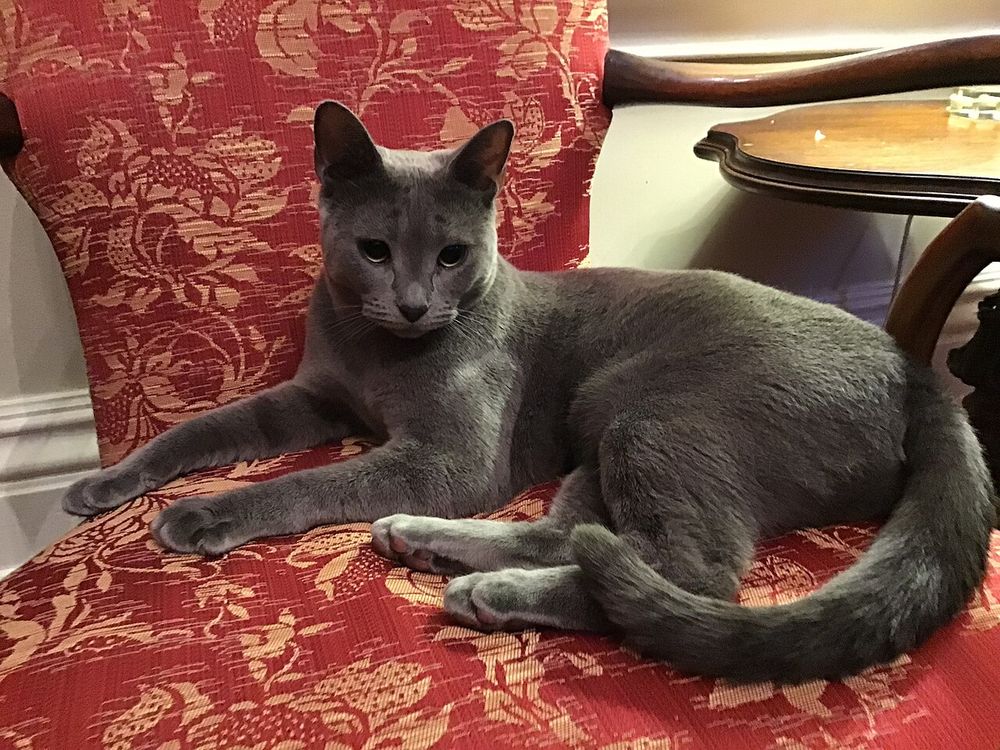
- Origin
- Believed to be the Archangel Isles, northern RussiaGoverning Council of the Cat Fancy
- Adult weight
- 3.6 to 6.8 kg (GCCF: an average of 8 to 15 lb when fully grown, males usually larger. CFA gives a lighter 5 to 10 lb.)Governing Council of the Cat Fancy
- Lifespan
- 12 to 15 yearsVCA Animal Hospitals
- Coat
- Short, thick and fine, a double coat with a very dense undercoat that stands away from the body. Blue with silver-tipped guard hairs; GCCF also recognises black and white.Governing Council of the Cat Fancy
- Energy
- ModerateThe Cat Fanciers' Association
- Indian heat
- Copes with careGoverning Council of the Cat Fancy
- Flats
- Suits a flatThe Cat Fanciers' Association
Russian Blue at a glance
| What | The rule | Source |
|---|---|---|
| Size | Medium. CFA says males rarely exceed 10 lb (about 4.5 kg) and females range from 5 to 8 lb; GCCF gives a wider 8 to 15 lb. | The Cat Fanciers' Association |
| Temperament | Graceful, playful and quiet. GCCF says it is reserved with strangers until it has assessed them, then very affectionate. | Governing Council of the Cat Fancy |
| Alone-time tolerance | Good for a cat: GCCF says Russians are content alone during the day and enjoy play and lap time when owners return. | Governing Council of the Cat Fancy |
| Coat | A double coat with a very dense undercoat that stands away from the body, in blue, black or white. | Governing Council of the Cat Fancy |
| Grooming | Light: CFA suggests combing two or three times a month to keep shedding down. | The Cat Fanciers' Association |
| Health to watch | No specific genetic problems known (CFA), but weight gain and diabetes need watching; white Russians bred from should be hearing-tested. | Acta Veterinaria Scandinavica (2015, conference supplement)study |
Where does the Russian Blue come from?
Nobody knows exactly where the Russian Blue began. GCCF says it is generally accepted as a natural breed from the Archangel Isles in northern Russia, most likely carried to England and northern Europe on ships from that region, and many of the first cats came from sailors; one, called Kola, is recorded as swapped for a leg of mutton at the London Docks in 1890. CFA notes Russian folklore that casts the cats as good-luck charms and pets of royalty.
The breed was shown at the Crystal Palace in London in 1875 as the Archangel Cat, and until 1912 it competed alongside all other blue cats. Development in England was interrupted by the Second World War, and with few cats left breeders outcrossed, usually to Siamese, an influence since mostly bred out. CFA says Scandinavian breeders led the breed from the early 20th century to the war, and after it US breeders combined English and Scandinavian lines into today's Russian Blue; VCA says CFA accepted it for registration in 1949.
How did the Russian Blue come to India?
The Russian Blue is an imported breed in India, and no source we could find records when or how it first arrived; its arrival here is not documented. CFA notes there are not enough breeders worldwide to meet demand, so a kitten may mean a wait.
Its dense double coat was built for a cold climate, as GCCF puts it, but GCCF also calls it a home-loving cat that does not suffer from being kept indoors with screened windows and plenty of play. That is how most Russian Blues in Indian flats live: indoors, in the coolest room through the summer.
What care does a Russian Blue need?
The three things that shape a good day for this breed.
Exercise
CFA says Russians have large appetites and need frequent, interactive exercise to avoid obesity. Puzzle toys suit a breed CFA calls one of the cleverest, known for opening doors, drawers and jars. The Cat Fanciers' Association
Grooming
Light. CFA suggests combing two or three times a month to keep shedding down, plus trimming claws and keeping eyes and ears clean. GCCF says gentle brushing with a soft brush is enjoyed. Governing Council of the Cat Fancy
Training
GCCF says a Russian is reserved with strangers until it has assessed them, then very affectionate. Let it come out to a visitor in its own time; CFA says it may hide under the sofa first and then investigate. The Cat Fanciers' Association
How much should a Russian Blue eat?
Daily calories for a healthy, neutered adult Russian Blue, worked out from its weight with the formula vets use (70 x weight in kg to the power 0.75, then AAHA's factor for a neutered adult). Divide by the kcal per kg on your food's pack for grams a day, and adjust by body shape.
| Resting need (kcal a day) | Neutered adult (kcal a day) | |
|---|---|---|
| 3.6 kg AAHA (American Animal Hospital Association) | 180 | 220 to 260 |
| 5.2 kg | 240 | 290 to 340 |
| 6.8 kg | 290 | 350 to 410 |
Feed a complete and balanced cat food labelled for your cat's life stage; Cornell says foods carrying an AAFCO nutritional guarantee meet that bar, and that wet, dry or a mix can all work. CFA warns that Russians have large appetites and are at risk of obesity, so measure each meal and count treats. Cornell calls obesity the most common nutrition problem in cats. Fresh water should always be out. Skip milk and curd as treats: Cornell says many cats are lactose-intolerant. Keep onion, garlic, chocolate, grapes and raisins, and anything sweetened with xylitol away from the cat, as ASPCA lists them among foods that harm pets. Meals a day: kitten to 6 months, 3 a day; 6 months to 1 year, 2 a day; adult, from about 1 year, 1 or 2 a day. Puppies, kittens, working, pregnant and older animals need different amounts: ask your vet, or use Petym's food calculator.
Which illnesses is the Russian Blue prone to, and how are they treated?
The conditions veterinary studies and breed surveys most often report in the Russian Blue. Knowing the early signs means a vet sees it sooner.
See your vet first. This is general information from veterinary sources, not a diagnosis. Only a vet who has examined your pet can say what is wrong and prescribe treatment, and this page never gives a dose. Do not give your pet human medicine. If your pet seems very unwell, go to a 24-hour vet: find one in your city.
Obesity
Ask at a routine checkBody weight 20% or more above normal, as Cornell defines it. CFA says Russian Blues have large appetites and are at risk if they do not get frequent, interactive exercise. Cornell Feline Health Center
Signs to watch for
- Ribs hard or impossible to feel under a layer of fat
- No waist behind the ribs
- A large fat pad on the belly
How a vet treats it
A vet weighs the cat, scores its body condition and sets an ideal weight, then guides the choice of food, the feeding method and a gradual weight-loss plan. Cornell says obese cats are far more likely to develop diabetes and lameness.
Prevention
Measure meals rather than leaving the bowl full, and play with the cat every day.
Diabetes mellitus
See a vet soonThe body cannot make or respond to insulin properly, so blood sugar runs high. A Swedish insurance study of over 500,000 cats found the Russian Blue among the breeds at increased risk, and obesity is a major risk factor. Acta Veterinaria Scandinavica (2015, conference supplement)study
Signs to watch for
- Drinking and urinating more
- Weight loss despite a good appetite
- In rare uncontrolled cases, walking flat on the hocks
How a vet treats it
A vet diagnoses it from persistently high glucose in the blood and urine, sometimes with a fructosamine test. Treatment is usually insulin injections and a change of diet prescribed by the vet, and some cats may suit newer oral medicines. Cornell warns that low blood sugar from treatment can be dangerous, so follow the vet's monitoring plan.
Prevention
Keep the cat at a healthy weight and active: Cornell says obese cats are up to four times more likely to develop diabetes.
Congenital deafness in white Russians
Ask at a routine checkA genetic hearing loss linked to white coats. GCCF requires white Russians used for breeding to be hearing-tested, though it says deafness is usually rare in them because their eyes are green. Governing Council of the Cat Fancy
Signs to watch for
- Not turning to sounds or its name
- Startling when approached from behind
How a vet treats it
A vet can test hearing. Cornell says congenital deafness cannot be corrected, so care means keeping the cat strictly indoors and using hand signals, vibrations and light cues instead of your voice.
How does a Russian Blue react to a new sitter?
It will probably hide first and investigate later. That is normal for the breed, not a sign that something is wrong.
CFA says it is typical for a Russian to hide under the sofa when a guest enters the house, and that curiosity usually wins in the end. GCCF describes a cat that is reserved with strangers until it has assessed them, and then very affectionate. For a sitter, the first visit may be spent talking quietly to a cat they never see.
This is why Petym's free meet and greet matters more for a Russian Blue than for a bolder cat. Have the sitter visit while you are home, sit on the floor, and let the cat watch from its safe spot. If the cat comes out to sniff, good; if not, the cat has still heard the voice and smelled the person once with you in the room. A second short visit before the trip helps more.
While you are away, ask the sitter to check that food has been eaten, the tray used and water drunk even if the cat stays hidden, and to look into the hiding place without dragging the cat out. A Russian that hides but eats and uses the tray is coping. A Russian that hides and does not eat over two visits needs a call to you and the vet.
Russian Blue myths a sitter should not believe
You may have read
If the cat hides from me, it must be ill or unhappy.
Myth
What the sources say
CFA says hiding under the sofa when a guest arrives is typical of the breed. What matters is whether it eats, drinks and uses the tray. The Cat Fanciers' Association
You may have read
A quiet cat needs no play while the owner is away.
Myth
What the sources say
CFA advises puzzle toys and interactive games, and warns that without frequent, interactive exercise the breed risks obesity. The Cat Fanciers' Association
You may have read
Russian Blues have no health problems, so there is nothing to watch.
Myth
What the sources say
CFA says the breed is not known for specific genetic problems, but a Swedish study of insured cats found it among breeds at increased risk of diabetes. Acta Veterinaria Scandinavica (2015, conference supplement)study
You may have read
A hungry cat that cries at the bowl should get a bit more.
Myth
What the sources say
CFA says Russians have large appetites and advises watching food intake carefully. The sitter feeds the amount on the care sheet, no more. The Cat Fanciers' Association
Why do Russian Blues gain weight, and why does it matter?
CFA describes the Russian Blue as one of the cleverest cat breeds, with large appetites, and says owners should monitor food intake carefully. A clever cat with a big appetite learns quickly that a new person can be persuaded to fill the bowl. While you are away, that is the sitter.
Weight is not only about looks. Cornell's Feline Health Center says obese cats are up to four times more likely to develop diabetes than cats at an ideal weight, and lists male sex, older age and inactivity among other risk factors. A 2015 Swedish study of insured cats reported the Burmese, Russian Blue, Norwegian Forest Cat and Abyssinian at increased risk of diabetes, and male cats with about twice the incidence of females. Talk to your vet about your own cat's ideal weight and how to keep it there.
For the trip, measure the daily food in advance if you can, write the amount on the care sheet, and put part of the ration in a puzzle feeder, which the AAFP and ISFM guidelines support as a way to give indoor cats something to do. Play counts as affection: ask the sitter for a short game with a wand or rolling toy at each visit.
Russian Blue numbers worth knowing
3
coat colours GCCF recognises for the breed: blue, black and white Governing Council of the Cat Fancy
2 to 3
combs a month CFA suggests to keep shedding under control The Cat Fanciers' Association
4 x
how much more likely obese cats are to develop diabetes than ideal-weight cats, per Cornell Cornell University College of Veterinary Medicine
2 x
the diabetes incidence in male cats compared with females in the Swedish insured-cat study Acta Veterinaria Scandinavica (2015, conference supplement)study
Health signs a Russian Blue's sitter should report
The sitter's job is to notice, write it down and call. These are the problems most relevant to the breed and to any indoor cat left with a visitor.
If Drinking far more than usual, a much wetter litter tray, or weight loss despite a good appetite.
Call the vet and tell the owner. Cornell lists these as the common signs of diabetes in cats. Cornell University College of Veterinary Medicine
If A cat known to be diabetic that becomes weak, wobbly, vomits or has a seizure.
Emergency: Cornell says low blood sugar can be fatal untreated. Go to the vet now and take the insulin and the log. Cornell University College of Veterinary Medicine
If Hiding and not eating, or eating very little, over two visits.
Hiding alone is normal for the breed; hiding and not eating is not. Call the vet: cats that stop eating risk liver disease. University of Illinois College of Veterinary Medicine
If Straining in the tray and passing little or no urine, especially in a male.
Emergency: a blocked bladder can kill within a day or two. Go to the vet now. Cornell University College of Veterinary Medicine
If Panting, red or pale gums, drooling or collapse on a hot day.
Heatstroke: cool water over the body, a fan, and the vet at once. PDSA
Does a Russian Blue's thick coat suffer in Indian summers?
No source makes a heat claim specific to the breed. GCCF describes a double coat with a very dense undercoat that stands away from the body, which is a lot of fur for a short-haired cat in a Delhi May or a humid Chennai June. PDSA lists overweight cats among those most at risk of heatstroke, and the breed's appetite makes extra weight a real possibility.
Plan the summer the way you would for any well-coated indoor cat. Leave the coolest room open, draw the curtains on sunny windows, and put water in more than one place, away from the litter tray. A shy cat may stay hidden in a warm cupboard rather than come out to a cooler room while a stranger is in the house, so tell the sitter where its hiding places are and ask them to check how warm each one gets by afternoon. Write down what to do in a power cut.
Regular combing in the months when the cat sheds most, two or three times a month as CFA suggests, keeps loose undercoat off the furniture and out of the cat's mouth when it grooms. Do not shave the coat for summer without your vet's advice.
Introducing a sitter to a Russian Blue: do and don't
Do
- Hold the meet and greet at home, with you there, before the trip; a second short visit helps a reserved cat. Governing Council of the Cat Fancy
- Sit low, talk quietly and let the cat approach in its own time. AAFP and ISFM (Journal of Feline Medicine and Surgery, 2013)study
- Keep visit times regular; International Cat Care says a predictable routine reduces stress. International Cat Care
- Use a puzzle toy or wand game to build trust instead of food. The Cat Fanciers' Association
Don’t
- Do not pull the cat out from under the sofa or bed to check on it. The Cat Fanciers' Association
- Do not add extra food or treats to win the cat over; CFA warns the breed has large appetites. The Cat Fanciers' Association
- Do not change the food while the owner is away; a sudden change commonly causes diarrhoea. PDSA
- Do not bring other people or pets on visits. International Cat Care
Which Petym service suits a Russian Blue?
Most Russian Blues are happiest at home, where their hiding places are, with the same sitter each time.
Most Russian Blues
Drop-in visits
A sitter visits at least twice a day for food, water, litter, play and a check on the hiding places, with a daily photo update. Suits a healthy adult on a trip of a few days to two weeks.
Diabetic cats
Special-needs care
For a cat already on insulin or a prescription diet, with every dose, meal and sign logged as your vet's plan says.
Long trips and older cats
Overnight pet sitting
A sitter stays in your home, so an older cat or one on medicine has someone there at night and in a power cut.
Breeds with similar care needs to the Russian Blue
Going away soon? Tell us your dates.
A checked local sitter feeds, walks and keeps your pet company at home, follows your care sheet to the letter and sends a photo every day. Petym is opening city by city: send your dates and we will tell you when a sitter can take them.
- Meet your sitter first, free
- PAN-checked, first-aid trained
- A photo every day
- Pay through Petym, never cash

Questions owners ask
Can I leave my Russian Blue alone while I travel?
- Yes, with a sitter visiting at least twice a day. GCCF says Russians are content alone during the day, which helps. Introduce the sitter before you go, because the breed is reserved with strangers, and ask them to confirm food, water and litter use at every visit even if the cat stays hidden.
Why does my Russian Blue hide from guests?
- It is typical of the breed. CFA says it is normal for a Russian to hide under the sofa when a guest arrives, and that curiosity usually brings it out later. GCCF says it is reserved until it has assessed a stranger. Give it time and never pull it out.
Are Russian Blues prone to diabetes?
- A 2015 Swedish study of insured cats found Russian Blues among the breeds at increased risk, with Burmese, Norwegian Forest Cats and Abyssinians. Cornell says obesity is the biggest risk factor. Signs include drinking and urinating more and weight loss despite a good appetite. Talk to your vet if you see them.
How much grooming does a Russian Blue need?
- Not much. CFA suggests combing two or three times a month to keep shedding down, and GCCF says the breed does not need much grooming to keep its dense double coat healthy. On a long trip, one gentle comb by the sitter is plenty if the cat accepts it.
Can a Russian Blue cope with Indian heat?
- Indoors, with shade and water, yes. No source names it as a heat-risk breed, but its double coat is dense, and PDSA lists overweight cats among those most at risk of heatstroke. Keep it in the coolest room in summer and tell your sitter where it hides and what to do in a power cut.
Are white Russian cats deaf?
- Not necessarily. GCCF says white Russians used for breeding need a BAER hearing test, which checks for deafness. If your white Russian has been tested or is known to be deaf, tell your sitter, since a deaf cat may startle when touched and will not hear a door or a call.
Keep reading
Services that help
Free tools for this
Words on this page, explained
Keep exploring
Sources
Each source was opened and read on the date shown. How Petym checks its sources
- Governing Council of the Cat Fancy: Russian (opens in a new tab)
- VCA Animal Hospitals: Russian Blue (cat breed profile) (opens in a new tab)
- The Cat Fanciers' Association: Russian Blue (opens in a new tab)
- Cornell Feline Health Center: Feeding your cat (updated 30 April 2026) (opens in a new tab)
- Cornell Feline Health Center: How often should you feed your cat? (opens in a new tab)
- ASPCA Animal Poison Control: People foods to avoid feeding your pets (opens in a new tab)
Show all 18 sourcesShow fewer
- AAHA (American Animal Hospital Association): 2021 AAHA Nutrition and Weight Management Guidelines for Dogs and Cats: energy requirement calculations (Box 1, PDF) (opens in a new tab)
- Merck Veterinary Manual: Nutritional requirements of small animals (full review November 2023, updated September 2024) (opens in a new tab)
- Cornell University College of Veterinary Medicine: Feline diabetes (Cornell Feline Health Center) (opens in a new tab)
- Cornell University College of Veterinary Medicine: Deafness (Cornell Feline Health Center) (opens in a new tab)
- PDSA: Heatstroke in cats (opens in a new tab)
- Cornell University College of Veterinary Medicine: Feline lower urinary tract disease (Cornell Feline Health Center) (opens in a new tab)
- University of Illinois College of Veterinary Medicine: Hepatic lipidosis: a serious problem when cats stop eating (opens in a new tab)
- International Cat Care: Stress in cats (opens in a new tab)
- PDSA: Diarrhoea after a change of food (opens in a new tab)
- Cats Protection: Going on holiday without your cat (opens in a new tab)
- Acta Veterinaria Scandinavica (2015, conference supplement): Feline diabetes mellitus: the Swedish situation (opens in a new tab)
- AAFP and ISFM (Journal of Feline Medicine and Surgery, 2013): Feline environmental needs guidelines (opens in a new tab)