Exotic Shorthair care in India: flat face, heat and sitters
Updated By PetymFacts checked against official sources on
Quick answer
An adult Exotic Shorthair can stay home while you travel if a sitter comes at least twice a day. The short coat is easy, but the flat face is not: Exotics share the Persian skull, so breathing, watery eyes and heat are the real risks. Keep the cat in a cool room and brief the sitter on noisy breathing.
Studies link flatter faces in cats to more breathing trouble and tear staining, and GCCF asks breeders not to take the short skull to extremes. A sitter's job is to notice changes early and call your vet.
- Meet your sitter first, free
- PAN-checked, first-aid trained
- A photo every day
- Pay through Petym, never cash

- Origin
- United StatesThe Cat Fanciers' Association
- Adult weight
- 3.2 to 6.4 kg (GCCF: females usually 7 to 12 lb, males 12 to 14 lb)Governing Council of the Cat Fancy
- Lifespan
- 12 to 15 yearsGoverning Council of the Cat Fancy
- Coat
- Short to medium, dense and plush, standing away from the body over a thick undercoat. It sheds more than a Persian's, mostly by season.The Cat Fanciers' Association
- Energy
- ModerateThe Cat Fanciers' Association
- Indian heat
- Struggles in heatPDSA
- Flats
- Suits a flatGoverning Council of the Cat Fancy
Exotic Shorthair at a glance
| What | The rule | Source |
|---|---|---|
| Size | Medium to large and cobby. GCCF gives about 7 to 14 lb (roughly 3 to 6.5 kg), with males the heavier end. | Governing Council of the Cat Fancy |
| Temperament | Sweet, affectionate and quiet, says CFA; GCCF calls it a lap cat that follows its people from room to room. | The Cat Fanciers' Association |
| Activity | Some consider Exotics a little more active and playful than Persians, according to CFA. | The Cat Fanciers' Association |
| Alone-time tolerance | Fine at home with a sitter at least twice a day; young, old and unwell cats need more. | Cats Protection |
| Heat tolerance | Low. PDSA lists flat-faced cats among those most at risk of heatstroke. | PDSA |
| Grooming | Weekly combing, more in the moult or the undercoat mats; eyes cleaned regularly (GCCF). | Governing Council of the Cat Fancy |
| Lifespan | GCCF lists 12 to 15 years or more. | Governing Council of the Cat Fancy |
Where does the Exotic Shorthair come from?
The Exotic is an American breed. CFA says that from the 1950s, Persian breeders on the US West Coast crossed their cats with American Shorthairs, and GCCF adds that the early crosses were to Silver Persians. The result was a short-coated cat with the Persian's round head and cobby body. Many of the first kittens were silver or chinchilla, colours not then found in other shorthair breeds, which is where the name Exotic came from.
The crosses were controversial at first, but the kittens were so popular that CFA recognised them as a breed in 1966. In Britain, GCCF recognised the Exotic in 1986 and gave it championship status in 1995. GCCF's standard matches the Persian's for head and body, so the Exotic is, in effect, a Persian in a short coat.
A UC Davis genetics study of 29 breeds found the Persian and Exotic Shorthair group together as one breed family, and notes that a single gene change, long hair against short, is the defining difference between the two.
How did the Exotic Shorthair come to India?
How and when the first Exotics came to India is not documented in any source we could find. The breed is now shown here: a December 2024 cat show in Kolhapur, organised by the Feline Club of India's Kolhapur branch, listed Exotics among more than nine breeds and over 200 cats, with prices quoted from Rs 5,000 to lakhs.
Life in India is mostly a question of heat. The Exotic has the Persian's short face, and PDSA lists flat-faced cats among those most at risk of heatstroke. The Animal Welfare Board of India's 2026 heat advisory asks owners to give animals shade through the day and clean water in bowls that cannot tip over. An Exotic does best as an indoor cat in a cool room, with a plan for power cuts.
What care does a Exotic Shorthair need?
The three things that shape a good day for this breed.
Exercise
Daily play matters: CFA says some consider Exotics a little more active and playful than Persians. Short sessions with a wand toy and food puzzles meet the cat's need for play and hunting-style behaviour, and are kinder than long games in a warm room. The Cat Fanciers' Association
Grooming
Comb weekly with a steel comb, more in the spring and summer moult, when GCCF says the old undercoat must be combed out to stop mats. Clean the eyes regularly; an occasional bath helps the coat. Governing Council of the Cat Fancy
Training
Cats do best with positive, consistent and predictable handling. Get an Exotic used to combing, eye wiping and its carrier from kittenhood, so vet visits and grooming stay calm. AAFP and ISFM (Journal of Feline Medicine and Surgery, 2013)study
How much should a Exotic Shorthair eat?
Daily calories for a healthy, neutered adult Exotic Shorthair, worked out from its weight with the formula vets use (70 x weight in kg to the power 0.75, then AAHA's factor for a neutered adult). Divide by the kcal per kg on your food's pack for grams a day, and adjust by body shape.
| Resting need (kcal a day) | Neutered adult (kcal a day) | |
|---|---|---|
| 3.2 kg AAHA (American Animal Hospital Association) | 170 | 200 to 230 |
| 4.8 kg | 230 | 270 to 320 |
| 6.4 kg | 280 | 340 to 390 |
Feed a complete and balanced cat food, wet, dry or both, and keep fresh water out at all times, in more than one place and away from the litter tray. Cornell says obesity is the most common nutrition-related problem in cats, and treats should stay within 10 to 15 percent of the day's calories. A heavy Exotic is at more risk in the heat and of liver disease if it stops eating. Many Indian kitchen foods are unsafe: onion and garlic damage a cat's red blood cells, milk and curd often upset the gut because most cats lack enough lactase, and fish canned for people is not a cat food. Some flat-faced cats find a deep bowl hard to eat from; ask your vet about a shallow dish if yours struggles. The energy table above gives the daily calories; your vet will fine-tune the amount. Meals a day: kitten to 6 months, 3 a day; 6 months to 1 year, 2 a day; adult, from about 1 year, 1 or 2 a day; senior, 10 years and over, As for an adult, unless your vet says otherwise. Puppies, kittens, working, pregnant and older animals need different amounts: ask your vet, or use Petym's food calculator.
Which illnesses is the Exotic Shorthair prone to, and how are they treated?
The conditions veterinary studies and breed surveys most often report in the Exotic Shorthair. Knowing the early signs means a vet sees it sooner.
See your vet first. This is general information from veterinary sources, not a diagnosis. Only a vet who has examined your pet can say what is wrong and prescribe treatment, and this page never gives a dose. Do not give your pet human medicine. If your pet seems very unwell, go to a 24-hour vet: find one in your city.
Brachycephalic airway problems (BOAS)
See a vet soonThe Exotic shares the Persian's short skull. Studies link shorter muzzles and noses set further back with more breathing difficulty, and name Persians and Exotics among the breed types most affected. PLOS ONE (2016), Royal Veterinary College and University of Edinburgh authorsstudy
Signs to watch for
- Noisy breathing or snoring while awake
- Breathing with the mouth open
- Tiring quickly after a short play session
- A cat that is unusually inactive, which can hide breathing trouble
How a vet treats it
A vet examines the face, nostrils and airway. Narrow nostrils can be widened by surgery, but UFAW notes the other airway narrowing in flat-faced cats cannot be fully corrected, so treatment eases the problem rather than cures it.
Prevention
Choose a kitten whose parents have a less extreme face and breathe quietly at rest; GCCF asks breeders not to take the short face to extremes.
Corneal sequestrum
See a vet soonA brown to black patch of dying tissue on the clear front of the eye. A Ghent University study says a predisposition in Persians and the related Himalayan and Exotic breeds has been widely reported. Animals (2022), Ghent Universitystudy
Signs to watch for
- A brown or black spot on the surface of the eye
- Watering eyes
- Squinting or keeping the eye shut
- Sensitivity to light
How a vet treats it
In mild cases a vet may only need to give pain relief while the patch sloughs off. Deeper or painful sequestra are usually removed by surgery (a keratectomy), sometimes with a graft to repair the cornea.
Prevention
Keep the eyes clean and get any change in the eye seen early.
Polycystic kidney disease (PKD)
See a vet soonAn inherited disease in which fluid-filled cysts grow in the kidneys and can lead to kidney failure. Exotics descend from Persians, the breed most affected, and GCCF asks that all breeding Exotics test PKD negative. Governing Council of the Cat Fancy
Signs to watch for
- Drinking and urinating more
- Poor appetite and weight loss
- Nausea and vomiting
- Lethargy, often from about seven years of age
How a vet treats it
A vet confirms the cysts by ultrasound; a genetic test shows the gene but not how badly a cat is affected. There is no cure: management uses diet control, fluid therapy and medicines the vet prescribes for kidney disease.
Prevention
Ask for clear PKD test certificates for both parents before you buy a kitten.
Tear overflow and facial skin problems
Ask at a routine checkIn flat-faced cats the tear ducts are distorted, so tears cannot drain and spill onto the face, and folds of facial skin stay damp. International Cat Care
Signs to watch for
- Constant tear staining
- Sore or red skin beside the nose
- Rubbing the face
How a vet treats it
A vet examines the eyes, tear ducts and skin, and treats any skin infection with the medicines it needs. The tear duct shape itself cannot be corrected, so daily cleaning is lifelong.
Prevention
Wipe the face gently every day with a soft, damp cloth, and have the cat checked at least once a year.
Dental disease
Ask at a routine checkThe short jaw of Persian-type cats means the teeth often do not meet properly, which makes plaque, tartar and gum disease more likely. UFAW (Science for Animal Welfare)
Signs to watch for
- Bad breath
- Red or bleeding gums
- Drooling or pawing at the mouth
- Difficulty eating
How a vet treats it
A vet examines the mouth, often under sedation or anaesthetic, with dental x-rays. Treatment may include pain relief, antibiotics for infection, a scale and polish under general anaesthetic and removal of badly affected teeth.
Prevention
Toothbrushing is the best home care, with a vet dental check at least once a year.
Heatstroke
Emergency: go to a vet nowFlat-faced cats such as Persians, and so Exotics, are among those PDSA says are most at risk of heatstroke, which matters in an Indian summer or a power cut. PDSA
Signs to watch for
- Panting and fast breathing
- Very red or very pale gums
- Vomiting or diarrhoea
- Weakness, wobbling or collapse
How a vet treats it
Start cooling at once with cool, not icy, water and a fan, and go to the nearest vet. Vets cool the cat with water, fans and ice packs and may give a fluid drip; severe cases may need oxygen, other medicines and several days in hospital.
Prevention
Shade and water at all times, a cool room in summer and a healthy weight.
What is an Exotic Shorthair, and why does the face matter?
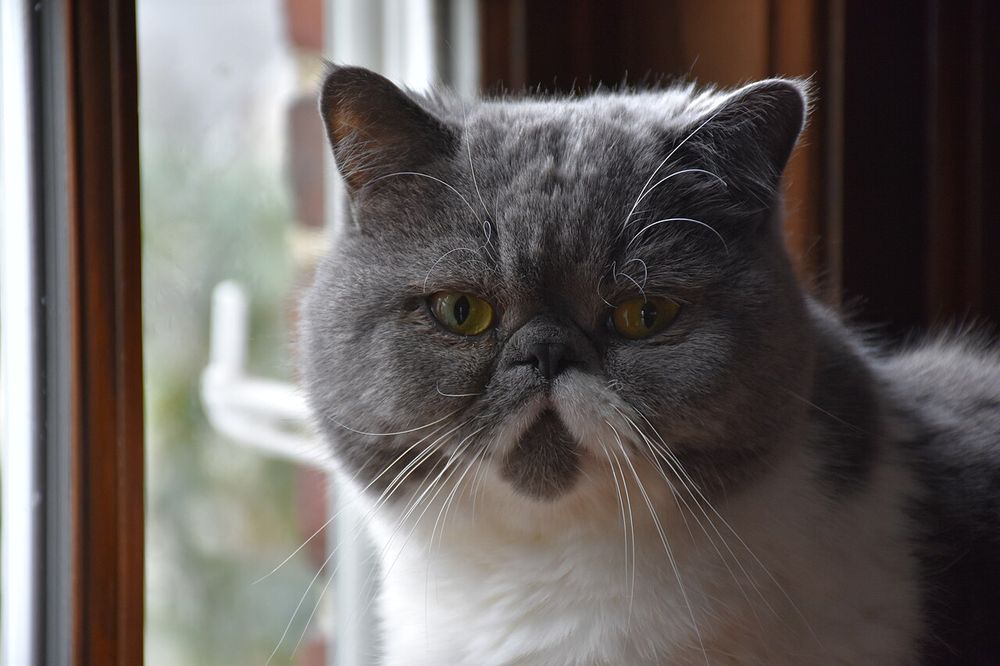
It is a Persian in a short coat. The body, the head and the health questions are the Persian's; only the grooming is lighter.
CFA traces the breed to the 1950s, when Persian breeders in the United States crossed their cats with American Shorthairs. CFA recognised the result in 1966, and after the first cross, Exotics were bred back to Persians rather than to the shorthaired side. GCCF says its standard matches the Persian for head and body type: a broad, round head, a short broad nose with a break, and round, full eyes.
That short skull is the reason this page spends more time on breathing and eyes than on brushing. GCCF describes the Exotic as brachycephalic and asks that the trait not be taken to extremes, for the health and comfort of the cat. International Cat Care lists the breeding of extreme, very flat-faced Persians as an example of breeding for looks at the expense of welfare, and the Exotic carries the same head.
In India, Exotics are often sold as a low-maintenance Persian. The coat is easier. The face needs the same attention, and an Indian summer adds a heat risk that a sitter must plan for.
What do studies report about flat faces in cats?
Plainly: flatter faces go with more breathing trouble and more eye trouble. These are the findings, not opinions.
- Breathing
- An Edinburgh and RVC study of 1,000 owner questionnaires measured cats' faces from photographs. Shorter muzzles and noses set further back were linked to worse owner-reported breathing: noise while asleep and difficulty after activity. The authors name Persians and Exotics as breed types more likely to have breathing difficulty. PLOS ONE (2016), Royal Veterinary College and University of Edinburgh authorsstudy
- Tear staining
- The same study found tear staining in cats with shorter faces and linked it to obstruction of the tear drainage system, which narrows along with the airway as the face shortens. PLOS ONE (2016), Royal Veterinary College and University of Edinburgh authorsstudy
- Quiet cats can hide it
- Sedentary cats had the highest breathing scores, and most owners reported few breathing problems. The authors suggest that breathing difficulty may make some cats less active, so a calm Exotic is not proof of easy breathing. PLOS ONE (2016), Royal Veterinary College and University of Edinburgh authorsstudy
- Corneal sequestrum
- A brown to black patch of dying tissue on the clear front of the eye. A 2022 study says a predisposition in Persians and the related Himalayan and Exotic breeds has been widely reported, and estimated very high heritability in one cattery's cats. Animals (2022), Ghent Universitystudy
- Skull, teeth and skin
- International Cat Care says short-faced Persian-type cats can have small nostrils, an overlong soft palate, deformed tear ducts, teeth that do not meet and facial skin folds prone to infection. International Cat Care
Can an Exotic Shorthair cope with Indian heat?
Indoors, with a cool room and a plan, yes. The short coat helps a little; the short airway does not.
A cat that already has to work to breathe has little in reserve when the room heats up. PDSA lists flat-faced cats among those most at risk of heatstroke, along with overweight, long-haired, young and old cats. An Exotic that is also heavy ticks two boxes.
From March to June in Delhi, Jaipur, Lucknow or Nagpur, a top-floor flat with the AC switched off can pass a dangerous temperature by afternoon. The Animal Welfare Board of India's May 2026 heat advisory asks for shade through the day and clean water in stable bowls, and lists heavy panting, drooling, lethargy, a fast heartbeat and collapse as signs that need a vet. Tell your sitter which room stays coolest, whether the inverter runs the AC or only the fans, and who in the building has a spare key if the power fails at night.
The moult needs a word here too. GCCF says Exotics shed a lot of undercoat in spring and summer, which in India often lines up with the hottest months, and the coat mats and knots if that undercoat is not combed out. A dense, matted coat holds heat, so a short combing session at each visit in April and May is part of heat care, not vanity.
Exotic Shorthair warning signs for a sitter
A sitter does not diagnose. They know what is normal for this cat from the care sheet, and they call you and the vet when something changes.
If Open-mouth breathing, loud snoring breaths while awake, breathing that gets harder after a short play session or in a warm room.
Stop play, move the cat to the coolest room and call the vet the same day. Open-mouth breathing in a cat is urgent at any time. PLOS ONE (2016), Royal Veterinary College and University of Edinburgh authorsstudy
If An eye that is squinting, watering more than usual, sensitive to light, or has a brown or dark spot on the surface.
Do not put anything in the eye. Call the vet: corneal disease is reported more often in Exotics and can need surgery. Animals (2022), Ghent Universitystudy
If Panting, very red or pale gums, weakness or stumbling on a hot afternoon or during a power cut.
Treat as heatstroke: cool (not cold) water on the body away from the face, a fan, and the vet at once. PDSA
If Drinking and passing much more urine, eating less, losing weight, vomiting. Exotics can inherit polycystic kidney disease from their Persian ancestry.
Write down what you saw and call the vet; tell the owner. Ask whether the cat's parents were PKD tested. Governing Council of the Cat Fancy
If Straining in the tray, many trips with little urine, crying in the tray.
A blocked bladder is an emergency, more often in males. Go to the vet now. Cornell University College of Veterinary Medicine
If No food eaten since the last visit, or a cat that hides and refuses favourite food twice in a row.
Call the vet. A cat that goes without food for days risks liver disease, and heavy cats are at greater risk. University of Illinois College of Veterinary Medicine
A visit to an Exotic: what the sitter does
Listen before you look
Stand quietly for a moment and listen to the cat breathe while it rests. Note snoring, wheezing or effort, and compare with what the owner described on the care sheet.
Room check
Feel the air in the room the cat uses most. If it is hot, open the cooler room, draw curtains on sunny glass and switch on the fan or AC as agreed.
Water and food
Fresh water in more than one bowl, kept apart from the food and the tray. Food exactly as the care sheet says, in the flat dish the cat is used to. AAFP and ISFM (Journal of Feline Medicine and Surgery, 2013)study
Tray
Scoop every tray and note urine clumps and stool. Remove soiled litter at least once a day. Battersea Dogs and Cats Home
Face
Wipe tear tracks gently with a soft, damp cloth as the owner showed you. Check both eyes are bright, open and clear. Governing Council of the Cat Fancy
Coat
A few minutes with a steel comb, which CFA recommends for managing the shedding. In the moult, comb at every visit; outside it, weekly is usually enough. The Cat Fanciers' Association
Gentle play
Short bursts with a wand toy, stopping if the breathing gets noisy. Then quiet time on the cat's lap or beside it.
Leave
Lock windows the cat can reach, set the fan or AC, and send the daily photo update with a short note on breathing and eyes.
Grooming an Exotic in Indian weather
CFA says Exotics shed more heavily than Persians, mostly in season, and recommends combing with a steel or Teflon-coated comb; mats are uncommon unless the coat is neglected. GCCF agrees that weekly grooming is enough most of the year, with more combing during the moult, regular eye cleaning and an occasional bath.
The monsoon is the harder season for the coat. A plush, dense coat stays damp for longer in humid air, and a damp undercoat is where mats start. Ask your sitter not to bathe the cat while you are away. If the coat gets wet or soiled, towel it dry in a cool room and use a fan on low, never a hot hair dryer on a flat-faced cat in a closed room.
Face care is the part owners forget to hand over. Show the sitter how you wipe the eyes and the fold beside the nose, what cloth you use, and what normal tear staining looks like on your cat, so they can tell normal from new.
Feeding an Exotic while you travel
Keep the brand, the amounts and the times the same. A sudden change of food is a common cause of loose stools, and a plush-coated cat with diarrhoea soils its back end fast. Leave the food measured out for the trip with a few days extra, and ask the sitter to log every meal.
Many flat-faced cats find it easier to pick food up from a shallow, wide dish than from a deep bowl, so tell the sitter which one your cat uses. Keep weight in mind. PDSA counts overweight cats among those most at risk in the heat, and a sitter who shows affection with treats can add weight in a fortnight. Ask for play and company instead.
Do not leave lilies in the flat, and do not let a sitter give any human painkiller or a dog flea product. International Cat Care lists these among the common poisons for cats.
Before you buy or adopt an Exotic in India
If you have not brought one home yet, these are the questions the sources point to.
- Ask for PKD DNA test results for both parents. GCCF says all Exotics used for breeding should be tested PKD negative. Governing Council of the Cat Fancy
- Ask whether the parents were also tested for PRA, an inherited eye condition GCCF says can be tested at the same time. Governing Council of the Cat Fancy
- Watch the kitten and its parents breathe at rest. Noisy breathing at rest is not normal for a cat, and a less extreme face is kinder to the cat. PLOS ONE (2016), Royal Veterinary College and University of Edinburgh authorsstudy
- Look at the eyes and the skin beside the nose for constant wetness, staining or soreness. International Cat Care
- Plan a cool room for summer, with a backup for power cuts, before the cat arrives. PDSA
- Find a vet near you who sees flat-faced cats regularly, and save a 24-hour vet's number too.
Which Petym service suits an Exotic Shorthair?
Healthy adults
Drop-in visits
A sitter visits one to three times a day for water, food, litter, a comb and a face wipe, with a daily photo update. Suits trips of a few days to two weeks outside the worst heat.
Summer and long trips
Overnight pet sitting
Someone sleeps in your home, so a hot night or a power cut is not left to chance. Suits May and June, older Exotics and long trips.
Diagnosed conditions
Special-needs care
For an Exotic with kidney disease, an eye condition or breathing trouble your vet is managing, with every medicine given and logged as your plan says.
Breeds with similar care needs to the Exotic Shorthair
Going away soon? Tell us your dates.
A checked local sitter feeds, walks and keeps your pet company at home, follows your care sheet to the letter and sends a photo every day. Petym is opening city by city: send your dates and we will tell you when a sitter can take them.
- Meet your sitter first, free
- PAN-checked, first-aid trained
- A photo every day
- Pay through Petym, never cash

Questions owners ask
Is an Exotic Shorthair just a short-haired Persian?
- Close to it. CFA says the breed began as Persian and American Shorthair crosses in the 1950s and was then bred back to Persians. GCCF says its standard matches the Persian for head and body. So the coat is easier, but the flat face and the health questions that come with it are the same.
Do Exotic Shorthairs have breathing problems?
- Many flat-faced cats do. A 2016 study of 1,000 cats found shorter muzzles and noses set further back were linked to more breathing noise and difficulty, and named Exotics among the breed types affected. International Cat Care says small nostrils and a long soft palate cause breathing problems in Persian-type cats. Ask your vet to check yours.
Can I leave my Exotic Shorthair alone for a weekend?
- Not without visits. Cats Protection advises a sitter at least twice a day for any cat. An Exotic also needs its eyes wiped and a cool room, and PDSA lists flat-faced cats among those most at risk of heatstroke. In summer, a cat left alone through a power cut is in real danger.
Why do my Exotic's eyes water all the time?
- The short face changes the tear ducts. A study of flat-faced cats linked tear staining to blocked tear drainage, and International Cat Care says the ducts are deformed in brachycephalic cats. Wipe the face gently each day. Squinting, cloudiness or a dark spot on the eye are reasons to call your vet.
How often should I groom an Exotic Shorthair in India?
- Weekly for most of the year, says GCCF, and more often during the moult, when lots of undercoat comes out and the coat will mat if left. In India the moult often falls in the hot months. Clean the eyes regularly, and keep baths occasional and away from the monsoon damp.
Do Exotic Shorthairs get kidney disease?
- They can inherit polycystic kidney disease from their Persian ancestry, according to GCCF, which says all breeding Exotics should be tested PKD negative. International Cat Care notes it was found in more than a third of Persian and Exotic cats in the 1990s. Signs include thirst, weight loss and poor appetite; call your vet.
Is a sitter or a cattery better for an Exotic?
- Usually a sitter at home. Exotics are quiet cats that follow their people around, and a familiar, cool room is easier to control than a cattery pen in summer. If you choose boarding, ask how the room is cooled, what happens in a power cut and who wipes the eyes.
Keep reading
- Cats: caring for a cat while you are away
- Persian cat careThe parent breed, with the same face and a longer coat.
- Himalayan cat careThe colourpoint Persian, another flat-faced cat.
- Can a Persian cat live without AC?
- How often should a sitter visit a cat?
- Summer pet care in India
- Drop-in visits for cats
Services that help
Free tools for this
Words on this page, explained
Keep exploring
Sources
Each source was opened and read on the date shown. How Petym checks its sources
- The Cat Fanciers' Association: Exotic (opens in a new tab)
- Governing Council of the Cat Fancy: Exotic Shorthair (opens in a new tab)
- PDSA: Heatstroke in cats (opens in a new tab)
- Animal Welfare Board of India: Request to ensure care and protection of animals from direct heat during extreme hot weather (4 May 2026) (opens in a new tab)
- Cornell Feline Health Center: How often should you feed your cat? (opens in a new tab)
- Cornell Feline Health Center: Feeding your cat (updated 30 April 2026) (opens in a new tab)
Show all 25 sourcesShow fewer
- ASPCA Animal Poison Control: People foods to avoid feeding your pets (opens in a new tab)
- University of Illinois College of Veterinary Medicine: Hepatic lipidosis: a serious problem when cats stop eating (opens in a new tab)
- AAHA (American Animal Hospital Association): 2021 AAHA Nutrition and Weight Management Guidelines for Dogs and Cats: energy requirement calculations (Box 1, PDF) (opens in a new tab)
- Merck Veterinary Manual: Nutritional requirements of small animals (full review November 2023, updated September 2024) (opens in a new tab)
- UFAW (Science for Animal Welfare): Persian: brachycephaly (opens in a new tab)
- International Cat Care: Persian cats and brachycephaly (opens in a new tab)
- Cornell University College of Veterinary Medicine: Polycystic kidney disease (Cornell Feline Health Center) (opens in a new tab)
- International Cat Care: Dental disease in cats (updated 26 September 2025) (opens in a new tab)
- International Cat Care: Inherited disorders in cats (opens in a new tab)
- Cats Protection: Going on holiday without your cat (opens in a new tab)
- Battersea Dogs and Cats Home: Cat litter trays (opens in a new tab)
- Cornell University College of Veterinary Medicine: Feline lower urinary tract disease (Cornell Feline Health Center) (opens in a new tab)
- PDSA: Diarrhoea after a change of food (opens in a new tab)
- International Cat Care: Cats and poisons (opens in a new tab)
- Animal Genetics (2013), UC Davis: Variation of cats under domestication: genetic assignment of domestic cats to breeds and worldwide random-bred populations (full text on VIN) (opens in a new tab)
- AAFP and ISFM (Journal of Feline Medicine and Surgery, 2013): Feline environmental needs guidelines (opens in a new tab)
- PLOS ONE (2016), Royal Veterinary College and University of Edinburgh authors: Flat feline faces: is brachycephaly associated with respiratory abnormalities in the domestic cat (Felis catus)? (opens in a new tab)
- Animals (2022), Ghent University: Genetic aspects of corneal sequestra in a population of Persian, Himalayan and Exotic cats (opens in a new tab)
- ETV Bharat: Cat show in Kolhapur draws visitors (news report, 2 December 2024) (opens in a new tab)