Bengal cat care in India: energy, play and time alone
Updated By PetymFacts checked against official sources on
Quick answer
A Bengal can stay home while you travel, but it is not a cat to feed and leave. GCCF calls it confident, active, curious, athletic and energetic, and CFA says it keeps kitten-like energy into old age. Plan sitter visits at least twice a day with proper play, climbing space and a flat with every window secured.
Its short, plush coat is easy to care for. The health points a sitter should know are heart disease (HCM) and an inherited eye condition seen in some lines.
- Meet your sitter first, free
- PAN-checked, first-aid trained
- A photo every day
- Pay through Petym, never cash

- Origin
- United States, from crosses of the Asian leopard cat with domestic catsThe Cat Fanciers' Association
- Adult weight
- 3.6 to 6.8 kg (adult; GCCF gives females 3.6 to 5.4 kg and males 4.5 to 6.8 kg)Governing Council of the Cat Fancy
- Lifespan
- 12 to 16 yearsGoverning Council of the Cat Fancy
- Coat
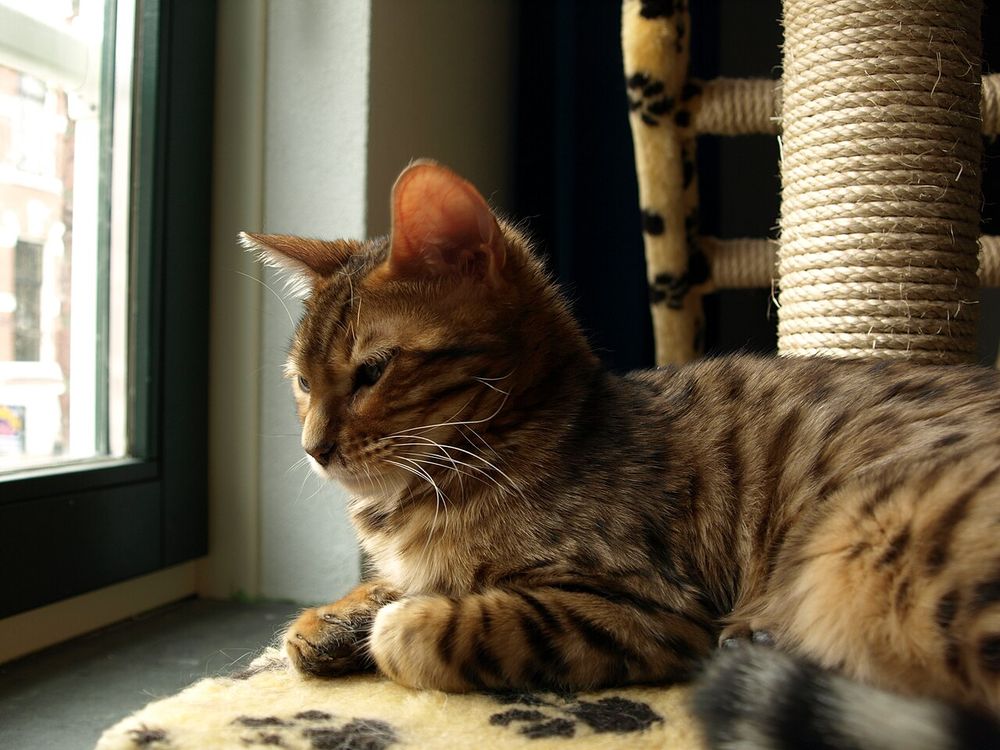
- Short, dense and plush, soft and silky, spotted or marbled; CFA says it is unlikely to mat and does not shed heavily.The Cat Fanciers' Association
- Energy
- Very highGoverning Council of the Cat Fancy
- Indian heat
- Copes with carePDSA
- Flats
- A flat, with daily exerciseGoverning Council of the Cat Fancy
Bengal cat at a glance
| What | The rule | Source |
|---|---|---|
| Size | Medium to large, with a sleek, muscular build. | The Cat Fanciers' Association |
| Activity | Very high: confident, active, curious, athletic and energetic, and needs toys and climbing features. | Governing Council of the Cat Fancy |
| Alone-time tolerance | Needs visits at least twice a day, and play at each one; boredom is the main risk. | Cats Protection |
| Heat tolerance | No breed-specific source. The coat is short and dense, and the Bengal is not among the long-haired or flat-faced cats PDSA lists as most at risk. | PDSA |
| Grooming | Low: the coat is soft, unlikely to mat and does not shed heavily; brush weekly. | The Cat Fanciers' Association |
| Sociability | Easy-going, affectionate and very vocal; GCCF says the calling should not be mistaken for aggression. | Governing Council of the Cat Fancy |
Where does the Bengal cat come from?
CFA says two unrelated goals gave birth to the Bengal. In 1963 the conservationist Jean Mill, who was working to preserve the Asian leopard cat, a small wild cat, crossed a black domestic tom with a female leopard cat. Around the same time Dr Willard Centerwall began breeding similar crosses in the hope of a domestic cat with the leopard cat's immunity to feline leukaemia. Mill later obtained cats from Centerwall and used them, with spotted domestic cats, to build the breed.
GCCF says other breeds used in the foundation include the Burmese, Egyptian Mau, Ocicat, Abyssinian and American Shorthair. Males from the first cross are sterile, and GCCF stopped registering first-generation Bengals in 2002 and third-generation cats in 2008. CFA accepted the Bengal for registration in 2016, requiring five generations of purely domestic ancestry, and gave it championship status in 2018. Today's Bengal is a domestic cat.
How did the Bengal cat come to India?
No source we could find documents when or how the first Bengals came to India; their arrival is not documented. The breed is now seen at Indian cat shows: ETV Bharat's report on the Feline Club of India's show in Kolhapur on 1 December 2024, with more than 200 cats, lists the Bengal among the breeds shown and says it became the centre of attraction.
In Indian homes the Bengal lives as an indoor cat. GCCF advises against letting Bengals roam free, which in a city also means netting balconies and windows, and says they can be trained to walk on a harness. Its short coat keeps it off PDSA's list of the cats most at risk of heatstroke, but a cat this active should do its hard play in the cooler hours of an Indian summer.
What care does a Bengal cat need?
The three things that shape a good day for this breed.
Exercise
GCCF calls the Bengal confident, active, curious, athletic and energetic, needing toys and activity centres; many like exercise wheels, and CFA says the kitten-like energy lasts into old age. Plan active play every day. Governing Council of the Cat Fancy
Grooming
Low: CFA recommends a weekly brush with a soft-bristled brush, and GCCF a light brush and comb once a week. Bathing is not usually needed. The Cat Fanciers' Association
Training
CFA calls Bengals extremely intelligent, and many enjoy walks on a harness and lead. GCCF says they can be harness trained; start indoors, in short sessions with rewards. Governing Council of the Cat Fancy
How much should a Bengal cat eat?
Daily calories for a healthy, neutered adult Bengal cat, worked out from its weight with the formula vets use (70 x weight in kg to the power 0.75, then AAHA's factor for a neutered adult). Divide by the kcal per kg on your food's pack for grams a day, and adjust by body shape.
| Resting need (kcal a day) | Neutered adult (kcal a day) | |
|---|---|---|
| 3.6 kg AAHA (American Animal Hospital Association) | 180 | 220 to 260 |
| 5.2 kg | 240 | 290 to 340 |
| 6.8 kg | 290 | 350 to 410 |
GCCF says Bengals are not fussy eaters. Feed a commercial cat food with a complete and balanced statement on the label, keep fresh water out at all times and keep treats under 10 to 15 per cent of daily calories, as Cornell's Feline Health Center advises. Wet food is at least 75 per cent water and helps in hot weather. Cornell calls obesity the most common nutrition problem in cats, so measure meals even for an active cat. Keep Indian kitchen food out of reach. ASPCA warns that onion and garlic damage red blood cells and that cats are more susceptible, which rules out dal, curry and anything with a tadka; Cornell does not recommend milk because many cats are lactose intolerant; and ASPCA lists chocolate, grapes, raisins and raw dough among foods to keep from pets. Ask your vet before switching to a raw or home-cooked diet. Meals a day: kitten to 6 months, 3 a day; 6 months to 1 year, 2 a day; adult, from about 1 year, 1 or 2 a day; senior, 10 years and over, as for an adult, unless your vet advises otherwise. Puppies, kittens, working, pregnant and older animals need different amounts: ask your vet, or use Petym's food calculator.
Which illnesses is the Bengal cat prone to, and how are they treated?
The conditions veterinary studies and breed surveys most often report in the Bengal cat. Knowing the early signs means a vet sees it sooner.
See your vet first. This is general information from veterinary sources, not a diagnosis. Only a vet who has examined your pet can say what is wrong and prescribe treatment, and this page never gives a dose. Do not give your pet human medicine. If your pet seems very unwell, go to a 24-hour vet: find one in your city.
Hypertrophic cardiomyopathy (HCM)
See a vet soonA thickening of the heart muscle, the most common heart disease in cats. Cornell lists the Bengal among breeds in which it is more common, and GCCF says it occurs in some Bengal lines and has no DNA test in the breed. Cornell University College of Veterinary Medicine
Signs to watch for
- Often none: Cornell says many cats with HCM do not appear ill
- Laboured, rapid or open-mouth breathing
- Lethargy
- Sudden pain or paralysis in the back legs from a blood clot
How a vet treats it
Cornell says HCM is diagnosed by echocardiography, an ultrasound scan of the heart, after high blood pressure and an overactive thyroid are ruled out. A vet may prescribe medicines to control the heart rate, relieve fluid on the lungs and help prevent clots, by mouth or by injection in serious cases. No therapy has been shown to cure it.
Prevention
CFA and GCCF say breeders should have breeding cats scanned by echocardiography and repeat it at intervals; ask to see the parents' results.
Progressive retinal atrophy (PRA)
Ask at a routine checkAn inherited, recessive retinal degeneration described in Bengals, with changes in the retina found in kittens as young as 8 weeks. International Cat Care lists the Bengal among predisposed breeds, and GCCF says a DNA test is available. American Journal of Human Genetics (2020)study
Signs to watch for
- Poor sight at night first
- Bumping into things or misjudging jumps
- Trouble finding food, water or the litter tray
- Wide pupils
How a vet treats it
A vet examines the eyes, may refer the cat to an eye specialist, and may check blood pressure and blood tests to rule out other causes. International Cat Care says there is no treatment, but PRA is not painful and the vet can advise on adapting the home.
Prevention
Ask for DNA test results for both parents; affected cats should not be bred.
Pyruvate kinase deficiency (inherited anaemia)
See a vet soonAn inherited defect of the red blood cells, caused by a recessive gene. GCCF lists it for the Bengal and says a commercial DNA test is available. Governing Council of the Cat Fancy
Signs to watch for
- Pale gums
- Weakness and tiring easily
- Fast heartbeat or breathing
- Yellowing of the gums or eyes (jaundice)
How a vet treats it
A vet diagnoses anaemia with a blood test and looks for the cause with further tests. International Cat Care says treatment depends on the cause, and a blood transfusion may be needed in severe anaemia.
Prevention
GCCF advises breeders to test breeding cats so that carriers are not mated together.
Patellar luxation (slipping kneecap)
See a vet soonGCCF says the kneecap slips to the inside of the joint when the leg is straightened in some Bengals, and is sometimes linked with hip dysplasia. Governing Council of the Cat Fancy
Signs to watch for
- Skipping or holding up a back leg
- Lameness
- Stiffness or reluctance to jump
How a vet treats it
GCCF says the condition can be corrected by surgery, which is usually highly successful; left untreated it leads to lameness and long-term arthritis. A vet examines the knee and advises whether surgery is needed.
What makes a Bengal different to leave at home?
Energy. A Bengal that has nothing to do for most of the day will find something, and it may not be something you like.
The Bengal began as a hybrid. GCCF says it was created in the early 1960s by Jean Mill, who crossed domestic cats with the Asian leopard cat, a small wild cat. Today's Bengals are domestic cats, and CFA describes them as extremely intelligent, easy-going and affectionate. Both registries stress activity: GCCF calls the breed athletic and energetic, needing toys and climbing features, and CFA says it keeps a kitten-like energy and attitude well into its senior years.
That changes what a sitter's visit is for. Food, water and litter take ten minutes. The rest of the visit should be play that lets the cat stalk, chase and catch, which the AAFP and ISFM guidelines describe as one of the five environmental needs of every cat. International Cat Care lists boredom and confinement indoors among causes of stress.
A Bengal is also very vocal, GCCF says, and that is not aggression. A sitter who is told this in advance is less likely to worry when the cat calls loudly at the door.
A Bengal visit plan your sitter can follow
Two visits a day at least, around 30 to 45 minutes each, with play as the main event.
Check the flat
Before anything else, look for open windows, torn mesh, toppled shelves or anything the cat has pulled down. A curious, athletic cat tests every gap.
Find the cat
Watch it move and breathe. A Bengal that is unusually still or quiet is worth noting.
Water, food, litter
Fresh water away from the food and the tray; food as on the care sheet; every tray scooped and the contents noted. Battersea Dogs and Cats Home
Play, properly
Fifteen minutes or more with a wand toy, letting the cat run, jump, catch and 'kill' it. End with a small meal or a treat from the day's allowance, as a hunt would. AAFP and ISFM (Journal of Feline Medicine and Surgery, 2013)study
Set up the next few hours
A food puzzle with part of the day's food, a few toys rotated from a box, and climbing spaces clear. Put away string, ribbon and wand toys so nothing is swallowed while the cat is alone. AAFP and ISFM (Journal of Feline Medicine and Surgery, 2013)study
Lock up
Windows and balcony doors locked, curtains drawn on sunny windows, fan or AC as agreed, daily photo update sent.
Which health problems should a Bengal's sitter know?
GCCF calls the Bengal generally healthy, with HCM and progressive retinal atrophy in some lines. The sitter notices and calls; the vet decides.
If Fast or open-mouth breathing, sudden tiredness, or sudden pain or paralysis in the back legs. Cornell names the Bengal among breeds with more HCM.
Emergency: go to the vet now. Cornell says many cats with HCM show no signs and some are at risk of sudden death. Cornell University College of Veterinary Medicine
If Missing a jump it usually makes, bumping into things, or hesitating in dim light. An inherited retinal degeneration has been described in Bengals, with changes visible as early as 8 weeks of age.
Keep furniture where it is, leave a light on at night, and tell the owner and the vet. American Journal of Human Genetics (2020)study
If Straining in the tray with little or no urine, especially in a male.
A true emergency that can be fatal within a day or two. Go to the vet now. Cornell University College of Veterinary Medicine
If Vomiting, gagging or not eating after play, or a toy or string missing.
Call the vet: swallowed string or toy parts can be dangerous. Do not pull at anything you can see.
If Not eating for a day, or eating much less over two visits.
Call the vet. Cats that stop eating for a few days risk hepatic lipidosis. University of Illinois College of Veterinary Medicine
If Panting, red or pale gums, wobbling on a hot day.
Cool the cat at once with cool, not icy, water and a fan, and call the vet. PDSA
How do I make my flat safe for a Bengal while I am away?
- Mesh or grilles on every window and balcony the cat can reach; check them before you leave.
- Tall, stable climbing posts and shelves the cat already uses, so it climbs there and not on the curtains. Governing Council of the Cat Fancy
- No lilies in the house, and no essential oils left out. International Cat Care
- Cables tidied, and breakable things moved off shelves.
- Wand toys and string stored away between visits.
- Doors to rooms the cat should not enter kept closed, with the sitter told which ones.
- Water in more than one bowl, kept apart from food and the litter tray. AAFP and ISFM (Journal of Feline Medicine and Surgery, 2013)study
Do Bengals cope with Indian heat?
No source makes a breed-specific claim about the Bengal and heat. CFA describes the coat as soft, silky and short, unlikely to mat and not heavy shedding. The Bengal is not among the long-haired, flat-faced or overweight cats PDSA lists as most at risk of heatstroke. That does not make it heat-proof. An athletic cat that plays hard at midday in a hot flat can still overheat.
Ask your sitter to schedule the main play session for the cooler visit of the day in summer, usually morning or evening. Leave the coolest room open with the curtains drawn and water in several places. The Animal Welfare Board of India's 2026 advisory lists excessive panting, lethargy, drooling, a rapid heartbeat and collapse as heat-stress signs that need a vet straight away.
Feeding a Bengal while you travel
Keep the food, the amount and the times the same; a sudden change of food is a common cause of diarrhoea. A Bengal that uses food puzzles should keep using them, and a sitter can scatter part of the dry ration for the cat to find. The AAFP and ISFM guidelines recommend feeding and play that let a cat express as much of its hunting sequence as possible.
Treats used in play come out of the day's food, not on top of it. Keep human medicines away from the cat: International Cat Care says paracetamol is highly toxic to cats even in a small dose. And never use a dog flea product on a cat.
On the care sheet, write down which games your Bengal likes best, which toys it destroys, where it likes to climb, and the times it is usually most active. Add how loud it normally is. A sitter who knows the cat's usual volume and routine can tell a bored Bengal from an unwell one, and can plan each visit around the cat rather than around a list.
Bengal energy across the day
| What the cat needs | What the sitter does | |
|---|---|---|
| Morning visit AAFP and ISFM (Journal of Feline Medicine and Surgery, 2013)study | Food, water, litter, a hard play session while it is cool | Fifteen minutes of wand play, then breakfast |
| While alone | Something to do | Food puzzle with part of the ration, toys rotated, climbing spaces clear |
| Evening visit | Company and a second play session | Play, a meal, quiet time if the cat wants it |
| Summer midday | Rest in the coolest room | If there is a midday visit, check water and temperature; keep play gentle |
Which Petym service suits a Bengal?
Most Bengals
Drop-in visits with play
Two or three visits a day in your home, with play as the main part of each one, and a photo update every day.
Young or restless cats
Overnight pet sitting
A sitter stays in your home. Suits a Bengal that is unsettled when alone, a young cat, or a long trip.
Diagnosed conditions
Special-needs care
For a Bengal with a heart or eye condition, with medicines and checks logged.
Breeds with similar care needs to the Bengal cat
Going away soon? Tell us your dates.
A checked local sitter feeds, walks and keeps your pet company at home, follows your care sheet to the letter and sends a photo every day. Petym is opening city by city: send your dates and we will tell you when a sitter can take them.
- Meet your sitter first, free
- PAN-checked, first-aid trained
- A photo every day
- Pay through Petym, never cash

Questions owners ask
Can a Bengal cat be left alone while I go away?
- Only with a sitter who visits at least twice a day and plays properly at each visit. GCCF describes the Bengal as active, curious, athletic and energetic, needing toys and climbing features. A bored Bengal left alone for long stretches can become stressed or destructive.
How much play does a Bengal need from a sitter?
- More than most cats. Plan a real session at each visit, with a wand toy the cat can chase and catch, followed by a meal. CFA says the breed keeps a kitten-like energy into old age, so this applies to older Bengals too, not just kittens.
Are Bengal cats wild?
- No. The breed began as a hybrid in the early 1960s, when Jean Mill crossed domestic cats with the Asian leopard cat, but today's Bengals are domestic cats. CFA describes them as easy-going and affectionate, and GCCF says their loud calling should not be mistaken for aggression.
What health problems do Bengals have?
- GCCF calls the breed generally healthy, with hypertrophic cardiomyopathy (HCM) and progressive retinal atrophy in some lines. Cornell names the Bengal among breeds with more HCM. A sitter should treat fast or open-mouth breathing, or sudden back-leg weakness, as an emergency, and report any change in sight.
Do Bengal cats need grooming?
- Very little. CFA says the coat is soft and silky, unlikely to mat and does not shed heavily, and suggests weekly brushing with a soft brush. On a longer trip a sitter can brush once a week, but their time is better spent on play.
How many sitter visits does a Bengal need?
- At least two a day, which Cats Protection suggests as the minimum for any cat. Many Bengals do better with three, because each visit breaks up a long stretch alone with play. A young Bengal, or one that is clearly restless when you are away, may suit overnight sitting better.
Can a Bengal live in a flat in India?
- Yes, if the flat gives it things to do: tall climbing posts, shelves, toys and daily play, and every window and balcony secured with mesh or grilles. In summer, schedule hard play for cooler parts of the day and keep the coolest room open, with water in more than one place.
Keep reading
- Cats: caring for a cat while you are away
- Siamese cat careAnother vocal, active breed that needs company.
- Indian cat careThe everyday Indian domestic cat.
- How often should a sitter visit a cat?
- Drop-in visits for cats
- Foods toxic to cats
Services that help
Free tools for this
Words on this page, explained
Keep exploring
Sources
Each source was opened and read on the date shown. How Petym checks its sources
- The Cat Fanciers' Association: Bengal (opens in a new tab)
- Governing Council of the Cat Fancy: Bengal (opens in a new tab)
- PDSA: Heatstroke in cats (opens in a new tab)
- Cornell Feline Health Center: Feeding your cat (updated 30 April 2026) (opens in a new tab)
- Cornell Feline Health Center: How often should you feed your cat? (opens in a new tab)
- ASPCA Animal Poison Control: People foods to avoid feeding your pets (opens in a new tab)
Show all 22 sourcesShow fewer
- AAHA (American Animal Hospital Association): 2021 AAHA Nutrition and Weight Management Guidelines for Dogs and Cats: energy requirement calculations (Box 1, PDF) (opens in a new tab)
- Merck Veterinary Manual: Nutritional requirements of small animals (full review November 2023, updated September 2024) (opens in a new tab)
- Cornell University College of Veterinary Medicine: Hypertrophic cardiomyopathy (Cornell Feline Health Center) (opens in a new tab)
- International Cat Care: Progressive retinal atrophy (PRA) in cats (opens in a new tab)
- International Cat Care: Anaemia in cats (first published 21 June 2024, updated 26 September 2025) (opens in a new tab)
- Animal Welfare Board of India: Request to ensure care and protection of animals from direct heat during extreme hot weather (4 May 2026) (opens in a new tab)
- Cats Protection: Going on holiday without your cat (opens in a new tab)
- International Cat Care: Stress in cats (opens in a new tab)
- PDSA: Diarrhoea after a change of food (opens in a new tab)
- University of Illinois College of Veterinary Medicine: Hepatic lipidosis: a serious problem when cats stop eating (opens in a new tab)
- International Cat Care: Cats and poisons (opens in a new tab)
- Battersea Dogs and Cats Home: Cat litter trays (opens in a new tab)
- Cornell University College of Veterinary Medicine: Feline lower urinary tract disease (Cornell Feline Health Center) (opens in a new tab)
- American Journal of Human Genetics (2020): Mutations in the kinesin-2 motor KIF3B cause an autosomal-dominant ciliopathy (includes the Bengal cat retinal degeneration) (opens in a new tab)
- AAFP and ISFM (Journal of Feline Medicine and Surgery, 2013): Feline environmental needs guidelines (opens in a new tab)
- ETV Bharat: Cat show in Kolhapur draws visitors (news report, 2 December 2024) (opens in a new tab)