Abyssinian cat care in India: play, heat and sitters
Updated By PetymFacts checked against official sources on
Quick answer
An Abyssinian can stay at home while you travel, but it is one of the busiest cat breeds and CFA says it does not like being left alone for long. Book at least two sitter visits a day with real play in each, leave high perches and toys out, and secure windows and balconies, because Abys love heights.
Gum disease, an inherited kidney disease (amyloidosis), an inherited anaemia and a form of eye disease are linked to the breed. A sitter should know the signs and call your vet early.
- Meet your sitter first, free
- PAN-checked, first-aid trained
- A photo every day
- Pay through Petym, never cash

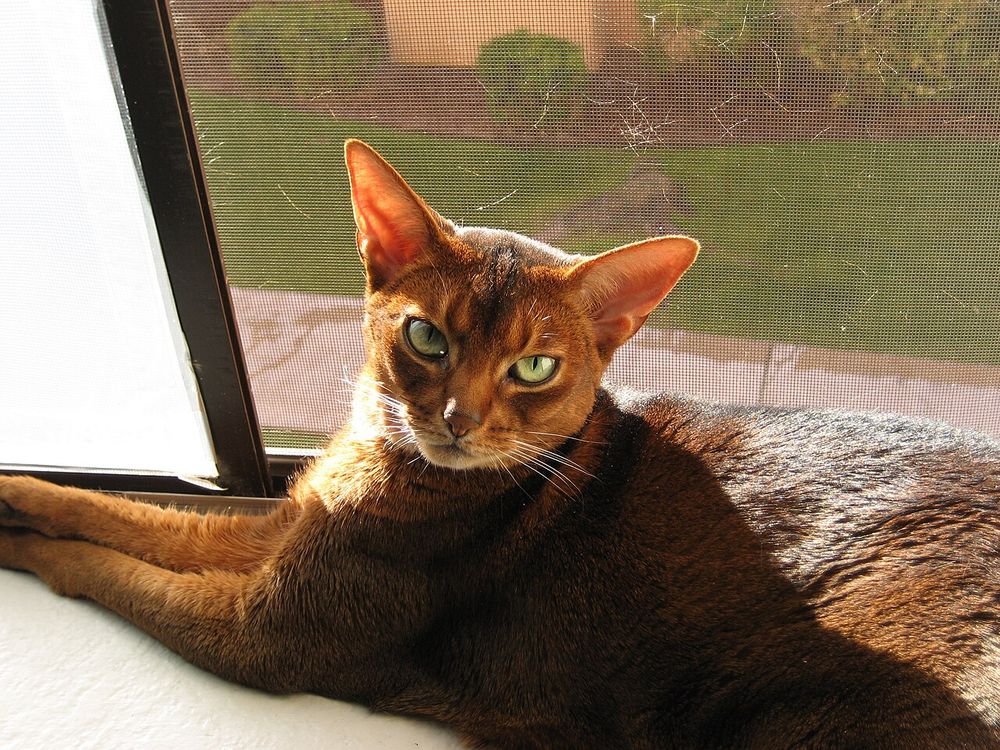
- Origin
- The coasts of the Indian Ocean and South East Asia, by DNA; the modern breed was developed in BritainThe Cat Fanciers' Association
- Adult weight
- 3.6 to 4.5 kg (adult, GCCF's 8 to 10 lb; GCCF gives an average of 4.5 kg, females slightly smaller than males)Governing Council of the Cat Fancy
- Lifespan
- 12 to 16 yearsGoverning Council of the Cat Fancy
- Coat
- Short, fine and dense, with a resilient feel and a lustrous sheen; a ticked coat that needs little grooming.The Cat Fanciers' Association
- Energy
- Very highThe Cat Fanciers' Association
- Indian heat
- Copes with carePDSA
- Flats
- A flat, with daily exerciseThe Cat Fanciers' Association
Abyssinian at a glance
| What | The rule | Source |
|---|---|---|
| Size | A medium-sized, short-haired cat, according to CFA. | The Cat Fanciers' Association |
| Activity | Very high. CFA calls the Aby busy and agenda-driven, constantly on the move unless asleep. | The Cat Fanciers' Association |
| Alone-time tolerance | Lower than many cats: CFA says Abys do not like to be left alone for long, and quieter homes may want two. | The Cat Fanciers' Association |
| Climbing | Loves high places; CFA advises perches from which it can survey its home. | The Cat Fanciers' Association |
| Grooming | Low: a comb or brush a few times a month, says CFA, plus a vet check of the mouth at the yearly visit, GCCF advises. | Governing Council of the Cat Fancy |
| Voice | Quiet, with a chirrup by way of greeting, according to GCCF. | Governing Council of the Cat Fancy |
Where does the Abyssinian cat come from?
The Abyssinian is one of the oldest established cat breeds. Its name points to Abyssinia, now Ethiopia, but CFA says genetic research has established that the breed originated in the coastal areas of the Indian Ocean and in South East Asia, and GCCF also says DNA analysis places its origin near the coast of the Indian Ocean. CFA thinks the cats were most likely brought back to England by returning soldiers.
The first Abyssinian seen at a cat show was a cat called Zula, at the Crystal Palace show in England in 1871, according to CFA. GCCF says the modern breed was developed in the United Kingdom by dedicated breeders, and GCCF recognised it in 1929. In America, the Abyssinian was one of the original breeds registered by CFA in 1906.
How did the Abyssinian cat come to India?
By CFA's and GCCF's account the breed's roots lie around the Indian Ocean, but no source we could find documents when or how the pedigree Abyssinian came to India, or how many live here. Abyssinians in India are kept as pedigree pets, almost always indoors in flats.
No source has tested the breed in Indian heat. Its short, fine coat and lean build keep it off PDSA's list of the cats most at risk of heatstroke (obese, long-haired, old, young and flat-faced cats), but an Aby races about more than most cats, so plan hard play for the cooler morning and evening hours in an Indian summer and keep water in more than one room.
What care does a Abyssinian cat need?
The three things that shape a good day for this breed.
Exercise
CFA calls the Abyssinian extremely active and playful. Plan real play every day, with toys to chase and high perches to climb, rather than leaving it to amuse itself. The Cat Fanciers' Association
Grooming
Light: CFA suggests combing or brushing a few times a month to control shedding, and GCCF says most Abys enjoy a soft brush. GCCF also asks that the vet check the mouth at each yearly visit, because tartar can cause gingivitis. Governing Council of the Cat Fancy
Training
An extremely active, playful cat needs outlets of its own. Give it a scratching post and high perches from the first day, reward the habits you want with play, and keep counters it may not use clear of food. The Cat Fanciers' Association
How much should a Abyssinian cat eat?
Daily calories for a healthy, neutered adult Abyssinian cat, worked out from its weight with the formula vets use (70 x weight in kg to the power 0.75, then AAHA's factor for a neutered adult). Divide by the kcal per kg on your food's pack for grams a day, and adjust by body shape.
| Resting need (kcal a day) | Neutered adult (kcal a day) | |
|---|---|---|
| 3.6 kg AAHA (American Animal Hospital Association) | 180 | 220 to 260 |
| 4.1 kg | 200 | 240 to 280 |
| 4.5 kg | 220 | 260 to 300 |
CFA says Abys love their owners, their toys and all food. Feed a commercial cat food that carries a complete and balanced statement on the label, keep fresh water available at all times, and keep treats under 10 to 15 per cent of the day's calories, as Cornell's Feline Health Center advises. Wet food is at least 75 per cent water, which helps a cat drink enough in an Indian summer. Obesity is the most common nutrition problem in cats, and overweight cats are about four and a half times more likely to develop diabetes, a disease the Abyssinian is already at higher risk of. Keep the Indian kitchen out of the bowl. ASPCA warns that onion and garlic damage red blood cells and that cats are more susceptible than dogs, so dal, curry or anything cooked with a tadka is unsafe. Cornell does not recommend milk as a treat, because many cats cannot digest lactose, and ASPCA lists chocolate, grapes, raisins and raw dough among foods to keep away from pets. Talk to your vet before any home-cooked or special diet. Meals a day: kitten to 6 months, 3 a day; 6 months to 1 year, 2 a day; adult, from about 1 year, 1 or 2 a day; senior, 10 years and over, as for an adult, unless your vet advises otherwise. Puppies, kittens, working, pregnant and older animals need different amounts: ask your vet, or use Petym's food calculator.
Which illnesses is the Abyssinian cat prone to, and how are they treated?
The conditions veterinary studies and breed surveys most often report in the Abyssinian cat. Knowing the early signs means a vet sees it sooner.
See your vet first. This is general information from veterinary sources, not a diagnosis. Only a vet who has examined your pet can say what is wrong and prescribe treatment, and this page never gives a dose. Do not give your pet human medicine. If your pet seems very unwell, go to a 24-hour vet: find one in your city.
Gum disease (gingivitis)
See a vet soonGCCF says tartar build-up can cause gingivitis in Abyssinians and asks vets to check the mouth at every yearly visit. Cats often hide mouth pain, so some cats with severe dental disease show few signs. Governing Council of the Cat Fancy
Signs to watch for
- Bad breath
- Red, sore or bleeding gums
- Pawing at the mouth
- Dropping food or chewing on one side
How a vet treats it
A vet examines the mouth, sometimes under sedation or anaesthesia, and may take dental X-rays. Treatment International Cat Care describes includes pain relief, antibiotics for infection, a scale and polish under general anaesthetic, and removal of badly diseased teeth.
Prevention
Regular tooth brushing is the most useful home care, and a vet may suggest a dental diet. International Cat Care advises a dental check at least every 12 months, or every 3 to 6 months after dental problems.
Amyloidosis (kidney)
See a vet soonAn inherited build-up of abnormal protein, mainly in the kidneys, which is more common in Abyssinians than in most breeds and runs in families. It usually shows between 1 and 5 years of age; GCCF says selective breeding has made it almost unheard of now. UFAW (Science for Animal Welfare)
Signs to watch for
- Drinking and urinating more
- Weight loss and a poor appetite
- Poor coat and lethargy
- Gingivitis and dehydration
How a vet treats it
A vet may feel small, firm kidneys; a definite diagnosis needs a kidney biopsy. Science for Animal Welfare says there is no specific treatment for the amyloid itself, so the vet manages the kidney failure it causes and treats any infection. Cornell names the tools vets use for failing kidneys: a prescription kidney diet, fluids, and medicines for blood pressure, anaemia and nausea.
Prevention
There is no gene test. Buy from a breeder who does not breed from affected cats or their close relatives.
Pyruvate kinase deficiency (inherited anaemia)
See a vet soonAn inherited defect that makes red blood cells fragile, seen particularly in Abyssinian and Somali cats, according to International Cat Care. GCCF says a reliable DNA test exists. International Cat Care
Signs to watch for
- Pale gums
- Weakness and tiring easily
- Fast heartbeat or breathing
- Yellowing of the gums or eyes (jaundice)
How a vet treats it
A vet diagnoses anaemia with a blood test and looks for the cause with further tests. Treatment depends on the cause; in severe anaemia, International Cat Care says a blood transfusion may be needed.
Prevention
Ask the breeder for proof that the parents have been DNA tested and are clear.
Progressive retinal atrophy (PRA)
Ask at a routine checkA group of inherited diseases in which the retina slowly wastes away, leading to poor sight and sometimes blindness. International Cat Care lists the Abyssinian among predisposed breeds; GCCF says it is not a common problem in the breed today. International Cat Care
Signs to watch for
- Poor sight at night first
- Bumping into things
- Trouble finding food, water or the litter tray
- Reluctance on stairs
- Wide pupils
How a vet treats it
A vet examines the eyes, may refer the cat to an eye specialist, and may run blood tests and a blood pressure check to rule out other causes of blindness. International Cat Care says there is no treatment, but PRA is not painful and the vet can advise on adapting the home.
Prevention
Genetic testing of predisposed breeds is recommended, and affected cats should not be bred.
Diabetes mellitus
See a vet soonA Swedish insurance study found the Abyssinian among breeds at increased risk of diabetes, alongside the Burmese, Russian Blue and Norwegian Forest Cat. Cornell names obesity, age, inactivity and being male as the main risk factors. Acta Veterinaria Scandinavica (2015, conference supplement)study
Signs to watch for
- Drinking and urinating more
- Weight loss despite a good appetite
- In some cats, walking flat on the hocks of the back legs
How a vet treats it
A vet diagnoses diabetes from persistently high glucose in blood and urine. Cornell says insulin injections are the standard of care, often with a low-carbohydrate diet; some newly diagnosed cats may suit an oral medicine. Early treatment can bring remission.
Prevention
Keep the cat lean and active: Cornell says obese cats are up to four times more likely to develop diabetes.
How long can an Abyssinian be left alone?
Not as long as a calmer breed. Plan for company and activity, not just food and a clean tray.
CFA describes the Abyssinian as extremely active and playful, and says it follows its people and does not like to be left alone for long. GCCF adds that many Abys follow their humans from room to room, and that playing with anything is better than sitting still. A cat built like that has a long, empty day when its family is away, and it fills that day itself if nobody else does.
Cats Protection suggests a sitter visit any cat at least twice a day. For an Aby, the visits should be long enough for a proper game, not a quick check. If your cat has a companion cat it already gets on with, the two will keep each other busy between visits; CFA suggests quieter homes consider two Abys for this reason. Do not bring in a new cat before a trip, though: a stranger in the home is a stress in itself.
GCCF also calls the breed wilful as well as affectionate, and quick to learn. Tell your sitter the house rules the cat already knows, such as which counters it is allowed on and which doors stay shut, so it does not spend your trip testing a new person.
In CFA's words
Word for word
They do not like to be left alone for long, so quieter homes may want to acquire two instead of one.
For an owner who travels, that line is the heart of the care plan: whoever looks after an Aby has to give it time, not only food.
Keeping an Abyssinian busy in a flat
GCCF says the breed adapts to an indoor home when it has plenty of toys, scratching posts and high spaces to look out from. Set these up before you leave.
- At least one tall, stable cat tree or a set of wall shelves, so the cat can climb and watch from above. Governing Council of the Cat Fancy
- A sturdy scratching post near where the cat sleeps, and another near the door it watches. International Cat Care
- A box of toys the sitter rotates each visit, so something is always new; leave out a few, put the rest away. AAFP and ISFM (Journal of Feline Medicine and Surgery, 2013)study
- A puzzle feeder for part of the day's food, so the cat works for some of it between visits. AAFP and ISFM (Journal of Feline Medicine and Surgery, 2013)study
- A note of the cat's favourite game: many Abys will fetch, GCCF says, and a sitter who knows this has a quick way in. Governing Council of the Cat Fancy
- Windows, grilles and balcony doors checked and kept shut or netted: a climbing cat finds the gap you forgot.
- Cords, hair ties, string toys and plastic bags put away; never leave a wand toy out between visits.
Is a balcony or open window safe for an Abyssinian?
Not without netting. CFA says Abys are fond of high places, and a cat that climbs everything treats a balcony railing or a window ledge as one more perch. In Indian flats, sliding windows with gaps, open grilles and unnetted balconies on upper floors are the common hazards. GCCF says some Abys enjoy time outdoors where a safe space exists; in a city flat, a properly netted balcony is the closest most owners get.
While you are away, the simplest rule is that the balcony door stays shut unless the balcony is fully netted and you have said the cat may use it. Tell the sitter which windows the cat can open or squeeze through, and ask them to check each one before leaving. International Cat Care lists falls from windows among the dangers for indoor cats, and asks owners of indoor cats to make the home as stimulating as possible, with shelves and climbing trees, since cats like to be up high.
Does an Abyssinian cope with Indian heat?
No source makes a heat claim specific to the breed. CFA describes a short, fine coat, and Abys are lean, active cats rather than heavy ones. Activity still raises body heat, though: a cat that races about at midday in a closed flat in May can overheat. PDSA lists the signs of heatstroke in cats, including panting, drooling and red gums, and the Animal Welfare Board of India's 2026 heat advisory asks owners to provide shade and water all day.
Ask your sitter to do play sessions in the morning and evening visits when the flat is cooler, keep curtains drawn on sunny windows, and leave water in two or three places. If the cat has a favourite sunny shelf, a blind on that window helps more than anything else.
Which Abyssinian health problems should a sitter know?
These are the problems GCCF, UFAW and International Cat Care link to the breed. A sitter notices and calls; the vet decides.
If Red, swollen gums, bad breath, drooling or dropping food. GCCF names gingivitis from tartar build-up as a breed problem.
Tell the owner and book a vet visit; do not try to clean the teeth unless the owner has shown you how. Governing Council of the Cat Fancy
If Drinking and urinating much more, weight loss, poor coat, less appetite and lethargy, often in a cat aged one to five. UFAW says Abyssinians are more commonly affected than most breeds by amyloidosis, which damages the kidneys.
Note the changes and call the vet. There is no gene test, so the vet will need to examine the cat. UFAW (Science for Animal Welfare)
If Pale gums, weakness, tiring easily or fast breathing. International Cat Care says pyruvate kinase deficiency, an inherited anaemia, is seen particularly in Abyssinians.
Call the vet the same day; collapse or very pale gums means go now. International Cat Care
If Bumping into things, reluctance on stairs or in the dark, or looking lost at night. International Cat Care lists the Abyssinian among breeds predisposed to progressive retinal atrophy.
Keep furniture where it is, avoid moving bowls or the tray, and tell the owner; a vet check follows. International Cat Care
If Drinking more with weight loss despite a good appetite.
Call the vet. A Swedish study found Abyssinians among breeds at increased risk of diabetes. Acta Veterinaria Scandinavica (2015, conference supplement)study
If Straining in the tray with little or no urine.
Emergency, especially in a male: go to the vet now. Cornell University College of Veterinary Medicine
An Abyssinian sitter's visit
Arrive
Expect to be greeted, often with a chirrup, as GCCF describes. A usually sociable Aby that stays away or seems slow is worth noting. Governing Council of the Cat Fancy
Basics
Fresh water in each bowl, food as written, litter scooped and checked. Note how much food was left.
Play first
At least one real game, chasing a wand toy, fetching a ball or a paper ball, until the cat chooses to stop. The Cat Fanciers' Association
Reset the room
Swap two or three toys, refill the puzzle feeder with part of the ration, and put string toys away. AAFP and ISFM (Journal of Feline Medicine and Surgery, 2013)study
Quick check
A look at the gums if the cat allows it, and a note of thirst and the wetness of the tray. Governing Council of the Cat Fancy
Leave
Windows and balcony checked, curtains set, and the daily photo update sent, ideally of the cat mid-game.
Feeding an Abyssinian while you are away
CFA says Abys love their owners, their toys and all food. Keep the food, amounts and times exactly as they are and leave enough for the whole trip plus a few days, since a sudden change of food commonly causes diarrhoea, PDSA notes. Using part of the daily ration in a puzzle feeder gives the cat food and something to do in one go.
Do not leave human food on counters an Aby can reach, which is most counters. Keep lilies out of the house while you are away, and tell the sitter not to give any treat, supplement or medicine that is not on the care sheet.
Abyssinian care through the Indian year
| What changes | What the sitter does | |
|---|---|---|
| Summer PDSA | A busy cat overheats faster in a closed flat | Play in the cooler visits, blinds on sunny windows, water in several rooms |
| Monsoon | Windows opened for air; more time indoors for everyone | Check every window and grille before leaving; keep the balcony shut unless netted |
| Diwali | Noise and smoke; a cat that climbs may bolt upwards | Windows shut, high hiding spots left open, a calm evening visit |
| All year UFAW (Science for Animal Welfare) | Gums, thirst and weight | Note gum colour, water drunk and appetite in the daily log |
Which Petym service suits an Abyssinian?
If Healthy adult Aby, ideally with a cat companion, trip of a few days
Drop-in visits, at least two a day, each with a proper play session. Drop-in visits
If A single Aby on a longer trip, or one that frets when alone
Overnight pet sitting, so it has company through the evening and night. Overnight sitting
If Diagnosed kidney disease, anaemia or another condition on medicine
Special-needs care, with doses and signs logged as your vet's plan says. Special-needs care
Breeds with similar care needs to the Abyssinian cat
Going away soon? Tell us your dates.
A checked local sitter feeds, walks and keeps your pet company at home, follows your care sheet to the letter and sends a photo every day. Petym is opening city by city: send your dates and we will tell you when a sitter can take them.
- Meet your sitter first, free
- PAN-checked, first-aid trained
- A photo every day
- Pay through Petym, never cash

Questions owners ask
Can I leave my Abyssinian alone while I travel?
- Yes, with visits, but plan for more company than a calm breed needs. CFA says Abys do not like to be left alone for long. Book at least two visits a day with real play in each, or an overnight sitter for a single Aby on a long trip, and leave high perches and toys out.
Are Abyssinian cats good for flats in India?
- They can be, if the flat gives them height and activity. GCCF says the breed adapts to an indoor home with plenty of toys, scratching posts and high spaces. Net the balcony, secure sliding windows and grilles, and set aside daily play time; a bored Aby will make its own entertainment.
What health problems do Abyssinians have?
- GCCF names gingivitis and an inherited anaemia (pyruvate kinase deficiency), for which breeders can test. UFAW says Abyssinians are more commonly affected than most breeds by amyloidosis, a kidney disease. International Cat Care lists the breed as predisposed to progressive retinal atrophy. Talk to your vet about checks.
Do Abyssinians need two cats?
- Not always, but CFA suggests quieter homes may want two, because Abys do not like being left alone for long. A companion helps only if the cats already get on. Never introduce a new cat just before you travel: a stranger in the home is itself a stress for cats.
How much grooming does an Abyssinian need?
- Very little. CFA suggests combing or brushing a few times a month to control shedding, and GCCF says most Abys enjoy a soft brush. GCCF also advises asking your vet to check the mouth at each yearly visit, since tartar and gingivitis are known problems in the breed.
How often should a sitter visit an Abyssinian?
- At least twice a day, as Cats Protection suggests for any cat, with enough time in each visit for a proper game. Add a third visit or choose overnight sitting for a single Aby that frets alone, an older cat, or a hot summer with power cuts.
Keep reading
- Cats: caring for a cat while you are away
- Bengal cat careAnother high-energy climber.
- Siamese cat careA people-led breed that dislikes being alone.
- Cat-proofing a balcony
- How long can a cat be left alone?
- Drop-in visits for cats
- Diwali fireworks and pets
Services that help
Free tools for this
Words on this page, explained
Keep exploring
Sources
Each source was opened and read on the date shown. How Petym checks its sources
- The Cat Fanciers' Association: Abyssinian (opens in a new tab)
- Governing Council of the Cat Fancy: Abyssinian (opens in a new tab)
- PDSA: Heatstroke in cats (opens in a new tab)
- Cornell Feline Health Center: Feeding your cat (updated 30 April 2026) (opens in a new tab)
- Cornell Feline Health Center: How often should you feed your cat? (opens in a new tab)
- ASPCA Animal Poison Control: People foods to avoid feeding your pets (opens in a new tab)
Show all 22 sourcesShow fewer
- AAHA (American Animal Hospital Association): 2021 AAHA Nutrition and Weight Management Guidelines for Dogs and Cats: energy requirement calculations (Box 1, PDF) (opens in a new tab)
- Merck Veterinary Manual: Nutritional requirements of small animals (full review November 2023, updated September 2024) (opens in a new tab)
- International Cat Care: Dental disease in cats (updated 26 September 2025) (opens in a new tab)
- UFAW (Science for Animal Welfare): Abyssinian: amyloidosis (opens in a new tab)
- Cornell Feline Health Center: Chronic Kidney Disease (opens in a new tab)
- International Cat Care: Anaemia in cats (first published 21 June 2024, updated 26 September 2025) (opens in a new tab)
- International Cat Care: Progressive retinal atrophy (PRA) in cats (opens in a new tab)
- Cornell University College of Veterinary Medicine: Feline diabetes (Cornell Feline Health Center) (opens in a new tab)
- Cornell University College of Veterinary Medicine: Feline lower urinary tract disease (Cornell Feline Health Center) (opens in a new tab)
- Animal Welfare Board of India: Request to ensure care and protection of animals from direct heat during extreme hot weather (4 May 2026) (opens in a new tab)
- Cats Protection: Going on holiday without your cat (opens in a new tab)
- International Cat Care: Scratching on furniture and carpets (updated 7 October 2026) (opens in a new tab)
- International Cat Care: Should I keep my cat indoors or allow outdoor access? (updated 26 September 2025) (opens in a new tab)
- PDSA: Diarrhoea after a change of food (opens in a new tab)
- Acta Veterinaria Scandinavica (2015, conference supplement): Feline diabetes mellitus: the Swedish situation (opens in a new tab)
- AAFP and ISFM (Journal of Feline Medicine and Surgery, 2013): Feline environmental needs guidelines (opens in a new tab)