Devon Rex care in India: thin coat, company and sitters
Updated By PetymFacts checked against official sources on
Quick answer
A Devon Rex is a people-focused cat that CFA says dislikes being left alone for long periods, so plan more than the minimum: two or three sitter visits a day with real play, or a sitter who stays overnight. Its short, curly coat insulates less than most, so it needs a warm bed in an air-conditioned room.
Two breed facts belong on every Devon's care sheet: some Devons carry an inherited muscle disease that makes swallowing hard, and the breed has a high rate of blood type B, which matters if a vet ever needs to give blood.
- Meet your sitter first, free
- PAN-checked, first-aid trained
- A photo every day
- Pay through Petym, never cash

- Origin
- Buckfastleigh, Devon, EnglandGoverning Council of the Cat Fancy
- Adult weight
- 2.7 to 4.1 kg (GCCF and CFA both give 6 to 9 lb (about 2.7 to 4.1 kg), males heavier than females.)Governing Council of the Cat Fancy
- Lifespan
- 12 to 16 yearsGoverning Council of the Cat Fancy
- Coat
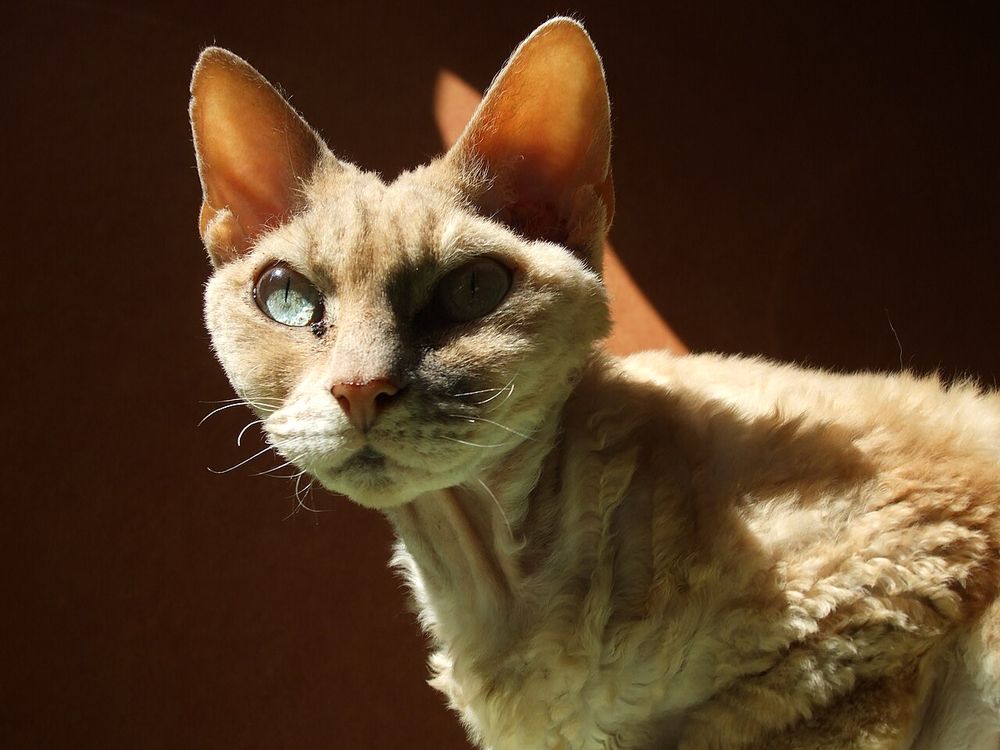
- Short, soft and wavy, with few guard hairs; it can be thin or have bare patches, and kittens often lose their curls while moulting. Whiskers and eyebrows are curly and may break off.Governing Council of the Cat Fancy
- Energy
- HighGoverning Council of the Cat Fancy
- Indian heat
- Copes with carePDSA
- Flats
- A flat, with daily exerciseGoverning Council of the Cat Fancy
Devon Rex at a glance
| What | The rule | Source |
|---|---|---|
| Size | Small to medium and muscular. CFA and GCCF give 6 to 9 lb (about 2.7 to 4 kg), males somewhat heavier. | The Cat Fanciers' Association |
| Coat | Short, soft and waved or rippled, with very sparse guard hairs; curly whiskers that can break. | The Cat Fanciers' Association |
| Warmth | GCCF says the body temperature is the same as other cats but the coat insulates less, so a Devon feels warm to touch. | Governing Council of the Cat Fancy |
| Activity | Alert, active and mischievous; often follows its people around and tries to help. | Governing Council of the Cat Fancy |
| Alone-time tolerance | Low. CFA says Devons dislike being left alone for long periods. | The Cat Fanciers' Association |
| Grooming | Light but gentle: GCCF says a hand stroked over the coat is often enough, and rough brushing breaks the hairs. | Governing Council of the Cat Fancy |
| Allergies | Not hypoallergenic. Both CFA and GCCF say Devons produce allergens like other cats. | Governing Council of the Cat Fancy |
Where does the Devon Rex come from?
The first Devon Rex was a smoky black, curly-coated kitten called Kirlee, born on 15 July 1959 to a non-pedigree mother and taken in by Beryl Cox and Margaret Croll of Buckfastleigh in Devon, GCCF says. CFA adds that the kitten came from a litter born in a garden in Devon.
CFA says Kirlee was at first taken for another example of the Cornish Rex mutation. GCCF says test matings proved his curl came from a separate and incompatible mutation, and GCCF recognised the Devon Rex in 1967.
CFA says the Devon has recently been named the most popular of all short-haired breeds in its registration figures, and that genetic testing matters in the breed because of its high rate of blood type B, which can cause blood type problems between parents and kittens.
How did the Devon Rex come to India?
No source we found records when the Devon Rex first came to India or how many live here, so ask any breeder for registration papers and the myopathy DNA test result UFAW describes.
India's climate asks two things of a thinly coated cat. GCCF says a Devon's coat gives less insulation than most, so it feels warm and seeks out heat: give it a covered bed in an air-conditioned room and on cold north Indian winter nights. In summer, PDSA's heatstroke advice applies as to any cat: shade, water and never a hot, closed room.
What care does a Devon Rex need?
The three things that shape a good day for this breed.
Exercise
GCCF describes the Devon as intelligent, mischievous, highly active and a powerful jumper that needs company and can become destructive if left alone for long periods. Daily play and climbing space suit it better than a quiet day alone. Governing Council of the Cat Fancy
Grooming
Light and gentle: GCCF says stroking by hand is often enough and warns that rough brushing breaks the delicate hairs. CFA notes Devons shed less than most cats but are not hypoallergenic. The Cat Fanciers' Association
Training
CFA says Devons are very intelligent and learn to respond to their names, so name recall and games with rewards come easily. Governing Council of the Cat Fancy
How much should a Devon Rex eat?
Daily calories for a healthy, neutered adult Devon Rex, worked out from its weight with the formula vets use (70 x weight in kg to the power 0.75, then AAHA's factor for a neutered adult). Divide by the kcal per kg on your food's pack for grams a day, and adjust by body shape.
| Resting need (kcal a day) | Neutered adult (kcal a day) | |
|---|---|---|
| 2.7 kg AAHA (American Animal Hospital Association) | 150 | 180 to 210 |
| 3.4 kg | 180 | 210 to 250 |
| 4.1 kg | 200 | 240 to 280 |
Feed a complete and balanced commercial cat food for the cat's life stage, with fresh water always out. CFA says Devons have a robust appetite and some like fruit and vegetables as much as chicken or fish, so measured meals and few treats keep the weight right; Cornell says treats should stay a small part of the day's food. If your Devon has hereditary myopathy, UFAW says feeding by hand or from a raised surface lowers the risk of choking: that rule comes before any other. Cornell advises against milk and raw meat, and ASPCA lists onions, garlic, chocolate, grapes, salty food and dairy among foods to keep from pets, so a Devon raiding the counter needs it kept clear. Meals a day: kitten to 6 months, 3 a day; 6 months to 1 year, 2 a day; adult, from about 1 year, 1 or 2 a day. Puppies, kittens, working, pregnant and older animals need different amounts: ask your vet, or use Petym's food calculator.
Which illnesses is the Devon Rex prone to, and how are they treated?
The conditions veterinary studies and breed surveys most often report in the Devon Rex. Knowing the early signs means a vet sees it sooner.
See your vet first. This is general information from veterinary sources, not a diagnosis. Only a vet who has examined your pet can say what is wrong and prescribe treatment, and this page never gives a dose. Do not give your pet human medicine. If your pet seems very unwell, go to a 24-hour vet: find one in your city.
Hereditary myopathy (Devon Rex myopathy)
See a vet soonAn inherited fault in how nerve signals reach the muscles, causing general weakness. UFAW says signs start between 3 and 23 weeks of age, worsen until about nine months and then level off; the Sphynx carries the same condition. UFAW (Science for Animal Welfare)
Signs to watch for
- Weakness and tiring quickly
- Trouble holding the head up
- Trembling or collapse
- Difficulty swallowing, gagging or choking while eating
How a vet treats it
UFAW says diagnosis is hard because signs vary; a vet may take muscle samples under anaesthesia, and a DNA test identifies affected cats and carriers. There is no cure. Affected cats often adapt, and feeding by hand or from a raised surface lowers the risk of choking.
Prevention
Test breeding cats: UFAW says both Devon Rex and Sphynx should be tested. Food stuck in the airway can cause sudden death if it is not dislodged, so a choking cat needs a vet at once.
Patellar luxation (slipping kneecap)
See a vet soonThe kneecap slips out of its groove. GCCF says it appears more common in the Devon Rex, and Merck says the inward-slipping form is the usual one in cats. Governing Council of the Cat Fancy
Signs to watch for
- Lameness or skipping on a back leg
- Holding a back leg up for a few steps
- Signs usually first seen before one year of age
How a vet treats it
A vet grades it from 1 to 4 by feeling the knee, and X-rays show the changes in the leg. Merck says mild cases are managed conservatively, and surgery in cats realigns the extensor mechanism of the knee and deepens the groove the kneecap runs in. The outlook is good in mild or moderate cases.
Inherited hypokalaemia (low blood potassium)
See a vet soonLow potassium in the blood weakens the muscles. International Cat Care lists the Devon Rex among the breeds related to the Burmese in which an inherited form occurs, usually first seen in kittens of 2 to 6 months. International Cat Care
Signs to watch for
- Muscle weakness that comes and goes
- The neck held drooped, chin towards the chest
- Struggling to stand
- Episodes after exercise, stress or cold
How a vet treats it
A vet diagnoses it with a blood test for potassium. ICC says treatment is usually potassium supplementation, often by drip first and then by mouth as a liquid, powder or tablet if it is needed long term, with repeat blood tests.
Prevention
A gene test is available, and ICC says breeding cats from these breeds should ideally be tested before breeding.
How long can a Devon Rex be left alone?
Less comfortably than most cats. The breed's main care need while you travel is company, not grooming.
CFA calls Devons intensely loyal and loving, says they bond strongly with their owners, often follow them around the house, and dislike being left alone for long periods. GCCF describes them as intelligent, mischievous and highly active, people-oriented, and good with children and other pets. A cat like this, left with a full bowl and a quick check once a day, is likely to be bored, noisy or destructive by the end of a week.
Cats Protection suggests a sitter who visits at least twice a day for any cat, and more often for young, old or unwell cats. For a Devon, treat twice a day as the floor. Longer visits with play, a third visit on long workdays for the sitter, or a sitter who stays overnight all suit the breed better. If you have two cats who get on well, a companion helps between visits; if you do not, do not bring in a new cat just before a trip.
Signs that a Devon is not coping with your absence include crying at the door, over-grooming, eating less, and soiling outside the tray. International Cat Care lists changes in grooming, appetite and toileting among the signs of stress in cats. Ask your sitter to note these in the daily update rather than waiting to mention them when you return.
A thin coat in Indian air conditioning and monsoon
The Devon is the rare breed whose Indian challenge is staying warm indoors as much as staying cool.
GCCF explains that a Devon's body temperature is the same as other cats but its coat gives less insulation, which is why the breed feels like a soft hot water bottle. CFA describes very sparse, short guard hairs and a coat that may develop bare or sueded patches. So a Devon has little to keep it warm in a room cooled by an AC set low for hours, or on a cold January night in Delhi, Lucknow or Chandigarh.
Leave a covered bed or a fleece-lined box in every room where the AC runs, off the floor and away from the cold air flow, and tell the sitter the setting you use. In summer the coat is less of a problem than in long-haired cats, but heat still matters: PDSA's heatstroke advice applies to all cats, and a Devon in a closed, sunny room during a power cut is at risk like any other.
In the monsoon, keep the cat indoors and dry. A damp Devon gets cold quickly because there is so little coat to hold air. Never bathe or wet the cat to cool it unless it is overheating and you are following the heatstroke steps.
Handling and grooming a Devon Rex: do and don't
Do
- Groom gently: GCCF says stroking a hand over the coat is often enough, and harsh brushing breaks the delicate hairs. Governing Council of the Cat Fancy
- Offer a warm bed, out of the AC draught, in each room the cat uses. Governing Council of the Cat Fancy
- Play at every visit; CFA describes an alert, active cat with a lively interest in everything around it. The Cat Fanciers' Association
- Look at the ears and the claw folds, where brown, greasy wax can build up, and tell the owner if it looks heavier than usual. Veterinary Dermatology (2008), Royal Veterinary Collegestudy
- Keep food in the cat's own bowl or feeder, served the way the owner shows, especially if it is fed from a raised platform. UFAW (Science for Animal Welfare)
Don’t
- Do not pull or trim the curly whiskers. CFA says they are fragile and break into bent stubs on their own. The Cat Fanciers' Association
- Do not use human shampoo, ear drops or medicines on the cat, or any dog flea product. International Cat Care
- Do not leave human food within reach: CFA notes the breed's hearty appetite, and it may steal. The Cat Fanciers' Association
- Do not leave the cat in a cold AC room with no bed or cover. Governing Council of the Cat Fancy
Which health problems should a Devon Rex's sitter know?
GCCF calls the Devon generally a very healthy breed. These are the conditions the sources link to it, and the general cat emergencies every sitter should know.
If Choking, coughing or gagging while eating, food coming back up, or a cat that cannot lift its head properly. UFAW says Devons with hereditary myopathy have weak muscles, a drooping head and trouble swallowing.
If the cat is choking, call the vet at once and go: UFAW says food blocking the airway is the most common cause of death in affected cats. Breathing trouble after eating is also urgent. UFAW (Science for Animal Welfare)
If Fast or noisy breathing, fever or lethargy in a cat with known myopathy. Food inhaled into the lungs can cause pneumonia.
Call the vet the same day and say the cat has myopathy and may have inhaled food. UFAW (Science for Animal Welfare)
If Skipping on a back leg, holding a leg up or reluctance to jump. GCCF says luxating patella, a slipping kneecap, appears more common in the breed.
Keep the cat calm, note when it happens and call the vet. Governing Council of the Cat Fancy
If Greasy, red or itchy skin, scratching at the ears, or dark waxy debris at the claws. A Royal Veterinary College survey found Devons carry Malassezia yeast far more often than domestic shorthairs, and are prone to greasy skin disease.
Do not clean deep into the ears. Note it and ask the vet; it is rarely an emergency. Veterinary Dermatology (2008), Royal Veterinary Collegestudy
If Straining in the tray, frequent trips, little or no urine.
A blocked bladder can kill within a day or two, especially in males. Go to the vet now. Cornell University College of Veterinary Medicine
If Not eating for a day, or much less across two visits.
Call the vet. Cats that stop eating risk hepatic lipidosis within days. University of Illinois College of Veterinary Medicine
What should a sitter know about Devon Rex myopathy?
UFAW's page on hereditary myopathy in the Devon Rex says signs usually start between three and 23 weeks of age, worsen slowly, and stabilise at about nine months. Affected cats have generalised weakness, cannot raise the head properly, may bob the head or walk with a high step at the front, and often sit up in a begging posture. The condition is autosomal recessive, there is a DNA test, and there is no cure. UFAW notes Devons and Sphynx should both be tested because the breeds are closely related.
The care point that matters to a sitter is feeding. UFAW says cats can be fed by hand or from a raised platform to lower the risk of choking, because food can lodge in the throat or a widened oesophagus. If your Devon has been diagnosed, write the exact feeding method at the top of the care sheet, show it to the sitter at the meet and greet, and ask them to stay with the cat until it has finished eating. If your cat has a clear DNA result, keep a copy with the care sheet too.
Blood type B: why a Devon owner should know it
CFA notes that the Devon Rex has a high incidence of blood type B, which is rare in most cats. For breeders this matters because CFA says breeding a type A male to a type B female can lead to kitten deaths unless the kittens are hand-raised. For an owner leaving the cat with a sitter, it matters in an emergency: if a vet ever needs to give your cat blood, giving the wrong type can cause a severe reaction.
Any emergency vet will type a cat's blood before a transfusion. You can save time by asking your own vet whether your Devon's blood type is known and writing it on the care sheet next to the vet's number, so the sitter can hand it over at a 24-hour clinic.
A Devon Rex visit, step by step
On arrival
Expect the cat at the door. Note whether it greets you as usual; a Devon that hides or stays in bed is unusual and worth recording. The Cat Fanciers' Association
Meal
Serve the food exactly as the care sheet says, raised or by hand if the owner does that, and stay until the cat has eaten. UFAW (Science for Animal Welfare)
Water and tray
Fresh water in each bowl, away from food and litter. Scoop the tray and note urine and stool. Battersea Dogs and Cats Home
Play
At least ten minutes of chase and pounce with a wand toy, plus any puzzle feeder the owner left. A tired Devon settles better until the next visit. AAFP and ISFM (Journal of Feline Medicine and Surgery, 2013)study
Quick check
A gentle hand over the coat, a look at the ears and the claw folds, and a check that the warm bed is dry and out of the AC draught. Governing Council of the Cat Fancy
Before you go
Put food and treats out of reach, close windows and the balcony door, set the AC as agreed, and send the daily photo update.
Devon Rex words on a breeder's or vet's paperwork
- Rex coat
- A coat that is waved or rippled, short, dense and soft, with sparse guard hairs. It is a breed feature, not a skin problem. Governing Council of the Cat Fancy
- Hereditary myopathy (spasticity)
- An inherited muscle disease of the Devon Rex that causes weakness and swallowing trouble. A DNA test shows whether a cat is affected, a carrier or clear. UFAW (Science for Animal Welfare)
- Blood type B
- A blood group that is rare in most cats but common in the Devon Rex, as CFA notes. It matters for breeding and transfusion. The Cat Fanciers' Association
- Luxating patella
- A kneecap that slips out of place. GCCF says it appears more common in the breed. Governing Council of the Cat Fancy
- Malassezia
- A yeast that lives on cat skin. Devons carry it more often than most cats and can get greasy, itchy skin or ears. Veterinary Dermatology (2008), Royal Veterinary Collegestudy
Feeding a Devon Rex while you are away
CFA describes the breed's hearty appetite, and says some Devons enjoy fruit and vegetables. That appetite means a sitter's kindness can easily become extra weight. Keep the food, the amount and the times exactly as you do, write them down, and ask the sitter to log each meal. PDSA warns that a sudden change of food often brings diarrhoea.
A curious, food-driven cat will also explore kitchen counters. Ask the sitter to keep human food and any medicines out of reach and to keep lilies out of the house: International Cat Care lists lilies among the plants that cause kidney failure in cats. If your vet has advised a special feeding method for myopathy, that comes before every other rule.
Which Petym service suits a Devon Rex?
If Healthy adult, a short trip, and you can afford three visits a day or have a second cat it likes
Drop-in visits, with long play sessions at each one. Drop-in visits
If A trip of more than a few days, or a Devon that cries or over-grooms when you are out
Overnight pet sitting, so the cat has company in the evenings and at night. Overnight sitting
If Diagnosed myopathy, skin or knee problems needing treatment
Special-needs care, with feeding method and medicines followed and logged. Special-needs care
Breeds with similar care needs to the Devon Rex
Going away soon? Tell us your dates.
A checked local sitter feeds, walks and keeps your pet company at home, follows your care sheet to the letter and sends a photo every day. Petym is opening city by city: send your dates and we will tell you when a sitter can take them.
- Meet your sitter first, free
- PAN-checked, first-aid trained
- A photo every day
- Pay through Petym, never cash

Questions owners ask
Can a Devon Rex be left alone while I travel?
- Not for long without company. CFA says Devons dislike being left alone for long periods and bond strongly with their owners. Plan at least two sitter visits a day with real play, and for longer trips choose a sitter who stays overnight so the cat has people around in the evenings.
Is a Devon Rex hypoallergenic?
- No. Both CFA and GCCF say the Devon Rex is not hypoallergenic: it produces allergens like every other cat, even though it sheds less noticeably. Anyone with a cat allergy, including a sitter, should spend time with the cat before agreeing to care for it.
Does a Devon Rex get cold in an air-conditioned room?
- It can. GCCF says the Devon's body temperature is normal but its thin coat insulates less than other cats' coats. Leave a covered or fleece-lined bed in each room where the AC runs, out of the cold air flow, and tell your sitter the setting you use.
What is Devon Rex myopathy?
- An inherited muscle disease. UFAW says affected Devons are weak, cannot raise the head properly and have trouble swallowing, and that food blocking the airway is the most common cause of death. A DNA test exists. A diagnosed cat may need hand feeding or a raised platform, which the sitter must follow.
Why does my Devon Rex's blood type matter?
- CFA says the breed has a high incidence of blood type B, which is uncommon in most cats. If your cat ever needs a transfusion, the vet must match the type. Ask your vet whether it is known and write it on the care sheet for the sitter.
How do I groom a Devon Rex?
- Gently and not much. GCCF says stroking a hand over the coat is often enough and rough brushing breaks the delicate hairs. The ears and claw folds can collect greasy wax, which a Royal Veterinary College study links to yeast; ask your vet how to clean them.
How many visits a day does a Devon Rex need?
- Two is the minimum Cats Protection suggests for any cat; a Devon usually does better with three, or with a sitter staying overnight. Each visit should include a meal served the usual way, water, the tray, a quick ear and coat check, and at least ten minutes of play.
Keep reading
- Cats: caring for a cat while you are away
- Sphynx cat careA close relative with the same myopathy test and skin care.
- Siamese cat careAnother vocal, people-focused breed.
- Do cats miss their owners?
- Drop-in visits or overnight sitting?
- Winter pet care in north India
- Overnight pet sitting
Services that help
Free tools for this
Words on this page, explained
Keep exploring
Sources
Each source was opened and read on the date shown. How Petym checks its sources
- Governing Council of the Cat Fancy: Devon Rex (opens in a new tab)
- PDSA: Heatstroke in cats (opens in a new tab)
- The Cat Fanciers' Association: Devon Rex (opens in a new tab)
- UFAW (Science for Animal Welfare): Devon Rex: hereditary myopathy (updated 6 May 2026) (opens in a new tab)
- Cornell Feline Health Center: How often should you feed your cat? (opens in a new tab)
- Cornell Feline Health Center: Feeding your cat (updated 30 April 2026) (opens in a new tab)
Show all 20 sourcesShow fewer
- ASPCA Animal Poison Control: People foods to avoid feeding your pets (opens in a new tab)
- AAHA (American Animal Hospital Association): 2021 AAHA Nutrition and Weight Management Guidelines for Dogs and Cats: energy requirement calculations (Box 1, PDF) (opens in a new tab)
- Merck Veterinary Manual: Nutritional requirements of small animals (full review November 2023, updated September 2024) (opens in a new tab)
- Merck Veterinary Manual: Patellar luxation in small animals (opens in a new tab)
- International Cat Care: Hypokalaemia in cats (updated 3 June 2026) (opens in a new tab)
- Cats Protection: Going on holiday without your cat (opens in a new tab)
- International Cat Care: Stress in cats (opens in a new tab)
- Cornell University College of Veterinary Medicine: Feline lower urinary tract disease (Cornell Feline Health Center) (opens in a new tab)
- University of Illinois College of Veterinary Medicine: Hepatic lipidosis: a serious problem when cats stop eating (opens in a new tab)
- Battersea Dogs and Cats Home: Cat litter trays (opens in a new tab)
- International Cat Care: Cats and poisons (opens in a new tab)
- PDSA: Diarrhoea after a change of food (opens in a new tab)
- Veterinary Dermatology (2008), Royal Veterinary College: Carriage of Malassezia spp. yeasts in Cornish Rex, Devon Rex and Domestic short-haired cats: a cross-sectional survey (abstract read via Europe PMC) (opens in a new tab)
- AAFP and ISFM (Journal of Feline Medicine and Surgery, 2013): Feline environmental needs guidelines (opens in a new tab)