Oriental Shorthair care in India: company, play and sitters
Updated By PetymFacts checked against official sources on
Quick answer
An Oriental Shorthair can stay home while you travel, but copes worse with an empty flat than most cats. GCCF says that in general the breed does not do well as an only cat, and CFA calls it vocal, active and insistent. Book a sitter who visits twice a day and stays to play, not just feed.
The coat is easy: GCCF says it does not tangle or mat. The work is attention, climbing space and watching for two inherited problems, failing night vision and liver amyloidosis.
- Meet your sitter first, free
- PAN-checked, first-aid trained
- A photo every day
- Pay through Petym, never cash

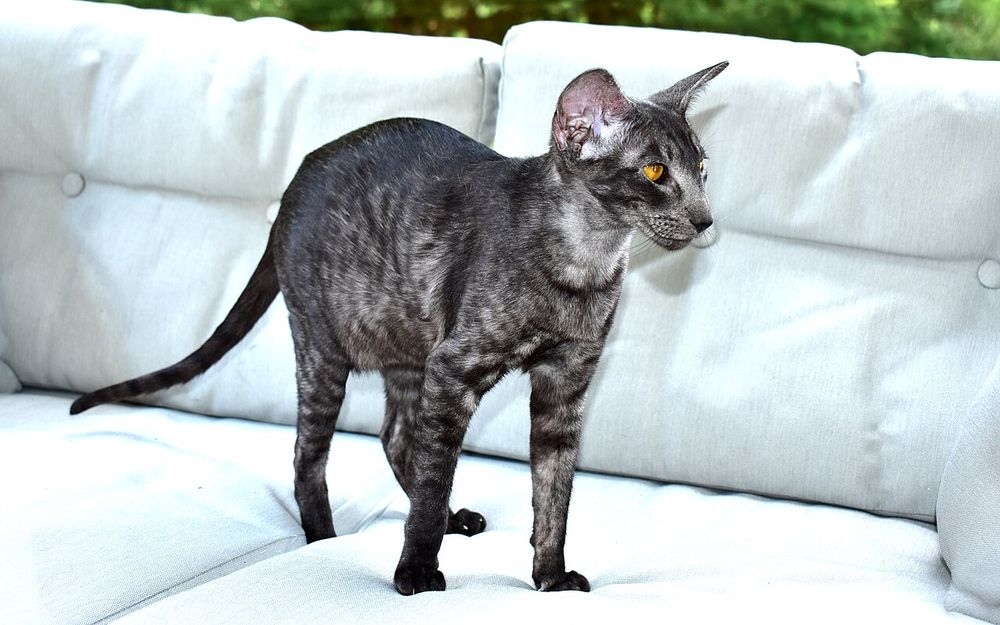
- Origin
- Europe (Britain), developed from the Siamese in the 1950sThe Cat Fanciers' Association
- Adult weight
- 3.6 to 6.4 kg (GCCF gives an average of 8 to 14 lb; CFA says males may be somewhat larger than females)Governing Council of the Cat Fancy
- Lifespan
- 12 to 15 yearsGoverning Council of the Cat Fancy
- Coat
- Very short, fine, glossy and close-lying; the Oriental Longhair has a medium-long silky coat with no woolly undercoat. Neither tangles or mats.Governing Council of the Cat Fancy
- Energy
- HighGoverning Council of the Cat Fancy
- Indian heat
- Copes with careGoverning Council of the Cat Fancy
- Flats
- A flat, with daily exerciseGoverning Council of the Cat Fancy
Oriental Shorthair at a glance
| What | The rule | Source |
|---|---|---|
| Size | Medium, long and slender with fine bones and firm muscle. GCCF gives an average of 8 to 14 lb (about 3.6 to 6.4 kg). | Governing Council of the Cat Fancy |
| Activity | High. GCCF says Orientals stay kitten-like all their lives, love fetch and can reach any cupboard or high shelf. | Governing Council of the Cat Fancy |
| Alone-time tolerance | Low for a cat. GCCF says an Oriental does not usually do well as an only cat; plan longer visits or overnight care. | Governing Council of the Cat Fancy |
| Voice | Loud and frequent. CFA says to expect a fair amount of conversation. | The Cat Fanciers' Association |
| Grooming | Light: a weekly session, with a rubber brush for the shorthair and a fine steel comb for the longhair, according to CFA. | The Cat Fanciers' Association |
| Lifespan | GCCF gives 12 to 15 years. | Governing Council of the Cat Fancy |
Where does the Oriental Shorthair come from?
The Oriental is a modern, planned breed with its roots in the Siamese. CFA says its development began in Europe in the 1950s, and that England's Governing Council of the Cat Fancy first recognised chestnut, lavender and white solids. GCCF says the Havana was the first Oriental recognised, followed by the Foreign Lilac and the Foreign White.
Breeders in the United States developed many more colours and patterns in the 1960s and 1970s. CFA accepted Oriental Shorthairs for registration in 1974 and gave them championship status in 1977. It accepted the Oriental Longhair in 1988, when the breed's name became simply Oriental.
How did the Oriental Shorthair come to India?
No source we found records when the Oriental first reached India, and it does not appear in the breed lists of the Indian cat show reports we read. Orientals in India live as indoor cats. The short, close coat with no woolly undercoat carries little insulation, so the breed is likely to find heat easier than a long-haired cat, which PDSA lists among the most at risk of heatstroke. An Oriental still needs a cool room and water through the summer. GCCF says it does not usually do well as an only cat, which matters in a flat where everyone is out at work.
What care does a Oriental Shorthair need?
The three things that shape a good day for this breed.
Exercise
High. GCCF says Orientals stay kitten-like all their lives, love to play fetch and can reach any cupboard or high shelf. Give daily play, a tall cat tree and safe high perches, and net balconies and windows. Governing Council of the Cat Fancy
Grooming
Light: CFA recommends a weekly session, with a rubber brush for the shorthair and a fine steel comb for the longhair. CFA says most Orientals enjoy being groomed. The Cat Fanciers' Association
Training
Sociable and responsive: CFA calls them vocal, affectionate and active, and insistent. Use play and food rewards, and plan company: GCCF says an Oriental does not usually do well as an only cat. Governing Council of the Cat Fancy
How much should a Oriental Shorthair eat?
Daily calories for a healthy, neutered adult Oriental Shorthair, worked out from its weight with the formula vets use (70 x weight in kg to the power 0.75, then AAHA's factor for a neutered adult). Divide by the kcal per kg on your food's pack for grams a day, and adjust by body shape.
| Resting need (kcal a day) | Neutered adult (kcal a day) | |
|---|---|---|
| 3.6 kg AAHA (American Animal Hospital Association) | 180 | 220 to 260 |
| 5 kg | 230 | 280 to 330 |
| 6.4 kg | 280 | 340 to 390 |
Feed a complete and balanced cat food that names the cat's life stage, with clean water available at all times. Neither CFA nor GCCF gives feeding advice specific to the breed. A slim, active cat can still put on weight indoors: Cornell says obesity is the most common nutrition-related problem in cats and treats should stay under 10 to 15% of the day's calories. Because amyloidosis can damage an Oriental's liver, a change in appetite or weight matters: tell your vet if your cat eats less or loses weight. Avoid Indian kitchen foods: ASPCA says cats are more susceptible than dogs to onion, garlic and chives, and milk and dairy can upset digestion. Cornell does not recommend raw meat for cats. Amounts come from the energy table above. Meals a day: kitten to 6 months, 3 a day; 6 to 12 months, 2 a day; adult, from about 1 year, 1 to 2 a day. Puppies, kittens, working, pregnant and older animals need different amounts: ask your vet, or use Petym's food calculator.
Which illnesses is the Oriental Shorthair prone to, and how are they treated?
The conditions veterinary studies and breed surveys most often report in the Oriental Shorthair. Knowing the early signs means a vet sees it sooner.
See your vet first. This is general information from veterinary sources, not a diagnosis. Only a vet who has examined your pet can say what is wrong and prescribe treatment, and this page never gives a dose. Do not give your pet human medicine. If your pet seems very unwell, go to a 24-hour vet: find one in your city.
Progressive retinal atrophy (PRA)
Ask at a routine checkAn inherited breakdown of the retina at the back of the eye that can end in blindness. International Cat Care lists the Oriental Shorthair among predisposed breeds, and CFA and GCCF say a DNA test is available. International Cat Care
Signs to watch for
- Worse vision at night first
- Bumping into things or trouble finding food, water or the tray
- Reluctance on stairs
- Wide pupils
How a vet treats it
A vet diagnoses PRA by examining the eyes and may refer the cat to an eye specialist, using blood tests and blood pressure checks to rule out other causes of blindness. International Cat Care says there is no treatment, but PRA is not painful; the vet can advise on keeping the home layout the same.
Prevention
Buy a kitten whose parents have been DNA tested. Affected cats should not be bred.
Familial amyloidosis
See a vet soonAbnormal protein deposits build up in body tissues, mainly the liver in Siamese-type cats. GCCF says it has been described in the Oriental, and CFA calls it more challenging than PRA because there is no genetic test. Governing Council of the Cat Fancy
Signs to watch for
- Weight loss and a poor appetite
- Lethargy
- Drinking and urinating more
- Sudden weakness, pale gums or pain from bleeding inside the belly
How a vet treats it
UFAW says diagnosis is made by finding amyloid in a liver biopsy, and a vet can give supportive treatment for chronic liver failure; no treatment prevents the disease. A ruptured liver with internal bleeding needs emergency treatment.
Prevention
UFAW advises against breeding from affected cats or their close relatives.
Flat-chested kitten syndrome
See a vet soonA chest deformity in young kittens. GCCF says it has been seen in Orientals. Governing Council of the Cat Fancy
Signs to watch for
- A young kitten whose chest looks flattened
How a vet treats it
GCCF names the condition without describing treatment. A vet examines any kitten with a flattened chest or breathing trouble and decides on care.
Prevention
Ask the breeder whether it has appeared in their lines.
Can an Oriental Shorthair be left alone?
For short spells, yes. For a holiday, only with a sitter who gives it company as well as food.
The Oriental is a Siamese in body and temperament without the coloured points. CFA describes it as vocal, affectionate, active and sometimes insistent, and says an Oriental given the attention it needs will do anything to please you, while one left without it is unhappy. GCCF goes further: in general an Oriental does not do well as an only cat, and it likes to snuggle and sleep with its companions.
So the question for an Indian owner in a flat in Pune or Gurgaon is not whether the cat will eat while you are away. It will. The question is who keeps it company. Cats Protection suggests a sitter visit at least twice a day for any cat. For an Oriental, ask for longer visits with time to sit, talk and play, and think about overnight sitting for trips of more than a few days or for a cat that lives without another pet.
If you have two cats that get on, that helps, and GCCF notes the breed gets on with other cats, dogs and children. Do not bring a new cat home just before you travel, though. International Cat Care says a large share of a cat's stress comes from other cats, and a sitter cannot referee a new introduction.
Oriental Shorthair in numbers
1,950 s
The decade GCCF says breeders in Europe began developing the Oriental from the Siamese Governing Council of the Cat Fancy
1 a week
How often CFA suggests grooming an Oriental The Cat Fanciers' Association
2 visits
The minimum per day Cats Protection suggests for a cat left at home Cats Protection
15 years
The upper end of the lifespan GCCF gives for the breed Governing Council of the Cat Fancy
Keeping a clever, athletic cat busy in a flat
An Oriental with nothing to do invents its own games, usually on the top of the fridge.
GCCF calls Orientals athletic, high-jumping cats that can get into any cupboard or onto any high shelf, and says many enjoy playing fetch. The AAFP and ISFM environmental needs guidelines ask for safe raised places, play that lets a cat stalk and pounce, and food that takes some effort to get. For this breed those needs are louder than for a calm one.
Before you leave, give the cat vertical space it is allowed to use: a tall cat tree, cleared bookshelves or wall shelves. Put away anything breakable from high surfaces, close cupboards that hold cleaning products, and check balcony nets and window grilles. In many Indian flats the balcony is the weak point, and a cat that can clear a kitchen counter in one jump can reach a ledge.
Ask your sitter for a real play session at each visit, with a wand toy or a ball the cat will bring back, ending with a small portion of the day's food so the hunt finishes with a meal. A food puzzle filled with part of the ration gives the cat something to work at between visits.
Myths about Orientals
You may have read
A short-coated cat needs no grooming at all.
Myth
What the sources say
Very little, not none. CFA suggests a weekly session with a rubber curry brush for the shorthair and a fine steel comb for the longhair, which also lets the sitter spot skin and weight changes. The Cat Fanciers' Association
You may have read
Cats are independent, so a chatty one will calm down when the house is empty.
Myth
What the sources say
GCCF says the Oriental does not usually do well as an only cat and wants interaction. Calling and following people is the breed's nature, and a lonely cat may become more demanding, not less. Governing Council of the Cat Fancy
You may have read
An Oriental is just a Siamese of a different colour.
Myth
What the sources say
It shares the Siamese build and many of its traits, and some of its inherited disorders, which GCCF lists. It comes in a far wider range of solid, tabby and other colours, in short and long coats. Governing Council of the Cat Fancy
You may have read
Older cats calm down and stop playing.
Myth
What the sources say
GCCF says Orientals do not grow out of their love of play and stay kitten-like all their lives. Plan play into every visit, whatever the cat's age. Governing Council of the Cat Fancy
Which health problems should an Oriental's sitter know about?
GCCF and CFA name a few inherited problems that the Oriental shares with the Siamese. A sitter does not diagnose; they notice a change and call you and the vet.
If Bumping into furniture, trouble finding the food bowl or tray, hesitating on steps, wide pupils, or a cat that goes quiet after dark. International Cat Care lists the Oriental Shorthair among breeds predisposed to progressive retinal atrophy, which first worsens night vision.
Leave lights on in the evening, keep furniture and bowls where they are, and tell the owner and the vet. ICC says a DNA test is available. International Cat Care
If Eating less, losing weight, drinking more, vomiting, pale or yellow gums, or a swollen belly. GCCF says familial hepatic amyloidosis has been described in the breed, and UFAW describes these signs in the related Siamese.
Call the vet the same day. A cat that suddenly becomes weak, cold or pale may be bleeding internally from a fragile liver: go now. UFAW (Science for Animal Welfare)
If Calling all night, pacing, over-grooming bald patches or toileting outside the tray during your trip.
These can be stress signs. Note them, add a visit or overnight care, and call the vet if over-grooming breaks the skin or the cat stops eating. International Cat Care
If The cat skips meals for a day, or eats far less than usual over two visits.
Call the vet. Cats that stop eating risk hepatic lipidosis, a serious liver disease. University of Illinois College of Veterinary Medicine
If Straining in the tray, crying while passing urine, little or no urine.
A possible blocked bladder: a true emergency, more often in male cats. Go to the vet now. Cornell University College of Veterinary Medicine
How does an Oriental cope with Indian heat and monsoon?
No breed source makes a heat claim for the Oriental. The coat is short, fine and lies close to the body, and GCCF says the longhair has no downy undercoat, so it carries much less insulation than a Persian or a Maine Coon. That does not make it heat-proof. PDSA says any cat can get heatstroke, usually after being shut in a hot space, and that heatstroke from exercise is very unusual in cats. For an Indian flat the hot space is the closed room on a May afternoon, with the fan off in a power cut.
In summer, leave the coolest room open with the curtains drawn, ask the sitter to keep play to the cooler morning and evening visits, and put water in more than one room. The Animal Welfare Board of India's 2026 heat advisory asks for shade and clean water throughout the day, and names panting, drooling and collapse as signs that need a vet. Tell the sitter what to do in a power cut. In the monsoon, a slim, short-coated cat dries fast, so the main job is keeping the tray dry and the flat aired.
An Oriental visit plan
Plan for more minutes than a calm breed needs. Most of the extra time is company.
At the door
Expect to be greeted and talked at. Note whether the cat comes to you as usual; a silent Oriental is worth a closer look.
Water and food
Fresh water in every bowl, food exactly as the care sheet says, logged. Keep bowls away from the tray. AAFP and ISFM (Journal of Feline Medicine and Surgery, 2013)study
Tray
Scoop each tray and note urine and stool. Remove soiled litter at least once a day. Battersea Dogs and Cats Home
Play
Ten minutes or more of chase, fetch or wand play, finishing with a little food from the day's ration. AAFP and ISFM (Journal of Feline Medicine and Surgery, 2013)study
Sit and talk
Time on the sofa with the cat if it wants it. GCCF says Orientals like to snuggle with their companions. Governing Council of the Cat Fancy
Before you go
Check cupboards and balcony doors are shut, lights on for the evening if the owner asks, and send the daily photo update.
Feeding an Oriental while you are away
Keep the food, amounts and times exactly as they are. PDSA says a sudden change of food is a common cause of diarrhoea. Write the plan on the care sheet and leave enough for the trip plus a few spare days.
Orientals are slim and long, and a sitter who is used to stockier cats may think the cat looks thin and add treats. Tell them what normal looks like for your cat. A loud cat that asks for food at every visit is not always hungry; it may be asking for company. Ask the sitter to answer with play first and food only as written.
Leave this for your Oriental's sitter
- Your vet and the nearest 24-hour vet, with phone numbers. Cats Protection
- Any eye test or DNA test result your vet or breeder gave you.
- The toys your cat plays with, and whether it fetches.
- Which cupboards, shelves and balcony doors must stay closed.
- How your cat greets people, and what its normal amount of calling sounds like.
- Food, litter and any medicines for the trip, with a few days extra. Cats Protection
Which Petym service suits an Oriental Shorthair?
If Two cats that get on, a trip of a few days
Drop-in visits at least twice a day, with play time written into each visit. Drop-in visits
If An only cat, or a trip longer than a week
Overnight pet sitting, so the cat has company in the evening and at night. Overnight sitting
If Diagnosed eye, liver or other condition, or daily medicine
Special-needs care, with each dose and check logged as your plan says. Special-needs care
Breeds with similar care needs to the Oriental Shorthair
Going away soon? Tell us your dates.
A checked local sitter feeds, walks and keeps your pet company at home, follows your care sheet to the letter and sends a photo every day. Petym is opening city by city: send your dates and we will tell you when a sitter can take them.
- Meet your sitter first, free
- PAN-checked, first-aid trained
- A photo every day
- Pay through Petym, never cash

Questions owners ask
Can I leave my Oriental Shorthair alone for a weekend?
- Not without visits. Cats Protection suggests a sitter at least twice a day for any cat, and GCCF says the Oriental does not usually do well as an only cat. Ask for longer visits with play and company, and consider overnight sitting if the cat has no other pet at home.
Why is my Oriental cat so loud?
- It is the breed. CFA describes Orientals as vocal and sometimes insistent, and GCCF says many tell you about their whole day. Calling is often a request for attention. A sitter should answer with play and company rather than extra food, and report any change from the cat's normal voice.
Do Oriental Shorthairs need another cat?
- Many do better with one. GCCF says that in general an Oriental does not do well as an only cat and enjoys other cats and dogs. If yours lives alone, plan for more company while you travel, such as longer sitter visits or a sitter staying overnight.
What health problems do Oriental Shorthairs have?
- GCCF names progressive retinal atrophy, a cause of blindness with a DNA test, and familial hepatic amyloidosis affecting the liver, both shared with the Siamese, and flat-chested kitten syndrome in kittens. A sitter should report eyesight changes, weight loss or poor appetite to your vet.
Can an Oriental Shorthair live in India's heat?
- Yes, indoors with shade, airflow and water. No source names it as a heat-risk breed, and its fine, close coat carries little insulation. PDSA says any cat can get heatstroke, mostly when shut in a hot space, so keep a cool room open and leave a power-cut plan with your sitter.
How much grooming does an Oriental need?
- Very little. CFA suggests a weekly session, with a rubber curry brush for the shorthair and a fine steel comb for the longhair, and GCCF says the coat does not tangle or mat. On a long trip, one session from the sitter is enough.
Is an Oriental Shorthair happier with a sitter or in a cattery?
- Usually with a sitter at home. Cats Protection says cats are less stressed in their own surroundings, and an Oriental's need for company is easier to meet with long home visits or an overnight sitter than in a cattery pen.
Keep reading
- Cats: caring for a cat while you are away
- Siamese cat careThe Oriental's pointed parent breed.
- Bengal cat careAnother active breed that needs real play.
- Do cats miss their owners?
- Cat-proofing a balcony
- Overnight pet sitting
- Cat sitter or cattery?
Services that help
Free tools for this
Words on this page, explained
Keep exploring
Sources
Each source was opened and read on the date shown. How Petym checks its sources
- The Cat Fanciers' Association: Oriental (opens in a new tab)
- Governing Council of the Cat Fancy: Oriental (opens in a new tab)
- PDSA: Heatstroke in cats (opens in a new tab)
- Cornell Feline Health Center: Feeding your cat (updated 30 April 2026) (opens in a new tab)
- Cornell Feline Health Center: How often should you feed your cat? (opens in a new tab)
- UFAW (Science for Animal Welfare): Siamese: amyloidosis (opens in a new tab)
Show all 19 sourcesShow fewer
- ASPCA Animal Poison Control: People foods to avoid feeding your pets (opens in a new tab)
- AAHA (American Animal Hospital Association): 2021 AAHA Nutrition and Weight Management Guidelines for Dogs and Cats: energy requirement calculations (Box 1, PDF) (opens in a new tab)
- Merck Veterinary Manual: Nutritional requirements of small animals (full review November 2023, updated September 2024) (opens in a new tab)
- International Cat Care: Progressive retinal atrophy (PRA) in cats (opens in a new tab)
- Cats Protection: Going on holiday without your cat (opens in a new tab)
- International Cat Care: Stress in cats (opens in a new tab)
- Battersea Dogs and Cats Home: Cat litter trays (opens in a new tab)
- Animal Welfare Board of India: Request to ensure care and protection of animals from direct heat during extreme hot weather (4 May 2026) (opens in a new tab)
- PDSA: Diarrhoea after a change of food (opens in a new tab)
- University of Illinois College of Veterinary Medicine: Hepatic lipidosis: a serious problem when cats stop eating (opens in a new tab)
- Cornell University College of Veterinary Medicine: Feline lower urinary tract disease (Cornell Feline Health Center) (opens in a new tab)
- AAFP and ISFM (Journal of Feline Medicine and Surgery, 2013): Feline environmental needs guidelines (opens in a new tab)
- ETV Bharat: Cat show in Kolhapur draws visitors (news report, 2 December 2024) (opens in a new tab)