Turkish Angora care in India: heat, hearing and sitters
Updated By PetymFacts checked against official sources on
Quick answer
A healthy Turkish Angora copes at home with a sitter visiting at least twice a day. CFA says the breed can be left during a workday, and its silky single coat has no undercoat. Keep it in a cool room in summer, give it high perches, and if your cat is white, tell the sitter whether it can hear.
Cornell reports that most white cats with two blue eyes are born deaf. A deaf cat is safe indoors with a few habits a sitter must follow: approach from the front, never let it slip out, and check every window.
- Meet your sitter first, free
- PAN-checked, first-aid trained
- A photo every day
- Pay through Petym, never cash

- Origin
- Turkey, around AnkaraVCA Animal Hospitals
- Adult weight
- 2.3 to 4.5 kg (VCA gives 5 to 10 lb. CFA and ACFA describe a small to medium cat but publish no weight, so this is the closest published figure.)VCA Animal Hospitals
- Lifespan
- 15 to 20 yearsVCA Animal Hospitals
- Coat
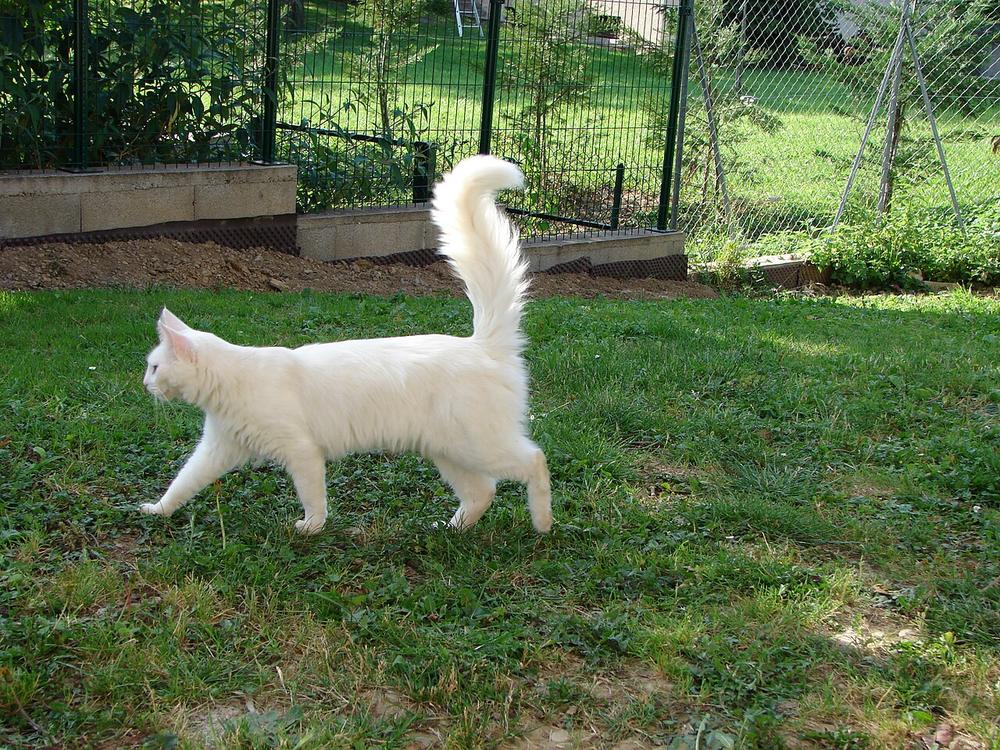
- A single, silky, fine coat with no undercoat, a longer ruff and undersides, and a full brush of a tail. CFA says it resists matting.American Cat Fanciers Association
- Energy
- HighThe Cat Fanciers' Association
- Indian heat
- Copes with carePDSA
- Flats
- Suits a flatThe Cat Fanciers' Association
Turkish Angora at a glance
| What | The rule | Source |
|---|---|---|
| Size | Small to medium, with a long body and legs to match; females usually smaller. CFA gives no weight range. | The Cat Fanciers' Association |
| Coat | A single, silky, fine coat with no undercoat, a longer ruff and undersides, and a full brush of a tail. | American Cat Fanciers Association |
| Grooming | Easy for a longhair: CFA suggests combing two or three times a month for young cats, more for older ones. | The Cat Fanciers' Association |
| Activity | Busy and curious; CFA says it is more likely to be found on top of the tallest cabinet. | The Cat Fanciers' Association |
| Alone-time tolerance | Moderate. CFA says Turks can be left alone during the workday; for trips, plan at least two visits a day. | Cats Protection |
| Hearing | White cats, especially blue-eyed ones, can be deaf. Coloured Turkish Angoras do not carry this concern. | The Cat Fanciers' Association |
| Heat tolerance | No breed-specific source. A long coat is a heat risk for any cat, so plan a cool room and extra water. | PDSA |
Where does the Turkish Angora come from?
The Turkish Angora is an old natural breed from Turkey, where CFA says it is a national treasure. VCA says it is thought to have begun with the Tartars near Ankara, and that Turkish sultans gave these cats as gifts to European nobility in the 16th century. CFA dates written history to the 1600s, when cats were brought to Europe from the Middle East; they were popular in France and are believed to have been among Marie Antoinette's pets.
In England the Angora was bred so closely with Persians that, CFA says, it virtually disappeared. The breed was saved in its homeland: CFA says the Turkish government set up preservation breeding at zoos in the 1930s, and VCA says the Ankara Zoo has run a breeding programme since 1917. Only white cats were once thought authentic, and the first Turkish Angoras reached the United States in 1954 as an all-white breed. Today they come in nearly every colour, though CFA does not register chocolate, lilac or pointed cats.
How did the Turkish Angora come to India?
No source we could find records when or how the Turkish Angora came to India, or how many live here; its arrival is not documented. The breed was not among those named in a 2024 news report of a Feline Club of India show in Kolhapur, and we found no Indian breed club or registration figure for it.
What is known is how its coat meets Indian weather. The coat is long but single, with no undercoat, and PDSA lists cats with long coats among those most at risk of heatstroke, so a Turkish Angora needs a cool room, shade and water through the summer and a plan for power cuts.
What care does a Turkish Angora need?
The three things that shape a good day for this breed.
Exercise
CFA calls the breed busy and curious and one of the most interactive of all, and VCA says these cats are athletic, enjoy learning tricks and like to perch up high. Give daily play, cat shelves or a tall tree, and screen windows and balconies. The Cat Fanciers' Association
Grooming
The single coat resists matting: CFA says combing two or three times a month is usually enough for a young cat, more for an older one, and VCA suggests once or twice a week, more often in summer to cut down hairballs. Many tolerate a bath well. VCA Animal Hospitals
Training
VCA calls the Turkish Angora exceptionally intelligent, and CFA says it is often described as doglike. Short play and reward sessions teach tricks and make handling easier. A deaf white cat learns hand signals instead of spoken cues. Cornell University College of Veterinary Medicine
How much should a Turkish Angora eat?
Daily calories for a healthy, neutered adult Turkish Angora, worked out from its weight with the formula vets use (70 x weight in kg to the power 0.75, then AAHA's factor for a neutered adult). Divide by the kcal per kg on your food's pack for grams a day, and adjust by body shape.
| Resting need (kcal a day) | Neutered adult (kcal a day) | |
|---|---|---|
| 2.3 kg AAHA (American Animal Hospital Association) | 130 | 160 to 180 |
| 3.4 kg | 180 | 210 to 250 |
| 4.5 kg | 220 | 260 to 300 |
Feed a commercial cat food carrying an AAFCO complete and balanced statement for the cat's life stage, with clean, fresh water out at all times, as Cornell's Feline Health Center advises. Cornell calls obesity the most common nutrition problem in cats, and PDSA notes that overweight cats cool down less easily, so keep this slender breed lean. Keep Indian kitchen food out of the bowl. ASPCA warns that onion, garlic and chives damage red blood cells, so no dal, curry or tadka, and lists chocolate, grapes and raisins and raw dough among foods to keep from pets. Cornell does not recommend milk as a treat, since many cats are lactose intolerant. Ask your vet before any home-cooked diet. Meals a day: kitten to 6 months, 3 a day; 6 months to 1 year, 2 a day; adult, from about 1 year, 1 or 2 a day; senior, 10 years and over, as for an adult, unless your vet advises otherwise. Puppies, kittens, working, pregnant and older animals need different amounts: ask your vet, or use Petym's food calculator.
Which illnesses is the Turkish Angora prone to, and how are they treated?
The conditions veterinary studies and breed surveys most often report in the Turkish Angora. Knowing the early signs means a vet sees it sooner.
See your vet first. This is general information from veterinary sources, not a diagnosis. Only a vet who has examined your pet can say what is wrong and prescribe treatment, and this page never gives a dose. Do not give your pet human medicine. If your pet seems very unwell, go to a 24-hour vet: find one in your city.
Congenital deafness in white cats
Ask at a routine checkCFA says white Turkish Angoras, especially blue-eyed ones, can be prone to deafness. Cornell says about 80 per cent of white cats with two blue eyes start to show signs of deafness at about four days old, from a genetic anomaly. The Cat Fanciers' Association
Signs to watch for
- No reaction to calls or household noise, often noticed in the first weeks of life
How a vet treats it
A vet examines the ears to rule out an infection or other cause that can be treated. Cornell says congenital deafness cannot be reversed, so care is about keeping a deaf cat safe.
Prevention
CFA says breeding white cats to coloured cats lowers the risk and some regions require a hearing (BAER) test for white kittens. Keep a deaf cat strictly indoors, approach from the front and use hand signals or vibrations.
Ear infection (otitis externa)
See a vet soonCornell calls an infection of the outer ear canal, usually from yeast, bacteria or ear mites, the most common acquired cause of deafness in cats. It matters more in a white cat whose hearing may already be poor. Cornell University College of Veterinary Medicine
Signs to watch for
- Persistent scratching at the ears
- Swelling or discharge
- Dirt and debris collecting in the ear
How a vet treats it
Do not probe the ears. Cornell says most cases can be treated with medicine prescribed by a vet, and that surgery is sometimes the only option if the infection has spread.
Heatstroke
Emergency: go to a vet nowThe body overheats faster than it can cool. PDSA lists cats with long coats and obese cats among those most at risk, which applies in an Indian summer or a power cut. PDSA
Signs to watch for
- Panting and fast breathing
- Red or pale gums, vomiting or diarrhoea
- Wobbliness, collapse or seizures
How a vet treats it
Move the cat somewhere cool, pour cold water slowly over the body away from the nose and mouth, use a fan and call the vet at once. PDSA says the vet cools the cat with water, fans, ice packs and possibly a fluid drip, may give oxygen or medication in severe cases, and runs blood and urine tests for kidney and clotting damage.
Prevention
Shade and water at all times, never a closed car, no travel in hot weather and a healthy body weight.
Hairballs and blockage
See a vet soonCornell says long-haired cats may be at greater risk of hairballs than short-haired breeds, and a hairball can occasionally block the gut. Cornell University College of Veterinary Medicine
Signs to watch for
- Repeated unproductive retching
- Vomiting
- Lethargy or refusing food for more than a day or two
How a vet treats it
A vet examines the cat and may use bloodwork, X-rays and perhaps ultrasound. Cornell says a confirmed blockage may need surgery, while milder cases are managed over several days, often with a laxative; never give one without the vet's approval.
Prevention
Cornell recommends brushing and combing every day, and checking with a vet before using any diet sold as a hairball remedy.
Lower urinary tract disease and blocked bladder
Emergency: go to a vet nowNot specific to the breed, but common in indoor cats. Cornell says males and neutered males are at greater risk of a urethral blockage. Cornell University College of Veterinary Medicine
Signs to watch for
- Straining or pain when passing urine
- Going to the tray more often
- Crying out while urinating
- Blood in the urine
How a vet treats it
A vet examines the cat and tests the urine. Cornell says a blocked urethra is an absolute emergency, usually treated by passing a urinary catheter, with intravenous fluid therapy for dehydration and electrolyte imbalance.
Prevention
Clean, fresh water at all times, a healthy weight and one more litter tray than the number of cats.
What is a Turkish Angora like to look after?
Lively, involved and easier to groom than it looks. If your cat was sold as an Angora without registration papers, the breed facts below may not all apply.
CFA describes Turkish Angoras as intelligent, affectionate and very interactive, often compared to dogs, generally good with young children and guests, and with a personality it sums up as busy and curious. It adds that intelligence varies widely from cat to cat. For a sitter, that usually means a cat that comes to see what you are doing, follows you to the kitchen and wants to be part of every visit.
CFA also says Turks can be left alone during the workday, which makes the breed easier than some people-focused cats when an owner travels. That is not the same as being left for days. Cats Protection advises a sitter who visits at least twice a day for any cat left at home, with more visits for kittens, older cats and cats on medicine.
The breed is not one of the very large or very flat-faced cats, and CFA says Turks are not known for specific health problems apart from deafness in white cats. That does not mean nothing can go wrong. Any cat can develop a blocked bladder, stop eating or overheat, and the sitter needs to know those signs as well as the breed points.
What the breed standard says about the coat
Word for word
The single coat is not prone to matting, making this breed one of the easiest longhair cats to care for.
In practice that means a comb every week or so is plenty on most trips, and a sitter should not need to deal with mats. CFA adds that combing two or three times a month controls shedding in younger cats, while older cats may need more, and that Turks usually tolerate a bath well because many like water. Even so, do not ask a sitter to bathe the cat during the monsoon, when a long coat dries slowly.
How does a Turkish Angora cope with Indian heat and monsoon?
Better than a Persian, but a long coat is still a long coat in May.
No breed body makes a heat claim for the Turkish Angora. Two things are in its favour: CFA describes a single coat with no undercoat, and a long, fine-boned body rather than a heavy, cobby one. Against it, the coat is still long, and PDSA lists long-haired cats among those most at risk of heatstroke. A cat's normal temperature, PDSA says, is about 38.1 to 39.2 °C.
Before a summer trip, pick the room that stays coolest in the afternoon, draw the curtains on sunny windows and leave water in at least two or three places. A Turk's favourite resting spot may be the top of a wardrobe, where hot air collects under the ceiling; give it a lower shelf or cat tree in the cool room so it has a high perch that is not also the hottest place in the flat. Leave the sitter a power-cut plan if the room depends on an AC.
In the monsoon a fine, silky coat clumps when damp and holds dirt around the rear end. Ask the sitter to check under the tail at every visit and to keep the cat indoors on rainy days. The Animal Welfare Board of India's heat advisory lists heavy panting, drooling, lethargy and collapse as signs that need a vet: a sitter who sees them should start cooling the cat and call at once.
Is my white Turkish Angora deaf?
It may be. CFA links the risk to white coats and blue eyes, so it applies to white Turks, not to coloured ones.
CFA says white Turkish Angoras can be prone to deafness, especially blue-eyed cats, and that coloured Turks do not carry this concern. Cornell's Feline Health Center gives the figures for white cats in general: about 17 to 22 per cent of white cats with non-blue eyes are born deaf, about 40 per cent of those with one blue eye, and about 65 to 85 per cent of white cats with two blue eyes. Some are deaf in only one ear, and Cornell notes that a cat with one deaf ear can seem perfectly normal.
Cornell also says congenital deafness cannot be corrected, and that deaf cats make good pets if kept strictly indoors and away from situations where safety depends on hearing. Its practical advice suits a sitter well: do not surprise the cat, let it see you before you touch it, especially from behind, and use vibration, such as a firm step on the floor, or visual cues like flicking a light to get its attention.
If you do not know whether your white cat can hear, ask your vet. Some breeders have kittens hearing-tested; CFA notes that some regions require a BAER hearing test for white kittens. Either way, write the answer on the care sheet so a new sitter does not mistake a deaf cat's lack of response for illness, or call its name at an open door.
Caring for a deaf or white Turkish Angora: sitter checklist
- Whether the cat hears in both ears, one ear or neither, written at the top of the care sheet. Cornell University College of Veterinary Medicine
- A rule that the cat never goes outside, and the doors are opened only when the sitter can see the cat. Cornell University College of Veterinary Medicine
- Approach from the front, let the cat see you, and use a stamp on the floor or a light switch to say you have arrived. Cornell University College of Veterinary Medicine
- Snug screens on every window the cat can reach; childproof grilles do not stop a cat from falling. ASPCA
- A comb, and a note of where the coat tangles first on your cat. The Cat Fanciers' Association
- Your vet's number and the nearest 24-hour vet. Cats Protection
- The coolest room, a high perch inside it, and what to do in a power cut.
- Any hand signals or light cues your cat already knows.
Which health signs should a Turkish Angora's sitter act on?
CFA says the breed is not known for specific health problems beyond deafness in white cats. These are the general cat emergencies a sitter must not miss.
If Panting, drooling, bright red or pale gums, wobbling or collapse on a hot day.
Heatstroke: move the cat to a cool room, wet the coat with cool (not icy) water away from the face, use a fan and call the vet at once. PDSA
If Straining in the litter tray with little or no urine, frequent trips, crying.
A blocked bladder, more common in males, can kill within a day or two. Go to the vet now. Cornell University College of Veterinary Medicine
If Limping, a swollen leg or a cat that will not jump after a fall from a shelf, window or balcony.
Go to the vet even if the cat seems fine; the ASPCA says cats that fall need prompt veterinary care. ASPCA
If Scratching at the ears, head shaking, discharge or a smell from the ears, or a hearing cat that stops responding.
Do not probe the ears. Cornell advises a prompt vet visit for signs of ear infection, which can damage hearing. Cornell University College of Veterinary Medicine
If Eating little or nothing for a day, or over two visits.
Call the vet. Cats that stop eating risk hepatic lipidosis within days. University of Illinois College of Veterinary Medicine
If Repeated retching with no hairball, vomiting and no appetite.
Call the vet; an occasional hairball is normal, repeated unproductive retching is not. Cornell University College of Veterinary Medicine
A busy climber in a flat
CFA describes the Turkish Angora as a cat that likes to perch high and enjoys chasing laser lights. In a flat that means a tall cat tree, a cleared shelf or two, and toys that move. The AAFP and ISFM environmental needs guidelines list chances for play and predatory behaviour among every cat's basic needs, alongside a safe place, separate key resources and kind, predictable human contact.
Ask your sitter for at least ten minutes of play at every visit. If a laser pointer is used, end each session on a real toy the cat can catch so the game finishes with a win. A wand toy works for most Turks, and a puzzle feeder with part of the day's food keeps a bright cat busy between visits.
Climbers fall. The ASPCA says most cats in high-rise falls fall accidentally from windows and terraces, often while watching a bird, and that childproof window guards do not keep cats in. Net the balcony fully or keep its door shut, and make sure the sitter knows which windows are safe to open. For a deaf white cat, an escape onto a society's common corridor or road is especially dangerous, because it cannot hear traffic or dogs.
Turkish Angora care through the Indian year
| What changes | What the sitter does | |
|---|---|---|
| Summer (March to June) PDSA | A long coat in heat; hot air at ceiling height where Turks like to perch | Cool room, curtains drawn, water in several places, a low perch, power-cut plan |
| Monsoon (June to September) The Cat Fanciers' Association | A silky coat clumps when damp; soiling under the tail | Indoors on rainy days, check the rear end, no baths |
| Diwali and wedding season Cornell University College of Veterinary Medicine | Noise and visitors; doors opened more often | Windows and doors shut, hiding places open, extra care with a deaf cat at the door |
| Moulting periods Cornell University College of Veterinary Medicine | More loose hair and more hairballs | Comb at every visit, log any vomiting |
Feeding a Turkish Angora while you are away
Keep the food, amount and times exactly as they are, and write them on the care sheet. PDSA warns that a sudden change of food is a common cause of diarrhoea, which in a long, fine coat means a messy rear end in humid weather. Leave enough for the trip and a few days more.
Put water away from the food and the litter tray, and in more than one room in summer. Keep lilies out of the house: International Cat Care says even pollen licked off the coat can poison a cat, and a long-coated cat picks up pollen easily. Ask the sitter not to give new treats or human food, however hard a curious cat begs.
Which Petym service suits a Turkish Angora?
Most adult Turks
Drop-in visits
A sitter visits one to three times a day for food, water, litter, play and a quick comb, with a daily photo update. Suits healthy adults on trips of a few days to two weeks.
Summer trips and deaf cats
Overnight pet sitting
A sitter stays in your home, so someone is there in a heatwave or power cut, and a deaf cat is never left with a door that might be opened by someone else.
Cats on medicine
Special-needs care
For a Turk with a diagnosed condition, with medicines given and logged exactly as your plan says.
Breeds with similar care needs to the Turkish Angora
Going away soon? Tell us your dates.
A checked local sitter feeds, walks and keeps your pet company at home, follows your care sheet to the letter and sends a photo every day. Petym is opening city by city: send your dates and we will tell you when a sitter can take them.
- Meet your sitter first, free
- PAN-checked, first-aid trained
- A photo every day
- Pay through Petym, never cash

Questions owners ask
Can a Turkish Angora be left alone while I travel?
- Yes, with a sitter visiting at least twice a day, as Cats Protection suggests for any cat. CFA says Turks can be left alone during the workday, but they are busy, interactive cats, so each visit should include play as well as food, water and the litter tray.
Are white Turkish Angoras deaf?
- Many are. CFA says white Turks, especially blue-eyed ones, can be prone to deafness. Cornell reports that about 65 to 85 per cent of white cats with two blue eyes are deaf, and about 40 per cent with one blue eye. Coloured Turkish Angoras do not carry this concern.
How should a sitter care for a deaf cat?
- Cornell advises keeping a deaf cat strictly indoors, never surprising it, approaching where it can see you, and using vibration such as a firm step on the floor, or light cues, to get its attention. Doors should only be opened when the sitter knows where the cat is.
Does a Turkish Angora need a lot of grooming?
- Not much for a longhair. CFA says the single coat is not prone to matting and suggests combing two or three times a month for younger cats, more for older ones. In the monsoon, check under the tail at every visit, as a damp, silky coat clumps and soils easily.
Can a Turkish Angora live in India's heat?
- Indoors with a cool room, shade and water, yes. No source names the breed as a heat risk, and its single coat has no undercoat, but PDSA lists long-haired cats among those most at risk of heatstroke. Plan for heatwaves and power cuts before a summer trip.
How do I know if a cat sold as a Turkish Angora is the real breed?
- Ask the breeder for registration papers from a recognised cat registry and for the parents' details. Without papers you cannot be sure of the breeding, and breed facts such as CFA's notes on the coat and temperament only apply to registered Turkish Angoras.
Do Turkish Angoras have health problems?
- CFA says the breed is not known for specific health problems apart from deafness in white cats. Like any cat, a Turk can still develop urinary blockage, stop eating or overheat, so a sitter should know those emergency signs and call your vet early.
Keep reading
- Cats: caring for a cat while you are away
- Siamese cat careAnother lean, talkative and busy breed.
- Persian cat careThe long-coated cat with the highest heat risk.
- How long can a cat be left alone?
- Cat-proofing a balcony
- Monsoon pet care
- Drop-in visits for cats
Services that help
Free tools for this
Words on this page, explained
Keep exploring
Sources
Each source was opened and read on the date shown. How Petym checks its sources
- VCA Animal Hospitals: Turkish Angora (cat breed profile) (opens in a new tab)
- American Cat Fanciers Association: Turkish Angora (breed description and breeders' directory) (opens in a new tab)
- The Cat Fanciers' Association: Turkish Angora (opens in a new tab)
- PDSA: Heatstroke in cats (opens in a new tab)
- Cornell University College of Veterinary Medicine: Deafness (Cornell Feline Health Center) (opens in a new tab)
- Cornell Feline Health Center: Feeding your cat (updated 30 April 2026) (opens in a new tab)
Show all 21 sourcesShow fewer
- Cornell Feline Health Center: How often should you feed your cat? (opens in a new tab)
- ASPCA Animal Poison Control: People foods to avoid feeding your pets (opens in a new tab)
- AAHA (American Animal Hospital Association): 2021 AAHA Nutrition and Weight Management Guidelines for Dogs and Cats: energy requirement calculations (Box 1, PDF) (opens in a new tab)
- Merck Veterinary Manual: Nutritional requirements of small animals (full review November 2023, updated September 2024) (opens in a new tab)
- Cornell University College of Veterinary Medicine: The danger of hairballs (Cornell Feline Health Center) (opens in a new tab)
- Cornell University College of Veterinary Medicine: Feline lower urinary tract disease (Cornell Feline Health Center) (opens in a new tab)
- Cornell University College of Veterinary Medicine: Ask Elizabeth: White cats and blindness/deafness (Cornell Feline Health Center) (opens in a new tab)
- Animal Welfare Board of India: Request to ensure care and protection of animals from direct heat during extreme hot weather (4 May 2026) (opens in a new tab)
- Cats Protection: Going on holiday without your cat (opens in a new tab)
- ASPCA: High-rise syndrome: lifesaving tips for cat parents (6 July 2023) (opens in a new tab)
- University of Illinois College of Veterinary Medicine: Hepatic lipidosis: a serious problem when cats stop eating (opens in a new tab)
- PDSA: Diarrhoea after a change of food (opens in a new tab)
- International Cat Care: Cats and poisons (opens in a new tab)
- AAFP and ISFM (Journal of Feline Medicine and Surgery, 2013): Feline environmental needs guidelines (opens in a new tab)
- ETV Bharat: Cat show in Kolhapur draws visitors (news report, 2 December 2024) (opens in a new tab)