Freshwater angelfish care in India: pairs, eggs and time away
Updated By PetymFacts checked against official sources on
Quick answer
The freshwater angelfish is a South American cichlid species, not a reef angelfish. It grows to about 15 cm and comes from warm Amazon and Orinoco waters, so it suits Indian warmth. While you travel, a sitter should visit daily, feed one measured meal, check the heater and filter, and leave any eggs and the pair alone.
Report a fish that hangs back, stops eating or passes white, stringy droppings.
- Origin
- Tropical South America: the Guianas, Venezuela and the Amazon basin south to Mato Grosso, BrazilUS Geological Survey, Nonindigenous Aquatic Species
- Adult length
- 15 cm (USGS gives up to about 15 cm)US Geological Survey, Nonindigenous Aquatic Species
- Coat
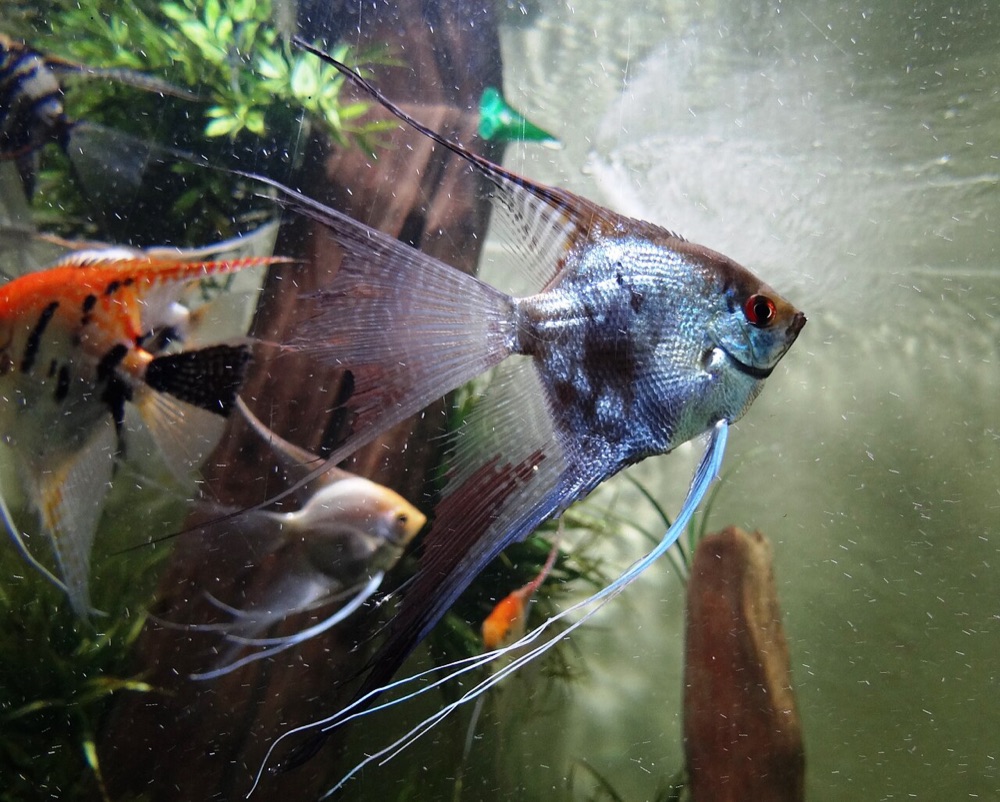
- Fins and colour: a flat, disc-shaped body with long, trailing dorsal and anal fins. Kept in silver with dark bars and in bred colour forms such as marble, black and koi.
- Energy
- Moderate
- Indian heat
- Copes wellRevista de Biologia Tropical (2009)study
- Flats
- Suits a flat
Freshwater angelfish at a glance
| What | The rule | Source |
|---|---|---|
| What it is | Pterophyllum scalare, a South American cichlid from the Guianas, Venezuela and the Amazon basin. | US Geological Survey, Nonindigenous Aquatic Species |
| Size | Up to about 15 cm. | US Geological Survey, Nonindigenous Aquatic Species |
| Warmth | In the wild it breeds around January in water of 28 to 30 °C. | Revista de Biologia Tropical (2009)study |
| Breeding | Adults pair up and lay eggs on a firm surface; a lab study gave each pair a plate to spawn on. | Revista de Biologia Tropical (2009)study |
| Food | In a study of young angelfish, live food gave better growth than dry food alone. | Revista de Biologia Tropical (2009)study |
| In India | Kept and traded here; Indian scientists have sequenced a virus taken from angelfish. | Aquaculture (2024)study |
Where does the Freshwater angelfish come from?
The freshwater angelfish, Pterophyllum scalare, is a wild cichlid species. The US Geological Survey gives its native range as tropical America, including Guyana, French Guiana, Venezuela and the Amazon basin of Colombia and Peru, south to Mato Grosso in Brazil. A 2009 study in Revista de Biologia Tropical says angelfish come from the Guianas and the Orinoco and Amazon basins and breed in the wild around January, at 28 to 30 °C.
The same study calls angelfish very popular with aquarists around the world, yet notes that little scientific information existed on their culture and husbandry. In its trials, young angelfish fed live foods grew better than those fed only commercial dry food. The many colour forms sold today are bred forms of the same species.
How did the Freshwater angelfish come to India?
No source we found records when angelfish first reached India. They are part of the Indian trade: a national study of ornamental fish in aquarium markets in Delhi, Mumbai, Kolkata, Kochi and Chennai from 2019 to 2022 sampled freshwater angelfish among 27 species, and noted that imported ornamental fish must be quarantined for 15 days.
In 2024, Indian researchers published the first whole genome of infectious spleen and kidney necrosis virus taken from angelfish in India, a megalocytivirus very close to an angelfish iridovirus reported from Australia. Their abstract does not describe signs or deaths, but it shows the virus is present in angelfish here, which is one more reason to quarantine new fish.
What care does a Freshwater angelfish need?
The three things that shape a good day for this breed.
Exercise
Tank and swimming space: a fish that reaches about 15 cm needs a large tank with open water and some plants, sized for the adult. Do not crowd a pair. US Geological Survey, Nonindigenous Aquatic Species
Grooming
Water care: a heater and thermostat for steady warm water, a good filter, and weekly 10 to 25% water changes with treated water at the same temperature. RSPCA Australia Knowledgebase
Training
Handling and feeding routine: approach the tank calmly, feed at set times, and net fish only when you must, since Merck notes handling and crowding can trigger gut parasite outbreaks in cichlids. Merck Veterinary Manual
What should a Freshwater angelfish eat?
Angelfish do well on a varied diet. In the 2009 study, young angelfish fed live foods such as brine shrimp cysts or rotifers and water fleas grew better than those fed only dry food. The Merck Veterinary Manual adds that live foods can lack some nutrients and can carry parasites, so a good commercial pellet or flake as the base, with clean frozen or live extras from a reliable shop, is the balance.
The RSPCA advises two or three small meals a day, only what is eaten in two to five minutes.
Meals a day: young angelfish, 2 to 3 small meals a day; adult, 2 small meals a day.
Which illnesses is the Freshwater angelfish prone to, and how are they treated?
The conditions veterinary studies and breed surveys most often report in the Freshwater angelfish. Knowing the early signs means a vet sees it sooner.
See your vet first. This is general information from veterinary sources, not a diagnosis. Only a vet who has examined your pet can say what is wrong and prescribe treatment, and this page never gives a dose. Do not give your pet human medicine. If your pet seems very unwell, go to a 24-hour vet: find one in your city.
Intestinal parasites (Spironucleus and Hexamita)
See a vet soonProtozoan parasites that Merck says attack the intestines of cichlids and other aquarium fish. Crowding, shipping and handling can set off an outbreak. Merck Veterinary Manual
Signs to watch for
- White, stringy droppings
- Weight loss
- Lethargy and hiding
How a vet treats it
An aquatic or exotics vet identifies the parasite from droppings or tissue and chooses a treatment for the tank.
Prevention
Avoid crowding and rough handling, and quarantine new fish.
Pleistophora (neon tetra disease)
See a vet soonA microsporidian parasite that Merck says attacks the skeletal muscle of neon tetras, angelfish and other freshwater aquarium fish. Merck Veterinary Manual
Signs to watch for
- Abnormal swimming movements, because the parasite damages muscle
How a vet treats it
Merck says there is no treatment and infected fish should be removed from the tank to stop it spreading. A vet can confirm it by examining tissue.
Prevention
Buy fish from clean shop tanks with no dead fish, and quarantine new arrivals.
White spot (ich)
Emergency: go to a vet nowA parasite of skin and gills whose life cycle runs faster in warm water, so outbreaks move quickly in a tropical tank, UF/IFAS explains. University of Florida IFAS Extension
Signs to watch for
- White spots on skin and fins
- Clamped fins and flashing
- Fast breathing
How a vet treats it
A vet confirms it under the microscope and plans repeated treatments spaced by water temperature, as UF/IFAS describes.
Prevention
Quarantine new fish for at least 30 days.
How warm should an angelfish tank be in India?
Warm and steady. Angelfish come from tropical rivers, and Indian rooms suit them for much of the year.
A study of angelfish breeding in Mexico notes that wild angelfish breed around January in water of 28 to 30 °C, and its lab fish lived in water between about 24 and 30 °C. That makes angelfish a better fit for a Chennai or Kolkata flat than a cool-water goldfish. The risks in India are the extremes: a heater left on in a sunny room in May, or a tank that cools on a north Indian winter night when the power fails.
Write the normal temperature on the care sheet and ask the sitter to photograph the thermometer at each visit. Warm water holds less oxygen, the Merck Veterinary Manual says, so keep the air stone running in hot weeks and leave a battery pump next to the tank for power cuts.
What if your angelfish lay eggs while you are away?
It happens. A settled pair may lay eggs on a firm, flat surface in the tank.
Do
- Tell the sitter which two fish are a pair and where they usually spawn. Revista de Biologia Tropical (2009)study
- Ask the sitter to send a photo of the eggs and keep visits calm and short near that corner.
- Leave clear instructions: in most homes, the simplest plan is to leave eggs and parents alone until you are back.
- Keep feeding the measured portion; the pair still needs its normal meal. RSPCA (England and Wales)
Don’t
- Don't let the sitter move eggs, parents or decor. That is a job for you, not for a visit.
- Don't add new fish or rearrange the tank before a trip; new fish can bring disease that quarantine would catch. University of Florida IFAS Extension
- Don't let anyone feed extra live food bought on the way. Merck warns live food can carry parasites. Merck Veterinary Manual
Which angelfish problems should a sitter report?
If A fish losing weight, hanging back and passing white, stringy droppings.
Merck links these signs to intestinal parasites that attack cichlids. Report it and send a photo; do not add medicines. Merck Veterinary Manual
If One fish wasting away or swimming oddly while the rest look well.
Report it. Merck describes a muscle parasite, Pleistophora, in angelfish and neon tetras that has no treatment; a fish vet confirms it and the owner decides on removing the fish. Merck Veterinary Manual
If White spots on fins and body.
Possible white spot (ich), which UF/IFAS calls a true emergency. Call the owner now. University of Florida IFAS Extension
If Gasping at the surface on a hot day or in a power cut.
Start the battery pump, stop feeding, and check the thermometer. Riverside Public Utilities, City of Riverside (California)
What does a sitter do on an angelfish visit?
Arrive slowly
Approach the tank calmly and count the fish, including a pair sitting near their eggs.
Thermometer
Read it and photograph it; compare with the owner's range.
Equipment
Filter outflow, heater light and air stone as the owner showed them; lid on. RSPCA (England and Wales)
Feed
The owner's measured portion, with sinking food for any bottom feeders; remove leftovers. Merck Veterinary Manual
Before leaving
Battery pump ready, visit logged, photo of the tank and any eggs sent.
Which Petym service suits angelfish?
If An established tank, with or without a breeding pair
A daily drop-in visit, calm and short, to feed and check the equipment. Drop-in visits
If Long power cuts or a cold north Indian winter
Overnight pet sitting, so someone can run the battery pump and watch the temperature. Overnight sitting
If A fish on a vet's treatment plan
Special-needs care, with each step logged as the vet wrote it. Special-needs care
Breeds with similar care needs to the Freshwater angelfish
Going away soon? Plan your pet’s care first.
Petym's bookings open for dogs and cats first. For every other pet, the free going-away checklist covers food, water, heat and what to leave written down before you travel.


Questions owners ask
Is a freshwater angelfish the same as a marine angelfish?
- No. The freshwater angelfish, Pterophyllum scalare, is a South American cichlid from rivers in the Guianas, Venezuela and the Amazon basin. Marine angelfish are unrelated reef fish that need a saltwater tank.
How big do angelfish get?
- The US Geological Survey gives up to about 15 cm. Plan the tank for an adult fish rather than the small one you bring home.
What temperature do angelfish need?
- Warm water. Wild angelfish breed around January at 28 to 30 °C, and a lab study kept them at about 24 to 30 °C. Keep the temperature steady with a heater and thermostat, and stop the tank overheating in summer.
My angelfish laid eggs. What should my sitter do?
- Usually nothing beyond photographing them and keeping visits calm. Angelfish pair up and lay eggs on a firm surface. Moving eggs or parents is best left to you when you return, so write that on the care sheet.
What is the white stringy poop in my angelfish tank?
- White, stringy droppings with weight loss and lethargy are signs Merck links to intestinal parasites that attack cichlids such as angelfish. Ask a vet who sees fish; do not add medicines without advice.
Can angelfish live with neon tetras?
- Some keepers mix them, but both species can carry the same muscle parasite, Pleistophora, which Merck says has no treatment. Quarantine new fish and buy from a clean shop with no dead fish in its tanks.
Keep reading
- Fish sitting while you're awayFeeding, power cuts and heat for any tank.
- Aquarium fish care in India
- Oscar fish care in IndiaA much larger South American cichlid.
- Neon tetra care in India
- What to leave for your pet sitter
- Winter pet care in north India
- Drop-in visits or overnight sitting
Services that help
Free tools for this
Words on this page, explained
Keep exploring
Sources
Each source was opened and read on the date shown. How Petym checks its sources
- US Geological Survey, Nonindigenous Aquatic Species: Freshwater angelfish (Pterophyllum scalare): species profile (revised 29 June 2023) (opens in a new tab)
- RSPCA Australia Knowledgebase: Why is water quality important when setting up a fish aquarium? (opens in a new tab)
- Merck Veterinary Manual: Disorders and diseases of fish (pet owner version, last updated April 2026) (opens in a new tab)
- Merck Veterinary Manual: Providing a home for fish (pet owner version, last updated April 2026) (opens in a new tab)
- RSPCA (England and Wales): Fish diet (opens in a new tab)
- Merck Veterinary Manual: Selection of fish (pet owner version, last updated September 2024) (opens in a new tab)
Show all 12 sourcesShow fewer
- University of Florida IFAS Extension: Ichthyophthirius multifiliis (white spot) infections in fish (CIR920/FA006) (opens in a new tab)
- RSPCA (England and Wales): Fish environment: tanks, filters, temperature and water (opens in a new tab)
- Riverside Public Utilities, City of Riverside (California): Tips for pets during outages: tips for aquariums (opens in a new tab)
- Revista de Biologia Tropical (2009): Fecundity, growth, and survival of the angelfish Pterophyllum scalare under laboratory conditions (Ortega-Salas and others) (opens in a new tab)
- Parasite (2025): Monogeneans on exotic Indian freshwater fish. 7. Results of a national study on ornamental fishes from 2019 to 2022 (Tripathi and others) (opens in a new tab)
- Aquaculture (2024): Whole genome sequence of infectious spleen and kidney necrosis virus isolated from angelfish in India (abstract read) (opens in a new tab)