Guppy care in India: a hardy livebearer and time away
Updated By PetymFacts checked against official sources on
Quick answer
The guppy is a small South American species that copes well with Indian warmth: India's vector control guidelines give 24 to 34 °C as its breeding range. Guppies give birth every few weeks, so numbers rise fast. While you travel, a sitter should visit daily, feed one light meal, count the adults and check for worms at the vent.
Never release spare guppies into a drain or lake, however hardy they seem.
- Origin
- Southern Lesser Antilles and northern South America, from western Venezuela to GuyanaUS Geological Survey, Nonindigenous Aquatic Species
- Adult length
- 2.5 to 6 cm (USGS: males to 2.5 cm and females to 6 cm standard length; India's NCVBDC gives males 3 cm)US Geological Survey, Nonindigenous Aquatic Species
- Lifespan
- 4 to 5 yearsNational Center for Vector Borne Diseases Control, Ministry of Health and Family Welfare
- Coat
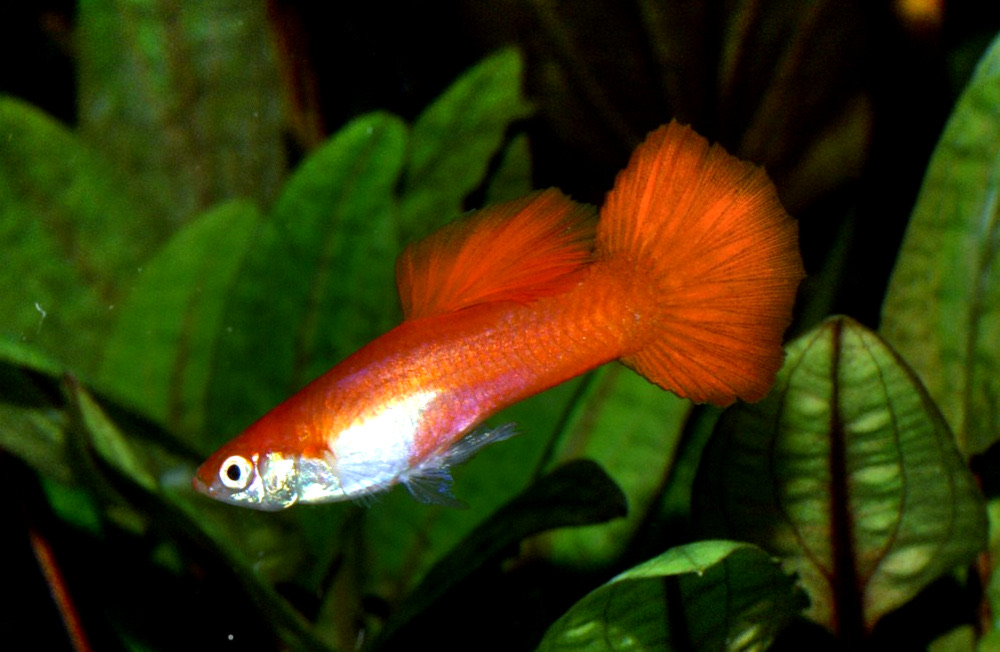
- Fins and colour: males are small and brightly coloured, with large fan, cobra or snakeskin tails in ornamental strains; females are larger, plainer and short-finned.
Guppy at a glance
| What | The rule | Source |
|---|---|---|
| What it is | Poecilia reticulata, a species from the southern Lesser Antilles and northern South America, from western Venezuela to Guyana. | US Geological Survey, Nonindigenous Aquatic Species |
| Size | Males about 2.5 to 3 cm, females up to 6 cm. | National Center for Vector Borne Diseases Control, Ministry of Health and Family Welfare |
| In India since | 1910, as an exotic fish later used against mosquito larvae. | National Center for Vector Borne Diseases Control, Ministry of Health and Family Welfare |
| Temperature | Breeds at 24 to 34 °C; does not survive water that falls below about 10 °C. | National Center for Vector Borne Diseases Control, Ministry of Health and Family Welfare |
| Breeding | Matures in about 90 days; a female can release young every four weeks, and adults eat their own fry. | National Center for Vector Borne Diseases Control, Ministry of Health and Family Welfare |
| Company | A peaceful community fish; give fry dense plants to hide in. | National Center for Vector Borne Diseases Control, Ministry of Health and Family Welfare |
Where does the Guppy come from?
The guppy, Poecilia reticulata, is a wild species, not a breed. The US Geological Survey gives its native range as the southern Lesser Antilles and northern South America from western Venezuela to Guyana, and says it has been introduced widely elsewhere, partly on purpose for mosquito control and partly through fish farm and aquarium releases.
Guppies give birth to live young rather than laying eggs, mature in about three months and breed every four weeks or so, which made them easy to breed into the many coloured, long-tailed strains sold today. Fancy guppies are selected forms of the same species.
How did the Guppy come to India?
India's National Center for Vector Borne Diseases Control says the guppy is an exotic fish introduced to India in 1910, that it is now widely distributed, and that it is an important fish for eating mosquito larvae, used alongside Gambusia. Its guidelines describe the guppy as very hardy, tolerant of organic pollution and able to breed from 24 to 34 °C.
Guppies now breed wild in places: a 2008 study found an established breeding population in the Chalakudy River in Kerala's Western Ghats. In the pet trade, a 2026 study found Camallanus worms in 11 of 16 guppies from Chennai's Kolathur ornamental fish market, and a national market study found guppies carrying the skin fluke Gyrodactylus bullatarudis.
What care does a Guppy need?
The three things that shape a good day for this breed.
Exercise
Tank and swimming space: a filtered tank with open swimming water and dense plants where fry can hide, since adults eat their own young. Numbers grow fast, so plan the tank for more fish than you buy. National Center for Vector Borne Diseases Control, Ministry of Health and Family Welfare
Grooming
Water care: guppies tolerate a wide range, pH 6.5 to 9.0 in India's guidelines, but a home tank still needs cycling, a filter and weekly partial water changes of 10 to 25%. RSPCA Australia Knowledgebase
Training
Handling and feeding routine: feed small amounts at set times and net fish only when you must. Quarantine new guppies before they join the tank. Parasitology Research (2026)study
What should a Guppy eat?
Guppies are surface feeders and, India's guidelines note, highly carnivorous: in the wild they eat mosquito larvae. In a tank, feed a good flake or small pellet food with occasional small live or frozen foods from a reliable shop; the Merck Veterinary Manual warns that live food can bring in parasites. The RSPCA advises feeding two or three times a day, only what is eaten in two to five minutes.
Fry need tiny, frequent meals of crushed or fry food. Never add food to make up for a missed visit.
Meals a day: fry, several tiny meals a day; adult, 2 to 3 small meals a day.
Which illnesses is the Guppy prone to, and how are they treated?
The conditions veterinary studies and breed surveys most often report in the Guppy. Knowing the early signs means a vet sees it sooner.
See your vet first. This is general information from veterinary sources, not a diagnosis. Only a vet who has examined your pet can say what is wrong and prescribe treatment, and this page never gives a dose. Do not give your pet human medicine. If your pet seems very unwell, go to a 24-hour vet: find one in your city.
Camallanus worms
See a vet soonAn intestinal roundworm, Camallanus cotti, first recorded in India in traded guppies from Chennai in 2026, where 11 of 16 fish sampled were infected. Parasitology Research (2026)study
Signs to watch for
- Red threads protruding from the vent
- A swollen belly
- Thin fish despite eating
How a vet treats it
An aquatic or exotics vet confirms the worm and treats the whole tank, since other fish are likely exposed.
Prevention
The study's authors recommend quarantine and monitoring of new fish.
Velvet (Piscinoodinium)
See a vet soonA parasite of skin and gills that caused mass deaths of larval, young and adult guppies and bettas in an Andaman Islands outbreak reported in 2024. Diseases of Aquatic Organisms (2024)study
Signs to watch for
- Fine yellowish spots or a velvety film
- Scratching, poor appetite and lethargy
- Fast breathing from damaged gills
How a vet treats it
A vet confirms it under the microscope. Merck says a vet may recommend a treatment for ornamental fish and recheck after 7 to 10 days.
White spot (ich)
Emergency: go to a vet nowA single-celled parasite of skin and gills that UF/IFAS calls a true emergency; carriers can show no signs until shipping stress. University of Florida IFAS Extension
Signs to watch for
- White spots on body and fins
- Flashing
- Weakness and poor appetite
How a vet treats it
A vet confirms it with a skin, fin or gill sample under the microscope. UF/IFAS names repeated treatments such as formalin or raised salt, timed to the water temperature.
Prevention
Quarantine new fish for at least 30 days.
Mycobacteriosis
See a vet soonA slow bacterial disease of aquarium fish. Merck says it can infect people through the skin, and that people with weak immune systems should avoid contact with an affected tank. Merck Veterinary Manual
Signs to watch for
- Weight loss
- Skin ulcers and bleeding
- Paleness
- A bent spine
How a vet treats it
A vet confirms it in the lab. Merck says the bacteria generally resist antibiotics in fish and infected fish are usually put down humanely.
Prevention
Merck advises that people with immune system disorders should not have contact with a tank known to carry Mycobacterium.
How do guppies cope with Indian heat and power cuts?
Better than most aquarium fish, which is why guppies are easy to underestimate.
India's National Center for Vector Borne Diseases Control calls the guppy a very hardy fish that survives in all types of water and tolerates organic pollution, with a breeding range of 24 to 34 °C. That hardiness is real, but a pet tank is a small closed box. Heat still lowers oxygen, and a crowded guppy tank full of fry uses oxygen fast.
So the summer plan is the same as for any tank, only with more fish to count: shade, an air stone and a battery pump for power cuts. In a cut, the sitter stops feeding until the power returns, because food raises waste and oxygen use. Guppies are less of a winter worry in most Indian cities, but in an unheated north Indian flat the guidelines' lower limit of about 10 °C is worth knowing.
What changes when guppies breed while you are away?
Fry appear without warning. A sitter needs to know what you want done.
Do
- Tell the sitter fry may appear, and whether you have a separate rearing tank or a breeding box. National Center for Vector Borne Diseases Control, Ministry of Health and Family Welfare
- Keep dense plants in the tank: adults eat their own young, and plants give fry somewhere to hide. National Center for Vector Borne Diseases Control, Ministry of Health and Family Welfare
- Ask the sitter to count adults only and write down roughly how many fry they see.
- Leave a photo of each adult so a missing or sick fish is noticed.
Don’t
- Don't let anyone feed extra because there are babies. Extra food fouls the water; underfeeding is safer. RSPCA (England and Wales)
- Don't give spare guppies to a pond, lake or drain. Released guppies have built a breeding population in Kerala's Chalakudy River. Biological Invasions (2008)study
- Don't add new guppies just before a trip: an Indian market study found worms in traded guppies and advised quarantine. Parasitology Research (2026)study
Which guppy problems should a sitter report?
If Thin red threads hanging from a guppy's vent, often with a swollen belly.
Camallanus worms, found in 11 of 16 guppies sampled at Chennai's Kolathur market. Send the owner a photo; a fish vet treats the tank. Parasitology Research (2026)study
If A gold or yellow dust over several fish, with scratching and clamped fins.
Possible velvet, which killed guppies of all ages in an Andaman outbreak. Call the owner the same day. Diseases of Aquatic Organisms (2024)study
If White spots like salt grains on fins and body.
Possible white spot (ich). UF/IFAS calls an outbreak a true emergency: call the owner now. University of Florida IFAS Extension
If Fish rubbing their bodies on gravel and decor.
Flashing can mean skin flukes; Indian market guppies carried Gyrodactylus. Report it rather than treat. Parasite (2025)study
If Fish thin, pale or with open sores over weeks.
Merck says mycobacteriosis causes these signs and can infect people through the skin. Avoid touching the water with cut hands and tell the owner. Merck Veterinary Manual
What does a sitter do on a guppy visit?
Arrive
Count the adults against the owner's photos and look along the plants for any fish stuck, hiding or dead.
Belly and vent
Look at each female's belly and every fish's vent for red threads. Parasitology Research (2026)study
Equipment
Filter running, air stone on, thermometer in the owner's range, lid on. RSPCA (England and Wales)
Feed
One measured pinch of the owner's food, eaten in two to five minutes; remove what is left. RSPCA (England and Wales)
Leave
Battery pump ready, visit logged, daily photo sent.
Why are guppies in Indian ponds and drains?
Because they have been put there on purpose. India's vector control guidelines say the guppy was introduced in 1910, reproduces quickly, is now widely distributed, and is used to eat mosquito larvae, though a guppy eats fewer larvae than Gambusia. The guidelines advise every state to scale up the use of fish against mosquitoes in rural areas.
That is not a reason to release pet guppies. The US Geological Survey calls the guppy a threat to native small fish where it has been introduced, and a study on Kerala's Chalakudy River in the Western Ghats found an established breeding population. Fancy pet guppies also carry diseases from the trade. If you have too many, ask your aquarium shop to take them.
Which Petym service suits guppies?
If An established guppy tank and a trip of a few days to two weeks
Daily drop-in visits to count, feed lightly and check the equipment. Drop-in visits
If Several tanks, or a heat wave with long power cuts
Overnight pet sitting, so someone can run air pumps through the night. Overnight sitting
If Guppies on a fish vet's treatment for worms or velvet
Special-needs care, with each treatment step done and logged as the vet's plan says. Special-needs care
Breeds with similar care needs to the Guppy
Going away soon? Plan your pet’s care first.
Petym's bookings open for dogs and cats first. For every other pet, the free going-away checklist covers food, water, heat and what to leave written down before you travel.


Questions owners ask
How long can guppies go without food?
- Most aquarium fish can go several days without eating, utility outage advice says, and the RSPCA says underfeeding is safer than overfeeding. Guppies still need their equipment checked daily, and fry need to be counted, so plan a daily visit with one light measured meal.
Do guppies need a heater in India?
- Often not in most Indian cities. India's vector control guidelines give 24 to 34 °C as the guppy's breeding range and say it cannot survive water that falls below about 10 °C. In a cold north Indian winter, check the thermometer and ask your aquarium shop.
Why are there baby guppies in my tank?
- Guppies give birth to live young. India's vector control guidelines say a guppy matures in about 90 days and a female can release young every four weeks. Adults eat fry, so give dense plants or a separate tank if you want to raise them.
What are the red worms coming out of my guppy?
- Probably Camallanus, an intestinal worm found in 11 of 16 guppies sampled at Chennai's Kolathur ornamental fish market in a 2026 study. Infected fish had swollen bellies and worms protruding from the vent. Ask a fish vet to treat the whole tank.
Can I release extra guppies into a lake?
- No. Released guppies have formed a breeding population in Kerala's Chalakudy River, and the US Geological Survey calls them a threat to native small fish. Pet guppies can also carry trade diseases. Give extras back to an aquarium shop.
How long do guppies live?
- India's vector control guidelines give a guppy's lifespan as 4 + 1 years. Good water, a light diet and a tank that is not overcrowded with fry give them the best chance of a full life.
Keep reading
- Fish sitting while you're awayFeeding, power cuts and heat for any tank.
- Aquarium fish care in India
- Molly fish care in IndiaA larger livebearer from the same genus.
- Platy fish care in India
- What to leave for your pet sitter
- Monsoon pet care
- Drop-in visits or overnight sitting
Services that help
Free tools for this
Words on this page, explained
Keep exploring
Sources
Each source was opened and read on the date shown. How Petym checks its sources
- US Geological Survey, Nonindigenous Aquatic Species: Guppy (Poecilia reticulata): species profile (revised 26 April 2013) (opens in a new tab)
- National Center for Vector Borne Diseases Control, Ministry of Health and Family Welfare: Guidelines on the use of larvivorous fish for vector control (PDF) (opens in a new tab)
- RSPCA Australia Knowledgebase: Why is water quality important when setting up a fish aquarium? (opens in a new tab)
- Merck Veterinary Manual: Providing a home for fish (pet owner version, last updated April 2026) (opens in a new tab)
- RSPCA (England and Wales): Fish diet (opens in a new tab)
- Merck Veterinary Manual: Disorders and diseases of fish (pet owner version, last updated April 2026) (opens in a new tab)
Show all 13 sourcesShow fewer
- University of Florida IFAS Extension: Ichthyophthirius multifiliis (white spot) infections in fish (CIR920/FA006) (opens in a new tab)
- RSPCA (England and Wales): Fish environment: tanks, filters, temperature and water (opens in a new tab)
- Riverside Public Utilities, City of Riverside (California): Tips for pets during outages: tips for aquariums (opens in a new tab)
- Biological Invasions (2008): Exotic fish species in a global biodiversity hotspot: observations from River Chalakudy, Kerala (abstract read) (opens in a new tab)
- Parasitology Research (2026): First record of Camallanus cotti in traded guppies (Poecilia reticulata) from India (abstract read) (opens in a new tab)
- Parasite (2025): Monogeneans on exotic Indian freshwater fish. 7. Results of a national study on ornamental fishes from 2019 to 2022 (Tripathi and others) (opens in a new tab)
- Diseases of Aquatic Organisms (2024): Piscinoodinium sp. associated with epizootics and mortality in non-native and endemic freshwater fish of the Andaman Islands (abstract read) (opens in a new tab)