Neon tetra care in India: shoals, soft water and time away
Updated By PetymFacts checked against official sources on
Quick answer
The neon tetra is a tiny wild species from the upper Amazon, about 4 cm, that must live in a group: the RSPCA advises shoals of six or more. It needs warm, steady, clean water. While you travel, a sitter should visit daily, feed a small measured meal, read the thermometer and count the shoal, watching for odd swimming.
A missing neon is easy to overlook, so a photo of the shoal at each visit helps.
- Origin
- Upper Amazon basin of Peru, Colombia and BrazilUS Geological Survey, Nonindigenous Aquatic Species
- Adult length
- 4 cm (USGS gives a maximum of about 4 cm)US Geological Survey, Nonindigenous Aquatic Species
- Coat
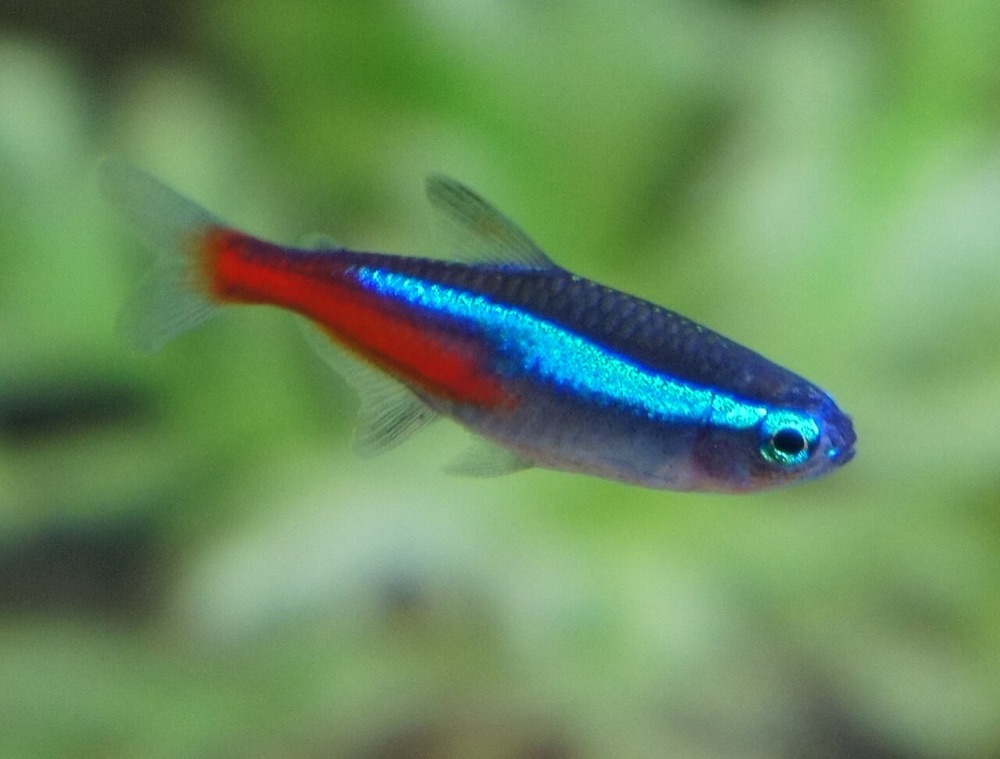
- Fins and colour: a slim, small fish with a bright blue-green stripe from eye to tail and a red band on the rear half of the body; clear fins.
- Energy
- Moderate
- Indian heat
- Copes with care
- Flats
- Suits a flatRSPCA (England and Wales)
Neon tetra at a glance
| What | The rule | Source |
|---|---|---|
| What it is | Paracheirodon innesi, a small South American characid from the upper Amazon basin of Peru, Colombia and Brazil. | US Geological Survey, Nonindigenous Aquatic Species |
| Size | Up to about 4 cm. | US Geological Survey, Nonindigenous Aquatic Species |
| Group | A shoaling fish: keep six or more, or it may feel stressed and hide. | RSPCA (England and Wales) |
| Water in the wild | Ion-poor, acidic water; a study found neons keep their salt balance even at very low pH. | Physiological and Biochemical Zoology (1999)study |
| In the trade | One of the most established and commercially important aquarium fish. | Animals (2021)study |
| Main disease risk | A muscle parasite, Pleistophora, that has no treatment. | Merck Veterinary Manual |
Where does the Neon tetra come from?
The neon tetra, Paracheirodon innesi, is a wild species, a small South American characid. The US Geological Survey gives its native range as the upper Amazon basin of Peru, Colombia and Brazil. A 1999 study in Physiological and Biochemical Zoology describes its home waters as ion-poor and acidic, and found that neons kept their salt balance for two weeks at pH 4.0 and 3.5, though all died within hours at pH 3.25.
A 2021 study in Animals calls the neon tetra one of the most well-established and commercially important species in the aquarium hobby, and notes that breeding methods were worked out years ago. The fish sold today come from that long trade.
How did the Neon tetra come to India?
No source we found documents when neon tetras came to India or how many are bred here rather than imported. A national study of 27 ornamental species sold in aquarium markets in Delhi, Mumbai, Kolkata, Kochi and Chennai from 2019 to 2022 included other tetras, finding a gill fluke on black tetras, but did not list the neon tetra.
That study also notes that imported ornamental fish must be quarantined for 15 days and that releasing them into the wild is an offence. In Indian homes, the neon's needs are a heated, shaded tank and water that does not swing in temperature through summer and winter.
What care does a Neon tetra need?
The three things that shape a good day for this breed.
Exercise
Tank and swimming space: a shoal of six or more needs a planted tank with open swimming water. In smaller groups, the RSPCA says, shoaling fish may feel stressed and hide. RSPCA (England and Wales)
Grooming
Water care: steady warm water from a heater, a gentle filter, weekly partial changes of 10 to 25%, and tests for ammonia and nitrite, aiming for zero. RSPCA Australia Knowledgebase
Training
Handling and feeding routine: feed small amounts at the same times and count the shoal while it feeds. Net neons only when you must. RSPCA (England and Wales)
What should a Neon tetra eat?
Neon tetras have small mouths, so feed a fine flake or micro pellet made for small tropical fish. The 2021 Animals study raised neons on commercial flakes and on freeze-dried natural food and found no difference in final body weight between the groups. The Merck Veterinary Manual says commercial dried foods are a good choice and warns that live foods can bring in parasites.
The RSPCA advises two or three small meals a day, only what is eaten in two to five minutes. Remove leftovers so they do not foul the water.
Meals a day: young neons, 2 to 3 tiny meals a day; adult, 2 to 3 small meals a day.
Which illnesses is the Neon tetra prone to, and how are they treated?
The conditions veterinary studies and breed surveys most often report in the Neon tetra. Knowing the early signs means a vet sees it sooner.
See your vet first. This is general information from veterinary sources, not a diagnosis. Only a vet who has examined your pet can say what is wrong and prescribe treatment, and this page never gives a dose. Do not give your pet human medicine. If your pet seems very unwell, go to a 24-hour vet: find one in your city.
Neon tetra disease (Pleistophora)
See a vet soonA parasite, Pleistophora hyphessobryconis, that Merck says attacks the skeletal muscle of neon tetras, angelfish and other freshwater aquarium fish. Merck Veterinary Manual
Signs to watch for
- Abnormal swimming movements caused by muscle damage
How a vet treats it
An aquatic or exotics vet confirms it by examining diseased tissue under a microscope. Merck says there is no treatment and infected fish should be removed from the tank so it does not spread.
Prevention
Buy from clean shop tanks with no dead fish, and quarantine new fish.
Streptococcus infection
See a vet soonA rare bacterial infection Merck has recorded in some tetras and cichlids, which can come from the environment or infected live food. Merck Veterinary Manual
Signs to watch for
- Spinning or spiralling in the water
- Other signs of nerve disease
How a vet treats it
Merck says laboratory testing is needed to choose an effective treatment, so a vet takes samples before prescribing.
Prevention
Use clean, reliable sources of live food, or none.
White spot (ich)
Emergency: go to a vet nowIchthyophthirius multifiliis, a parasite of skin and gills. UF/IFAS says outbreaks are a true emergency and often follow sudden changes in water temperature. University of Florida IFAS Extension
Signs to watch for
- White spots on fins and body
- Flashing and clamped fins
- Weakness and less interest in food
How a vet treats it
A vet confirms it with a skin or gill sample under a microscope and plans repeated treatments timed to the water temperature, as UF/IFAS describes.
Prevention
Quarantine new fish for at least 30 days and keep the temperature steady.
Why do neon tetras need a group?
Because a lone neon is a stressed neon. The shoal is part of its care, not decoration.
The RSPCA lists tetras among shoaling fish and advises groups of six or more, saying fish kept in smaller numbers may feel stressed and that a group comes out of hiding more readily. A 2021 study of neon tetras in Animals cites earlier work that found larger groups had a calming effect on neon tetras. RSPCA Australia says neons can share a betta's community tank of 40 litres or more if kept in a shoal of five or more.
For a sitter, the shoal is also the hardest thing to check. Neons move together and hide in plants, so counting takes patience. Ask the sitter to count twice, and leave the number on the tank. A neon that keeps apart from the group, hangs near the surface or swims oddly is the one to report.
How do neon tetras manage Indian summers and power cuts?
They are tropical fish, but a small, warm tank can still overheat or run short of oxygen.
The 2021 Animals study kept its neon tetras at 25 °C. In much of India that means a heater is needed in winter and shade in summer. A closed room in May can push a small tank well above the owner's range, and the Merck Veterinary Manual says warm water holds less oxygen. Keep the tank out of the sun, run an air stone, and leave a battery pump for power cuts.
Neons come from soft, acidic, mineral-poor water. Tap and borewell water vary a lot between Indian cities, so owners who prepare or soften water should leave enough prepared water for any change, and the sitter should never top up with untreated tap water.
What does a sitter check for neon tetras?
- Count the shoal twice against the number written on the tank, and look in the plants for any fish stuck or dead. RSPCA (England and Wales)
- Watch for one fish swimming abnormally or apart from the group.
- Read the thermometer and photograph the shoal for the daily update.
- Feed a small, measured portion of fine food; it should be gone in two to five minutes. RSPCA (England and Wales)
- Check the filter outflow is gentle and running, and the lid is on. RSPCA (England and Wales)
- Top up only with water the owner prepared, at the same temperature. RSPCA Australia Knowledgebase
Which neon tetra problems should a sitter report?
If A neon with abnormal swimming while the rest of the shoal looks normal.
Merck describes Pleistophora, a muscle parasite of neon tetras with no treatment; infected fish should be removed. Send a photo and call the owner. Merck Veterinary Manual
If A fish spinning or spiralling in the water.
Merck lists this as a sign of Streptococcus infection, found in some tetras. A vet needs lab tests to treat it. Call the owner. Merck Veterinary Manual
If White spots on fins and bodies of several fish.
Possible white spot (ich), which UF/IFAS calls a true emergency. Call now. University of Florida IFAS Extension
If The count is one short and no body can be found.
Search behind decor and under the filter; a dead fish fouls the water. Tell the owner. RSPCA (England and Wales)
If Fish gasping near the surface in heat or a power cut.
Start the battery pump, stop feeding, and check the temperature. Riverside Public Utilities, City of Riverside (California)
Do neon tetras get along with other fish?
Neons are small and peaceful, so the risk comes from their tank mates. RSPCA Australia warns that some tetras nip fins and names neons among fish that can live with a betta in a large enough tank. Merck notes that the same muscle parasite affects neon tetras and angelfish, so a mixed tank shares that risk.
Ask the shop which fish were in the neons' tank, buy from tanks with clear water and no dead fish, and quarantine new fish before adding them. Do not add fish just before a trip.
Which Petym service suits neon tetras?
If An established community tank with a settled shoal
Daily drop-in visits to feed, count and check the heater and filter. Drop-in visits
If A cold north Indian winter or frequent power cuts
Overnight pet sitting, so the heater and air are watched through the night. Overnight sitting
If Fish under a vet's care
Special-needs care, following the vet's written plan. Special-needs care
Breeds with similar care needs to the Neon tetra
Going away soon? Plan your pet’s care first.
Petym's bookings open for dogs and cats first. For every other pet, the free going-away checklist covers food, water, heat and what to leave written down before you travel.


Questions owners ask
How many neon tetras should be kept together?
- The RSPCA advises groups of six or more for shoaling fish such as tetras, because fish in smaller groups may feel stressed and hide. RSPCA Australia suggests a shoal of at least five where neons share a betta tank. More fish need a bigger, well filtered tank.
How big do neon tetras get?
- The US Geological Survey gives a maximum of about 4 cm. They are among the smallest common aquarium fish, which is why counting them on every visit matters.
What is neon tetra disease?
- It is caused by Pleistophora, a parasite that Merck says attacks the muscle of neon tetras, angelfish and other freshwater aquarium fish. Muscle damage causes abnormal movement. There is no treatment, and infected fish should be removed to stop it spreading.
Do neon tetras need a heater in India?
- Usually in winter, and especially in north India. One feeding study kept neons at 25 °C. In summer the risk flips: keep the tank shaded so it does not overheat, and run an air stone because warm water holds less oxygen.
Can neon tetras live with a betta?
- RSPCA Australia lists neon tetras among possible tank mates for a betta in a community tank of 40 litres or more, in a shoal of five or more, and says beginners should avoid mixing a male betta with other fish.
Can I leave neon tetras alone for a weekend?
- The RSPCA asks for a responsible person to check fish and equipment daily while you are away and says tropical fish need feeding daily. Neons are small and easy to lose in plants, so a daily visit with a count is the safer plan.
Keep reading
- Fish sitting while you're awayFeeding, power cuts and heat for any tank.
- Aquarium fish care in India
- Betta fish care in India
- Freshwater angelfish care in IndiaShares the same muscle parasite risk.
- Platy fish care in India
- What to leave for your pet sitter
- Drop-in visits or overnight sitting
Services that help
Free tools for this
Words on this page, explained
Keep exploring
Sources
Each source was opened and read on the date shown. How Petym checks its sources
- US Geological Survey, Nonindigenous Aquatic Species: Neon tetra (Paracheirodon innesi): species profile (revised 13 November 2003) (opens in a new tab)
- RSPCA (England and Wales): Fish company: keeping fish together (opens in a new tab)
- RSPCA Australia Knowledgebase: Why is water quality important when setting up a fish aquarium? (opens in a new tab)
- RSPCA (England and Wales): Fish diet (opens in a new tab)
- Merck Veterinary Manual: Providing a home for fish (pet owner version, last updated April 2026) (opens in a new tab)
- Merck Veterinary Manual: Disorders and diseases of fish (pet owner version, last updated April 2026) (opens in a new tab)
Show all 15 sourcesShow fewer
- Merck Veterinary Manual: Selection of fish (pet owner version, last updated September 2024) (opens in a new tab)
- University of Florida IFAS Extension: Ichthyophthirius multifiliis (white spot) infections in fish (CIR920/FA006) (opens in a new tab)
- RSPCA (England and Wales): Fish environment: tanks, filters, temperature and water (opens in a new tab)
- RSPCA (England and Wales): Fish health and welfare (opens in a new tab)
- RSPCA Australia Knowledgebase: How should I care for my Siamese fighting fish? (updated 1 May 2024) (opens in a new tab)
- Riverside Public Utilities, City of Riverside (California): Tips for pets during outages: tips for aquariums (opens in a new tab)
- Physiological and Biochemical Zoology (1999): Ionoregulatory specializations for exceptional tolerance of ion-poor, acidic waters in the neon tetra (abstract read) (opens in a new tab)
- Animals (2021): Performance of co-housed neon tetras and glowlight rasboras fed commercial flakes and lyophilized natural food (Kasprzak and others) (opens in a new tab)
- Parasite (2025): Monogeneans on exotic Indian freshwater fish. 7. Results of a national study on ornamental fishes from 2019 to 2022 (Tripathi and others) (opens in a new tab)