Goldfish care in India: heat, fancy types and time away
Updated By PetymFacts checked against official sources on
Quick answer
A goldfish is a domesticated form of carp, not a separate wild species, and a cool-water fish: SPCA New Zealand gives 20 to 24 °C as ideal, so an Indian summer is its hardest season. While you travel, a sitter should visit daily, feed one measured meal, check the filter and thermometer, and watch for floating, sinking or white spots.
Goldfish produce a lot of waste and can live 10 to 15 years, so a big, well filtered tank matters more than any holiday food.
- Origin
- China, domesticated from the crucian carpProceedings of the National Academy of Sciences (2020)study
- Adult length
- 12 to 41 cm (USGS gives a typical 120 to 220 mm standard length and a maximum of 410 mm; fancy types in tanks stay smaller)US Geological Survey, Nonindigenous Aquatic Species
- Lifespan
- 10 to 15 yearsSPCA New Zealand
- Coat
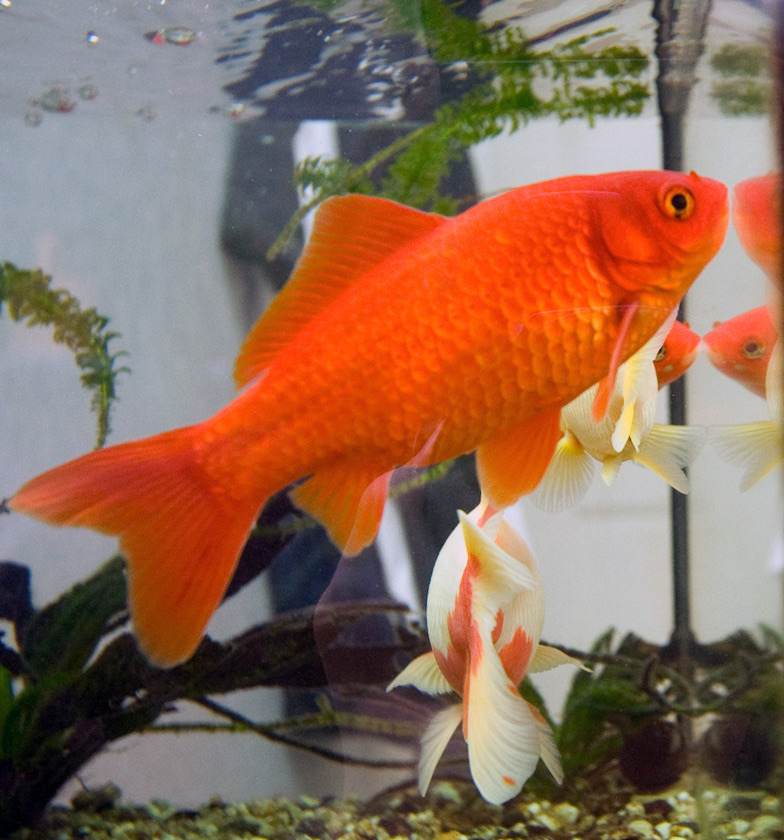
- Fins and colour vary by type: slim single-tailed commons and comets, or short-bodied, twin-tailed fancy types such as fantails and orandas, in orange, red, white, black and mixed colours.RSPCA (England and Wales)
- Energy
- ModerateRSPCA (England and Wales)
- Indian heat
- Copes with careSPCA New Zealand
- Flats
- Suits a flatSPCA New Zealand
Goldfish at a glance
| What | The rule | Source |
|---|---|---|
| What it is | A domesticated form of the crucian carp, bred in China for over 1,000 years into hundreds of varieties. | Proceedings of the National Academy of Sciences (2020)study |
| Size | Slim-bodied goldfish such as commons, comets and shubunkins can grow to about 30 cm. | SPCA New Zealand |
| Lifespan | 10 to 15 years on average, and some live up to 30. | SPCA New Zealand |
| Water temperature | Ideal 20 to 24 °C, with a tolerance range of 8 to 30 °C. | SPCA New Zealand |
| Tank | 75 litres for one fancy goldfish, plus 40 litres for each extra fish; never a bowl. | SPCA New Zealand |
| Company | Can live alone. Do not keep single-tailed and twin-tailed types together. | RSPCA (England and Wales) |
Where does the Goldfish come from?
The goldfish is not a wild species but a domesticated form of the crucian carp, Carassius auratus. A 2020 genome study in PNAS says goldfish were domesticated in ancient China: red-scaled fish were first recorded in the Jin dynasty (AD 265 to 420), fish with favoured traits were kept in ornamental ponds under the Tang, and in the Song dynasty the gold variety was a symbol of the imperial family.
Over more than 1,000 years of selective breeding, hundreds of variants in body shape, fins, eyes and colour appeared. The same study found that the common goldfish is still closer to the wild crucian carp than to fancy types, which split into groups with a dorsal fin, such as the oranda and telescope, and without one, such as the lionhead and ranchu. Goldfish reached Japan first, then Europe at the start of the 17th century and North America around 1850.
How did the Goldfish come to India?
No source we found records when goldfish first reached India. What the sources show is that goldfish are now bred on commercial ornamental farms here: a 2016 study in Acta Tropica described the first viral disease outbreak recorded in Indian ornamental farms, in goldfish, caused by cyprinid herpesvirus 2 with a multidrug-resistant Aeromonas infection on top.
A national study of ornamental fish sold in aquarium markets in Delhi, Mumbai, Kolkata, Kochi and Chennai between 2019 and 2022 found goldfish carrying several species of gill and skin flukes. The same paper notes that imported goldfish must spend 21 days in quarantine, longer than the 15 days for other ornamental fish, and that releasing such fish into the wild is an offence.
What care does a Goldfish need?
The three things that shape a good day for this breed.
Exercise
Tank and swimming space: a big tank, never a bowl. SPCA New Zealand suggests 75 litres for one fancy goldfish plus 40 litres for each extra, and a tank at least four times the adult fish's length. Slim types grow to about 30 cm and suit a pond. SPCA New Zealand
Grooming
Water care: an efficient filter is a must because goldfish make a lot of waste. Change 10 to 25% of the water weekly with conditioned water, and keep ammonia and nitrite below 0.1 ppm. SPCA New Zealand
Training
Handling and feeding routine: goldfish learn the feeding time and come to the front. Feed two or three times a day, only what they finish in under two minutes, and do not net them unless you must. SPCA New Zealand
What should a Goldfish eat?
Goldfish are omnivores. SPCA New Zealand suggests a mix of goldfish flakes, pellets and brine shrimp, and the RSPCA says tropical flakes are the wrong food because the nutrients differ, adding chopped peas or spinach as extras. Leftovers foul the water, so net out anything not eaten within two minutes. The Merck Veterinary Manual says goldfish need less food in colder weather because they are less active.
Do not drop roti, rice or biscuit into the tank. For trips, leave each day's portion measured out: holiday feeding blocks release too much food at once.
Meals a day: young, growing goldfish, 2 to 3 small meals; adult, 2 to 3 small meals; cold weather (north indian winter), fewer, smaller meals as appetite drops.
Which illnesses is the Goldfish prone to, and how are they treated?
The conditions veterinary studies and breed surveys most often report in the Goldfish. Knowing the early signs means a vet sees it sooner.
See your vet first. This is general information from veterinary sources, not a diagnosis. Only a vet who has examined your pet can say what is wrong and prescribe treatment, and this page never gives a dose. Do not give your pet human medicine. If your pet seems very unwell, go to a 24-hour vet: find one in your city.
Buoyancy (swim bladder) disorders
See a vet soonThe fish cannot hold its depth and floats, sinks or tilts. SPCA New Zealand lists buoyancy disorders among common goldfish problems, and a WAVMA review of 47 goldfish found causes including fluid in the swim bladder, kidney cysts and wider disease, with no clear cause in some fish. World Aquatic Veterinary Medical Association (WAVMA)
Signs to watch for
- Floating at the surface or stuck on the bottom
- Swimming tilted or upside down
- A swollen body
How a vet treats it
An aquatic or exotics vet examines the fish, and the WAVMA review found radiography (X-rays) the most useful test. Environmental, medical and surgical treatment has been tried, but the review reported a very poor response, so a vet may also discuss quality of life.
White spot (ich)
Emergency: go to a vet nowA single-celled parasite, Ichthyophthirius multifiliis, that burrows into the skin and gills. UF/IFAS calls an outbreak a true emergency, and outbreaks often follow fast changes in water temperature. University of Florida IFAS Extension
Signs to watch for
- Small white spots on skin and fins
- Flashing or rubbing on decor
- Extra mucus, weakness and poor appetite
- Pale, swollen gills
How a vet treats it
A vet confirms it by looking at skin scrapings, fin clips or gill clips under a microscope, because other diseases look similar. UF/IFAS names treatments such as formalin, copper sulfate or raised salt, repeated on a schedule set by the water temperature, since only the free-swimming stage can be killed.
Prevention
Quarantine new fish for at least 30 days and do not share nets or buckets between tanks without disinfecting them.
Aeromonas infection and dropsy
See a vet soonA bacterial infection. Merck says koi and goldfish are especially susceptible to Aeromonas salmonicida, and fluid swelling of the belly is known as dropsy or pinecone disease. Merck Veterinary Manual
Signs to watch for
- Bloody spots or ulcers
- A swollen belly with raised scales
- Ragged fins
- Bulging eyes
How a vet treats it
Merck says antibiotics can work, but laboratory testing is needed to choose the right one, so a vet may take samples before treating.
Gill and skin flukes
See a vet soonTiny parasitic worms (monogeneans) such as Dactylogyrus on the gills. Merck names Dactylogyrus in goldfish, and an Indian market study found goldfish carrying several fluke species. Merck Veterinary Manual
Signs to watch for
- Fast breathing or gasping
- Flashing and rubbing
- Pale or swollen gills
How a vet treats it
A vet identifies the parasite under a microscope from a gill or skin sample and chooses a treatment for the tank.
Prevention
Quarantine new fish before they join the tank.
Can a goldfish cope with an Indian summer?
Yes, with shade, a strong filter and a sitter who reads the thermometer. Warm water is the danger, not cold.
Goldfish are hardy in one sense: the US Geological Survey says the species can survive water from 0 to 41 °C and tolerates low oxygen. Surviving is not thriving. SPCA New Zealand gives 20 to 24 °C as the ideal, and the RSPCA calls goldfish a cool-water fish. In a closed Delhi or Nagpur flat in May, a tank in a sunny room can go well past that range by afternoon.
Heat matters more for a goldfish than for most small tropical fish because a goldfish is big and messy. More fish and more waste use more oxygen, and warm water holds less of it. Before you leave, move the tank out of any sun, keep an air stone running and tell the sitter the highest reading you are happy with. If the water climbs past it, they float sealed bags of ice to cool it slowly and call you.
In a power cut, the filter is the first thing to stop. A goldfish tank fouls faster than a betta tank, so the battery air pump and the inverter socket matter. Ask the sitter not to feed while the power is off.
What does a sitter do on a goldfish visit?
Look first, feed second, fix nothing they have not been shown.
Arrive
Count the fish and watch them swim for a minute. A healthy goldfish swims actively, with no floating or sinking and no leaning to one side. SPCA New Zealand
Thermometer
Read it and photograph it for the daily update. Compare with the range on the owner's care sheet.
Filter and air
Check the outflow is moving and the air stone is bubbling. An efficient filter is an absolute must for goldfish. SPCA New Zealand
Feed
One measured portion of goldfish food, not tropical flakes. It should be gone in under two minutes; net out anything left. SPCA New Zealand
Weekly day
If the owner asked, a 10 to 25% water change with conditioned water at the same temperature. SPCA New Zealand
Leave
Lid on, light on its timer, battery pump ready, visit logged.
Which goldfish problems should a sitter know?
A sitter does not treat fish. They notice change, call you, and you or a fish vet decide.
If A fish floating at the top, stuck at the bottom or swimming tilted.
Buoyancy disorders are common in goldfish and often hard to treat. Note when it started, do not add anything to the water, and tell the owner the same day. World Aquatic Veterinary Medical Association (WAVMA)
If Small white spots on the body and fins, or fish flashing and rubbing on decor.
Possible white spot (ich), which UF/IFAS calls a true emergency. Call the owner now so a fish vet can confirm it. University of Florida IFAS Extension
If Red streaks, ulcers, a swollen belly with raised scales, or bulging eyes.
Merck lists these as signs of Aeromonas infection, to which goldfish are especially prone. A vet needs lab tests to pick an antibiotic. Merck Veterinary Manual
If Fish gasping at the surface on a hot afternoon.
Start the air pump at once, then look for the cause: heat, a stopped filter, leftover food or a dead fish. University of Florida IFAS Extension
If Cloudy, smelly water after a power cut.
Do not feed. With the pump running, change about a quarter of the water with treated water at the same temperature. Riverside Public Utilities, City of Riverside (California)
Fancy or common goldfish: does it change the care?
Yes. The RSPCA describes slim, single-tailed goldfish as faster, better swimmers and generally hardier, and fancy twin-tailed types as slow, short-bodied fish that miss out on food when kept with fast ones. SPCA New Zealand advises against types bred for extreme features such as bubble eyes, because those traits can harm health and welfare.
Common, comet and shubunkin goldfish can reach about 30 cm and suit a pond better than a flat. Fancy types such as fantails and orandas stay smaller and suit a large indoor tank. Tell your sitter which you have: a round-bodied fancy goldfish that floats after a meal needs a closer eye than a slim comet.
Goldfish care through the Indian year
| Main risk | What the sitter does | |
|---|---|---|
| Summer (March to June) Merck Veterinary Manual | Warm water short of oxygen | Thermometer photo daily, curtains shut, air stone on, ice bags if the owner left them |
| Monsoon (June to September) RSPCA (England and Wales) | Power cuts, insect sprays in closed rooms | Battery pump ready, no sprays near the tank, lid on |
| Change of season University of Florida IFAS Extension | White spot after fast temperature swings | Check fins and skin at every visit and report spots at once |
| Winter (north India) Merck Veterinary Manual | Cold nights, slower appetite | Feed only what is eaten; goldfish do not need a heater in room-temperature water |
Which Petym service suits a goldfish?
If An established tank, a trip of a few days to two weeks
Daily drop-in visits to feed, check the filter and thermometer, and count the fish. Drop-in visits
If A heat wave forecast or long power cuts in your area
Overnight pet sitting, so someone is there to start the air pump when the power goes. Overnight sitting
If A goldfish already on treatment from a fish vet
Special-needs care, with the vet's written plan followed and logged. Special-needs care
Breeds with similar care needs to the Goldfish
Going away soon? Plan your pet’s care first.
Petym's bookings open for dogs and cats first. For every other pet, the free going-away checklist covers food, water, heat and what to leave written down before you travel.


Questions owners ask
How long can a goldfish go without food while I travel?
- Hunger is rarely the problem on a short trip; the water is. The RSPCA says underfeeding is safer than overfeeding, but asks for someone to check the fish and equipment daily. A goldfish makes a lot of waste, so a stopped filter in a warm flat is the real risk.
Is a goldfish bowl fine in India?
- No. SPCA New Zealand says goldfish should never be kept in a bowl and suggests 75 litres for one fancy goldfish plus 40 litres for each extra fish, with an efficient filter. A bowl warms fast in an Indian summer and holds little oxygen.
What temperature should my goldfish tank be in summer?
- SPCA New Zealand gives 20 to 24 °C as ideal and 8 to 30 °C as the tolerance range. In Indian summers the risk is water that is too warm, so keep the tank shaded, run an air stone and ask the sitter to photograph the thermometer daily.
Why is my goldfish floating upside down?
- Buoyancy disorders are common in goldfish. A WAVMA review of 47 cases found radiography the most useful test, and the response to treatment was very poor. Call a vet who sees fish rather than trying home remedies, and keep the water clean meanwhile.
Can goldfish live with tropical fish?
- Goldfish can share with fish larger than their mouths and with similar swimming ability, SPCA New Zealand says, but most tropical fish need warmer water than a goldfish prefers. Keep slim and fancy goldfish apart, as the RSPCA advises.
How long do goldfish live?
- SPCA New Zealand gives 10 to 15 years on average, with some reaching 30. That makes a goldfish a long commitment, and someone has to care for the tank every time you travel during those years.
Keep reading
- Fish sitting while you're awayFeeding, power cuts and heat for any tank.
- Aquarium fish care in IndiaSetting up the tank and cycling it.
- Koi care in IndiaThe goldfish's bigger pond relative.
- Betta fish care in India
- What to leave for your pet sitter
- Summer pet care in India
- Drop-in visits or overnight sitting
Services that help
Free tools for this
Words on this page, explained
Keep exploring
Sources
Each source was opened and read on the date shown. How Petym checks its sources
- US Geological Survey, Nonindigenous Aquatic Species: Goldfish (Carassius auratus): species profile (opens in a new tab)
- SPCA New Zealand: Caring for goldfish (opens in a new tab)
- RSPCA (England and Wales): Fish company: keeping fish together (opens in a new tab)
- RSPCA (England and Wales): Fish diet (opens in a new tab)
- Merck Veterinary Manual: Providing a home for fish (pet owner version, last updated April 2026) (opens in a new tab)
- World Aquatic Veterinary Medical Association (WAVMA): Buoyancy disorders of goldfish (Dr William Wildgoose, VC2016 webinar) (opens in a new tab)
Show all 14 sourcesShow fewer
- University of Florida IFAS Extension: Ichthyophthirius multifiliis (white spot) infections in fish (CIR920/FA006) (opens in a new tab)
- Merck Veterinary Manual: Disorders and diseases of fish (pet owner version, last updated April 2026) (opens in a new tab)
- RSPCA (England and Wales): Fish environment: tanks, filters, temperature and water (opens in a new tab)
- University of Florida IFAS Extension: FA27/FA002: Dissolved oxygen for fish production (Francis-Floyd and Pouder) (opens in a new tab)
- Riverside Public Utilities, City of Riverside (California): Tips for pets during outages: tips for aquariums (opens in a new tab)
- Proceedings of the National Academy of Sciences (2020): The evolutionary origin and domestication history of goldfish (Carassius auratus) (Chen and others) (opens in a new tab)
- Acta Tropica (2016): Cyprinid herpesvirus 2 with multi-drug resistant Aeromonas hydrophila infection in goldfish: first viral disease outbreak in Indian ornamental farms (abstract read) (opens in a new tab)
- Parasite (2025): Monogeneans on exotic Indian freshwater fish. 7. Results of a national study on ornamental fishes from 2019 to 2022 (Tripathi and others) (opens in a new tab)