New Zealand White rabbit care in India: weight, feet and heat
Updated By PetymFacts checked against official sources on
Quick answer
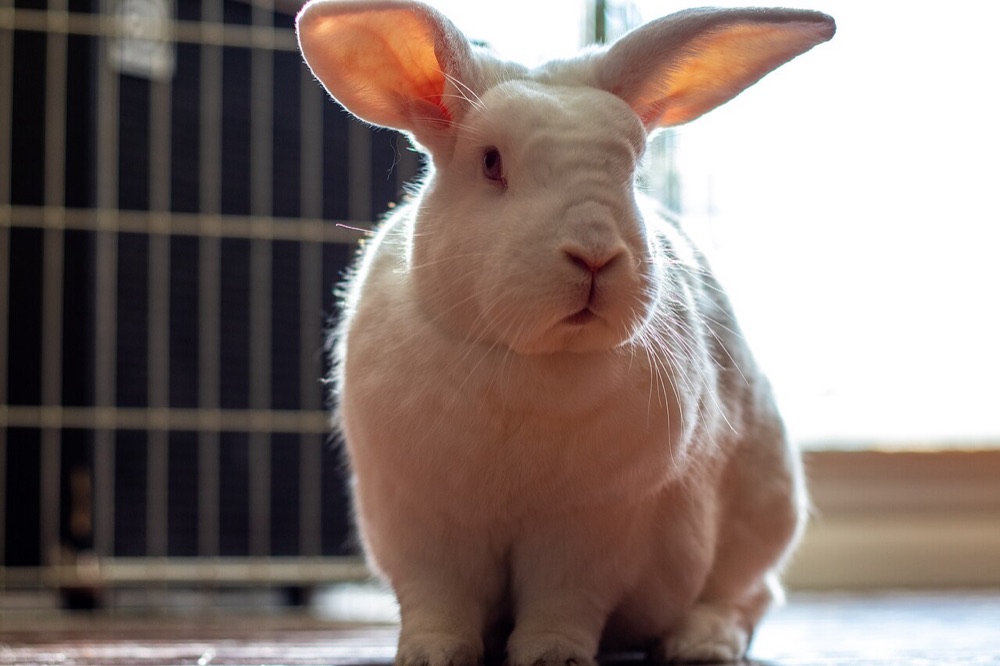
The New Zealand White is a medium to large rabbit, about 4 to 5.4 kg, with an all-white coat and red eyes. Bred in the United States for meat and fur, it is one of the main breeds on Indian rabbit farms. As a pet it is friendly, but it gains weight easily, and heavy rabbits get sore feet.
Like every rabbit, it needs a cool room in an Indian summer, hay and water all day and someone checking every day that it eats and passes droppings. Unspayed does need a vet's advice on spaying.

- Origin
- United States (California), early 1900s, despite the namePetMD (reviewed by Laurie Hess, DVM, DABVP)
- Adult weight
- 4.1 to 5.4 kg (PetMD gives 9 to 12 lb; ARBA's maximum is 12 lb)PetMD (reviewed by Laurie Hess, DVM, DABVP)
- Lifespan
- 5 to 8 yearsPetMD (reviewed by Laurie Hess, DVM, DABVP)
- Coat
- Short, soft, pure white fur with pink skin and red eyes from a lack of melanin. Weekly brushing, more in the spring and autumn moults.Kerala Agricultural University, Centre for e-Learning
- Energy
- ModeratePetMD (reviewed by Laurie Hess, DVM, DABVP)
- Indian heat
- Struggles in heatMerck Veterinary Manual
- Flats
- A flat, with daily exercisePetMD (reviewed by Laurie Hess, DVM, DABVP)
New Zealand White at a glance
| What | The rule | Source |
|---|---|---|
| Size | Medium to large: PetMD gives 9 to 12 lb (about 4.1 to 5.4 kg); ARBA's maximum is 12 lb. | PetMD (reviewed by Laurie Hess, DVM, DABVP) |
| Coat and eyes | White fur with red eyes, because the breed lacks melanin pigment, Kerala Agricultural University notes. | Kerala Agricultural University, Centre for e-Learning |
| Temperament | Friendly, social and docile, and generally easier to handle than smaller breeds, PetMD says. | PetMD (reviewed by Laurie Hess, DVM, DABVP) |
| Lifespan | Typically 5 to 8 years, PetMD says, potentially longer if neutered and kept indoors. | PetMD (reviewed by Laurie Hess, DVM, DABVP) |
| Weight watch | Grows quickly and gains weight easily; laboratory guidance notes these rabbits become very heavy with age and develop sore feet. | Canadian Council on Animal Care |
| Heat tolerance | Low, like all rabbits. Merck's ideal is 15.5 to 21 °C at 40 to 60% humidity. | Merck Veterinary Manual |
| In India | Farmed for meat and fur; a Kerala study kept it as a temperate breed in the humid tropics. | Marykutty T and Nandakumar P, World Rabbit Science 8(2) (2000)study |
Where does the New Zealand White rabbit come from?
Despite its name, ARBA says the New Zealand was developed in the United States and recognised in 1916. PetMD places its development in California in the early 1900s and says nobody is sure where the name came from. The first New Zealands were red; after a red doe produced white kits in 1917, white became the preferred colour.
ARBA says the breed was prized for its quick growth and meat, and that white pelts, which were easier to dye, let the White take over the fur market. ARBA today recognises five colours: red, black, blue, white and broken.
The White also became a research animal. The Canadian Council on Animal Care's guide names it the most widely used breed in Canadian laboratories, for its medium size, very docile nature and large unpigmented ears.
How did the New Zealand White rabbit come to India?
The New Zealand White is one of the rabbit breeds Indian agricultural institutions describe for meat and fur. Kerala Agricultural University lists it with the Soviet Chinchilla, Grey Giant and White Giant, giving an adult weight of 4.5 to 5 kg, though it describes the breed as developed in England, unlike ARBA. A Kerala study published in 2000 kept it as a temperate breed in the humid tropics and found it had the lowest pre-weaning mortality of the three breeds compared.
India's rabbit population was about 406,000 according to an ICAR review, spread across 27 states and kept mainly for meat and Angora wool. No source we found gives a date for the breed's first import. Kept as a pet, the farm breed's fast growth means its weight and flooring need watching.
What care does a New Zealand White rabbit need?
The three things that shape a good day for this breed.
Exercise
PetMD advises an enclosure at least four times the rabbit's stretched-out length, multi-level if possible, and at least five hours a day out of it in a supervised, rabbit-proofed area. Indoor housing is generally healthier. PetMD (reviewed by Laurie Hess, DVM, DABVP)
Grooming
Weekly brushing of the short coat, more during the spring and autumn sheds; nails every four to six weeks, with a vet showing you how the first time. PetMD (reviewed by Laurie Hess, DVM, DABVP)
Training
Intelligent and docile: PetMD says New Zealands can learn tricks and to use a litter tray, and are easier to handle than smaller breeds. Supervise children. PetMD (reviewed by Laurie Hess, DVM, DABVP)
What should a New Zealand White rabbit eat?
PetMD says unlimited fresh hay should be at least 80% of the diet, timothy for adults and alfalfa for young rabbits and breeding does, with rinsed leafy greens daily, high-calcium greens such as kale, spinach and parsley limited, carrots and broccoli kept to once or twice a week, a little fruit only as an occasional treat, and pellets as a supplement. Fresh water every day, in a bowl and a bottle until the rabbit shows a preference.
PDSA advises nuggets twice a day for rabbits over 3.5 kg, which covers most adult New Zealand Whites, always as a measured amount from your vet. The breed grows fast and gains weight easily, PetMD says, so the measure matters more than for most rabbits.
Meals a day: young rabbit, unlimited hay (alfalfa suits growing rabbits, PetMD says), with greens and pellets as your vet advises; adult over 3.5 kg, unlimited timothy hay; greens twice a day; nuggets twice a day; older rabbit, as your vet advises.
Which illnesses is the New Zealand White rabbit prone to, and how are they treated?
The conditions veterinary studies and breed surveys most often report in the New Zealand White rabbit. Knowing the early signs means a vet sees it sooner.
See your vet first. This is general information from veterinary sources, not a diagnosis. Only a vet who has examined your pet can say what is wrong and prescribe treatment, and this page never gives a dose. Do not give your pet human medicine. If your pet seems very unwell, go to a 24-hour vet: find one in your city.
Obesity
Ask at a routine checkPetMD lists obesity first for the breed, because it grows quickly and gains weight easily, and CCAC notes laboratory New Zealand Whites tend to eat too much and become very heavy with age. Merck links obesity to sore hocks and gut stasis. PetMD (reviewed by Laurie Hess, DVM, DABVP)
Signs to watch for
- Weight going up at each vet visit
- Sore or bald hocks
How a vet treats it
A vet weighs the rabbit and sets a feeding and exercise plan, usually more hay and fewer pellets and treats.
Prevention
Measured pellets, unlimited hay and daily time out of the enclosure.
Sore hocks (pododermatitis)
See a vet soonSores on the underside of the feet. PetMD says they are often caused by wire floors or unsanitary cages, and CCAC notes laboratory New Zealand Whites develop sore feet as they get heavy. PetMD (reviewed by Laurie Hess, DVM, DABVP)
Signs to watch for
- Weight shifted onto the front feet
- Red, bald or swollen patches under the back feet
- Less hopping, eating less from pain
How a vet treats it
A vet examines the feet and decides on treatment: Merck and PetMD describe removing the cause, soft clean bedding, antibiotics for infection, pain relief, dressings and, in severe cases, surgery.
Prevention
A smooth, solid, cushioned floor, daily cleaning and a healthy weight.
Uterine adenocarcinoma in unspayed does
See a vet soonMerck calls it the most common tumour in rabbits, reaching 60% in unspayed does over 3 years old, and notes some strains have an 80% likelihood by age 3. Merck Veterinary Manual
Signs to watch for
- Often nothing an owner can see early on
- Masses a vet can feel in the belly
- Swollen, cystic mammary glands, which Merck says may occur alongside
How a vet treats it
Merck says the cancer often spreads to the liver and lungs, so the vet decides on tests and treatment. Prevention by spaying is the main reason vets recommend it.
Prevention
Spaying: from about five months, PDSA says, or around six months, Merck says; your vet decides.
Parasites: ear mites, Cheyletiella and E. cuniculi
See a vet soonPetMD lists ear mites, Cheyletiella (walking dandruff, which can spread to people) and E. cuniculi, which can cause neurological signs and kidney damage. PetMD (reviewed by Laurie Hess, DVM, DABVP)
Signs to watch for
- Scratching or shaking the ears
- Flaky dandruff along the back
- Head tilt, wobbly back legs, drinking more
How a vet treats it
A vet confirms the parasite and prescribes an anti-parasitic treatment; for E. cuniculi, PDSA says vets often treat on the signs with a daily course and supportive care.
Prevention
Clean housing, new rabbits kept apart for a month, and no shared bowls between groups.
Gut stasis
Emergency: go to a vet nowPetMD calls GI stasis a potentially life-threatening slowdown of digestion that needs urgent veterinary care. PetMD (reviewed by Laurie Hess, DVM, DABVP)
Signs to watch for
- Eating less or nothing
- Small or no droppings
- Hunched and quiet
How a vet treats it
A vet the same day; Merck describes fluids, pain management, roughage and, once stable, medicine to stimulate the gut.
Prevention
Hay making up most of the diet and no sudden changes.
What changes when a farm breed becomes a house rabbit?
Mostly the diet and the floor. A New Zealand White was bred to grow fast; in a flat, that means watching its weight and its feet.
ARBA says the New Zealand was developed in the United States and recognised in 1916, prized for its quick growth and meat production, and that white pelts, being easier to dye, made the White the dominant variety. The Canadian Council on Animal Care's guide notes the breed is the one most widely used in Canadian laboratories, for its medium size and very docile nature, but that with age these rabbits usually become very heavy, tend to eat too much and develop sore feet.
That is the same pattern PetMD lists for pets: obesity, because the breed grows quickly and gains weight easily, and sore hocks, often caused by wire floors or dirty cages. A pet New Zealand White needs a solid, cushioned floor instead, and an enclosure at least four times its stretched-out length, as PetMD advises, with at least five hours a day out of it in a rabbit-proofed area.
PetMD calls the breed friendly, social and intelligent, able to learn tricks and use a litter tray, and generally easier to handle than smaller breeds. It may do better with a companion rabbit, and the RSPCA says rabbits should not live alone.
How does a New Zealand White cope with Indian humidity and heat?
It is farmed in India, but farmed is not the same as comfortable. Indoor pets still need a cooling plan.
A study at Kerala Agricultural University described the New Zealand White, Grey Giant and Soviet Chinchilla as temperate breeds kept in the humid tropics of Kerala, and found the New Zealand White had the lowest death rate of the three before weaning. That tells us the breed can be raised here, not that it tolerates heat. The Merck Veterinary Manual's ideal range for rabbits is 15.5 to 21 °C at 40 to 60% humidity, and its rule of thumb is that the temperature in Fahrenheit plus the humidity percentage should not exceed 150.
Merck's farm advice in hot, humid weather is free access to cool water and sprinkling the hutches, and it notes that heat stress can leave breeding bucks infertile for weeks. For a pet in a flat, the Rabbit Welfare Association's steps fit better: shade, curtains shut, a marble surface, frozen bottles wrapped in a towel, a battery fan aimed at the bottles and plenty of cool water without ice. A heavy rabbit can find it harder to move to a cooler spot, so set up the coolest room before you leave.
New Zealand White care through the Indian year
What the sitter does differently season by season.
| Main risk | What the sitter does | |
|---|---|---|
| Summer (March to June) Rabbit Welfare Association and Fund | Heat stress in a large, white-coated rabbit | Coolest room, curtains drawn, frozen bottles swapped each visit, fan on the inverter, a second water source |
| Monsoon (June to September) RSPCA | Damp bedding, urine-stained fur, flies | Change wet litter and bedding at every visit; lift the tail twice a day to check for soiling and eggs |
| Festivals (Diwali, Holi) | Noise, and colour powder on a white coat | Indoors with curtains closed and a hiding box; any colour on the fur means a call to the owner and the vet |
| Winter (north India) | Cold nights in an unheated flat | The pen kept indoors and off a cold balcony, with dry bedding and hay topped up |
Why should a female New Zealand White be spayed?
The Merck Veterinary Manual calls uterine adenocarcinoma the most common tumour in rabbits, with an incidence that can reach 60% in unspayed does over 3 years old, and says it often spreads to the liver and lungs. Merck's management chapter adds that some strains have been reported to have an 80% likelihood of developing it by 3 years of age, and that this is the main reason for spaying does. PDSA says spaying removes the risk of ovarian and uterine cancer.
On timing, PDSA says females can be spayed from around five months, Merck suggests around sexual maturity, usually six months, and both note that larger rabbits mature later. Your vet decides. After surgery PDSA advises keeping the rabbit with its bonded partner in a quiet place, offering its usual hay and favourite greens, and calling the vet if it stops eating, since stress after surgery can bring on gut stasis. A sitter looking after a recently spayed doe should have the vet's discharge notes in writing.
What does a sitter check on a New Zealand White?
- Hay pile, greens and pellets: what was eaten since the last visit. A rabbit that stops eating needs a vet now. PDSA
- Droppings: plenty, round and of normal size. PDSA
- Feet: does it sit and hop normally, or shift its weight forward? Heavy rabbits are prone to sore hocks. Merck Veterinary Manual
- Pellets measured with the owner's scoop, never topped up by eye: the breed gains weight easily. PetMD (reviewed by Laurie Hess, DVM, DABVP)
- White fur under the tail: urine staining shows clearly on this breed, so check twice a day in warm weather. RSPCA
- Ears and skin: dandruff-like flakes can be Cheyletiella mites, which PetMD says can spread to people. PetMD (reviewed by Laurie Hess, DVM, DABVP)
- Head tilt or wobbly back legs, which can be signs of E. cuniculi. PDSA
- Room temperature, the cooling set-up and the inverter, before leaving.
Feeding a New Zealand White while you travel
PetMD says unlimited fresh hay should make up at least 80% of the diet, timothy for adults and alfalfa for young rabbits and breeding does, with rinsed leafy greens daily, high-calcium greens such as spinach limited, carrots kept to once or twice a week and pellets treated as a supplement. PDSA advises nuggets twice a day for rabbits over 3.5 kg, which covers most adult New Zealand Whites, in a measured amount.
Leave the measuring scoop, the same hay and pellets, and a list of greens. PDSA warns that changes should be made over two to four weeks, so the sitter should not swap brands even if a shop runs out: buy extra before you go.
Which Petym service suits a New Zealand White?
Healthy adults
Drop-in visits
One or two visits a day for hay, measured pellets, greens, water and litter, a check of eating, droppings and feet, and a daily photo update.
Heatwaves, long trips
Overnight pet sitting
A sitter living in your home through a hot spell or a trip of a week or more, with the rabbits seen many times a day.
After surgery
Special-needs care
For a doe recovering from a spay or a rabbit with sore hocks, with the vet's instructions followed and logged.
Breeds with similar care needs to the New Zealand White rabbit
Going away soon? Plan your pet’s care first.
Petym's bookings open for dogs and cats first. For every other pet, the free going-away checklist covers food, water, heat and what to leave written down before you travel.

Questions owners ask
Is the New Zealand White a good pet rabbit in India?
- Yes, for a family with room for a medium to large rabbit. PetMD calls the breed friendly, social and docile, and easier to handle than small breeds. It needs a solid floor rather than a wire cage, a cool room in summer, a companion and measured pellets, because it gains weight easily.
Why does a New Zealand White have red eyes?
- It is an albino breed. Kerala Agricultural University notes its white fur, albino skin and red eyes come from a lack of melanin pigment.
Is the New Zealand White from New Zealand?
- No. ARBA says the breed was developed in the United States and recognised in 1916; PetMD says California in the early 1900s, and that the origin of the name is uncertain. Red was the first colour, and white became dominant because white pelts were easier to dye.
How big does a New Zealand White rabbit get?
- PetMD gives an adult weight of 9 to 12 lb, about 4.1 to 5.4 kg, and ARBA sets a 12 lb maximum. Canadian laboratory guidance notes these rabbits usually become very heavy with age, so keep an eye on weight with your vet.
Should I spay my female New Zealand White?
- Talk to your vet. Merck says uterine cancer can affect up to 60% of unspayed does over 3 years old, and that the high risk is the main reason vets recommend spaying. PDSA says spaying removes the risk of uterine and ovarian cancer.
How long do New Zealand White rabbits live?
- PetMD gives a typical lifespan of 5 to 8 years, and potentially longer for a rabbit that is spayed or neutered and kept indoors. A healthy weight, soft flooring and a cool home also help.
How often should a sitter visit a New Zealand White?
- At least once a day for a healthy pair in mild weather, and twice a day in warm or humid weather, when the RSPCA asks for the rear end to be checked twice daily. For a week away or a heatwave, a sitter staying in the home is safer.
Keep reading
- Rabbits: caring for a rabbit while you are away
- Flemish Giant careAn even larger breed with the same feet and weight to watch.
- Dutch rabbit careAnother breed used for both pets and research.
- Rabbit care guide for India
- Monsoon pet care
- Holi safety for pets
- Animal cruelty law in India
Services that help
Free tools for this
Words on this page, explained
Keep exploring
Sources
Each source was opened and read on the date shown. How Petym checks its sources
- PetMD (reviewed by Laurie Hess, DVM, DABVP): New Zealand rabbit (updated 10 November 2023) (opens in a new tab)
- Kerala Agricultural University, Centre for e-Learning: Rabbit breeds (opens in a new tab)
- Merck Veterinary Manual: Noninfectious diseases of rabbits (full review July 2021, updated September 2024) (opens in a new tab)
- American Rabbit Breeders Association: New Zealand (opens in a new tab)
- Canadian Council on Animal Care: Guide to the care and use of experimental animals, volume 2: XVI. Rabbits (opens in a new tab)
- PDSA: Feeding your rabbits (opens in a new tab)
Show all 16 sourcesShow fewer
- PetMD (Melissa Witherell, DVM): Pododermatitis in rabbits (26 February 2026) (opens in a new tab)
- Merck Veterinary Manual: Management of rabbits (full review July 2021, updated April 2025) (opens in a new tab)
- PDSA: Rabbit neutering: a guide to castration and spaying (opens in a new tab)
- PDSA: E. cuniculi in rabbits (opens in a new tab)
- PDSA: Reduced appetite in a rabbit (opens in a new tab)
- RSPCA: Flystrike (opens in a new tab)
- RSPCA: Rabbit companionship (opens in a new tab)
- Rabbit Welfare Association and Fund: Keep your rabbits cool (leaflet, 2026) (opens in a new tab)
- Marykutty T and Nandakumar P, World Rabbit Science 8(2) (2000): Factors influencing litter traits and body weight up to 12 weeks among temperate rabbit breeds in humid tropics (abstract read) (opens in a new tab)
- Risam K S, Das G K and Bhasin V, ICAR Central Sheep and Wool Research Institute, Indian Journal of Animal Sciences 75(3) (2005): Rabbit for meat and wool production in India: a review (abstract read) (opens in a new tab)